Wayground logo

Free Printable Worksheets

Font size

S
M
L
XL
Worksheets

Unit Review: Meiosis & Inheritance

Total questions: 50

Worksheet time: 48mins

Name
Class
Date
1.
How are Incomplete Dominance and Co Dominance different than a normal Mendelian cross?
a)
There is no difference
b)
The heterozygous genotype has a unique phenotype
c)
There is no heterozygous genotype
d)
There is only one phenotype regardless of genotype.
2.

What type of inheritance is shown in this image?

a)

Incomplete dominance

b)

Codominance

c)

Multiple Alleles

d)

Polygenic Inheritance

3.

Snap dragon color is an incomplete dominant trait. A pink flower (Rr) is crossed with white flower (rr)? What is the phenotype ratio expected

a)

50% White: 50% Pink

b)

50: Red : 50% White

c)

25% Red : 50% Pink : 25% White

d)

100% Pink

4.

What type of inheritance do two alleles have if their traits blend together?

a)

Incomplete Dominance

b)

Codominance

c)

Complete dominance

d)

Sex-Linked

5.
What do you call the non-Mendelian inheritance pattern that states that both traits are dominant and both appear in the organism and neither trait is masked?
a)
Codominance
b)
Incomplete dominance
c)
Polygenic traits
6.

Based on the data on human height, it is reasonable to conclude that height is an example of a(n) ________ trait.

a)

polygenic

b)

codominant

c)

x-linked

d)

multallelic

7.

Many genes determine 1 trait (ex: skin color)

a)

Incomplete Dominance

b)

Polygenic

c)

Codominance

d)

Multiple alleles

8.
How many daughter cells are produced from meiosis ?
a)
10
b)
6
c)
4
d)
2
9.
Humans have how may chromosomes ?
a)
112
b)
46
c)
8
d)
67
10.
Which process and type of resulting cells are represented?
a)
mitosis, gametes
b)
mitosis, body cells
c)
meiosis, gametes
d)
meiosis, body cells
11.
The chromosomes that pair up during meiosis, are called __________ chromosomes.  
a)
homozygous 
b)
asexual
c)
homologous
d)
genes
12.
A male shark has 40 chromosomes in each of its sex cells. How many would be present in its body cells?
a)
20
b)
40
c)
80
d)
160
13.
Which letter(s) in the diagram correspond to cells that are haploid? 
a)
A
b)
B
c)
C
d)
A and B
14.
Females have ____ and males have _____ chromosomes.
a)
XX, XY
b)
XY, XX
c)
XX, XX
d)
XY, XY
15.
A human being has a somatic cell that has 46 chromosomes.  What is the haploid number found in a gamete?
a)
23
b)
46
c)
69
d)
92
16.

When does the process shown in the diagram above happen?

a)

mitosis

b)

cytokinesis

c)

prophase I

d)

Prophase II

17.
What causes genetic variation in meiosis?
a)
chromosomes lining up
b)
crossing over of chromosomes
c)
separation of chromosomes
d)
chromosomes pulling apart
18.
B=brown eyes
b= blue eyes
What is true about two brothers that have brown eyes?
One has genotype BB the other Bb.
a)
they have same phenotype and genotype
b)
they have different genotypes and phenotypes
c)
they have same phenotype but different genotypes
d)
they have same genotype but different phenotypes
19.
Which best describes the process shown?
a)
mutation in which the DNA content of the gene is ltered
b)
segregation of sister chromatids
c)
condensation and segregation of the alleles
d)
crossing-over which alleles are exchanged
20.
If you have a parent who has GgBb as their genotype, what are the possible alleles they could donate to their gametes?
a)
GB, Gb, gB, gb
b)
GB, GB, gb, gb
c)
Gb, Gb, Gb, GB
d)
GG, BB, gg, bb
21.
How many offspring will you have in a dihybrid cross? 
a)
4
b)
8
c)
16
d)
5
22.
T4 - What genotype is missing from this Punnett Square?
a)
RrYy
b)
RRYY
c)
rryy
d)
RrYY
23.
Assume dad's gametes are on top, what is his genotype?
a)
AAPP
b)
AaPp
c)
aaPP
d)
Aapp
24.

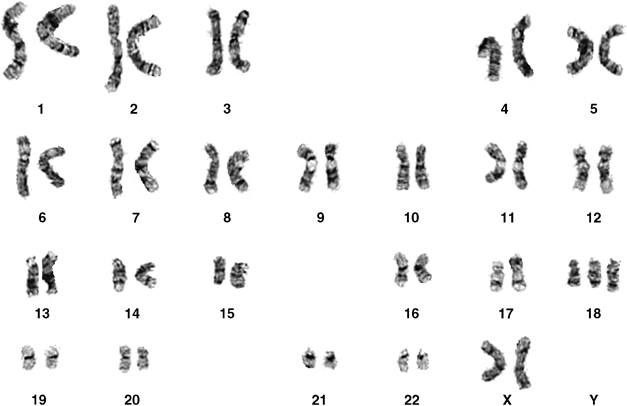
What is the gender of this person?

a)

Male

b)

Female

25.
What makes this individual's karyotype not normal?
a)
An extra sex chromosome
b)
An extra autosome
c)
A missing sex chromosome
d)
A missing autosome
26.

The failure of one or more pairs of homologous chromosomes or sister chromatids to separate "normally" during meiosis is called _____________________.

a)

nondisjunction

b)

anaphase I

c)

nondiploidy

d)

karyotype

27.
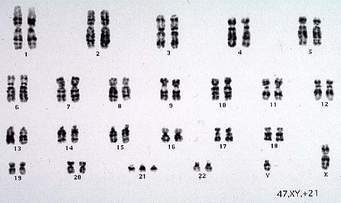
What is the chromosomal condition of the individual whose karyotype is seen in the image?
a)
Monosomy X (Turner's Syndrome)
b)
Trisomy 21 (Down's Syndrome)
c)
Trisomy 13 (Patau Syndrome)
d)
Trisomy 18 (Edwards's Syndrome)
28.
Based on the Karyotype shown, at which chromosome pair can we identify a genetic disorder? 
a)
Chromosome pair 5
b)
sex chromosomes
c)
Chromosome pair 21
d)
There are no chromosomal disorders
29.

In a pedigree, which shape represents a male?

a)

circle

b)

square

30.

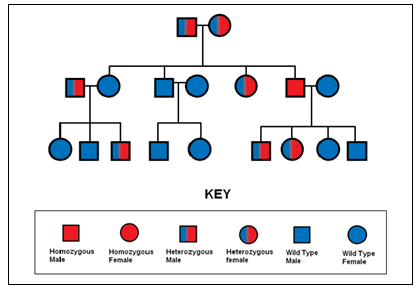
How many individuals are there in the 3rd generation?

a)

1

b)

2

c)

4

d)

6

31.

How are individuals III-2 and II-4 related?

a)

Brother and sister

b)

Dad and daughter

c)

Uncle and niece

d)

Grandfather and granddaughter

32.

What is the mode of inheritance shown here?

a)

Recessive because it "skips" a generation

b)

Dominant because it shows up in every generation

33.
How many generations are shown in this pedigree?
a)
1
b)
2
c)
3
d)
4
34.

If this pedigree shows a recessive disorder, what MUST the genotype of individual 4 be?

a)

HH

b)

Hh

c)

hh

35.
Homozygous is when...
a)
the alleles are the same
b)
the alleles are different
c)
the alleles are absent
d)
the alleles are present
36.
Dominant or recessive?
tt
a)
Dominant 
b)
Recessive
37.
An organism’s physical appearance, or visible traits. 
a)
Genotype
b)
Phenotype
c)
Beanotype
d)
Notype
38.
Which of the following is homozygous dominant?
a)
Yy
b)
Y
c)
yy
d)
YY
39.
T - tall and t = short
In the punnett square below, what belongs in the missing square
a)
tt
b)
Tt
c)
Bb
d)
TT
40.
B = brown fur  b = white fur
In the punnett square, what is the probability for white fur? 
a)
0%
b)
25%
c)
50%
d)
75%
41.

Which phrase best describes the process of meiosis?

a)

occurs in body cells

b)

produces haploid gametes

c)

happens only in haploid cells

d)

results in genetically identical cells

42.

Separation of homologous chromosomes occurs during __________.

a)

mitosis

b)

meiosis I

c)

meiosis II

d)

fertilization

43.

What happens to sister chromatids in meiosis II?

a)

They duplicate

b)

They are divided into daughter gametes

c)

mutate in the first divisionThey cross over

d)

They remain together

44.

The main purpose of genetic testing for changes in chromosomes, genes, or proteins is to __________. 

a)

look for the natural variation in DNA

b)

prevent genetic discrimination by employers

c)

assess the risk of having or carrying a genetic condition or disorder

d)

restrict carriers from ever passing on genetic conditions to newborns

45.

Chromosomes determine all inherited traits because they are made up of __________.

a)

ATP

b)

DNA

c)

centromeres

d)

phospholipids

46.

The law of segregation deals with which of the following?

a)

the separation of alleles during meiosis

b)

the separation of daughter cells during mitosis

c)

the separation of homologous chromosomes during mitosis

d)

the separation of homologous chromosomes during meiosis

47.

Which of these will complete the analogy female: XX: : __________?

a)

male: XY

b)

male: YY

c)

female: eggs

d)

female: gametes

48.

In the case of codominant alleles, a plant that is homozygous for red flowers that is crossed with a plant that is homozygous for white flowers will produce flowers that are _____.

a)

pink and red

b)

completely white

c)

dark pink all over

d)

red and white spotted

49.

Which phrase best describes meiosis I?

a)

fusion of sister chromatids

b)

creation of two diploid cells

c)

duplication of paired chromosomes

d)

division of homologous chromosomes

50.

Which phrase best describes the process of meiosis?

a)

occurs in body cells

b)

produces haploid gametes

c)

happens only in haploid cells

d)

results in genetically identical cells