wayground logo

Free Printable Worksheets

Font size

S
M
L
XL
Worksheets

EOC Review- Proficient, Accelerated, Advanced (and more)

Total questions: 105

Worksheet time: 2hrs 51mins

Name
Class
Date
1.

Mutations are__________

a)

Harmful

b)

Harmful or beneficial

c)

Neutral

d)

Harmful, neutral, or beneficial

2.
A desert animal with extra thick fur/hair would be___
a)
Harmful
b)
Neutral
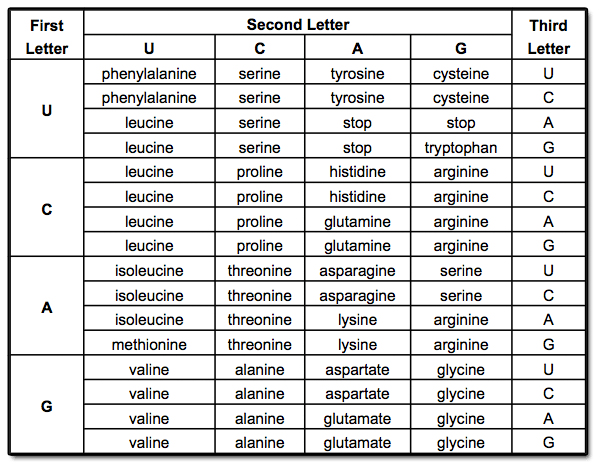
c)
Beneficial
d)
Happy
3.

Would a mutation in the DNA of a skin cell be passed on to an organism's offspring?

a)

Yes, because any change to the DNA is passed on to the offspring

b)

Maybe. Sex cells only use half of the body's genetic code. It might get the copy of a gene that wasn't mutated.

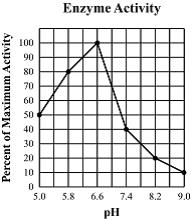
c)

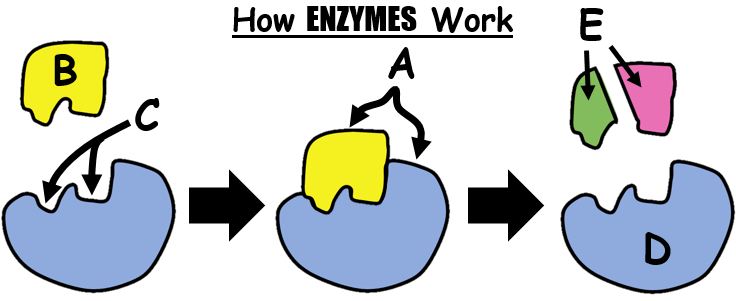
No. Only mutations that occur in the sex cells that are passed on to the offspring

d)

Without knowing the animal, it would be hard to tell whether or not the mutation would be passed on.

4.

A mutation is a change in an organism's _____________.

a)

Cell

b)

DNA

c)

Phenotype

d)

Ribosome

5.
Original: ATC CAT
Mutation: ATC GCAT
What mutation occurred?
a)
deletion
b)
insertion
c)
silent
d)
transverse
6.
Original DNA: CAT GAT
New DNA: CAT AT
What mutation occurred?
a)
deletion
b)
substitution 
c)
tranverse
d)
insertion
7.
What are the building blocks of proteins called?
a)
DNA
b)
RNA
c)
Ribosomes
d)
Amino Acids
8.
Normal-
GAG-CTC-GAC-AGA
Mutant
GAG CTC-CAC-AGA
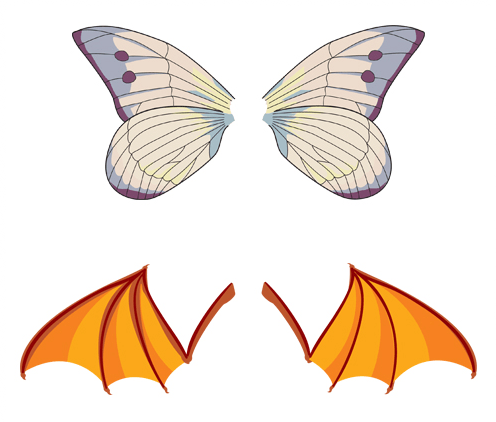
a)
no mutation
b)
substitution
c)
insertion
d)
deletion
9.
Why is DNA important?
a)
it is very small and very complicated
b)
it's in everything
c)
it serves as the blueprint for traits of all living things
d)
because we eat it every day for energy
10.
What do helpful mutations do? 
a)
Increases chances of survival 
b)
Decreases changes of survival 
c)
Increases chances of developing cancer
d)
Decreases skills
11.

Which mutation will cause translation to stop?

a)

Mutations 1 and 3 only

b)

Mutation 1 only

c)

Mutation 2 only

d)

Muations 1, 2, 3

12.

A single gene has 3 or more alternative forms. These are called

a)

heterozygotes

b)

multiple alleles

c)

epistatic

d)

polygenic

13.
In mice, the homozygous mice are black and white. The heterozygous mice are gray. What pattern of inheritance is expressed in fur color in mice?
a)
complete dominance and recessiveness
b)
co-dominance
c)
incomplete dominance
d)
pleiotropy
14.
If this image were real, it would represent what type of inheritance?
a)
incomplete dominance
b)
codominance
c)
polygenic inheritance
d)
compete dominance
15.
Homozygous is when...
a)
the alleles are the same
b)
the alleles are different
c)
the alleles are absent
d)
the alleles are present
16.
Heterozygous is when...
a)
the alleles are the same
b)
the alleles are different
c)
the alleles are absent
d)
the alleles are present
17.
This is when a trait is controlled by more than one gene.
a)
Multiple alleles
b)
Polygenetic inheritance
c)
Codominance
d)
Incomplete Dominance 
18.
A red flowered plant (RR) breeds with a White flowered plant (WW). The gene for petal color in these plants expresses incomplete dominance.  What percentage of the offspring will have pink (RW) flowers?
a)
0%
b)
25%
c)
50%
d)
100%
19.
What goes in box 3
a)
Aabb
b)
AABB
c)
AAbb
d)
aaBb
20.
What is the genotype for a pea plant heterozygous for round seeds (R), and homozygous recessive for green seeds (y)?
a)
Ry
b)
RRyy
c)
RrYy
d)
Rryy
21.
Using the dihybrid cross and key provided, what is the probability of the offspring being tall and white?
a)
9
b)
2
c)
3
d)
6
22.

In what process is mRNA synthesized?

a)

Transcription

b)

Translation

c)

DNA Replication

d)

Mitosis

23.

Where does TRANSCRIPTION occur?

a)

Nucleus

b)

Ribosome

c)

Cytoplasm

d)

Mitochondria

24.

Why must transcription occur where DNA can be found?

a)

because DNA can't leave

b)

because ribosomes are in the nucleus

c)

because DNA polymerase is found there

d)

because helicase unzips the DNA

25.

How many codons equals 1 amino acid?

a)

1

b)

2

c)

3

d)

4

26.

TRANSCRIBE this DNA sequence: TACGTTACT

a)

AUGCAAUGA

b)

ATGCAATGA

c)

AUGGATUGA

d)

TACGTTACT

27.

Which organelle is the location where protein is made?

a)

Ribosome

b)

Nucleus

c)

Cytoplasm

d)

Nucleotide

28.

When these bond together, they form a protein

a)

Amino Acids

b)

Peptide Bonds

c)

Ribose

d)

Nucleotides

29.
The process to go from mRNA to a protein is called ____
a)
transcription
b)
rRNA
c)
replication
d)
translation
30.
What amino acid is represented by the codon UUA?
a)
Phenylalanine
b)
Tyrosine
c)
Leucine
d)
Stop codon
31.

Choose the sequence of the mRNA strand that would be match up with to the following strand:

GTAGTCA

a)

UATUAGA

b)

ACGACTG

c)

CAUCAGU

d)

CATCAGT

32.
The main function of tRNA is to...
a)
carry a message that, when translated, forms proteins
b)
form a portion of ribosomes
c)
string together complementary RNA and DNA strands
d)
bring amino acids from the cytoplasm to the ribosomes
33.
Genetic recombination is the production of offspring - - - 
a)
with new combinations of genes
b)
with similar genes as their parent
c)
that are completely different from the parents
d)
that are super cute and irresistible
34.

What contributes to genetic variation?

a)

crossing over

b)

law of independent assortment

c)

law of segregation

d)

gene linkage

35.

In the graph to the right, what is the population of deer at the carrying capacity of the environment?

a)

3

b)

7

c)

70

d)

40

36.

What will happen if all of the frogs in a population die?

a)

The frogs' predators will decrease and the frogs' prey will increase

b)

The frogs' predators will increase and the frogs' prey will decrease

c)

We better all pray because there isn't anymore frogs.
37.
What is a substance called if it speeds up a chemical reaction?
a)
reusable
b)
catalyst
c)
specific
d)
fragile
38.
Each enzyme only has 1 substrate that will fit its active site.  What is this called?
a)
reusablility
b)
denaturation
c)
specificity
d)
fragility
39.
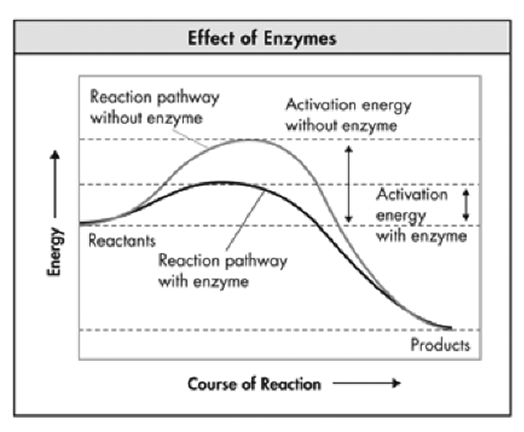
The graph shows how enzymes affect reactions in cells. Which statement best summarizes the information shown in the graph?
a)
Enzymes increase the energy of the reactants.
b)
Enzymes decrease the energy level of the products.
c)
Enzyme decrease the activation energy of the reaction.
d)
Enzymes reverse the direction of the reaction.
40.
Which of the following conclusions can be drawn from this graph?
a)
The optimum pH of the enzyme is 6.6.
b)
The optimum pH of the enzyme is 5.8
c)
The enzyme’s activity increases as pH increases 5.0 to 9.0
d)
The enzyme’s activity is greater around pH of 8.0 .
41.
In the diagram, what is letter A? 
a)
product
b)
substrate
c)
enzyme-substrate complex
d)
active site
42.
What happens when enzymes are heated to a high temperature?
a)
The enzymes die.
b)
The shapes of the enzyme are altered denature
c)
The enzymes' amino acid sequence changes.
d)
The enzymes remain the same
43.
Which enzyme is most efficient in a basic solution?
a)
A
b)
B
44.
What is another word that can be used to describe "homeostasis"?
a)
STABLE
b)
EQUAL
c)
COMPLETE
d)
CORRECT
45.

Which of the following is not regulated by homeostasis?

a)

body temperature

b)

blood sugar

c)

blood pH

d)

body movements

46.

Homeostasis

a)

allows for a wildly fluctuating internal environment

b)

is impossible in vertebrates

c)

is the maintenance of a relatively stable internal environment and often incorporates a form of feedback regulation

47.
Most bacteria that cause sickness in humans grow best at 98.6oF. Sometimes a fever is the body's response to the bacteria. What is the reason for developing a fever?
a)
To lower the temperature of the body to kill the bacteria
b)
The increase the temperature of the body to kill the bacteria
c)
To allow the bacteria to take over
d)
To make you feel miserable
48.

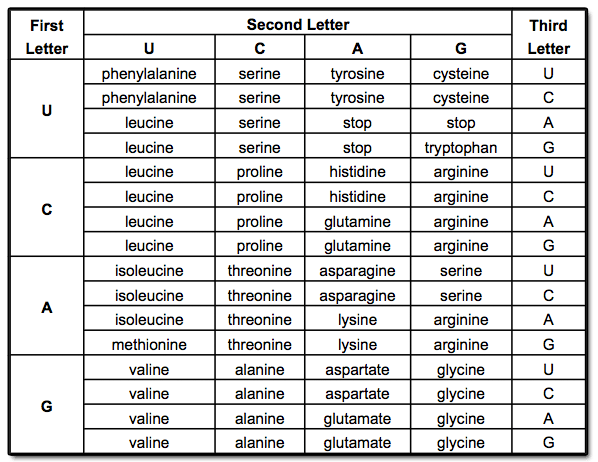
When using your codon chart, what sequence can you use to find the correct amino acid?

a)

DNA

b)

mRNA

c)

tRNA

d)

Any of these will do

49.

What is the order for Protein Synthesis?

a)

Transcription -> Translation -> Protein

b)

Translation - > Transcription -> Protein

c)

Protein -> Transcription -> Translation

d)

Translation -> Protein -> Transcription
50.
What is the correct amino acid sequence for the mRNA code AUGCCAGUAUGA
a)
Met-Pro-Ala-Val
b)
Met-Pro-Val
c)
Tyr-Gly-His
d)
Tyr-Gly-Arg-His
51.
The codon CCU codes for what amino acid?
a)
Isoleucine
b)
Stop
c)
Methionine
d)
Proline
52.
What are the products of photosynthesis?
a)
glucose and oxygen
b)
glucose and carbon dioxide
c)
water and carbon dioxide
d)
water and oxygen
53.
What are the reactants in cellular respiration?
a)
glucose and oxygen
b)
glucose and carbon dioxide
c)
water and carbon dioxide
d)
oxygen and glucose
54.
What are the products in cellular respiration?
a)
water and carbon dioxide
b)
water and glucose
c)
carbon dioxide and oxygen
d)
glucose and oxygen
55.

This is the equation is for? 6Co2 + 6H2O ----> C6 H12 O6 6O2

a)

photosynthesis

b)

cellular respiration

56.
Autotroph or heterotroph?
a)
Autotroph
b)
Heterotroph
57.
Which of the following is the correct equation for cellular respiration?
a)
6CO2 + 6H2→ 6O2 + C6H12O6 + Energy
b)
6O2 + C6H12O→ 6CO2 + 6H2O + Energy
c)
6CO2 + 6H2O + Energy → 6O2 + C6H12O6
d)
6O2 + C6H12O6 + Energy → 6CO2 + 6H2O
58.

This laboratory procedure is known as

a)

CLONING

b)

gel electrophoresis

c)

chromatography

d)

use of a dichotomous key

59.
Based on these results whose blood was found in the blood stain at the crime scene?
a)
Bob
b)
Sue
c)
John
d)
Lisa
60.
Which suspect is likely guilty?
a)
Suspect #1
b)
Suspect #2
c)
Suspect #3
61.
What is the function of ATP in living things?
a)
provides energy for cells
b)
stores genetic information
c)
provides structure in the nucleus
62.

Which would NOT be a reason to use GM crops?

a)

Using GM crops can increase crop yields.

b)

Using GM crops can reduce use of insecticide sprays.

c)

Using GM crops may be able to feed more people faster.

d)

Using GM crops can increase pesticide resistance in pests.

63.

GMO stands for

a)

Genetically made organism

b)

Genetically modified organism

c)

Gene manipulated organism

d)

Genetic mutant organism

64.

What is a GMO?

a)

An organism that has had its DNA modified by humans

b)

An organism missing a chromosome

c)

Epigenetics

d)

A genetically identical organism

65.

In recent years "SuperBugs" (bacteria that aren't effected by antibiotics) are becoming more and more common. How could natural selection explain this?

a)

Superbugs have developed resistance because they can survive antibiotics and reproduce

b)

Antibiotics cause bacteria to become superbugs

c)

We have always had the same amount of superbugs; modern media just discusses them more.

d)

There is no reliable data on the origin of super bugs.

66.

Which of these is an example of natural selection?

a)

The largest animal in a population will have more opportunities for reproduction.

b)

Several species of organisms work together so that they all succeed.

c)

One species takes all the resources in an environment leaving none for others.

d)

Organisms that are best suited to an environment tend to survive and reproduce more often.

67.
Which of the following explains adaptation.
a)
An individual organism changes to meet its needs in the environment. These changes pass down to their offspring.
b)
The species as a whole changes their characteristics.
c)
Beneficial traits allow organism to survive and pass on those traits
d)
New characteristics arise in a species as needed.  If these traits are helpful, they are passed down.
68.

Why might it be helpful for a species to have a lot of variations?

a)

They can't be seen by predators

b)

If the environment changes, they might be better able to adapt

c)

It is helpful in asexual reproduction

d)

They don't recognize each other

69.
The example of the peppered (brown) moths living near English industrial cities demonstrates that
a)
A change in an environment can result in the evolution of species living there
b)
Evolution occurs so slowly that is it not possible to determine that it has happened in less than a million years
c)
The environment near these cities has always favored dark colored moths
70.

Humans selecting which traits are preferred in an organism, and then intentionally breeding organisms for those particular sets of characteristics is known as

a)

natural selection

b)

artificial selection

c)

adaptations

d)

macroevolution

71.

Select every answer that is a main principle of natural selection

a)

overproduction of offspring

b)

variation

c)

adaptation

d)

destructive morphology

72.

Select all statements that are true regarding individuals whose traits do not interact well with the environment.

a)

They are likely to survive.

b)

They are likely to die.

c)

They are likely to produce great numbers of offspring who survive.

d)

They are likely to produce fewer offspring.

73.
When a piece of liver is dropped into hydrogen peroxide, the peroxide bubbles vigorously as the hydrogen peroxide (H2O2) decomposes into water (H2O) and oxygen (O2). This rapid change in reaction rate suggests 
a)
that liver contains lots of germs
b)
 the liver contains an enzyme that breaks down hydrogen peroxide
c)
 that liver is a substrate for hydrogen peroxide
d)
that hydrogen peroxide is a powerful enzyme
74.
The graph shows the relative rates of action of four enzymes, A, B, C, and D. Which enzyme shows the greatest change in its rate of action with the least change in pH?
a)
enzyme A 
b)
enzyme B 
c)
enzyme C
d)
enzyme D
75.
Based on the phylogenic tree, which of these shows a correct ancestral lineage?
a)
E is an ancestor to F and G
b)
C is an ancestor to D and E
c)
B is an ancestor to A
d)
E is an ancestor to H and I
76.

Chemosynthesis:

a)

converts carbon dioxide or methane and nutrients into organic matter without sunlight

b)

Converts carbon dioxide into organic matter using sunlight

c)

Converts water into oxygen without sunlight

d)

Converts water into oxygen using sunlight

77.

The main difference between photosynthesis and chemosynthesis is:

a)

Photosynthesis gives off carbon doxide, while chemosynthesis gives off oxygen

b)

photosynthesis happens in the dark, while chemosynthesis happens in light

c)

photosynthesis uses chemicals (hydrogen sulfide) to make food, while chemosynthesis uses light

d)

chemosynthesis uses chemicals (hydrogen sulfide) to make food, while photosynthesis uses sunlight
78.
The Hardy-Weinberg Model is?
a)
Available at local hobby stores and retailers throughout the Greater Cleveland area.
b)
A mathematical tool that biologists can use to predict allele frequencies and determine whether or not evolution is occurring within a population.
c)
Always occurring within populations of organisms in nature.
d)
Only useful in the lab and cannot be practically applied to real-world populations of organisms.  
79.

Two populations of the same species are separated by land barriers like rivers or mountains.

a)

geographical isolation

b)

temporal isolation

c)

adaptive ratiation

d)

behavioral isolaton

80.

After a long time in isolation, Island fruit flies and mainland fruit flies meet. They do not produce viable eggs due to genetic differences. The flies have resulted in two seperate lineages due to:

a)

Gene Pool

b)

Genetic Drift

c)

Gene Frequency

d)

Speciation

81.
In natural selection, the selective agent is the
a)
humans
b)
mutations
c)
breeders
d)
environment
82.
Which of the following is a term for a group of similar organisms that can reproduce fertile offspring?
a)
individual
b)
population
c)
species
d)
fossil
83.

Genetic drift is change in the allele frequency of a population due to...

a)

random chance

b)

natural selection

c)

non-random mating (sexual selection)

d)

artificial selection

84.
A rabbit that can easily outcompete other rabbits for food and that can produce many offspring has a high
a)
sexuality
b)
mutation rate
c)
fitness
d)
adaptability
85.

The diagram below represents a change that occurred in a pair of chromosomes during the formation of an egg cell. The alteration that occurred will most likely be passed on to every cell that develops from the egg cell. Why would this type of alteration result in offspring with combinations of traits that differ from those found in either parent?

a)

It converts sex cells into body cells.

b)

It results in the formation of diploid gametes.

c)

. It results in new combinations of genes on each chromosome.

d)

It changes the chromosome number of the body cells that develop from the egg cell.

86.

The diagram shows the process of crossing over. Which claim about crossing over in chromosomes is best supported by the diagram?

a)

Crossing over increases genetic diversity through deletion.

b)

Crossing over decreases genetic diversity through mutation.

c)

Crossing over increases genetic diversity by creating new combinations of genes.

d)

Crossing over decreases genetic diversity by inserting nucleotides into gene sequences.

87.
What is plant biotechnology?
a)
Adding chemicals to foods to preserve them.
b)
Making synthetic foods using artificial, man-made proteins.
c)
Inserting a gene or genes with beneficial traits into a plant cell.
d)
Taking immature plants and adding steroids to make them grow bigger and stronger.
88.
DNA can be spliced, in order to insert it in a different organism, using
a)
prescription enzymes
b)
digestive enzymes
c)
restriction enzymes
d)
transcription enzymes
89.

How would the fossils in the sediment layers of Earth appear to prove evolution?

a)

fossils in upper layers complex and lower layers complex

b)

fossils in upper layers simple and lower layers complex

c)

fossils in upper layers complex and lower layers simple

d)

fossils in upper layers simple and lower layers simple

90.

Which statement is correct about the evidence in this picture?

a)

similar bones indicate a similar diet

b)

similar bones indicate a similar habitat

c)

similar bones indicate a common ancestor

d)

similar bones indicate evolution happened quick

91.
Structures are similar in appearance but not in structure
a)
Vestigial 
b)
Homologous 
c)
Analogous Structures 
d)
Embryonic 
92.

Similar structures with different purposes found in different species are known as _____

a)

vestigial structures

b)

DNA

c)

homologous structures

d)

the fossil record

93.

What is this an example of?

a)

Homologous structure

b)

Analogous structure

c)

Vestigial organs

d)

Functional adaption

94.
Which is not evidence for evolution?
a)
many animals have homologous structures due to common ancestry
b)
Many animals have vestigial structures from an ancestor
c)
We can observe changes in life forms by observing the fossil record
d)
All of these are evidence for evolution
95.
A change in the inherited characteristics of an organism over time is ________
a)
evolution.
b)
development.
c)
growth.
d)
ancestry.
96.
What does biodiversity mean?
a)
Only one species in an area.
b)
The different amount of species in an area
c)
All abiotic life
d)
Nitrogen fixation
97.

Species that are clearly critical to the functioning of an ecosystem are known as

a)

biodiversity

b)

keystone species

c)

main species

d)

native species

98.

a species that is not native to a particular region and has no natural predators and little competition

a)

consumer species

b)

producer species

c)

invasive species

d)

adapted species

99.

Organisms with a ___________ gene pool have a __________ chance of surviving

a)

smaller, lesser

b)

larger,greater

c)

smaller, greater

d)

larger, smaller

100.

If the dots represent sugar which is more concentrated

a)

Inside the cell

b)

Outside the cell

c)

Neither they are equal (equilibrium)

101.

If the dots represent sugar, what direction will water flow?

a)

Into the cell

b)

Out of the cell

c)

Into and out equally (equilibrium)

102.

If the percentage represents sugar, what direction will water flow?

a)

Into the cell

b)

Out of the cell

c)

Into and out equally (equilibrium)

103.

If the miligrams are referring to the amount of sugar, what direction will water flow?

a)

Into the cell

b)

Out of the cell

c)

Into and out equally (equilibrium)

104.

Which cell would water move into?

a)
b)
c)
d)
105.
Where will the water go?
a)
Into the cell
b)
Out of the cell
c)
Equally in & out - it's isotonic
d)
There is no water