
Font size
 Worksheets
Unit 5 Review - Petroski
Total questions: 35
Worksheet time: 35mins
New traits usually occur due to:
Random genetic mutations
An organism adapting
Effects from the environment
If a new trait DOES NOT help an organism survive, what may happen to it?
It dies and its DNA is not passed on
It survives and its DNA is passed on
It changes its traits to adapt and survive
If a new trait DOES help an organism survive, what may happen to it?
It dies and its DNA is not passed on
It survives and its DNA is passed on
It changes its traits to adapt and survive
What happens to new traits that HELP organisms survive over time?
They become MORE COMMON
They become LESS COMMON
They are EQUALLY COMMON

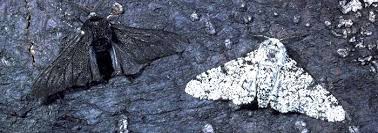
What happened to the peppered moth population after the Industrial Revolution?
There were MORE LIGHT moths because the bird couldn't see them on the DARK TREES
There were MORE DARK moths because the bird couldn't see them on the DARK TREES
There were MORE DARK moths because the bird couldn't see them on the LIGHT TREES
What do you call a related organism from a previous generation?
ancestor
adaptive trait
distribution
environment
What is a way of hiding by looking the same as the background?
feature
distribution
chromosome
camouflage
Natural Selection is driven by a change in the environment and survival of the
Smartest
Fastest
Most well adapted
Biggest
A population can be described by:
the traits present
the number of individuals who have each trait
the different species of organisms in it
abiotic factors
The number of individuals with each trait in
a population ________________ over time.
can change
stays the same
Over many generations, individuals with _______________ become more common in
a population, while individuals with _________________ become less common.
adaptive traits ; non-adaptive traits
non-adaptive traits ; adaptive traits
The traits that __________________ in a population determine which traits can become more common over many generations.
exist
an organism wants
Biologists analyze data about __________________________ (the causes) to explain changes in ______________________________ (the effects).
environmental conditions ; the distribution of traits in populations
the distribution of traits in populations ; environmental conditions
What caused this newt population to become more poisonous?
*Your answer will automatically be marked correct. Therefore, you MUST read the answer explanation to ensure that your answer is correct.

Scientists measured the spot size of guppies (small fish) in two different populations. Which population has more guppies with large spots?
They both have the same number of guppies with large spots.
The population in Brazil has more guppies with large spots.
The population in Venezuela has more guppies with large spots.
These bar graphs do not show which population has more guppies with large spots.

Scientists measured the height of the giraffes in two different populations. Which population has the largest number of tall giraffes?
The population in Niger has the largest number of tall giraffes.
The population in Somalia has the largest number of tall giraffes.
Both populations have the same number of tall giraffes.
These bar graphs do not show which population has more tall giraffes.

Scientists measured the spine size of a population of cactuses found in an area in 1970. They measured the spine size of the cactus population again in 2015. Which of the statements below best describes the difference in the cactuses at the two time points?
The cactuses in 1970 had smaller spines than the cactuses in 2015.
The cactuses in 1970 had larger spines than the cactuses in 2015.
There were more cactuses in 1970 than there were in 2015.
There was more variation in spine size in 1970 than there was in 2015.

Northern foxes can have different fur colors.
The foxes hunt squirrels for food. Foxes that have fur the same color as their environment are better at getting close to squirrels and catching them.
The diagrams below show three possible fox populations.
If their environment changes to have only brown dirt, which of the following fox populations will most likely survive?
Populations 1 and 2 will most likely survive.
Populations 2 and 3 will most likely survive.
Only Population 2 will survive because it is the only population with variation.
All the populations will survive because the foxes will change the color of their fur if they need to.

Scientists measured the beak length of a population of birds in a lake in 1960. They measured the beak length of the bird population again in 2010. What do the graphs show you about the variation in the beak lengths of the birds by the lake?
There was the same amount of variation in 1960 and in 2010.
These bar graphs do not show the amount of variation in the population.
There was more variation in 2010.
There was more variation in 1960.

Darwin theorized that organisms with traits that are best suited to their environment will ________________
increase in number
become extinct
The way in which traits are shared in the population
Predominant
Resistance
Distribution
Heritable
In a cold environment what would be some adaptive traits? Sellect all that apply.
thick blubber
thick fur
thin fur
strong muscles
Can mutations be passed down to offspring?
Yes
No
How do you "win" at natural selection?
survive
go extinct
survive & reproduce

The squirrel in the picture is using an adaptation called
camouflage
hibernation
migration
retention
Starting in 1954, commercial fishers in the northwest Pacific were paid by weight, rather than by the individual fish, for pink salmon. The fishers increased the use of a type of net that selectively catches larger fish. Which of the following effects did this change in fishing technique most likely have on the salmon population over the next 20 years?
The average body size of the salmon population decreased significantly.
The average body size of the salmon population increased significantly.
The average body size of the males in the salmon population increased, and the females stayed the same.
None of the above.
A population of finches that have 3 different beaks live on an island. Each beak type is adapted to one of 3 specific food sources. Two of the three food sources are eliminated during a hurricane. What will happen to the finch population?
The food source will adapt to the remaining finches
All 3 finches adapt to the remaining food source
All 3 finches will die
The finch that is adapted to the remaining food source will survive
There is a species of beetle that has two variations in the population: brown beetles and green beetles. About 82% of all brown beetles survive to adulthood while only 31% of green beetles survive to adulthood. Which of the following statements is true about the fitness of these beetles?
The green beetles have higher fitness
The brown beetles have higher fitness
The green beetles have more adaptations
The brown and green beetles have the same level of fitness


