
 Worksheets
Biology Unit 6 Test Review
Total questions: 129
Worksheet time: 3hrs 17mins


In the punnett square below, what belongs in the missing square


If a homozygous dominant allele (AA) is crossed with a homozygous recessive allele (aa), all of the resulting offspring will be
Homozygous dominant
Heterozygous
Homozygous Recessive
In guinea pigs, the allele for short hair is dominant. If all the guinea pigs are born short haired what are the possible genotypes of the parents? (There are two possible combinations.)
Ss + Ss
SS + SS
SS + Ss
ss + ss

This type of inheritance pattern is a MIXTURE of two traits. This is known as ---
incomplete dominance.
codominance
When one allele is not dominant over the other, resulting in both traits expressed in a heterozygous individual.....
Incomplete Dominance
Codominance
When one allele is not dominant over another, resulting in a blended phenotype for heterozygous offspring is considered....
Incomplete Dominance
Codominance
Which of the following genotypes code for the blood type AB?
IA IA and IA IB
IA IB only
IA IB and IB i
ii only
Which of the following are genotypes for blood type B?
IA IA and IA IB
IB IB and ii
IB IB and IB i
IA IB and IA IB

A woman with curly hair and a man with straight hair produced a child with wavy hair:
Incomplete dominance
Codominance
Complete dominance


2.Which blood type would not be possible for children of a type AB mother and a type A father?
(a)
3.If two white rabbit produce a black offspring, the parent’s genotypes for color must be:
heterozygous
homozygous black
homozygous white
not enough information was given

A black male and white female produced this grey offspring:
Incomplete dominance
Codominance
Complete dominance
Radish color is incompletely dominant, red and white are pure breeding colors. While heterozygous are purple.
Cros a red radish with a white.
4 purple
1 red, 2 purple, 1 white
2 red, 2 white
1 red, 1 purple, 2 white
Which of the following are genotypes for blood type B?
IA IA and IA IB
IB IB and ii
IB IB and IB i
IA IB and IA IB
Which of the following is true about blood type O?
It contains antigen A only.
It contains antigen B only.
It contains both antigen A and antigen B.
It doesn’t contain antigen A or antigen B.

In the image above, what is the percentage of the offspring has the possibility of inheriting blood type O?
0%
25%
50%
100%
Which of the following refers to a complete dominant cross?
One allele completely dominates over the other.
The two alleles are equally seen in the heterozygous genotype.
The two alleles are blended in the heterozygous genotype.
Neither allele is seen in the phenotypes.
Which of the following genotypes code for the blood type AB?
IA IA and IA IB
IA IB only
IA IB and IB i
ii only

Which of the following codes for blood type O?
IA IA
IB i
IA IB
ii

The image above shows the incomplete dominant cross where D codes for straight hair in dogs and d codes for curly hair in dogs. The incomplete dominant trait is wavy hair. Which of the following statements is true about the offspring?
Only the heterozygous genotype can code for wavy hair.
Only the homozygous dominant genotype can code for wavy hair.
Only the homozygous recessive genotype can code for wavy hair.
The homozygous recessive and homozygous dominant genotypes can code for wavy hair.

The proteins found on the surface of RBCs that allow us to type blood as A, B, O or AB are called
antigens
antibodies
aggluntates
Rh factors

What is produced by your body in response to foreign antigens, such as the wrong type of blood?
agglutinates
clotting factors
phagocytes
antibodies
Which blood type has Type A antibodies?
Type AB
Type O
Type B
Type B and Type O
A woman has type B blood and her husband has type O blood. What must be the woman's genotype, if they have a child with type O blood?
IB i
IB IB
ii
type B blood
If a father is IA IA and a mother is IA IB, what is the probability for a child with AB blood type?
0%
25%
50%
75%
What inheritance patterns makes the blood type AB possible?
incomplete dominance
multiple alleles
codominance
total dominance
What is the inheritance of color blindness an example of?
co-dominance
continuous variation
karyotype cross
sex linkage
For haemophilia, let H be the normal allele and h the mutant allele.
Which is the genotype of the unaffected male?
XhY
XHXH
XHXh
XHY
Which of the following explains why color blindness is more common in males? Tick two.
The mutant allele for color blindness is carried by the X chromosome.
The mutant allele for color blindness is carried by the Y chromosome.
Male has only one X chromosome, so either allele is expressed.
Female has two X chromosomes, so either allele is expressed.
Color blindness is carried by the X chromosome.
A mother is a carrier of color blindness. Her husband has normal vision.
The probability of having a color blind offspring is (a) percent.

The diagram shows the sex chromosomes of a woman and of a man. Their genotypes for a recessive sex-linked condition are also shown.
What are the chances that their daughter will show the sex-linked condition?
0%
25%
50%
75%


Which genotype represents a female who is a carrier for hemophilia?
Which genotype represents a male with hemophilia?
How many alleles does a child get from each parent for a trait?
1
2
3
4
Aa, DD, Bb, yy are all examples of ---
genotypes.
phenotypes.
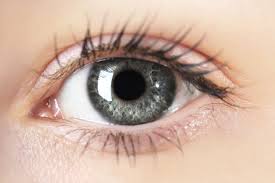
What you see, or the physical appearance of an organism, is called the ---
genotype.
phenotype.
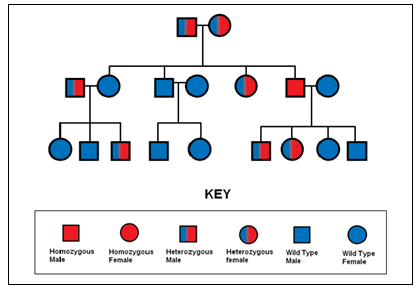
In a pedigree, which shape represents a male?
circle
square
Which gender has an X and a Y chromosome?
male
female

On a pedigree, this symbol represents a ----
not affected male.
not affected female.
affected male.
affected female.

How many individuals are there in the 3rd generation?
1
2
4
6

How are individuals III-2 and II-4 related?
Brother and sister
Dad and daughter
Uncle and niece
Grandfather and granddaughter

What is the mode of inheritance shown here?
Recessive because it "skips" a generation
Dominant because it shows up in every generation

On this pedigree, the allele for curly hair is dominant. The couple labeled 2 both have curly hair, but have a daughter who does not have curly hair. Therefore, we can tell from the chart that for the couple labeled 2 -
the male is heterozygous and the female is heterozygous.
the male is homozygous recessive and the female is homozygous dominant.


If this pedigree shows a recessive disorder, what MUST the genotype of individual 4 be?
HH
Hh
hh
How are women represented on a Pedigree?
Triangle
Circle
Square
Octagon
How are men represented on a Pedigree?
Rectangle
Circle
Square
Hexagon
If a circle or square is completely shaded in, that means ________________.
he or she is dominant.
he or she is missing a trait.
he or she is affected.
he or she is a carrier.
If one or both parents have the disorder or the disorder is seen in many generations, the disorder is ________________.
Homozygous
Dominant
Recessive
Sex-linked
If one or neither of the parents have the disorder, but a child has the disorder, the disorder is _______________.
Autosomal
Dominant
Recessive
Heterozygous
If mostly males are affected in the pedigree, the disorder is said to be ________________.
Dominant
Recessive
Autosomal
Sex-linked
If both males and females are affected int the pedigree, the disorder is said to be ________________.
Autosomal
Sex-linked
Dominant
Recessive
A _____________ is a diagram that shows the genotypes and phenotypes of organisms from one generation to the next
Dihybrid cross
Punnett square
Pedigree
Monohybrid cross
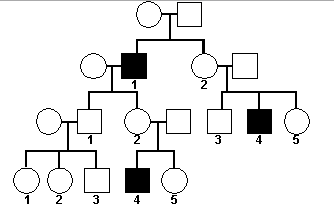
What type of heredity is shown in the pedigree?
Sex-Linked Dominant
Sex-Linked Recessive
Autosomal Dominant
Autosomal Recessive
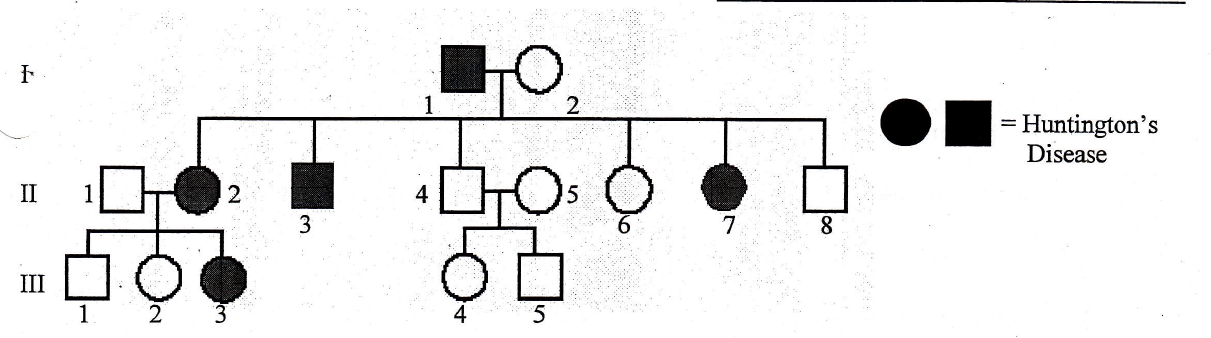

What is the correct genotype for individual I-2?


Which of the following is an autosomal recessive disorder?
Huntington's disease
sickle cell anemia
colorblindness
Hemophilia
Which of the following is a autosomal dominant disorder?
Huntington's
Cystic fibrosis
Hemophilia
Sickle cell anemia
A normal human zygote should have _____ chromosomes inside.
46
23
92
64
What is the correct genotype for individual I-2?
When you look at the cells of individuals with sickle cell anemia, what do you expect to see?
C-shaped cells
S-shaped cells
Disk-Shaped Cells
Globular shaped cells
Sick cells
Sickle Cell is inherited in a _________ pattern.
Autosomal Dominant
Autosomal Recessive
Codominant
Incompletely dominant

Normal RBC
A
B
Sickled RBC
A
B
Human males are much more likely to have hemophilia than human females. This is the case because: (3.2.2)
the gene for hemophilia is carried on the Y chromosome
hemophilia is carried on autosomes
the gene for hemophilia is sex-linked
hemophilia is a contagious disease to which males are more susceptible

What type of inheritance is shown in the pedigree below? (3.2.2)
autosomal dominance
codominance
incomplete dominance
sex-linked recessive
Which of the following is homozygous recessive?
RR
Rr
rR
rr
Which genotypes are heterozygous?
EE
tt
Rr
Both EE and tt
Which genotypes are homozygous dominant?
EE
tt
Rr
Both EE and tt
Which genotypes are homozygous?
EE
tt
Rr
Both EE and tt
_____ is the genetic makeup of an organism.
phenotype
genotype
A ____ is a region of DNA that controls a trait.
gene
phenotype
chromatin
genotype
Passing traits from parents to their offspring
Genetics
Heredity
Punnett square
Monohybrid cross

What is this?
Pedigree
Karyotype
Venn diagram
Punnett Square
Is this trait (the shaded individuals) dominant or recessive?
dominant
recessive

What does a filled in square represent?
Not affected Female
Not affected Male
Affected Male
Affected Female
A man carrying the allele for Huntington’s disease marries a woman who is homozygous recessive for the allele. What is the probability that their offspring will develop Huntington’s disease?
25 percent
50 percent
75 percent
100 percent


