Worksheets
8.ESS2
Total questions: 161
Worksheet time: 3hrs 47mins
Wegener's idea of Continental Drift was rejected by geologists because _________.
He used too many pieces of evidence to support the idea.
He wanted to know what Earth looked like millions of years ago, which is impossible.
He couldn't identify why or how the continents moved around.
They were afraid of the new idea.
Undersea mountain ranges are called ____________.
Rifts
Mid-ocean ridges
Continental shelf
Ocean trench
The OLDEST rocks on the seafloor are located?
Closest to the mid-ocean ridge
Farthest from the mid-ocean ridge
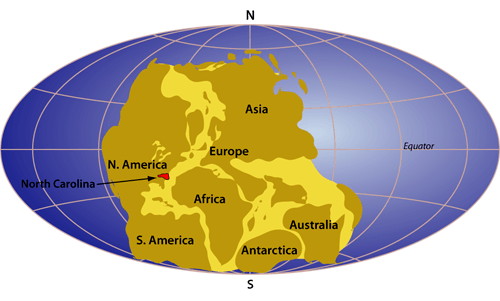
What theory states that the continents were once part of a super continent called Pangaea and have moved slowly to their current locations over hundreds of millions of years.
Oceanic wandering
Land-form Evidence
Continental Drift
Fossil Distribution
What types of evidence did Wegener use to support the theory of Continental Drift? (Select ALL answers that are correct)
evidence from land features
evidence from animal fossils
evidence from ancient climates
evidence from plant fossils
evidence from human remains
According to Wegener, the continents used to be joined together as one supercontinent known as:
South Africa
Eurasia
Pangaea
Potlopia
Younger sea floor crust is located...
farther from the mid-ocean ridges
at the mid ocean ridges
near the continents
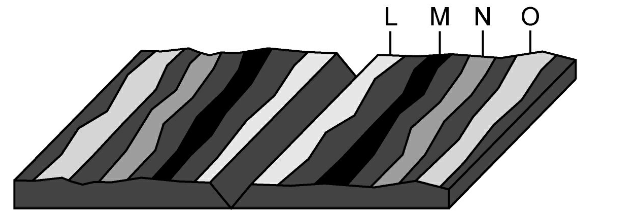
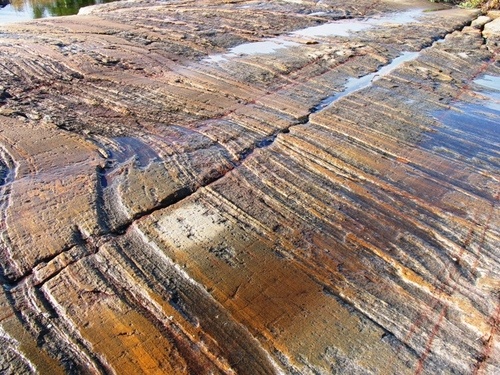
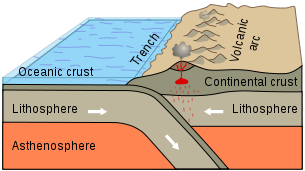
What features are associated with Seafloor spreading? Choose all that apply.
rift valley
subduction
mid-ocean ridge
volcanoes
Sea-floor spreading begins at the
Deep ocean trench
Mid-ocean ridge
Continent's edge
What phenomenon's can be explained by plate tectonics? (Choose ALL that apply)
Mountains
Volcanoes
Tsunamis
Hurricane
Seafloor structures
What is found at divergent boundaries in the ocean? (Select all that apply)
Mid-ocean ridge
Subduction zones
Rift Vally
Magma Formation

What is found at J?
Mid-Ocean Ridge
Ocean Trench
Continental Shelf
Volcanic Island

What is found at E?
Continental Slope
Volcanic Island
Seamounts
Ocean Trench
Who came up with the theory of seafloor spreading?
Harry Hess
Alfred Wegner
Ms. Flowers
Albert Einstein
Which is not a piece of evidence to support Continental Drift
Continents fit together like a puzzle
Continuous Mountain Chains
Same fossils found on different continents
Age of Igneous Rocks
What evidence of Wegener's Theory is shown in the remains of organisms that lived long time ago?
embryology
continental drift
seafloor spreading
fossils

Earth's plates meet at ____________.
plate tectonics
plate boundaries
continental drift
oceans
________________ currents drive Earth's plate movement.
ocean
atmosphere
wind
convection
Which theory describes the motion of the force driving Earth's Plates?
continental drift
plate tectonics
first law of motion
third law of motion
Which feature forms at convergent boundaries?
trench
rift valley
mountain range
mid-ocean ridge
In some areas of the world, like California and Japan, earthquakes are a common occurrence. How can this best be explained?
The strong ocean currents are undermining both areas causing earthquakes.
Both areas are located near the edge of the Pacific Ocean, the unstable sand causes earthquakes.
Both areas are subjected to strong ocean wind and waves that causes earthquakes.
Both areas are on the boundary of active plates, the motion of the plates causes earthquakes.
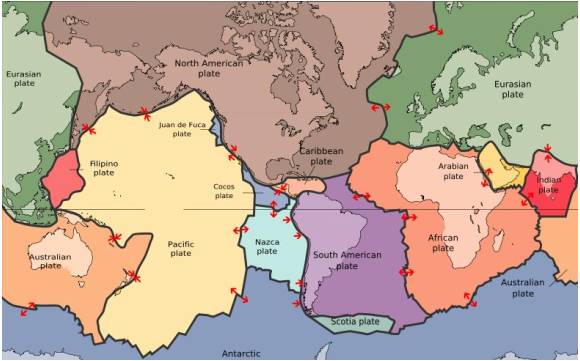
The map in the picture shows tectonic plate boundaries. This map would be useful in predicting the location of future
droughts
hurricanes
earthquakes
tornadoes
Earth's plates meet at ____________.
plate tectonics
plate boundaries
continental drift
oceans

The OLDEST seafloor is located?
Closest to the mid-ocean ridge
Farthest from the mid-ocean ridge

True or False : Sea-floor Spreading adds new material to the ocean floor?
True
False

What is seafloor spreading?
continental crust-continental crust
rift valleys
seafloor spreads
ocean spreads and magma rises to fill in gaps creating a Mid Ocean Ridge

What was Wegener's hypothesis called?
The Pangea
sea floor spreading
The Continental Drift
Techtonic Plates
What evidence helped Wegener support his theory?
Climate change
Fossils
Land Features
All of the Above


Transfer of energy as light through space or clear
substances.
Conduction
Convection
Radiation
Geosphere
Transfer of energy between objects that are touching.
Conduction
Convection
Radiation
Geosphere
Transfer of energy caused by the circulation of matter due to differences in density.
Conduction
Convection
Radiation
Geosphere
All of the rock above and below the surface of the Earth.
Biosphere
Convection
Atmosphere
Geosphere
Which type below moves energy from the core out to the crust?
radiation
convection
conduction
Which type below moves rock/magma around the mantle in a circular motion?
radiation
convection
conduction
Why does energy move in a circular motion during convection?
As rock heats up, it becomes more dense and rises. As it cools, it becomes less dense and falls.
As rock heats up, it becomes less dense and rises. As it cools, it becomes more dense and falls.
As rock heats up, it becomes more dense and falls. As it cools, it becomes less dense and rises.
As rock heats up, it becomes less dense and falls. As it cools, it becomes more dense and rises.
Where does the energy come from that drives the movement or rock inside the Earth?
Core of the Earth
Sun
Water Cycle
Electricity

What type of energy transfer is shown?
Radiation
Convection
Conduction

What type of energy transfer is shown happening as the spoon heats up?
Radiation
Convection
Conduction

What kind of energy transfer is shown happening inside the teapot?
Radiation
Conduction
Convection
Which layer of the Earth is the layer we live on?
Core
Mantle
Crust
Atmsophere
Which layer of the Earth is the layer directly below the top layer?
Core
Mantle
Crust
Which layer of the Earth is the layer right in the center and is the most dense?
Core
Mantle
Crust

Mid Ocean Ridge
trench
Abyssal plain
Cont Slope

Continental shelf
continental Slope
New Crust
old crust

Mesosphere
old crust
new crust
Divergent boudary

Transform Boundary
Continental shelf
Asthenosphere
Magnetic Reversal

Divergent Boundary
Convergent Boundary
Transform Boundary

Divergent Boundary
Convergent Boundary
Transform Boundary

Divergent Boundary
Convergent Boundary
Transform Boundary

Light Blue Area only
continental shelf
Abyssal Plane
Seafloor ridge
fracture zone

Dark Blue Area only
Continental Shelf
Continental slope
Abyssal Plain
Fracture zone

Center-black area
trench
mid ocean ridge
mesosphere

What is number 1?
Lithosphere
asthenosphere
Mesosphere
atmosphere

What is number two?
Lithosphere
Asthenosphere
Mesosphere
Atmosphere

Magma
Lava
fire ants
forest fire

Lava
Magma
digestive system
ant mounts
layer at the center of the Earth made of Solid Iron and nickel
mantle
inner core
crust
outer core
layer of hot, molten lava & iron and nickel
mantle
inner core
outer core
what is the mantle
layer that surrounds Earth. Made of continental and oceanic rock.
thickest layer made of hot rock
Underwater mountain chain
is energy transfer by the movement of a material.
layer that surrounds Earth. Made of continental and oceanic rock
Mantle
Crust
Earth lithosphere broken into many large and small slabs of rock.
Mid-ocean ridge
Convection
Convection currents
Tectonic Plates
Underwater mountain chain
Convection
Mid-ocean ridge
energy transfer by the movement of a material.
Tectonic Plates
Mantle
Convection
motion that transfers heat energy in a material
Convection
Convection currents
The supercontinent that included all land masses on earth
Asthenosphere
Convection
Convection currents
Pangaea
A layer of hotter, softer rock in the upper mantle.
Pangaea
Convergent Boundary
Lithosphere
Asthenosphere
layer of the Earth is divided into huge pieces called tectonic plates.
Lithosphere
Divergent Boundary
Convergent Boundary
Transform Boundary
two plates COLIDING together.
Lithosphere
Transform Boundary
Convergent Boundary
Divergent Boundary
two plates DIVIDING.
Lithosphere
Transform Boundary
Subduction
Divergent Boundary
two plates SLIDING past each other.
Transform Boundary
Divergent Boundary
Lithosphere
Subduction
When tectonic plates collide and one plate sinks beneath another plate.
Transform Boundary
Subduction
Lithosphere
Divergent Boundary
Why does energy move in a circular motion during convection?
As rock heats up, it becomes more dense and rises. As it cools, it becomes less dense and falls.
As rock heats up, it becomes less dense and rises. As it cools, it becomes more dense and falls.
As rock heats up, it becomes more dense and falls. As it cools, it becomes less dense and rises.
As rock heats up, it becomes less dense and falls. As it cools, it becomes more dense and rises.
According to most scientists, what is the ultimate cause of most mass extinctions?
overhunting
evolution of new species to replace old ones
major change in environment
asteroid impact
A species that no longer exists is said to be _______________.
extinct
endangered
threatened
born
Which of the following events resulted in the most species extinctions overall?
Triassic
End Permian
Late Devonian
Cretaceous (KT Event)
What classifies a mass extinction?
Only 5% of species go extinct.
Massive flooding due to hurricanes.
Happens in a relatively short period of time and is global
There have never been any mass extinctions on Earth.


The process by which the ocean floor sinks beneath a deep-ocean trench and back into the mantle is known as _______
convection.
continental drift.
subduction.
conduction.

Most geologists think that the movement of Earth’s plates is caused by _______
convection.
continental drift.
subduction.
conduction.
The geological theory of _______ states that pieces of Earth’s lithosphere are in constant, slow motion.
subduction
plate tectonics
deep-ocean trenches
sea-floor spreading
A place where two plates slip past each other, moving in opposite directions, is known as a _______
transform boundary
divergent boundary.
convergent boundary.
rift valley.

The place where two plates come together is known as a _______
transform boundary.
divergent boundary.
convergent boundary.
rift valley.

Below is a picture of sea-floor spreading. How are the ocean crusts moving?
Converging
Diverging
Sliding
No movement
The San Andreas Fault in California is known as an active earthquake area. What type of
boundary is it?
Converging
Diverging
Transform
Sea Floor Spreading
In some areas of the world, like California and Japan, earthquakes are a common occurrence. How can this best be explained?
The strong ocean currents are undermining both areas causing earthquakes.
Both areas are located near the edge of the Pacific Ocean, the unstable sand causes earthquakes.
Both areas are subjected to strong ocean wind and waves that causes earthquakes.
Both areas are on the boundary of active plates, the motion of the plates causes earthquakes.
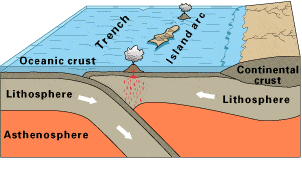
Observe this diagram of a plate boundary. One statement BEST describes what is happening. It is that
the oceanic crust is melting.
the denser ceanic crust is subducting under the less dense oceanic crust
volcanic islands are forming.
the tectonic plates are moving away from each other.
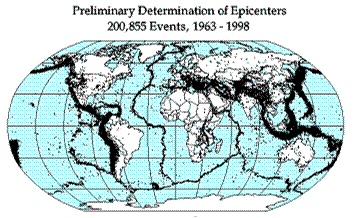
Earthquake epicenters (center of where the earthquakes started) were mapped for a 35 year period in the diagram above. The black dots indicate these epicenters. The black dots appear along what feature on Earth?
hot spots
plate boundaries
rift zones
sea floor spreading

The place where an earthquake originates inside the Earth's surface is called...
Epicenter
Focus
Underground
Crust

The place on the Earth's surface, above the origin of the earthquake.
Epicenter
Focus
Surface
Crust

What is the instrument used to measure earthquakes?
Seismograph
Seismologist
Scale
Seismogram
Which wave can travel through all materials?
P - primary
S - secondary
L - Long
Which wave can travel through solids only?
P - Primary
S - Secondary
Surface

How do scientists know that the outer core is a liquid?
P waves do not travel through the outer core but S waves do.
S waves do not travel through the outer core but P waves do.
P waves and S waves do not travel through the outer core.
P waves and S waves travel through the outer core.
What type of evidence was used by Alfred Wegener to support his continental drift hypothesis? (Select 3)
evidence from landforms / geology
evidence from fossils
evidence from human remains
evidence from climate
According to Wegener's hypothesis of continental drift,
Earth's surface is made up of seven major landmasses
the continents DO NOT move
Earth is slowly cooling and shrinking
the continents were once joined together in a single landmass named Pangea, and these plates will continue to move.