wayground logo

Free Printable Worksheets

Font size

S
M
L
XL
Worksheets

Physical Science Semester 2 Review

Total questions: 100

Worksheet time: 24mins

Name
Class
Date
1.

Where is the element's atomic NUMBER located?

a)

the top

b)

the bottom

c)

the top + the bottom

d)

the number of protons + the number of neutrons

2.

What are the 3 subatomic particles of an atom?

a)

carbon atom, proton, electron

b)

quarks, neutrons, protons

c)

nucleus, protons, electrons

d)

protons, neutrons, electrons

3.

Which subatomic particle has a positive charge?

a)

proton

b)

neutron

c)

electron

4.
What is the atomic mass of "F"
a)
9
b)
18
c)
17
d)
19
5.
all matter is made of what 
a)
energy 
b)
atoms 
c)
electrons 
d)
compounds 
6.
an atom with atomic number 6 would have how many protons 
a)
6
b)
12
c)
3
d)
cannot be determined 
7.

Which subatomic particles contribute the most to the mass of an atom?

a)

Protons and Neutrons

b)

Protons only

c)

Electrons only

8.
A particle that moves around the nucleus is a(n)...
a)
Proton
b)
Neutron
c)
Electron
d)
Quark
9.
Beryllium has how many protons?
a)
4
b)
9.0122
c)
2
d)
13.0122
10.
In the modern periodic table elements are arranged by:
a)
atomic mass
b)
atomic number
c)
valence electrons
d)
number of isotopes
11.

Different isotopes have...

a)

different masses

b)

different protons

c)

different electrons

12.

The atomic weight represents the weighted average of the

a)

electrons

b)

isotopes

c)

protons

13.
Elements which are shiny, conduct electricity and heat are called
a)
metal
b)
nonmetal
c)
metalloid
d)
nonexistent
14.
Which is an alkali metal?
a)
Magnesium
b)
Iron
c)
Sodium
d)
Europium
15.
Each element is unique based on its number of protons, also known as the...
a)
atomic mass
b)
valence number
c)
atomic symbol
d)
atomic number
16.
Group Name and Number for Neon
a)
Alkaline Earth Metals 2 or 2A
b)
Noble Gases 18 or 8A
c)
Halogens 17 or 7A
d)
Alkali Metals 1 or 1A
17.
Which elements have the most similar chemical properties?
a)
K and Na
b)
K and Ca
c)
K and Cl
d)
K and S
18.
What is the atomic mass of Neon?
a)
10
b)
30
c)
10.18
d)
20.18
19.
Who first developed the Periodic Table?
a)
Mendeleev
b)
Mosely
c)
Mendella
d)
Murphy
20.
What is the atomic number of Rubidium?
a)
37
b)
44
c)
45
d)
86
21.
Which one of these is not a noble gas?
a)
Helium
b)
Radon
c)
Iodine
d)
Krypton
22.
What family is Sodium a part of?
a)
Transition Metals
b)
Halogens
c)
Alkali Metals
d)
Alkaline Earth Metals
23.
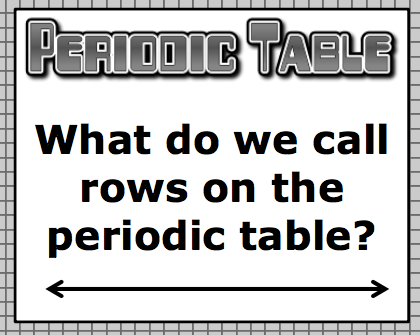
a)
Periods
b)
Groups
24.
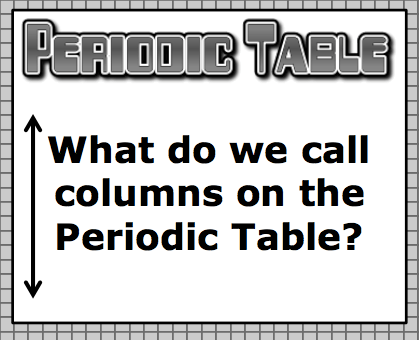
a)
Periods
b)
Groups
25.
__________ would have some characteristics of metals and some characteristics of nonmetals.
a)
Gold
b)
Sodium
c)
Arsenic
d)
Bismuth
26.
Dimitri found that there was a pattern of properties that repeated every ____ elements.
a)
2
b)
4
c)
5
d)
7
27.
Which element that starts with a B is an Alkaline Earth Metal?
a)
Barium
b)
Boron
c)
Bread
d)
Bromine
28.
How do covalent bonds form?
a)
Donating & receiving valence e- between atoms.
b)
Opposite slight charges attract each other between compounds.
c)
Scientists are still not sure how they form.
d)
Sharing valence e- between atoms.
29.
Which of the following is NOT formed by a covalent bond?
a)
K2S
b)
H2O
c)
I2
d)
CO2
30.
Is hydrogen considered a metal or a non-metal?
a)
A metal
b)
Nonmetal
c)
Metalloid
31.
Atoms are most stable when their outer shell is complete.
a)
true
b)
false
32.
Why do elements bond?
a)
To be friends
b)
To create a new element
c)
To become stable
33.

What kind of element forms covalent bond?

a)

metals

b)

semi -metals

c)

non metals

d)

metal and non metal

34.
 A lone pair is defined as
a)
A pair of bonding electrons
b)
One non-bonding electron
c)
A pair of non-bonding electrons
d)
A pair of electrons on the central atom
35.
Phosphorous trichloride
a)
PCl3
b)
P3Cl
c)
P3Cl3
d)
PCL
36.
Ionic bonds are between...
a)
nonmetals and nonmetals
b)
carbon and oxygen
c)
metals and nonmentals
d)
hydrogen and chlorine
37.
What is the name for an ion with a positive charge?
a)
cation
b)
anion
c)
onion
d)
union
38.
What are valence electrons?
a)
sum of the protons and neutrons
b)
protons minus electrons
c)
electrons in the inner shells
d)
electrons in the outer shell
39.
If an atom loses two electrons what charge will it have?
a)
-2
b)
-1
c)
+1
d)
+2
40.
Predict the bond that will form between Se and Cl.
a)
Ionic
b)
Covalent
41.

What is a chemical equation?

a)

Describes the number of elements in a compound.

b)

One or two letters that represent the elements on the periodic table.

c)

The number to the lower right of an element that shows the number of atoms bonded.

d)

A written description of a chemical reaction.

42.

______ is the end result of a chemical reaction. (Right Side)

a)

Product

b)

Deleting atoms and matter

c)

Subscript

d)

Reactant

43.

What does the Law of Conservation of Matter state?

a)

Matter cannot be created or destroyed in a chemical reaction, it just changes into something new/changes form.

b)

Matter can only be lost in a chemical reaction.

c)

Matter can only be gained in a chemical reaction.

d)

Matter can be gained and lost in a chemical reaction.

44.
What is the left part of a chemical equation called?
2H2 + O2 --> 2H2O
a)
Reactants
b)
Products 
c)
Yields 
d)
Chemical Equation 
45.

How many elements are in C6H12O6?

a)

1

b)

6

c)

3

d)

24

46.

Identify the number in blue.

a)

Product

b)

Reactant

c)

Coefficient

d)

Subscript

47.
 Fill in the blank to balance the chemical equation. 
2KI  +  ____Cl  2KCl  +  I2
a)
1
b)
2
c)
3
d)
4
48.

Which type of reaction is represented by the following chemical equation? 2H2O2 → 2H2O + O2

a)

Synthesis

b)

Decomposition

c)

Single replacement

d)

Double replacement

e)

Combustion

49.

Which type of reaction is represented by the following chemical equation? HCl + NaOH ↔ H2O + NaCl

a)

Synthesis

b)

Decomposition

c)

Single replacement

d)

Double replacement

e)

Combustion

50.

Balance the following equation: __ KCl + __ O2 → __ KClO3

a)

4, 3, 3,

b)

2, 2, 1

c)

2, 3, 2

d)

3, 4, 3

e)

2, 2, 3

51.

What reaction has the following general formula:
CxHy + O2 >CO2 + H2OC_xH_y\ +\ O_2\ ->CO_{2\ }+\ H_2O  

a)

Combination

b)

Decomposition

c)

Single Replacement

d)

Double Replacement

e)

Combustion

52.

Which type of reaction is:

3 Pb + 2 H3PO4 → 3 H2 + Pb3(PO4)2

a)
Synthesis
b)
Single Displacement
c)
Double Displacement
d)
Combustion
53.

Vaporization/ evaporation is the change of physical state from _______ to _______.

a)

gas to liquid

b)

liquid to gas

c)

solid to gas

d)

gas to solid

54.

Dry ice on the kitchen counter has disappeared without a trace. Dry ice skips the liquid phase. It never "melts" instead turns directly into a gas. This is an example of what change of physical state?

a)

Sublimation

b)

Melting

c)

Condensation

d)

Deposition

55.

It is formed by heating and ionizing a gas. Occurs only in lightning discharges and artificial devices.

a)

Bose-Einstein Condensate

b)

Plasma

c)

Plsama

d)

Plamas

56.

Why does your drink get cold when you put ice on them?

a)

because the ice takes up energy from your drink causing them to get colder

b)

because the ice takes up energy from the surrounding air causing your ice to melt

c)

because the ice needs energy to melt causing it to release energy to your drink

d)

none of the choices

57.

Mass is a measurement of:

a)

the amount of particles a substance has.

b)

the space an object occupies

58.

What is the density of a liquid if its volume is 125 mL and its mass is 50 g?

a)

2.5 g/mL

b)

175 g/mL

c)

0.4 g/mL

d)

6250 g/mL

59.
True or False:  The density of a specific type of material never changes.  
a)
True
b)
False
60.
Jack has a rock. The rock has a mass of 14 g and a volume of 2 cm3. What is the density of the rock?
a)
7 mL
b)
7 g/cm3
c)
28 g/cm3
d)
1/7 g/cm3
61.
When the temperature of matter increases the particles...
a)
speed up and move closer
b)
speed up and move farther apart
c)
slow down and move closer together
d)
slow down and move farther apart
62.
How do gas molecules move? 
a)
in an orderly fashion 
b)
constantly and randomly
c)
in straight line paths
d)
in a circular motion
63.
In Charles' Law the pressure remains constant.
a)
True
b)
False
64.
What causes pressure?
a)
The walls of the container
b)
The vacuum in the container
c)
The collisions of the particles
d)
Atmospheric pressure acting on the outside walls
65.
The relationship of which two variables are compared in Boyle's Law?
a)
pressure & volume
b)
volume & temperature
c)
temperature & pressure
d)
volume & moles (amount of gas)
66.
What is the universal solvent?
a)
salt
b)
sugar
c)
water
d)
ice
67.

A mixture with more solute dissolved in the solvent than is usually soluble is called:

a)

concentrated

b)

supersaturated

c)

saturated

d)

unsaturated

68.
The pH of a solution is tested, and it is found to be a basic solution. Of the following choices, what could the pH have been?
a)
3
b)
9
c)
7
d)
5
69.

Which of these pH values would indicate that a solution is a weak base?

a)

4

b)

5.6

c)

8

d)

13

70.

Explain what happens when a strong acid and a strong base are poured into the same container.

a)

they form separate layers

b)

they mix physically but not chemically

c)

they break apart into separate elements

d)

they react to form a salt and water

71.
How many grams of K2Cr2O7, are soluble in 100 g of water at 95 ºC?
a)
83 grams
b)
75 grams
c)
40 grams
d)
12 grams
72.
Which substance is MOST soluble at 0 ºC?
a)
KI
b)
NaNO3
c)
NaCl
d)
Ce2(SO4)3
73.
When 20 grams of KNO3 is dissolved in 100 grams of water at 80 ºC, the solution can be correctly described as:
a)
supersaturated
b)
saturated
c)
unsaturated
74.
The amount of solute actually dissolved in a given amount of solvent.
a)
dilution
b)
concentration
c)
saturated solution
d)
supersaturated mixture
75.
__________ are made up of solutes and solvents.
a)
Solutions
b)
Suspensions
c)
Heterogeneous Mixtures
d)
Pure Substances
76.
What does it mean to dilute a solution?
a)
lower the concentration of solute per solvent
b)
increase the concentration of solute per solvent
77.
What does it mean to be "Soluble" ?
a)
Capable of being a solid.
b)
To have soul.
c)
Capable of being dissolved.
d)
To sink.
78.
An unsaturated solution is one that....
a)
contains the maximum amount of dissolved solute.
b)
contains less solute than a saturated solution.
c)
contains more solute than a saturated solution.
d)
is the amount of a substance required to form a saturated solution.
79.
Which has a bitter taste?
a)
Base
b)
Acid
c)
flagella
d)
cila
80.
Turns litmus red
a)
Acids
b)
Bases
c)
All
81.
Which of the following is most likely to be basic:
a)
Lemon juice
b)
Vinegar
c)
Laundry detergent
d)
Coke
82.
Tastes Sour
a)
Acids
b)
Bases
c)
Salts
d)
All
83.
Why are bases useful as cleaning products?
a)
They dissolve fats and oils
b)
they are corrosive, so they eat anything
c)
they don't mix with water
d)
since bases are slippery, they slip dirt off of surfaces
84.
Which type of ion does a base produce when it is dissolved in water?
a)
oxide
b)
oxygen
c)
hydrogen
d)
hydroxide
85.

Which is the correct set of acid properties:

a)

sour taste, corrosive, change litmus from red to blue

b)

sour taste, corrosive, change litmus from blue to red

c)

sweet taste, slippery, change litmus from blue to red

d)

sour taste, slippery, change litmus from blue to red

86.

NaOH may be found in drain cleaners and as a component of soaps. Is NaOH an acid or a base?

a)

Acid

b)

Base

c)

Neither (Neutral)

87.

Is pure water acidic, basic, or neutral?

a)

Acidic

b)

Basic

c)

Neutral

88.

An alpha particle is made up of

a)

2 protons and 4 neutrons

b)

1 proton and 1 neutron

c)

2 protons and 2 neutrons

d)

4 protons and 2 neutrons

89.

Which type of nuclear radiation can be stopped by a sheet of paper?

a)

Alpha

b)

Beta

c)

Gamma

90.

A sample of Radium-228 decays from 100g to 12.5g. How many half lives did it experience?

a)

1

b)

2

c)

3

d)

4

91.

This image shows

a)

nuclear fission

b)

nuclear fusion

92.

Fusion occurs when nuclei

a)

split

b)

combine

c)

mutate

d)

gain energy

93.

Alpha particles are nuclei are

a)

Helium

b)

Iron

c)

Carbon

d)

Uranium

94.

The amount of time it takes for half of the nuclei in a sample to undergo radioactive decay is

a)

nuclear stability

b)

nuclear instability

c)

beta decay

d)

half life

95.

Lighter nuclei are produced from heavier nuclei by the process of

a)

mass energy

b)

fusion

c)

magnetism

d)

fission

96.
An isotope of an element has the same number of _________, but a different number of _________.
a)
Protons, electrons
b)
Protons, neutrons
c)
Electrons, neutrons
97.
What type of radioactive decay is shown here?
a)
Alpha decay
b)
Beta decay
c)
Gamma decay
98.
Which type of radiation releases an electron?
a)
Alpha radiation
b)
Beta radiation
c)
gamma radiation
99.
Which process involves the splitting of large nuclei?
a)
alpha decay
b)
nuclear fusion
c)
beta decay
d)
nuclear fission
100.

A(n) _____ is a penetrating ray of energy emitted by an unstable nucleus.

a)

alpha particle

b)

gamma ray

c)

beta particle

d)

delta particle