wayground logo

Free Printable Worksheets

NEW

Font size

S
M
L
XL
Worksheets

DNA, mRNA, & Protein

Total questions: 75

Worksheet time: 1hrs 9mins

Name
Class
Date
1.
Which sequence of DNA bases would pair with this partial strand
ATG TGA CAG
a)
ATG TGA CAG
b)
TAC ACT GTC
c)
GTA AGT GAC
d)
CAT TCA CTG
2.
Which of the following best describes a DNA molecule?
a)
double helix
b)
contains ribose
c)
made of amino acids
d)
contains Uracil
3.
Guanine bonds with ______________.
a)
Adenine
b)
Guanine
c)
Cytosine
d)
Thymine
4.
What would the complimentary DNA strand be to this DNA template?
CGA
a)
GTU
b)
GCU
c)
GCT
d)
TCA
5.
What would the mRNA strand be after transcription of this DNA strand?
TGA  AGT  CGG
a)
ACT TCA  GCC
b)
GAT  CAG  GCA
c)
ACU  UCA  GCC
d)
TCA  GCA  ACT
6.
What is the process of turning DNA into mRNA?
a)
Central Dogma
b)
Transcription
c)
Translation
d)
Trapezoid
7.
Amino Acids link together to form?
a)
Carbohydrates
b)
DNA
c)
Protein
d)
Carbohydrates
8.

chargaff said that..

a)

A to T , G to C

b)

G to C , A to C

c)

G to A , A to C

d)

biology is hard

9.

where is the site of translation ?

a)

ribosomes

b)

telomerase

c)

helicase

d)

primase

10.
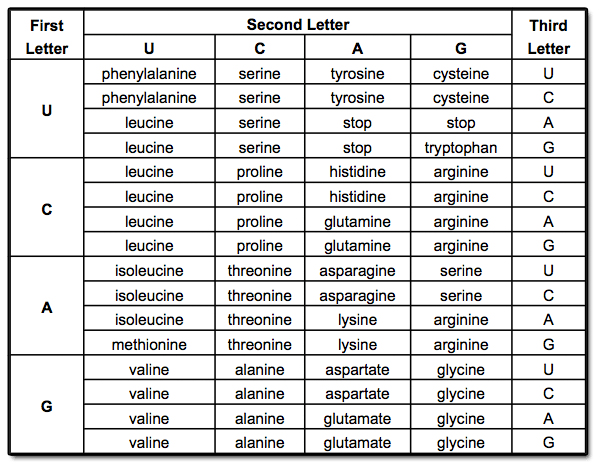
What amino acid is represented by the codon UUA?
a)
Phenylalanine
b)
Tyrosine
c)
Leucine
d)
Stop codon
11.
What is the correct amino acid sequence for the mRNA code AUGCCAGUAUGA
a)
Met-Pro-Ala-Val
b)
Met-Pro-Val
c)
Tyr-Gly-His
d)
Tyr-Gly-Arg-His
12.
What are the 4 nitrogen bases?
a)
Guanine, Cytosine, Adenine, Uracil
b)
Bromine, Chlorine, Adenine, Guanine
c)
Adenine, Guanine, Thymine, Cytosine
d)
Cytosine, Bromine, Guanine, Adenine
13.
What are 3 types of RNA?
a)
mRNA, tRNA, rRNA
b)
aRNA, fRNA, mRNA
c)
TRNA, MRNA, RRNA
d)
MRNA, ARNA, FRNA, MRNA
14.
Which type of RNA takes the instructions from the nucleus to the cytoplasm?
a)
mRNA
b)
tRNA
c)
rRNA
d)
RNA polymerase
15.
How does RNA differ from DNA?
a)
RNA contains uracil and deoxyribose
b)
RNA contains ribose and thymine
c)
RNA contains uracil and ribose
d)
RNA contains adenine and ribose
16.

Messenger RNA travels out of the nucleus to ribosomes

and is used as a template to assemble a protein.

a)

Translation

b)

Transcription

c)

Replication

d)

Homeostasis

17.
Choose the nucleotide sequence of the RNA strand that would be complementary to the following strand: 
GTAGTCA
a)
UATUAGA
b)
ACGACTG
c)
CAUCAGU
d)
CATCAGT
18.
What is the term for a three-nucleotide sequence that codes for an amino acid?
a)
base
b)
codon
c)
amine
d)
serine
19.
Any change in the sequence of DNA is...
a)
transgenic shift
b)
Single Genotype
c)
Monohybrid Trait
d)
Mutation
20.

What type of mutation is shown in the diagram?

a)

Point mutation - missense

b)

Frameshift Mutation - deletion

c)

Frameshift Mutation - addition

d)

Point mutation - nonsense

21.
What mutation has occurred here? 
T-G-A-C-C-A
T-G-A-G-C-A
a)
Substitution
b)
Deletion
c)
Insertion
d)
Frameshift 
22.

Genetic mutations can be...

a)

beneficial, harmful, or neutral

b)

beneficial only

c)

harmful only

d)

neutral only

23.
DNA is copied during a process called ______________ which results in an identical copy of itself.
a)
Photosynthesis
b)
Transcription
c)
Replication
d)
Translation
24.
Genes contain instructions for assembling _______________.
a)
Nucleosomes
b)
Proteins
c)
Purines
d)
Pyrimidines
25.
What is produced during transcription?
a)
Protein
b)
tRNA
c)
mRNA
d)
DNA
26.
DNA controls traits through the order of its--
a)
phosphates
b)
sugars
c)
carbons
d)
nitrogen bases
27.
In eukaryotes, DNA:
a)
floats freely in the cytoplasm
b)
is found in the nucleus
c)
is wrapped within the ribosome
d)
is circular
28.
A DNA nucleotide may contain--
a)
ribose, uracil, and a polypeptide.
b)
deoxyribose, cytosine, and a lipid.
c)
deoxyribose, thymine, and a phosphate group.
d)
ribose, adenine, and thymine.
29.
The entire molecule shown in the diagram is called a ______.
a)
amino acid
b)
polysaccharide
c)
nucleotide
d)
pyrimidine
30.
What structure is labeled #1?
a)
guanine
b)
thymine
c)
phosphate
d)
deoxyribose
31.
Which of the following is true about DNA replication:
a)
Protein is made after cell division.

b)
A copy of DNA is made before a cell divides.
c)
Enzymes called DNA mutagens are used.
d)
Four single-stranded DNA are made.
32.
Which nitrogen base is found only in RNA?
a)
Cytosine
b)
Adenine
c)
Thymine
d)
Uracil
33.
What does DNA stand for?
a)
Deoxyribonucleic acid
b)
Denitrogenous acid
c)
Deribonucleic acid
d)
Diribonucleic acid
34.

What sugar is found in RNA?

a)

glucose

b)

deoxyribose

c)

ribose

d)

sucrose

35.

True or False: RNA leaves the nucleus.

a)

True

b)

False

36.
Which of the following is true of DNA?
a)
It can sometimes leave the nucleus
b)
It never leaves the nucleus
c)
It is portable
d)
It is temporary
37.
Who is responsible for producing this image?
a)
Francis Crick
b)
James Watson
c)
Rosalind Franklin
d)
Watson and Crick
38.
What did Erwin Chargaff conclude from his experiments?
a)
Nitrogen bases are held together by peptide bonds
b)
A and T, C and G always occur in equal amounts
c)
Proteins are the carriers of genetic information
d)
C and G rarely occur in eukaryotic organisms
39.
What was Watson and Crick's main scientific accomplishment?
a)
Building the first accurate model of DNA
b)
Isolating strains of pneumonia causing bacteria
c)
Determining base pairing rules
d)
Discovering the process of genetic transformation
40.
From his work with mice and pneumonia-causing bacteria, Frederick Griffith discovered what?
a)
Replication
b)
Transcription
c)
Transformation
d)
Translation
41.
The work of Erwin Chargaff allowed Watson and Crick to determine the rules of.......
a)
protein synthesis
b)
transcription
c)
hydrogen bonding
d)
nitrogen base pairing
42.
The work of scientists including Griffin, Avery, Hershey & Chase, and Franklin helped us to determine that _______ are responsible for carrying genetic material.
a)
Amino Acids
b)
Proteins
c)
Nucleic Acids
d)
Carbohydrates
43.
Why is DNA important?
a)
it is very small and very complicated
b)
it's in everything
c)
it serves as the blueprint for traits of all living things
d)
because we eat it every day for energy
44.
What are the three components of a nucleotide?
a)
sugar, hydrogen, nitrogen base
b)
sugar, oxygen, nitrogen base
c)
sugar, phosphate, nitrogen base
d)
sugar, phosphate, protein
45.
What is a Gene?
a)
A segment of RNA that encodes for a protein
b)
A chromosome
c)
A segment of DNA that encodes for a protein
d)
Your genome
46.

A _________ is tightly coiled DNA.

a)

gene

b)

chromosome

c)

trait

d)

mutation

47.
Replicate the following strand of DNA: 
AATCATGGA
a)
AATCATGGA
b)
TTAGTACCT
c)
UUAGUACCU
d)
GGATAUCUA
48.
The enzyme that unzips the DNA to prepare for replication
a)
helicase
b)
replicase
c)
polymerase
d)
synthase
49.
DNA replication results in two DNA molecules,
a)
each one with two original strands
b)
each one with two new strands
c)
each one with one new strand and one original strand
d)
one with two new strands and the other with two original strands
50.
A process in which DNA has the unique ability to make an exact copy of itself.
a)
Replication
b)
Translation
c)
Transcription
51.
What is responsible for holding the two strands of the DNA double helix together?
a)
hydrogen bonds
b)
alleles
c)
London dispersion forces
d)
deoxyribose sugars
52.
Name this structure
a)
double helix
b)
nucelotide
c)
twisted ladder
d)
hydrogen bond
53.

The fragments on the lagging strand that are made up of repeating segments of DNA and RNA Primers

a)

okazaki fragments

b)

Primase

c)

Polymerase

d)

unused DNA

54.

Which of the following best describes the arrangement of the sides of the DNA molecule

a)

Bonding

b)

Alternating

c)

Anitparallel

d)

Parallel

55.

Enzyme that breaks hydrogen bonds (unzips)

a)

Ligase

b)

Polymerase

c)

Primase

d)

Helicase

56.

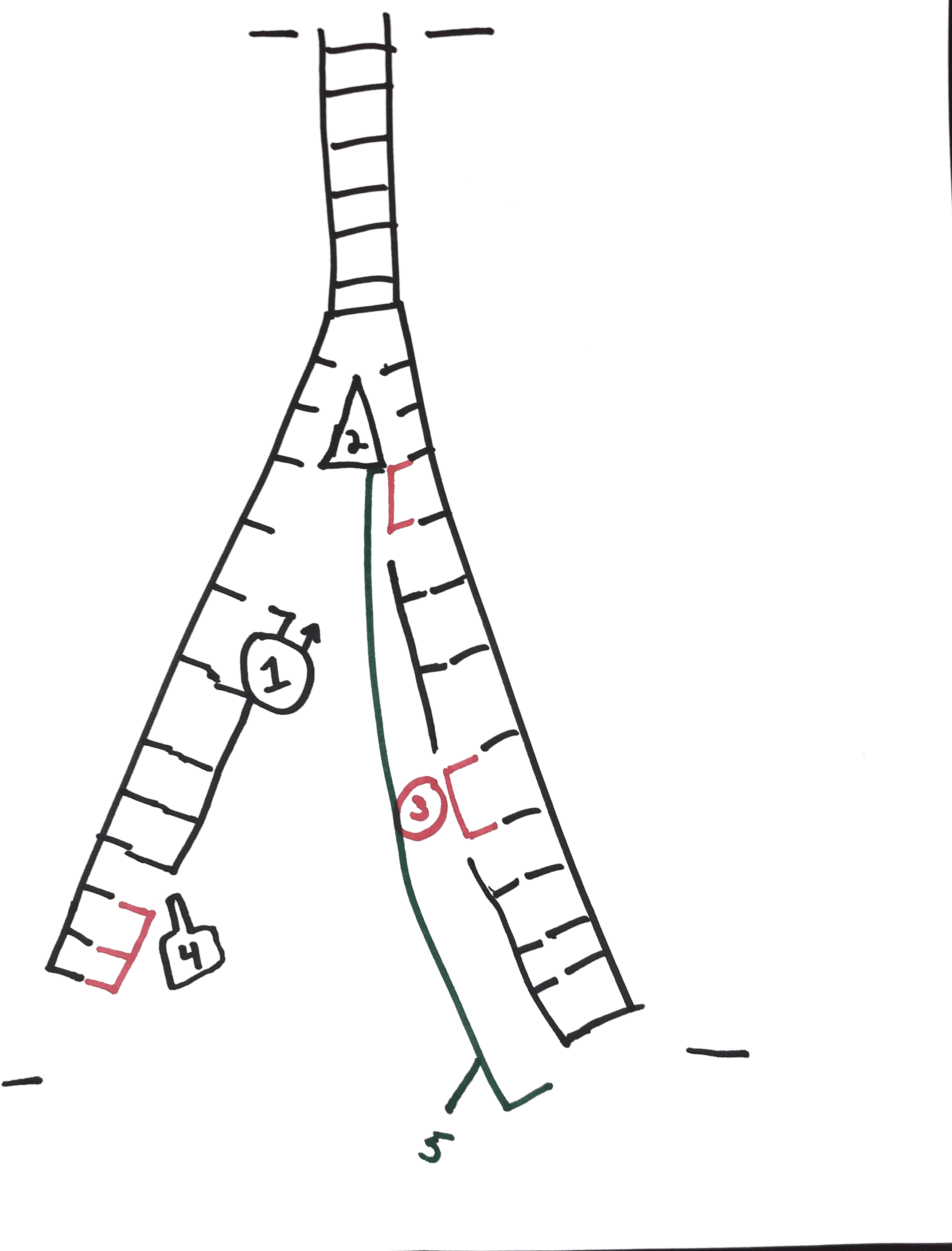
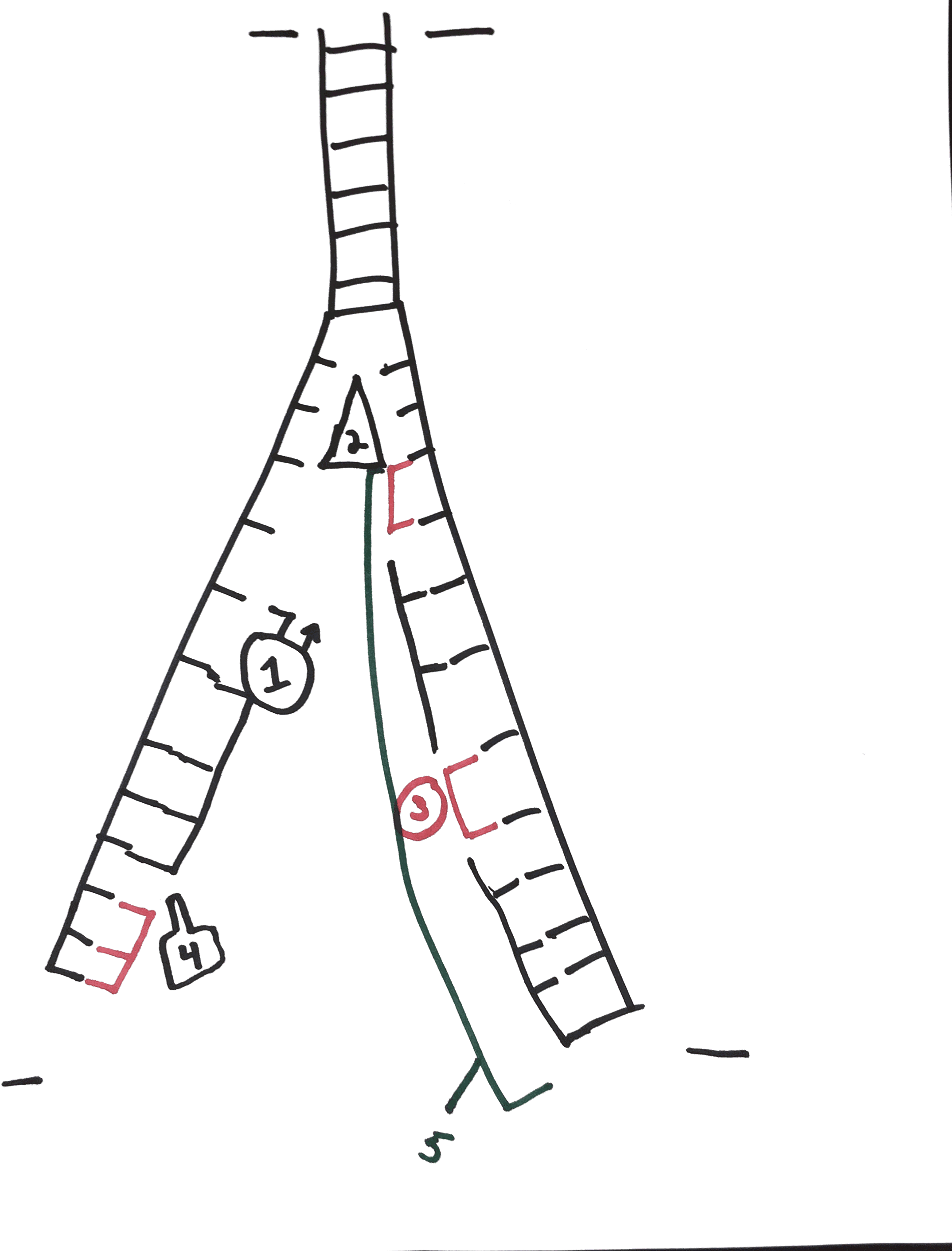
Number 1 in the picture above

a)

Replication

b)

DNA Polymerase

c)

Primase

d)

Ligase

57.

#4 in the picture

a)

Polymerase

b)

Primase

c)

Helicase

d)

Ligase

58.
Before DNA can replicate it has to...
a)
Separate the two strands
b)
Find 4 new strands
c)
Ask its mom
59.
The enzyme that unwinds the double helix is called
a)
Helicase
b)
Primase
c)
Polymerase
d)
Replicase
60.
The enzyme that adds more nucleotides (monomers into a polymer) is called
a)
helicase
b)
primase
c)
polymerase
d)
 nuclease
61.
In what phase of the cell cycle does DNA replication take place?
a)
G1
b)
S
c)
G2
d)
M
62.
Okazaki fragments form on the:
a)
lagging strand
b)
leading strand
c)
base-pairs
d)
5' end
63.

Which enzyme proofreads and removes RNA Primase

a)

Ligase

b)

Polymerase 1

c)

Polymerase 3

d)

Helicase

64.

H is the

a)

leading strand

b)

lagging strand

c)

parent strand

d)

none of these

65.

Structure G is

a)

primase

b)

gyrase

c)

DNA polymerase III

d)

DNA polymerase I

66.

This structure is an Okazaki fragment.

a)

A

b)

D

c)

F

d)

G

67.

Where does TRANSCRIPTION occur?

a)

Nucleus

b)

Ribosome

c)

Cytoplasm

d)

Mitochondria

68.

TRANSCRIBE this DNA sequence: TACGTTACT

a)

AUGCAAUGA

b)

ATGCAATGA

c)

AUGGATUGA

d)

TACGTTACT

69.

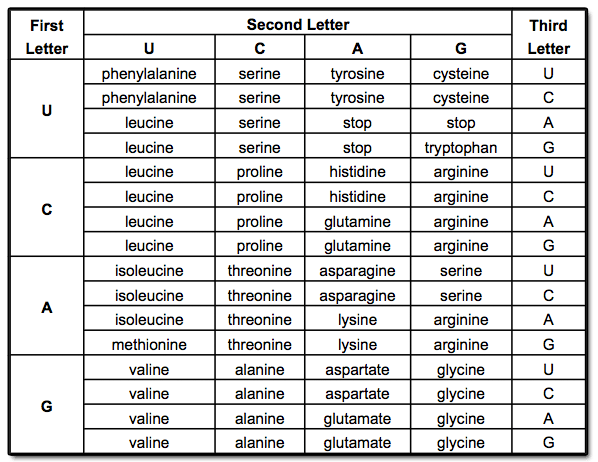
TRANSLATE this RNA sequence: AUGCAAUGA

a)

Met-Glu-Stop

b)

Met-His-Stop

c)

Thr-Glu-Stop

d)

Thr-Pro-Stop

70.
In RNA, Uracil pairs with ______. 
a)
cytosine
b)
adenine
c)
guanine
d)
thymine
71.
What amino acid is represented by the codon UUA?
a)
Phenylalanine
b)
Tyrosine
c)
Leucine
d)
Stop codon
72.
What are the backbones (sides) of the DNA structure made up of?
a)
repeating phosphates and sugars
b)
nitrogen bases
c)
nucleotides
d)
adenine and thymine
73.
What type of RNA carries the DNA message out of the nucleus to the ribosomes?
a)
mRNA
b)
tRNA
c)
RNA
d)
DNA
74.
Amino acids are the building blocks of... 
a)
DNA
b)
RNA
c)
Atoms
d)
Proteins
75.
Brings the amino acids to the ribosome
a)
mRNA
b)
tRNA
c)
rRNA
d)
DNA