wayground logo

Free Printable Worksheets

NEW

Font size

S
M
L
XL
Worksheets

Heart/Lungs

Total questions: 59

Worksheet time: 6hrs 33mins

Name
Class
Date
1.
a)
Pulmonary veins
b)
Pulmonary artery
c)
Aorta
d)
Vena cava
2.
a)
Left atrium
b)
Right atrium
c)
Left ventricle
d)
Right ventricle
3.
a)
Left atrium
b)
Right atrium
c)
Left ventricle
d)
Right ventricle
4.
When blood enters the right atrium, where is it coming from?
a)
The body
b)
Left ventricle
c)
Right Atrium
d)
Lungs
5.
What chamber pumps blood to the body?
a)
Right atrium
b)
Right ventricle
c)
Left atrium
d)
Left ventricle 
6.
A flap of tissue that prevents blood from flowing backward
a)
Aorta
b)
Atrium
c)
Septum
d)
Valve
7.
Which side of the heart has oxygen rich blood?
a)
Left Side
b)
Right Side
8.
Un-oxygenated blood enters the right atrium from the top of the heart.
a)
inferior vena cava
b)
superior vena cava
c)
aorta
9.
Un-oxygenated blood enters the right atrium from the bottom of the heart.
a)
inferior vena cava
b)
superior vena cava
c)
pulmonary veins
10.
Name this part.
a)
Right ventricle
b)
Aorta
c)
Right atrium
d)
Atrium
11.
Name this part.
a)
Right ventricle
b)
Pulmonary artery
c)
Left ventricle
d)
Right atrium
12.
Which side of the heart pumps oxygen-rich blood to the rest of the body?
a)
Right
b)
Left
13.
Which side of the heart pumps blood into the lungs?
a)
Right
b)
Left
14.
______ carry blood to the heart.
a)
Arteries
b)
Veins
c)
Capillaries
d)
Vena Cava
15.
Identify the circled valve
a)
Tricuspid
b)
Mitral
c)
Pulmonary
d)
Aortic
16.
Identify the circled valve
a)
Tricuspid
b)
Mitral
c)
Pulmonary
d)
Aortic
17.
Identify the circled valve
a)
Tricuspid
b)
Mitral
c)
Pulmonary
d)
Aortic
18.
Identify the circled valve
a)
Tricuspid
b)
Mitral
c)
Pulmonary
d)
Aortic
19.
The heart has ___ chambers.
a)
1
b)
2
c)
3
d)
4
20.

This part of the heart separates the left and right heart chambers.

a)

Mitral valve

b)

Septum

c)

Aortic valve

d)

Inferior vena cava

21.

What is the name of A?

a)

P wave

b)

PR Interval

c)

QRS complex

d)

ST segment

22.

What is the name of B?

a)

P wave

b)

QRS complex

c)

PR Interval

d)

ST segment

23.

What is the name of C?

a)

P wave

b)

PR Interval

c)

QRS complex

d)

T wave

24.

What is Happening during the QRS complex?

a)

AV node fires

b)

Atrial Repolarization

c)

Ventricular Contraction

d)

Ventricular Systole

e)

All of the answer choices

25.

What is Happening during the P wave?

a)

AV node fires

b)

Atrial Repolarization

c)

Atrial Contraction

d)

Ventricular Systole

26.

What area represents Ventricular Repolarization?

a)

A

b)

B

c)

C

d)

All of the answer choices

27.

What area represents impulse travel from the AV node, through the Bundle of His, the bundle branches and the purkinje fibers?

a)

A

b)

B

c)

C

d)

All of the answer choices

28.
The two superior receiving chambers of the heart are known as the _________
a)
atria
b)
ventricles
29.
The valves between the atria and ventricles are known as the ________ valves.
a)
atrioventricular
b)
aortic
c)
semilunar
d)
pulmonary
30.
Blood leaves the right ventricle through the ___________.
a)
pulmonary trunk
b)
aorta
c)
superior vena cava
d)
coronary sinus
31.
The term that means heart contraction is ________.
a)
diastole
b)
systole
c)
tachycardia
d)
fibrillation
32.
Large blood vessels that carry blood away from the heart are called:
a)
arteries
b)
capillaries
c)
veins
d)
venae cavae
33.
Pulmonary circulation involves blood flow to and from the heart and the _______.
a)
body
b)
digestive organs
c)
brain
d)
lungs
34.
When the ventricles contract, the bicuspid (mitral) valve prevents blood from flowing from the ________.
a)
right ventricle to right atrium
b)
left ventricle to left atrium
c)
left atrium to the right atrium
d)
right atrium to the left atrium
35.
The sinoatrial node is located in the ________.
a)
aorta
b)
right atrium
c)
left atrium
d)
right ventricle
36.
Which one of the following represents the correct path for the transmission of an impulse in the intrinsic conduction system of the heart?
a)
AV node, Bundle of His, SA node, Purkinje fibers, bundle branches
b)
SA node, AV node, Bundle of His, bundle branches, Purkinje fibers
c)
SA node, Bundle of His, AV node, Purkinje fibers, bundle branches
d)
SA node, Bundle of His, bundle branches, Purkinje fibers, AV node
37.
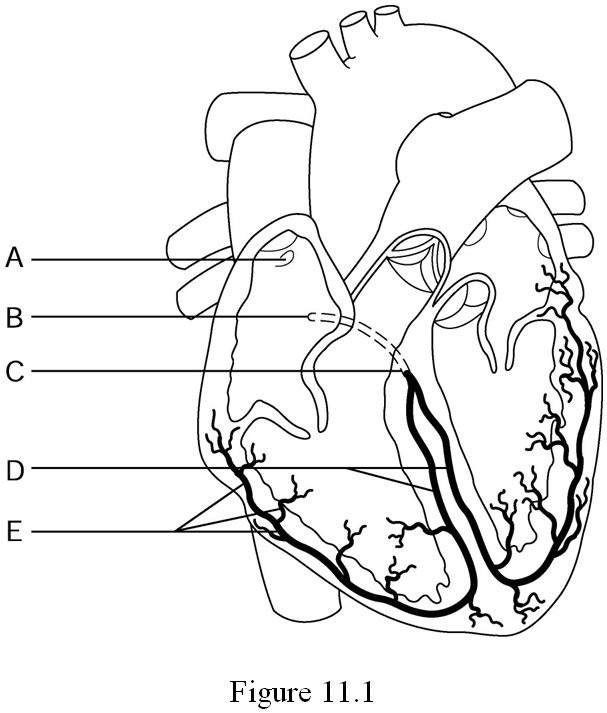
Which label is representing the Purkinje fibers?
a)
A
b)
C
c)
D
d)
E
38.

State which cell contains hemoglobin

a)

White Blood

b)

Red Blood

c)

Platelet

d)

Plasma

39.

What carries oxygen around the body?

a)

Plasma

b)

Red Blood Cells

c)

Platelets

d)

White Blood Cells

40.

What is the function (job) of the platelets?

a)

To form clots (i.e. scabs) when you have cuts and grazes.

b)

To transport oxygen to the muscles

c)

To carry dissolved sugars.

d)

To produce antibodies

41.

What is the function (job) of the white blood cells?

a)

To transport oxygen around the body.

b)

To carry dissolved sugars.

c)

To clot and cover wounds like cuts and grazes.

d)

To release antibodies to help destroy infections.

42.

What is the function (job) of the plasma?

a)

To release antibodies to fight infections.

b)

To transport oxygen around the body.

c)

To carry dissolved nutrients and sugars.

d)

To transport oxygen around the body.

43.

What is the function (job) of the red blood cells?

a)

To transport oxygen around the body and to the muscles.

b)

To release antibodies to fight infections.

c)

To carry dissolved nutrients and sugars.

d)

To clot and form scabs if there is a wound on the body.

44.

Which blood vessels take blood TO the heart?

a)

Veins

b)

Arteries

c)

Capillaries

45.

Which blood vessels take blood AWAY from the heart?

a)

Veins

b)

Arteries

c)

Capillaries

46.

The proteins found on the surface of RBCs that allow us to type blood as A, B, O or AB are called

a)

antigens

b)

antibodies

c)

aggluntates

d)

Rh factors

47.

What is produced by your body in response to foreign antigens, such as the wrong type of blood?

a)

agglutinates

b)

clotting factors

c)

phagocytes

d)

antibodies

48.

Tyler has blood type AB+, he can donate blood to a person that has blood type?

a)

AB+

b)

AB-

c)

O-

d)

O+

49.

Which blood type has Type A antibodies?

a)

Type AB

b)

Type O

c)

Type B

d)

Type B and Type O

50.
If a father is AA and a mother is AB, what is the probability for a child with AB blood? 
a)
0%
b)
25%
c)
50%
d)
75%
51.

Which sample is B-

a)
b)
c)
d)
52.

Which sample is O+

a)
b)
c)
d)
53.
If a red blood cell has no antigens on its surface, what is its blood type?
a)
A
b)
B
c)
AB
d)
O
54.

Which system moves body parts?

a)

muscular

b)

skeletal

c)

digestive

d)

respiratory

55.

Which system provides oxygen and removes carbon dioxide?

a)

digestive

b)

muscular

c)

respiratory

d)

nervous

56.

Which system controls all parts of your body and sends/receives messages?

a)

muscular

b)

digestive

c)

circulatory

d)

nervous

57.

Which system carries blood to and from body cells?

a)

muscular

b)

circulatory

c)

skeletal

d)

respiratory

58.

Which system supports the body and protects organs?

a)

skeletal

b)

muscular

c)

respiratory

d)

digestive

59.
Your heart is about the size of what other body part?
a)
head
b)
fist
c)
thumb
d)
foot