
 Worksheets
Waves: Light and sound
Total questions: 100
Worksheet time: 2hrs 52mins
_____ waves NEED a medium to travel.
Seismic
Light
Mechanical
Radio Waves are an example of _________ waves.
mechanical
electromagnetic
light
The distance in between two waves.
wave speed
frequency
wavelength
Frequency is always measured in _________
kilometers
Hertz
centimeters
the number of waves that pass a certain point.
wave speed
frequency
when a wave hits a barrier and bounces
diffraction
reflection
You're in your room blasting music with the door shut, your mom opens your door. Now your music is heard throughout your home. This is an example of _______
interference
diffraction
reflection

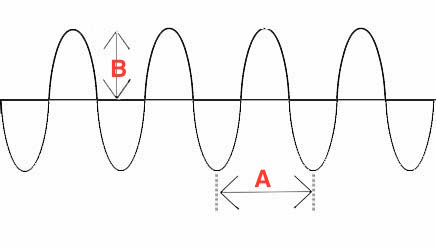
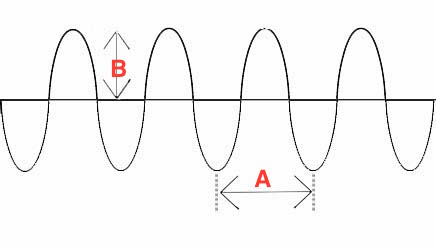
This is a high frequency wave. Which part of the wave is "B"
crest/peak
wavelength
trough

Look at this wave. "A" is which part of a wave?
Crest/Peak
Wave Speed
Resting Point

Which wave has the longest wave length?
top wave
bottom wave

Which of the following can waves transfer energy through?
solid
liquid
gas
empty space
all of the above

What are the two types of waves?
longitudinal and transverse
sound and light

What is the number of complete waves passing a fixed point in a given amount of time?
Amplitude
Intensity
Wavelength
Frequency

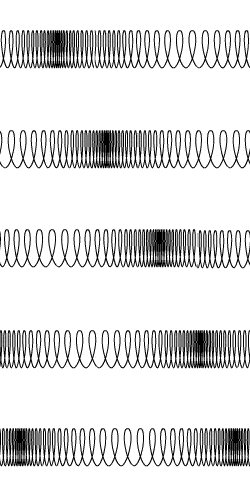
What is the frequency of this wave? You must count the number of complete waves.
1 Hz
5 Hz
10 Hz

What is frequency measured in?
Milliseconds
Miles
Hertz
Kilograms

Period of a wave refers to...
how long it takes for the event to repeat.
how strong a wave is.
how long a wave is.
how much energy a wave has.

Which type of waves have the longest wavelength?
Visible light
Radio waves
X-rays
Gamma-Rays

Wavelengths are usually measured in ....
seconds
Hz
inches
meters

Shorter wave lengths can carry more energy. Which of these probably carries the MOST energy:
Infrared light
Visible light
X-rays
UV light

What is the distance between the calm sea and the highest wave called?
Wave
Frequency
Amplitude
Magnitude

What is transferred from place to place by waves?
matter
energy
particles
waves

This is the distance between two peaks. What is this called?
amplitude
wavelength
longitude
trough
Waves DO NOT transfer ______?
Matter
Energy
The highest point of a wave is called what?
Trough
energy
Peak
amplitude
What emits sound waves?
Phone
desk
chair
light bulb
Which emits light waves?
microphone
trumpet
food
Light bulb

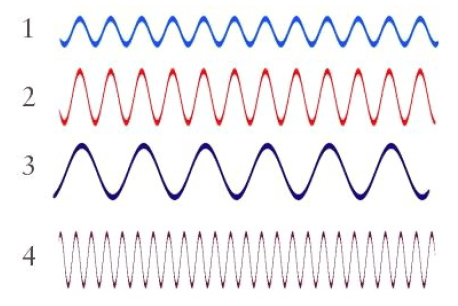
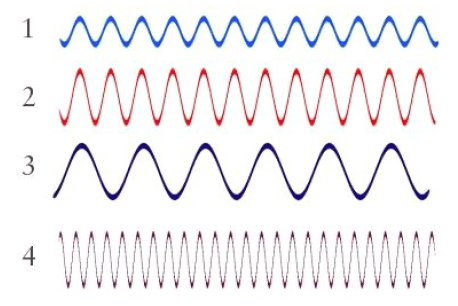
Mrs. Yarbrough produced many sound waves while playing the piano. Which diagram shows the sound wave that she produced with the LONGEST wavelength?


What factors affect how fast a sound wave travels?
The medium or material in is moving through
The amplitude
The wavelength
The perpendicular motion in which it travels to the direction of the wave.

Which of the following is true?
1. x-rays travel slower than infrared.
Infrared travels slower than x-rays.
Gamma rays are the slowest moving.
Radio waves have the most energy and shortest wavelength.
What part of a sound wave measures LOUDness?
wavelength
magnitude
amplitude
frequency

The picture shows a light ray hitting the surface of a mirror what is going to happen as it strikes?
It is going to absorb
It will reflect back from where it began.
It is reflected at an angleequal to the angle of incident.
It reflects 30 degrees from the angle of incident.

A light wave travels through the air, passes into this glass and then travels back into the air as seen in the picture. Which best describes what is happening.
The light wave is
refracted
The light wave is diffused
The light is reflected.
The light is diffracted.
Mrs. Culpepper moved into her new home with vaulted ceilings and hardwood floors. Everytime someone spoke you would hear an echo. Why did this echo happen?
Sound waves diverging and bouncing off the walls.
The sound waves diffracted.
The sound waves reflected.
The sound waves refracted.
Sound travels fastest in............
solids because the particles are closer together than air particles.
air because the particles are moving slowly
Liquid
Air because the particles are moving quickly and the particles are far apart.
A __________ is a substance through which a wave travels.
Medium
Longitudinal wave
Transverse Wave
Wave speed
The height of a wave is called it's ______________.
frequency
amplitude
wavelength
rest position
Real Image is one which you can see and not touch
True
False
Law of Reflection states that the incident angle is ____ the reflected angle
greater than
less than
equal to

If Θ1 is 70 degrees what is Θ2?
20
40
70
90
If Θ1 is 70 degrees what is Θ4?
20
40
70
90

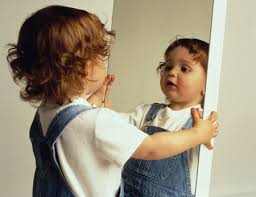
If the man is 4 m from the mirror, his image is how far from the mirror?
2 m
4 m
8 m
The bouncing back of light ray
Refraction
Reflection
Diffusion
Dispersion
A mirror with a flat reflective surface is called
convex mirror
concave mirror
plane mirror
side mirror
If a 2.5 m object is placed in front of a plane mirror, the height of its image is
less than 2.5 m
2.5 m
more than 2.5 m
0
A plane mirror always produce ________images.
virtual
real
ideal
refracted
As indicated by the hands of the clock without numbers, the real time is 9:30. What is the time indicated inits image if the clock is placed in front of a plane mirror?
10:30
9:30
3:30
2:30
In the numbers: 0, 1, 2, 3, 4, 5; which number will you read properly in mirror?
0
1
2
3
4
What is the distance of your image from you if you stand 1.5 m in front of a plane mirror?
1.5 m
2.0 m
3.0 m
4.5 m

The picture the word as seen from an image in a plane mirror. Write down the word of the object
(a)


flint glass n=1.70
barium glass n=1.60
crown glass n=1.523
water n=1.33
diamond n=2.45

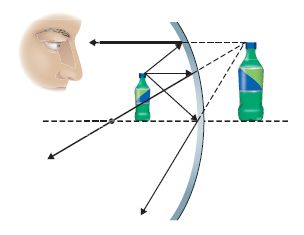
An image that points below the principal axis is (choose 2)...
virtual
real
upright
inverted
If the object is beyond C (2F)...
image is real, smaller and inverted
image is real, smaller and upright
image is virtual, smaller and inverted
image is real, bigger and upright
A dentist uses a small dental mirror to help magnify teeth in your mouth. What type of mirror is this?
a convex mirror
a concave mirror
a convex lens
a concave lens
The side view mirrors on your car help shrink the image on both sides of the car, allowing you to see a larger field of view. What type of mirror is this?
a convex mirror
a concave mirror
a convex lens
a concave lens
An image that forms when light rays actually meet
virtual image
real image
diffuse reflection
regular reflection

Which is the angle of Incidence?
A
B
C
D
The normal is ____ to the mirror
Perpendicular
Parallel
Perpendicular and Parallel
None of the above
How do light waves travel in air?
Slowly
It curves
In straight lines
Different colours have different speeds

Light is made up of...
electricity and waves
magnetism and waves
electricity and magnetism
electricity and energy
The color with the longest wavelength is...
Blue
Red
Green
Yellow
A shadow is created by the....
absence of light.
absence of waves.
absence of color.
blocking of sound.
If you see a green leaf on a tree, that means...
Green is the color being reflected off the leaf.
Green is the color being absorbed by the leaf.
All the colors are being reflected off the leaf.
All the colors are being absorbed by the leaf.

