
 Worksheets
Physical Final Review
Total questions: 99
Worksheet time: 52mins
How charges transfer when object is rubbed
Physically scraping off electrons - friction
Object losing electrons become positively charged and object gaining electrons become negatively charged
Vector nature of electric fields and electrical charges
Electrical field lines have direction and magnitude
Field lines point away from + towards -
Magnetic field lines: away from north towards south
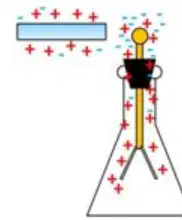
behavior of electroscope when additional charge is near
Charged object near electroscope causes leaves to move apart - induced charges
If electroscope is grounded while near charged object, it becomes permanently charged
Coulomb's law
Which can move freely: conductors or insulators
Conductors
Insulators
6. conduction, induction, polarization
Conduction: direct transfer of electrons by touch
Induction: rearranging charges without touching
Polarization: shifting electrons within atoms in insulators
7. electrical forces
Forces between charged particles can attract or repel
Opposites attract, likes repel
Proton and electron
What is the flow of electrons measured in?
Volts
Amps
Ohms
Watts
The movement of electrons is from:
Negative to positive
Positive to negative
Both directions
None of the above
Conventional current is from ______ to ______.
+ to -
- to +
neutral to +
+ to neutral
What does a voltmeter measure?
Current
Resistance
Voltage
Power
How is a voltmeter connected in a circuit?
In series
In parallel
Both
Neither
What does an ammeter measure?
Voltage
Current
Resistance
Capacitance
How is an ammeter connected in a circuit?
In series
In parallel
Both
Neither
What is the function of resistors in a circuit?
Store charge
Control current flow
Measure voltage
Protect from lightning
What is the function of capacitors?
Store electric charge
Measure current
Control voltage
Break circuits
Lightning is caused by:
Chemical reaction
Charge buildup in clouds and discharge to the ground
Wind friction
Solar flares
Lightning doesn’t strike twice in the same place.
True
False
You’ll die from lightning.
True
False
What is the function of lightning rods?
Attract lightning
Direct charge safely to the ground
Store energy
Measure voltage
How far does lightning travel in 5 seconds?
One mile
Two miles
Half a mile
Ten miles
In a series circuit, the current is:
The same everywhere
Different in each resistor
Zero
Only at the source
In a series circuit, voltage drop is:
Inversely proportional to resistor
Directly proportional to resistor
The same everywhere
Zero
Sum of voltage drop across all resistors in series equals:
Zero
Total voltage available
Half the voltage
Double the voltage
As resistance increases in a series circuit, current:
Increases
Decreases
Stays the same
Doubles
If a resistor glows in a series circuit, what happens to the current in the entire line?
Increases
Stops
Decreases
Doubles
Fuses and circuit breakers are connected in:
Series
Parallel
Both
Neither
Series wiring is best for:
Whole-house wiring
Individual rooms or section wiring
Outdoor wiring
None of the above
Ammeters are connected in series and have:
High resistance
Low resistance
No resistance
Variable resistance
In a parallel circuit, current is:
Directly proportional to resistance
Inversely proportional to resistance
The same everywhere
Zero
Sum of current in each branch of a parallel circuit equals:
Zero
Total current
Half the current
Double the current
Total resistance in a parallel circuit is:
Always more than any individual resistor
Always less than any individual resistor
The same as any resistor
Zero
In a parallel circuit, resistance is:
Different everywhere
The same everywhere
Zero
Infinite
In a parallel circuit, voltage drop is:
Different everywhere
The same
Zero
Double
In a parallel circuit, voltage is equal to:
Current multiplied by equivalent resistance
Resistance divided by current
Current divided by resistance
Power times resistance
Voltmeters are connected in parallel and have:
High resistance
Low resistance
No resistance
Variable resistance
Ammeters connected in parallel will:
Work normally
Burn out
Show zero
Show double current
If you lose one resistor in a parallel circuit, the rest will:
Stop working
Still work
Burn out
Double current
Adding resistors in parallel will:
Increase overall resistance and decrease current
Lower overall resistance and increase current
Not affect resistance
Not affect current
Parallel wiring is best suited for:
Individual rooms
Whole-house wiring
Outdoor wiring
None of the above
What is the electrical potential difference called?
Voltage
Current
Resistance
Power
Voltage is measured in which unit?
Volts
Amperes
Watts
Ohms
What does voltage do in a circuit?
Pushes current through circuit
Slows down the current
Removes resistance from the circuit
Stores energy in the circuit
What is the formula for electrical power?
P=IV
P=IR
P=V/R
P=I2/R
What is the formula for electrical energy?
E=Pt
E=IR
E=V/R
E=It
What are charged atoms called?
Ions
Molecules
Neutrons
Isotopes
What are positively charged ions called?
Cations
Anions
Neutrons
Electrons
What are negatively charged ions called?
Anions
Cations
Neutrons
Protons
What is Ohm's Law for solving an unknown voltage?
V=IR
I=VR
R=VI
V=I/R
What causes magnetism?
Moving charges
Stationary charges
Heat
Light
Magnetic fields go from which pole to which pole?
North to south
South to north
East to west
West to east
Motors convert ______ energy into ______ energy.
electrical, mechanical
mechanical, electrical
thermal, mechanical
chemical, electrical
Generators convert ______ energy into ______ energy.
mechanical, electrical
electrical, mechanical
chemical, thermal
thermal, chemical
What do transformers use to change voltage?
Magnetic induction
Electric current
Thermal conduction
Chemical reaction
In a transformer, what happens in a step up transformer?
Increase voltage, decrease current
Decrease voltage, increase current
Increase voltage, increase current
Decrease voltage, decrease current
In a transformer, what happens in a step down transformer?
Decrease voltage, increase current
Increase voltage, decrease current
Increase voltage, increase current
Decrease voltage, decrease current
What is conserved in a transformer?
Voltage
Power (P=IV)
Current
Resistance
What creates magnetic fields?
Moving charges
Stationary charges
Heat
Light
How can a voltage be induced?
By changing the magnetic field
By increasing the temperature
By reducing the pressure
By adding more resistance
How do Earth's magnetic fields come about?
Caused by molten iron in Earth's outer core
Formed by the movement of tectonic plates
Generated by the Earth's atmosphere
Produced by the gravitational pull of the Moon
What is the highest part of a wave called?
Trough
Crest
Amplitude
Node
What is the lowest part of a wave called?
Crest
Trough
Antinode
Frequency
Fill in the blank: The height from rest position in a wave is called ________.
Amplitude
Frequency
Wavelength
Period
Fill in the blank: The distance from crest to crest in a wave is called ________.
Wavelength (λ)
Amplitude
Frequency
Period
Fill in the blank: The time for one cycle of a wave is called ________.
Period (T)
Frequency (f)
Amplitude (A)
Wavelength (λ)
Fill in the blank: The number of cycles per second in a wave is called ________.
Frequency (f)
Amplitude (A)
Wavelength (λ)
Velocity (v)
Standing waves are created by interference of two identical waves moving in ________ directions.
the same
opposite
random
circular
In a standing wave, what is the point of no motion called?
Node
Antinode
Crest
Trough
In a standing wave, what is the point of maximum motion called?
Node
Antinode
Crest
Trough
What is the relationship between frequency and wavelength?
Direct
Inverse
No relationship
Exponential
As frequency increases, what happens to wavelength?
Increases
Decreases
Stays the same
Doubles
Constructive interference occurs when waves are ________ and their amplitudes ________.
in phase, increase
out of phase, decrease
in phase, decrease
out of phase, increase
Destructive interference occurs when waves are ________ and their amplitudes ________.
in phase, increase
out of phase, decrease
in phase, decrease
out of phase, increase
What determines the speed of waves?
The amplitude
The medium
The frequency
The wavelength
Sound travels faster in solids than in gases.
True
False
What happens when force vibrations match natural frequencies?
Nothing
Resonance occurs
Amplitude decreases
Frequency decreases
Fill in the blank: When you match natural frequency, the amplitude gets ________.
bigger
smaller
unchanged
random
Which of the following is an example of resonance?
Bridges falling
Glass breaking
Earthquake
All of the above
What does it mean if something is polarized?
It means they only vibrate in one direction.
It means they are split into two colors.
It means they move in circles.
It means they stop moving.
What kind of waves can be polarized, and why?
Only transverse waves can be polarized because they are a form of EM induction.
Only longitudinal waves can be polarized because they travel through solids.
Both transverse and longitudinal waves can be polarized because they both have oscillations.
No waves can be polarized because polarization is not a physical phenomenon.
Loudness of sound waves is measured in ________.
decibels
watts
meters
hertz
Which of the following is NOT a primary color of light?
Red
Blue
Green
Yellow
Which of the following is NOT a primary color of pigment?
Magenta
Yellow
Cyan
Red
Combining all primary colors of light results in which color?
White
Black
Red
Green
Combining all primary colors of pigment results in which color?
Black
White
Red
Blue
An object appears a certain color based on what it ________ and what it ________.
reflects; absorbs
emits; transmits
creates; destroys
bends; scatters
What is the photoelectric effect?
Photons knock electrons out.
Electrons emit photons spontaneously.
Photons are absorbed without any effect.
Electrons combine to form photons.
Which type of electromagnetic wave has the lowest energy and longest wavelength?
Gamma Rays
X-Rays
Radio Waves
Ultraviolet
Shorter wavelength = ______ frequency = ______ energy.
higher; more
lower; less
higher; less
lower; more
Why is the sky blue?
The sky is blue because tiny particles in the atmosphere scatter at high frequencies, which creates the blue pigment.
The sky is blue because the ocean reflects its color onto the sky.
The sky is blue because of the presence of blue-colored gases in the atmosphere.
The sky is blue because the sun emits blue light during the day.
Why are sunsets red?
Sunsets are red because sunlight passes through more atmosphere at low angles, scattering the shorter blue and green wavelengths and leaving the longer red and orange ones to reach your eyes.
Sunsets are red because the sun emits more red light in the evening.
Sunsets are red because the Earth's surface reflects only red light at sunset.
Sunsets are red because clouds absorb all colors except red.
Why is snow white?
Snow is white because the tiny ice crystals within it scatter and reflect all the colors of sunlight, resulting in a blend that our eyes perceive as white.
Snow is white because it contains salt, which is naturally white.
Snow is white because it absorbs all colors of sunlight except white.
Snow is white because it is made of clouds, which are also white.
Color by addition involves which of the following?
light
pigments
Color by subtraction involves which of the following?
light
pigments
State the Law of Conservation of Energy.
Energy cannot be created nor destroyed but can be transformed from one form to another.
Energy can only be created but not destroyed.
Energy is always destroyed during chemical reactions.
Energy can be created from nothing.
What is a transparent material?
A transparent material is one where light passes through in straight lines.
A transparent material is one that blocks all light.
A transparent material is one that reflects all light.
A transparent material is one that absorbs all light.
What is a translucent material?
A translucent material is one where light does not pass through in straight lines.
A translucent material is one where no light passes through at all.
A translucent material is one where light passes through completely without scattering.
A translucent material is one that reflects all light.
What is an opaque material?
An opaque material is one where light is reflected or absorbed.
An opaque material is one where light passes through completely.
An opaque material is one where light passes through partially.
An opaque material is one that emits light.
Explain the Motor Effect in a linear motor or generator.
The Motor Effect is when energy is passed through coiled wire in a magnetic field to get mechanical energy.
The Motor Effect is when a magnetic field is created by cooling the wire in a generator.
The Motor Effect is when electrical energy is converted to heat in a resistor.
The Motor Effect is when a magnetic field is used to store electrical energy in a capacitor.

