Wayground logo

Free Printable Worksheets

Font size

S
M
L
XL
Worksheets

Biology EOC Review

Total questions: 115

Worksheet time: 3hrs 33mins

Name
Class
Date
1.
All organisms are composed of_______________?
a)
blood
b)
chemicals
c)
cells
d)
nitrogen
2.
This organelle is composed of proteins and a phospholipid bilayer.  It controls what goes in and out of a cell.
a)
endoplasmic reticulum
b)
golgi body (apparatus)
c)
cell wall
d)
cell membrane
3.
This organelle contains enzymes which digest old, worn out cell parts.
a)
lysosome
b)
golgi body (apparatus)
c)
vacuole
d)
cytoplasm
4.
This is a _________________ cell.
a)
skin cell
b)
virus
c)
eukaryotic
d)
prokaryotic
5.
This organelle directs cell activities, contains genetic information (DNA) and the RNA (directions to make proteins).
a)
mitochondria
b)
nucleus
c)
ribosome
d)
lysosome
6.

This organelle performs photosynthesis and is only found in plant and algae cells.

a)
chlorophyll
b)
lysosome
c)
chloroplast
d)
mitochondria
7.
Which organelles are found in plant cells that make food and protect, and are not found in animal cells?
a)
Cell membrane and ribosomes
b)
Cell wall and chloroplast
c)
Mitochondria and a nucleus
d)
Flagella and Golgi body
8.
Which of the following correctly lists the organizational hierarchy of organisms from simplest to most complex?
a)
Cells, organs, organelle, tissues, organ systems organisms
b)
Organelles, cells, tissues, organs, organ systems, organisms
c)
Tissues, organelles, cell, organs, organ systems, organisms
d)
Tissues, organs, cells, organelles, organ systems, organisms
9.
Where does cellular respiration take place?
a)
Mitochondria
b)
Nucleus
c)
ER
d)
Ribosomes
10.
What is a function of a vacuole?
a)
Make prteins
b)
Store water
c)
Make sugar
d)
Harden the cell
11.
Which organelle is responsible for packaging and preparing the assembled proteins to be sent to other areas?
a)
ER
b)
Ribosomes
c)
Cell membrane
d)
Golgi body
12.
a)

Prophase

b)

Interphase

c)

Anaphase

d)

Telophase

13.
a)
Anaphase
b)
Cytokinesis
c)
Telophase
d)
Metaphase
14.
a)
Cytokinesis
b)
Interphase
c)
Anaphase
d)
Metaphase
15.
a)
Cytokinesis
b)
Anaphase
c)
Telophase
d)
Prophase
16.
In mitosis, the two resulting cells are
a)
different from the starting cell and identical to each other.
b)
different from the starting cell and different from each other.
c)
identical to the starting cell and different from each other.
d)
identical to the starting cell and identical to each other.
17.
Unlike mitosis, meiosis in male mammals results in the formation of
a)
one haploid gamete
b)
three diploid gametes
c)
four diploid gametes
d)
four haploid gametes
18.
If a body cell in a butterfly contains 24 chromosomes, a butterfly egg would contain
a)
3
b)
6
c)
12
d)
24
19.
Identify the phase.
a)
Metaphase I
b)
Metaphase II
c)
Prophase I
d)
Anaphase II
20.
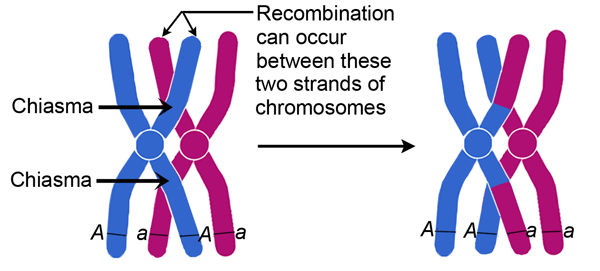
This image shows chromosomes during Prophase 1. Which of the following correctly describes the process shown?
a)
segregation of sister chromatids
b)
condensation and segregation of alleles
c)
mutationin which the DNA content of the gene is altered
d)
crossing - over in which alleles are exchanged
21.

Each human skin cell has ___ pairs of chromosomes.

a)

13

b)

23

c)

26

d)

46

22.

Offspring are genetically different from parents

a)

Asexual reproduction

b)

Sexual reproduction

23.

There is only one parent.

a)

Asexual reproduction

b)

Sexual reproduction

24.

Most of the life of any cell is spent in a period of cell growth and development called ___.

a)

interphase

b)

metaphase

c)

prophase

d)

telophase

25.
What stage of the cell cycle is the cell in?
a)
Prophase
b)
Metaphase
c)
Anaphase
d)
Telophase
26.

Fully grown parent cells split into two halves resulting in two daughter cells with the exact DNA as the parent.

a)

Binary Fission

b)

Budding

c)

Fragmentation

d)

Vegetative Reproductions

27.

Meiosis makes sperm and egg cells. In humans, sperm and egg cells each have _____ chromosomes. Therefore a fertilized human egg cell (sperm and egg cell combined) would create a cell with _____ chromosomes.

a)

23, 46

b)

46, 23

c)

2, 4

d)

50, 100

28.

How many daughter cells are produced at the end of meiosis?

a)

1

b)

2

c)

3

d)

4

29.
Name the process in the diagram. 
a)
Meiosis 
b)
Mitosis 
c)
Endocytosis 
d)
Phagocytosis 
30.
The process on the left is:
The process on the right is:
a)
Left: meiosis
Right: meiosis
b)
Left: meiosis
Right: cloning
c)
Left: mitosis
Right: meiosis
d)
Left: mitosis
Right: mitosis
31.

A carbohydrate is a macromolecule that is used to...

a)

give cells/systems energy.

b)

build cell parts.

c)

give cells/systems long term energy storage.

d)

help cells with chemical processes.

32.

A protein is a macromolecule that is used to...

a)

give cells/systems energy.

b)

build cell parts.

c)

give cells/systems long term energy storage.

d)

help cells with chemical processes.

33.
DNA and RNA are examples of 
a)
Carbohydrates
b)
Lipids
c)
Proteins
d)
Nucleic Acids
34.
Proteins are made of monomers called ___________
a)
Nucleotides
b)
Monosaccharides
c)
Amino Acids
d)
Glycerol and fatty acids
35.
Nucleotides are monomers of
a)
Carbohydrates
b)
Lipids
c)
Proteins
d)
Nucleic Acids
36.
Waxes, oils and fats are examples of
a)
Carbohydrates
b)
Lipids
c)
Proteins
d)
Nucleic Acids
37.
What are the monomers of DNA?
a)
glycerols
b)
amino acids
c)
fatty acids
d)
nucleotides
38.
Lipids can be digested into what smaller subunits?
a)
nucleic acids
b)
amino acids
c)
fatty acids
d)
glucose
39.
Which group of biomolecules provide quick energy to organisms?
a)
proteins
b)
carbohydrates
c)
lipids
d)
nucleic acids
40.
Genetic information is stored in which class of organic compounds?
a)
proteins
b)
lipids
c)
nucleic acids
d)
carbohydrates
41.
Building blocks of the body, hair , muscles etc.
a)
protein
b)
nucleic acid
c)
lipids
d)
carbohydrates
42.
Is found in the cell membrane as a bilayer. 
a)
lipids
b)
protein
c)
nucleic acid
d)
carbohydrate
43.
Which macromolecule is made of simple and complex sugars?
a)
lipids
b)
proteins
c)
carbohydrates
d)
nucleic acids
44.
What is a substance called if it speeds up a chemical reaction?
a)
reusable
b)
catalyst
c)
specific
d)
fragile
45.

Enzymes are an example of

a)

Lipids

b)

Carbohydrate

c)

Protein

d)

Nucleic Acid

46.
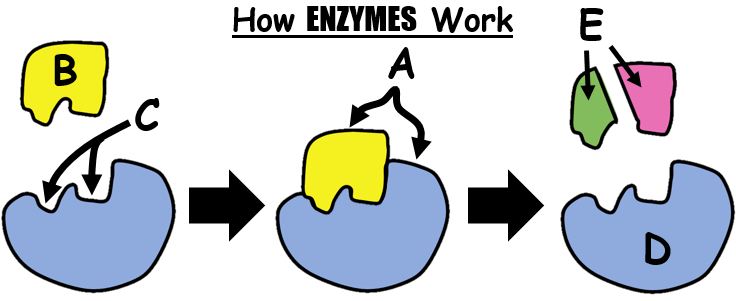
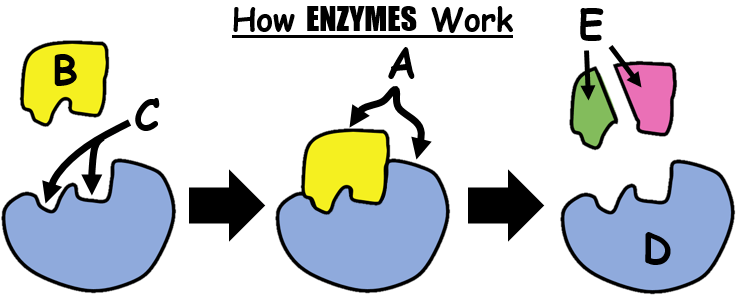
In the diagram, what is letter A? 
a)
product
b)
substrate
c)
enzyme-substrate complex
d)
active site
47.
Letter D...
a)
active site
b)
enzyme
c)
substrate
d)
products
48.
Letter B...
a)
active site
b)
enzyme
c)
substrate
d)
products
49.
An enzyme speeds up a reaction by
a)
lowering the activation energy.
b)
raising the activation energy.
c)
releasing energy.
d)
absorbing energy.
50.
What is the purpose  of an enzyme?
a)
give permission for the reaction
b)
raise activation energy
c)
speed up reactions
d)
control how many reactions occur
51.
Where do substrates bind on an enzyme?
a)
voltage-gated channels
b)
surface receptor
c)
calcium channels
d)
active site
52.
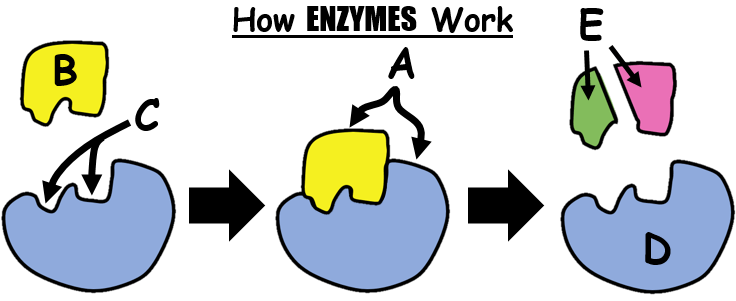
What is structure A?
a)
Substrate
b)
Active site
c)
Enzyme
d)
Products
53.

Particle of movement from an area of lower concentration to an area of higher concentration.

a)

Active transport

b)

Passive transport

54.

Particle of movement from an area of higher concentration to an area of lower concentration.

a)

Active transport

b)

Passive transport

55.

Which type of transport uses energy in the form of ATP to transport substances?

a)

Active transport

b)

Passive transport

56.

Which type of diffusion is represented?

a)

Facilitated diffusion

b)

Osmosis

c)

Diffusion

57.

Which type of diffusion is represented?

a)

Facilitated diffusion

b)

Osmosis

c)

Diffusion

58.

Which type of diffusion is represented?

a)

Facilitated diffusion

b)

Osmosis

c)

Diffusion

59.

Which type of solution has the same solute concentration inside of and outside of the cell?

a)

Hypertonic

b)

Hypotonic

c)

Isotonic

60.

The cell shrunk in size, which means it was placed in a ____ solution.

a)

Isotonic

b)

Hypertonic

c)

Hypotonic

61.

The cell shows water moving in and out equally, which means it was placed in a ___ solution.

a)

Isotonic

b)

Hypertonic

c)

Hypotonic

62.

Which type of active transport is displayed?

a)

Endocytosis

b)

Exocytosis

63.

___ is reached when there are stable internal and external cell conditions.

a)

Energy

b)

Active transport

c)

Homeostasis

d)

Passive transport

64.

ATP is a form of energy used in what type of transport?

a)

Passive Transport

b)

Active Transport

65.

A plant cell will take on water and swell, if placed in what type of solution?

a)

hypotonic solution

b)

hypertonic solution

c)

isotonic solution

66.

What is it called when large molecules move across the cell membrane from an area of high concentration to an area of low concentration through a protein channel?

a)

Diffusion

b)

Osmosis

c)

Active Transport

d)

Facilitated Diffusion

67.
What are the products of photosynthesis?
a)
water and carbon dioxide
b)
oxygen and glucose
c)
oxygen and carbon dioxide
d)
oxygen and water
68.
Which gas is removed from the atmosphere during photosynthesis?
a)
hydrogen
b)
oxygen
c)
nitrogen
d)
carbon dioxide
69.
Which statement about photosynthesis is correct?
a)
Plants get the energy they need for photosynthesis from water.
b)
Plants get the energy they need for photosynthesis from soil.
c)
Plants get the energy they need for photosynthesis from sunlight.
d)
Plants do not require energy to perform photosynthesis.
70.
What is the organelle that contains the chlorophyll used in photosynthesis ?
a)
mitochondria
b)
ribosome
c)
chloroplast
d)
nucleus
71.
The raw ingredients (reactants) of photosynthesis are sunlight along with ?
a)
CO2 and H20
b)
CO2 AND C6H12O6
c)
oxygen and water
d)
oxygen and CO2
72.
An autotroph is an organism that can ?
a)
make its own food.
b)
grow its own food
c)
kill and eat other organisms.
d)
play ball with you. 
73.
Which of the following is the correct equation for PHOTOSYNTHESIS?
a)
CO2 + light + H2O --> O2 + glucose
b)
CO2 + glucose + H2O --> O2 + light
c)
O2 + light + H2O --> CO2 + glucose
d)
CO2 + O2 + H2O --> Light+ glucose
74.

The term aerobic means

a)

wine-making

b)

with carbon dioxide

c)

without carbon dioxide

d)

with oxygen

e)

without oxygen

75.
The purpose of cellular respiration is to produce ?
a)
energy
b)
oxygen
c)
sugar
d)
protein
76.
What is the sugar that carbs are broken down to?
a)
sucrose
b)
maltose
c)
glucose
d)
lactose
77.
The splitting of the glucose molecule is called?
a)
synthesis
b)
denaturalization
c)
glycolysis
d)
dissolving
78.
What is the energy organelle?
a)
nucleus
b)
mitochondria
c)
ribosomes
d)
lysosomes
79.
The waste gas given off by cellular respiration is?
a)
oxygen
b)
carbon dioxide
c)
nitrogen
d)
methane
80.
The waste gas given off by cellular respiration is?
a)
oxygen
b)
carbon dioxide
c)
nitrogen
d)
methane
81.

What are the reactants (taken into) of cellular respiration? (Mark all of them!)

a)

oxygen

b)

glucose

c)

carbon dioxide

d)

water

e)

energy

82.

Where does Glycolysis occur inside the cell? (first step in the overall process)

a)

Cytoplasm

b)

Mitochondria

c)

Chloroplast

d)

Nucleus

83.

Which stage of the cellular respiration process produces the most ATP?

a)

Glycolysis

b)

Acetyl CoA

c)

Kreb's Cycle

d)

Electron Transport Chain

84.
Which sequence of DNA bases would pair with this partial strand
ATG TGA CAG
a)
ATG TGA CAG
b)
TAC ACT GTC
c)
GTA AGT GAC
d)
CAT TCA CTG
85.
Which of the following best describes a DNA molecule?
a)
double helix
b)
contains ribose
c)
made of amino acids
d)
contains Uracil
86.
Which of the following units are repeatedly joined together to form a strand of DNA?
a)
amino acids
b)
nucleotides
c)
fatty acids
d)
polysaccharides
87.
What is occurring in this picture?
a)
Translation
b)
Replication
c)
Translocation
d)
Transcription
88.
what does mRNA do?
a)
carry info from genes to ribosomes
b)
carry amino acids to ribosomes
c)
help with RNA splicing
d)
make up ribosomes
89.

When the mRNA sequence leave the nucleus, what organelle does it travel to?

a)

mitochondria

b)

smooth ER

c)

ribosome

d)

vacuole

90.

What best explains the interaction between tRNA and mRNA during translation?

a)

anticodons on the mRNA line up with complementary codons on the tRNA

b)

anticodons on the tRNA line up with complementary codons on the mRNA

c)

tRNA attach amino acids to the complementary mRNA sequence

d)

mRNA attach amino acids to the complementary tRNA sequence

91.

What does tRNA "transfer"?

a)

amino acids

b)

nucleic acids

c)

nucleotides

d)

AUG

92.

codons are located on __________

a)

mRNA

b)

tRNA

c)

rRNA

d)

snRNA

93.

A polypeptide only becomes a functioning protein after it has folded into its exact 3D shape.

a)

True

b)

False

94.

How many nucleotides make up a single codon?

a)

3

b)

5

c)

4

d)

1

95.

The following codon is translated into which amino acid?


AUU

a)

Methionine

b)

Isoleucine

c)

Histidine

d)

Arginine

96.

The following codon is translated into which amino acid?


CAU

a)

Methionine

b)

Isoleucine

c)

Histidine

d)

Arginine

97.
Any change in the sequence of DNA is...
a)
transgenic shift
b)
Single Genotype
c)
Monohybrid Trait
d)
Mutation
98.
DNA molecule segment is : TTACGCAAG
The mutated DNA segment is TTCGCAAG. This is an example of ___ mutation.
a)
Substitution
b)
Deletion
c)
Insertion
d)
Inversion
99.
What pairs with Adenine (A)? 
a)
Guanine (G)
b)
Cytosine (C)
c)
Adenine (A)
d)
Thymine (T)
100.
What pairs with Thymine (T)?
a)
Adenine (A)
b)
Thymine (T)
c)
Guanine (G)
d)
Cytosine (C) 
101.

This type of mutation in DNA alters just one base in a DNA sequence

a)

point mutation

b)

translocation

c)

inversion

d)

trisomy

102.

The bottom DNA sequence in the image has been altered by this type of mutation

a)

substitution

b)

insertion

c)

deletion

d)

translocation

103.

The bottom DNA sequence in the image has been altered by this type of mutation

a)

substitution

b)

insertion

c)

deletion

d)

translocation

104.

This type of mutation is possible because certain codons may code for the same amino acid

a)

silent

b)

missense

c)

nonsense

d)

6th sense

105.

Grey (G) fur is dominant to brown (g) fur in mice. What would be the genotype of a mouse that is heterozygous?

a)

GG

b)

Gg

c)

gg

d)

GGG

106.

Who was Gregor Mendel?

a)

Father of genetics

b)

Father of cells

c)

Coined the term heredity

d)

No one

107.

What is Aa

a)

Homozygous Dominant

b)

Heterozygous

c)

Homozygous Recessive

d)

Heterozygous dominant

108.

What is AA

a)

Homozygous Dominant

b)

Heterozygous

c)

Homozygous Recessive

d)

Heterozygous dominant

109.

The physical look or the organism, such as brown eyes

a)

genotype

b)

phenotype

c)

Dominant

d)

Recessive

110.

The genetic makeup of an organism. Example BB

a)

genotype

b)

phenotype

c)

Dominant

d)

Recessive

111.
T - tall and t = short
In the punnett square below, what belongs in the missing square
a)
tt
b)
Tt
c)
Bb
d)
TT
112.
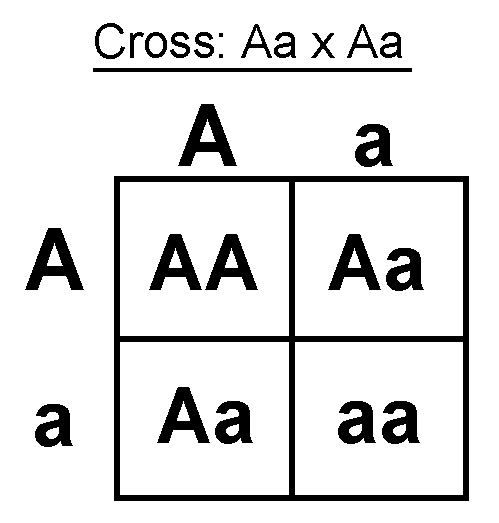
B = brown fur  b = white fur
In the punnett square, what is the probability for white fur? 
a)
0%
b)
25%
c)
50%
d)
75%
113.

What are the possible phenotype(s) of the offspring? (A-Brown hair; a-blond hair)

a)

50 % Brown Hair and 50% Blond Hair

b)

25 % Brown Hair and 75% Blond Hair

c)

75 % Brown Hair and 25% Blond Hair

d)

0% Brown Hair and 100% Blond Hair

114.
What genotype would go in box 2?
a)
BB
b)
Bb
c)
bb
115.
An offspring will receive how many alleles from each parent to determine a specific trait?
a)
one
b)
two
c)
three
d)
five