Wayground logo

Free Printable Worksheets

Font size

S
M
L
XL
Worksheets

PBS EOC Review 2

Total questions: 88

Worksheet time: 48mins

Name
Class
Date
1.
A variable that is being measured in response to what the researcher is changing is
a)
the independent variable
b)
the dependent variable
c)
the control
d)
the hypothesis
2.
What enzymes cut DNA in specific places in order to create RFLP's?
a)
polymerases
b)
restriction enzymes
c)
ligases
d)
DNA cutter enzymes
3.
Which hormone is produced when blood sugar is LOW?
a)
glucagon
b)
insulin
c)
glucose
d)
pancreasome
4.
If a person has LOW blood sugar, they have
a)
hypoglycemia
b)
hyperglycemia
5.
During transcription
a)
DNA is used to make mRNA
b)
mRNA is used to make proteins
c)
DNA is used to make proteins
d)
mRNA is used to make DNA
6.
Why can a child have sickle cell, but their parents do not?
a)
it is recessive
b)
it is dominant
c)
it only shows in males
d)
it only shows if a person is sick
7.
Control of blood sugar levels in the body is an example of a
a)
positive feedback loop
b)
negative feedback loop
c)
neutral feedback loop
d)
cause-effect feedback loop
8.

Any of various infectious proteins that are abnormal forms of normal cellular proteins, that proliferate by inducing the normal protein to convert to the abnormal form, and that in mammals include pathogenic forms.

a)

Prion

b)

Virus

c)

Fungus

d)

Coccus

9.

A condition of being able to resist a particular disease, especially through preventing development of a pathogenic microorganism or by counteracting the effects of its products.

a)

Immunity

b)

Infection

c)

Microbiology

d)

T Lymphocyte (T Cells)

10.

A parasitic worm (as a tapeworm, liver fluke, ascarid, or leech).

a)

Helminth

b)

Fungus

c)

Bacteria

d)

Protozoan

11.

Pressure exerted by the blood upon the walls of the blood vessels, especially arteries, usually measured by means of a sphygmomanometer and expressed in millimeters of mercury.

a)

Electrocardiogram

b)

systolic pressure

c)

diastolic pressure

d)

blood pressure

12.

Blood pressure that remains between heart contractions.

a)

diastolic pressure

b)

systolic pressure

c)

Hypertension

d)

Hypotention

13.

An abnormally high blood pressure.

a)

Hypertension

b)

Heart rate

c)

asystole

d)

Hypotension

14.

n acute episode of heart disease marked by death or damage of heart muscle due to insufficient blood supply to the heart muscle.

a)

Carotid pulse

b)

myocardial infarction

c)

Hypertension

d)

heart rate

15.
A protein hormone secreted by the pancreas that is essential for the metabolism of carbohydrates and the regulation of glucose levels in the blood.
a)
Glucagon
b)
Insulin
16.
Diabetes of a form that usually develops during childhood or adolescence and is characterized by a severe deficiency of insulin, leading to high blood glucose levels.
a)
Type 1 Diabetes
b)
Type 2 Diabetes
17.
Diabetes of a form that develops especially in adults and most often obese individuals and that is characterized by high blood glucose resulting from impaired insulin utilization coupled with the body’s inability to compensate with increased insulin production.
a)
Type 2 Diabetes
b)
Type 1 Diabetes
18.
The maintenance of relatively stable internal physiological conditions (as body temperature or the pH of blood) in higher animals under fluctuating environmental conditions.
a)
Homeostasis
b)
negative feedback
19.
Feedback that tends to magnify a process or increase its output.
a)
negative feedback
b)
positive feedback
20.
A discrete unit of hereditary information.
a)
Model
b)
Genetic Material
c)
Genes
d)
Guanine
21.

Any of the usually linear bodies in the cell nucleus that contain the genetic material. Become visible when the cell is preparing to divide.

a)
gel electrophoresis
b)
Chromosomes
c)
Transfer RNA
d)
Transcription
22.
The separation of nucleic acids or proteins, on the basis of their size and electrical charge, by measuring their rate of movement through an electrical field in a gel.
a)
Polymerase Chain Reaction
b)
Ribonucleic Acid
c)
Guanine
d)
gel electrophoresis
23.
Differences in DNA sequence on homologous chromosomes that can result in different patterns of restriction fragment lengths 
a)

Restriction Fragment Length Polymorphisms RFLP

b)
Deoxyribonucleic Acid
c)
Ribonucleic Acid
d)
Transfer RNA
24.

A enzyme that recognizes specific nucleotide sequences and cuts up DNA.

a)
Genetic Material
b)
Genotype
c)
Restriction enzymes
d)
Ribonucleic Acid
25.
An RNA molecule that functions as an interpreter between nucleic acid and protein language by picking up specific amino acids and recognizing the appropriate codons in the mRNA.
a)
Deoxyribonucleic Acid
b)
Transfer RNA
c)
gel electrophoresis
d)
Restriction Fragment Length Polymorphisms
26.
Individuals who are homozygous for the gene controlling hemoglobin S. The disease is characterized by the destruction of red blood cells and by episodic blocking of blood vessels by the adherence of sickle cells to the vascular endothelium.  
a)
Sickle Cell Disease
b)
Transcription
c)
Autosome
d)
Pedigree
27.
The percent of the volume of whole blood that is composed of red blood cells as determined by separation of red blood cells from the plasma usually by centrifugation.
a)
Hematosis
b)
Hematocrit
c)
Hemorrhage
d)
Erythr
28.
Any of the blood cells that are colorless, lack hemoglobin, contain a nucleus, and include the lymphocytes, monocytes, neutrophils, eosinophils, and basophils.
a)
Red Blood Cells
b)
Thrombocytes
c)
Erythrocytes
d)
Leukocytes
29.
A minute colorless anucleate disklike body of mammalian blood that assists in blood clotting by adhering to other platelets and to damaged epithelium.
a)
Thrombocytes
b)
Erythrocytes
c)
Leukocytes
30.
A condition in which the blood is deficient in red blood cells, hemoglobin, or in total volume
a)
anemia
b)
sickle cell
c)
hematocrit
d)
centrifugation
31.
A protein in red blood cells that carries oxygen throughout the body.
a)
Hematocrit
b)
genetic material
c)
Hemoglobin
d)
homologous chromosomes
32.
The creation of a protein from a DNA template.
a)
Transcription
b)
Translation
c)
protein synthesis
d)
Mutation
33.
A three-nucleotide sequence of DNA or mRNA that specifies a particular amino acid or termination signal; the basic unit of the genetic code
a)
Codon
b)
Anticodon
c)
Hydrophobic
d)
Protein
34.
A cell organelle that functions as the site of protein synthesis in the cytoplasm.
a)
Nucleotides
b)
Ribosome
c)
amino acids
d)
Gene
35.

A process that takes place in the nucleus of a dividing cell, involves a series of steps, and results in the formation of two new cells each having the same number of chromosomes as the parent cell.

a)
Mitosis
b)
Meiosis
c)
Mutation
d)
Sex Chromosome
36.
The cellular process that results in the number of chromosomes in sex cells being reduced to one half and in which one of each pair of homologous chromosomes passes to each daughter cell.
a)
Meiosis
b)
Mitosis
c)
Mutation
d)
Phenotype
37.
Chromosomes having the same or allelic genes with genetic loci usually arranged in the same order.
a)
Dominant
b)
Leukocytes
c)
homologous chromosomes
d)
Thrombocytes
38.
Alternative versions of a gene that produce distinguishable phenotypic effects.
a)
Allele
b)
Karyotype
c)
Ribosome
d)
Chromosomes
39.
The physical and physiological traits of an organism that are determined by its genetic makeup.
a)
Phenotype
b)
Genotype
c)
Hereditary
d)
Autosomal
40.
A condition that appears only in individuals who have received two copies of a mutant gene, one copy from each parent.
a)
Recessive Trait
b)
Dominant trait
c)
Genotype
d)
Phenotype
41.
A chromosome that is not directly involved in determining sex, as opposed to a sex chromosome.
a)
Recessive
b)
Autosomal
c)
Dominant
d)
Pedigrees
42.
A display of the chromosome pairs of a cell arranged by size and shape.
a)
Phenotype
b)
Karyotype
c)
Genotype
d)
Hematocrit
43.

This type of pathogen can be treated with antibiotics?

a)

Bacteria

b)

Virus

c)

prion

d)

Protozoa

44.

The diastolic pressure for a normal young adult would be

a)

120 mm Hg

b)

100 mm Hg

c)

60 mm Hg

d)

80 mm Hg

45.

The aorta leaves the

a)

right ventricle

b)

left ventricle

c)

left atrium

d)

right atrium

46.

The left side of the heart contains __________________ blood and the right side contains __________________ blood.

a)

oxygenated, deoxygenated

b)

deoxygenated, oxygenated

c)

deoxygenated, deoxygenated

d)

oxygenated, oxygenated

47.

The effect of narrowed arteries on a person’s blood flow and blood pressure would be

a)

Increased flow and increased pressure.

b)

Increased flow and decreased pressure

c)

Decreased flow and decreased pressure.

d)

Decreased flow and increased pressure.

48.

These vessels bring oxygenated blood back to the heart from the lungs.

a)

10

b)

3

c)

2

d)

9

49.

The location of the bicuspid valve is shown by ___ on the diagram.

a)

12

b)

6

c)

two dotted lines

d)

13

50.

Hematocrit is best defined as:

a)

The percent of the volume of whole blood that is composed of red blood cells.

b)

The percent of the volume of whole blood that is composed of oxygen verses carbon dioxide.

c)

The average blood sugar concentrations for the preceding two to three months.

d)

The ratio of blood plasma to red blood cells and white blood cells.

51.

The picture below shows red blood cells that are:

a)

all healthy

b)

all sickled

c)

both sickled and healthy

d)

none of the above

52.
What is the role of an restriction enzyme?
a)
Create a pattern of a person's DNA
b)
Act as molecular scissors that cut DNA
c)
Separate and compare different DNA sequences
d)
Produce millions of copies of DNA
53.
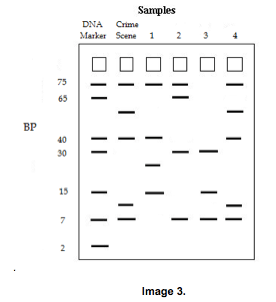
Who should the lawyer request a warrant for?
a)
Suspect 1
b)
Suspect 2
c)
Suspect 3
d)
Suspect 4
54.
DNA is ________ charged and migrates to the ________ end of the gel.
a)
negative, positive
b)
positive, negative
c)
negative, neutral
d)
positive, neutral
55.
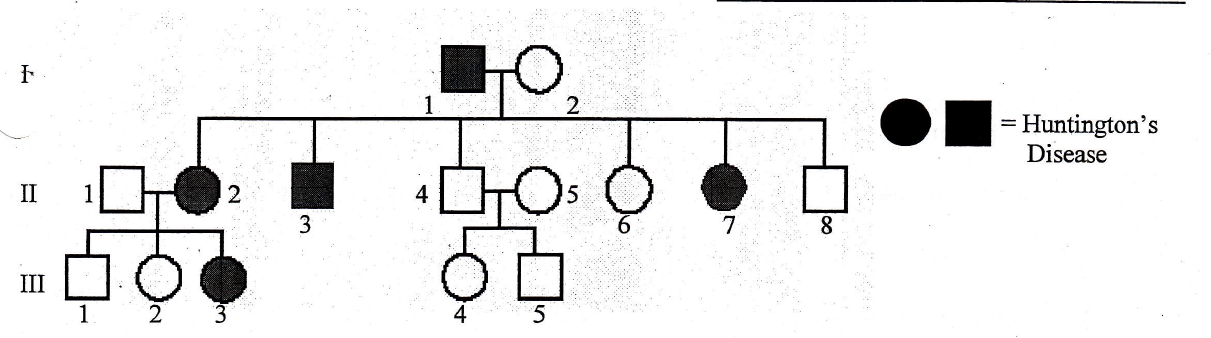
There are no carriers for Huntington's Disease- you either have it or you don't. Is Huntington's disease caused by a dominant or recessive trait?
a)
Dominant
b)
Recessive
56.
What does this shape represent in a pedigree?
a)
Not affected male (doesn't have the trait)
b)
Not affected female (doesn't have the trait)
c)
Affected male (has the trait)
d)
Affected female (has the trait)
57.
Infection and disease are caused by microorganisms called pathogens.
a)
True
b)
False
58.
Hand washing is an example of a(n)_______ technique.
a)
sterile
b)
aseptic
c)
antiseptic
d)
clean
59.
Viruses are not affected by antibiotics.
a)
True
b)
False
60.
Which DNA fragment would end up closest to the top of gel (where the DNA is loaded into the wells)?
a)
100 bp
b)
1,000 bp
c)
5,000 bp
d)
10,000 bp
61.
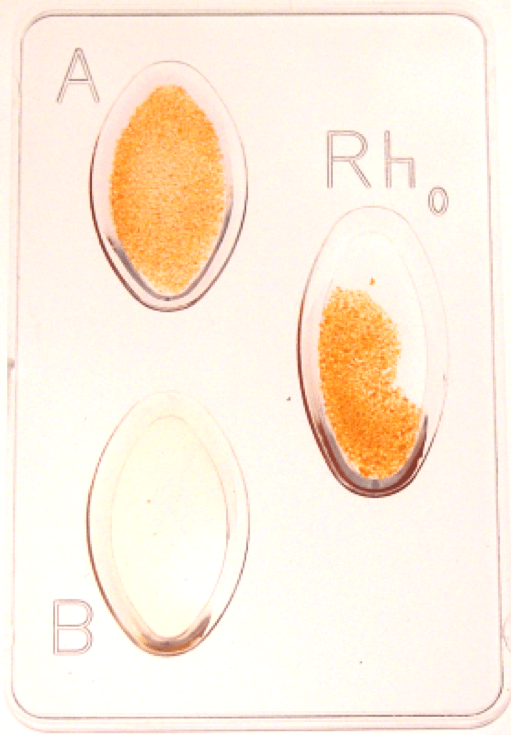
What blood type does the person have given the image?
a)
Type A 
b)
Type B
c)
Type AB
d)
Type O
62.
Mary's husband come to the doctor with her and demands to know the results of her blood test.  He begins yelling at the nurse.  The nurse gives him the records- was HIPAA violated?
a)
Yes, he is not entitled to know her information just because he came to the doctor's office.
b)
No, He came with his wife to the doctor and she never told the nurse not to say anything.
c)
Yes, because he should not be yelling at the nurse
d)
No, husbands and wives are exempt from HIPAA
63.
Andy went to the middle east and came back with the measles.  He doesn't want anyone to know and asks his nurse to not tell anyone.  The nurse notifies public health authorities anyway.  Was HIPAA violated?
a)
Yes, the patient specifically asked her to protect his privacy.
b)
No, measles is a public health concern and trumps the patient's entitlement to privacy
c)
It depends on if the nurse has proper clearance from her boss.
64.
The normal range for resting blood sugar is 
a)
30-69 mg/dL
b)
70-130 mg/dL
c)
160-280 mg/dL 
d)
425 mg/dL
65.
Which lipoprotein decreases your chances of heart disease?
a)
HDL
b)
LDL
c)
PDL
d)
BDL
66.
Total cholesterol should be under _____ mg/dL
a)
100
b)
150
c)
200
d)
250
67.

Can someone be a carrier of the FH gene? Why or why not?

a)

Yes, because it is recessive

b)

Yes, because it is dominant

c)

No, because it is recessive

d)

No, because it is dominant

68.
Draw a Punnett Square of a heterozygous male & heterozygous female with FH. What is the % chance of a child without FH?
a)
100%
b)
75%
c)
50%
d)
25%
69.
What is atherosclerosis?
a)
Plaque build up in the inner walls of arteries
b)
Plaque build up in the heart chambers
c)
Quivering contraction of the ventricles
d)
Quivering contraction of the atria
70.
What is a function of the coronary arteries?
a)
Supply blood to the lungs
b)
Supply blood to the brain
c)
Supply blood to the heart
d)
Supply blood to the Aorta
71.
What is the medical term for heart attack?
a)
Myocardial infarction
b)
Hypertrophic cardiomyopathy
c)
Commotio cordis
d)
Myocardial difibrilation
72.
Herd immunity is most effective at protecting infants and others who cannot have vaccines when
a)
everyone under 18 is vaccinated
b)
a high proportion of all people are vaccinated
c)
factory farming is outlawed
d)
antibiotic are used to treat viral infections
73.
Airborne transmission of viruses involves
a)
mosquitoes biting an infected person and flying to the next victim
b)
viral particles left on surfaces where they can picked up on people's hands
c)
viral particles are carried through the air in droplets when people sneeze
d)
bodily fluids containing virus are exchanged through skin-to-skin contact
74.
What do all viruses need to reproduce?
a)
They need host genetic material
b)
They need a host cell
c)
They need bacteria
d)
They need insulin
75.
Why is it important to complete a course of antibiotics?
a)
to prevent antibiotic resistance
b)
so you do not waste drugs
c)
because antibiotics are good for you
76.
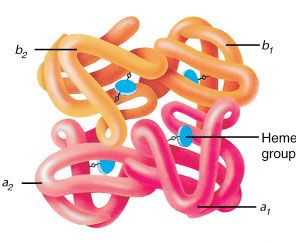
Hemoglobin is a _______.
a)
protein
b)
parasite
c)
plasma
77.
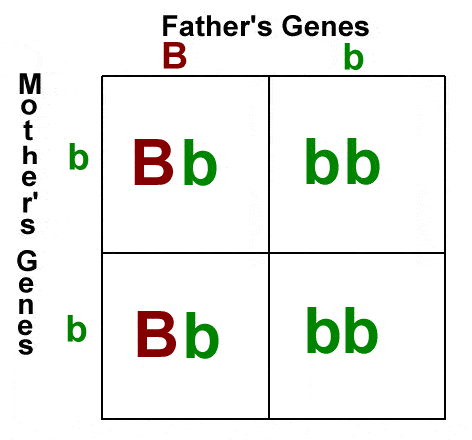
In this Punnet Square, the mother has two __________ genes.
a)
recessive
b)
dominant
78.
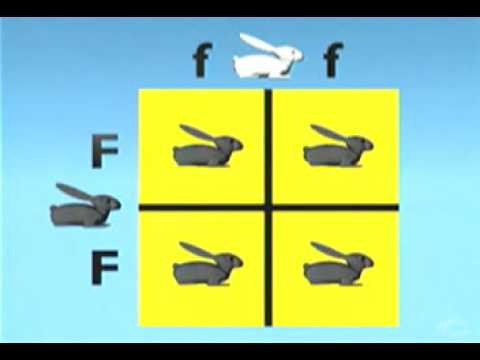
In this Punnet Square, grey fur is the ________ gene.
a)
recessive
b)
dominant
79.

If you have type B- blood, who can be your donor?

a)

B- only

b)

A- and AB-

c)

O- and B-

d)

AB+

80.
What happens if you receive blood from a blood type that doesn't match?
a)
The Antibodies do not bind with the antigen.
b)
Nothing happens.
c)
The immune system will attack the blood cells.
d)
The antigens change shape.
81.
sickle cell anemia causes an abnormal shape of the ...
a)
platelets
b)
leukocytes
c)
blood vessels
d)
erythrocytes
82.
Pale yellow fluid portion of whole blood that consists of water & its dissolved constituents
a)
Plasma
b)
Leukocytes
c)
Anemia
d)
Erythropoietin
83.
Stiffening of the body is also known as 
a)
Decomposition
b)
Mummification
c)
Rigor mortis
d)
None of the above
84.
To take a corpse’s temperature, forensic investigators insert a thermometer into the:
a)
liver
b)
mouth
c)
stomach
d)
underarm
85.

Wire mesh that widens blocked arteries.

a)

Stent

b)

Pacemaker

c)

Blood thinning drugs

d)

Statins

86.

Drugs given to patients that have suffered a heart attack.

a)

Stent

b)

Pacemaker

c)

Blood thinning drugs

d)

Statins

87.

drugs that lower cholesterol.

a)

Stent

b)

Pacemaker

c)

Blood thinning drugs

d)

Statins

88.

Which type of cholesterol do we need to decrease to be healthier?

a)

LDL

b)

HDL