
Font size
 Worksheets
Ecology Review
Total questions: 96
Worksheet time: 2hrs 25mins
Ecology is the study of .
life
Interactions among organisms and their environments
interactions among organisms
how traits are passed from parents to offspring
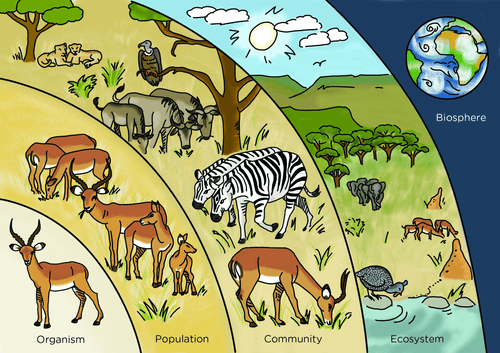
What is made up of all the populations in an area?
Habitat
Niche
Community
Ecosystem
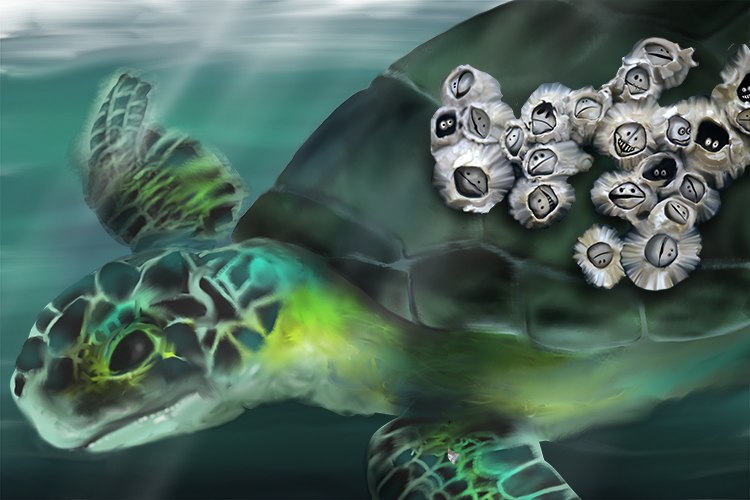
A close, ongoing relationship between species in which at least one is benefiting and the other is not helped or harmed.
Commensalism
Symbiosis
Predator & Prey
Mutualism
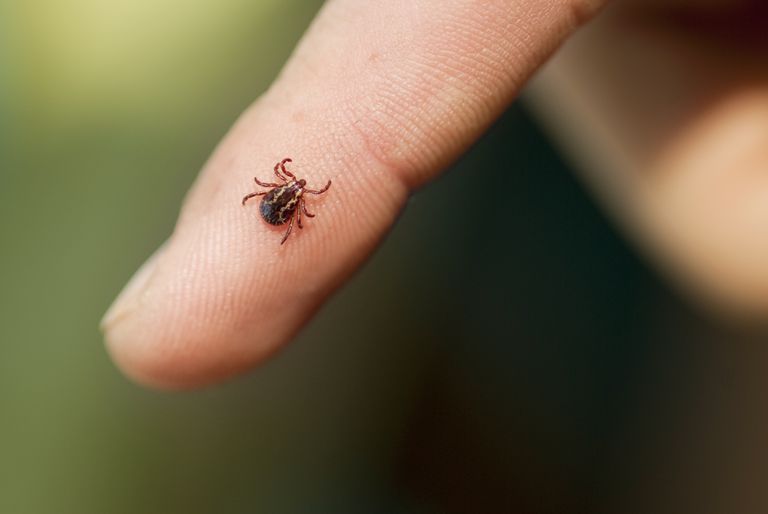
An ongoing relationship in which one organism benefits and the other is harmed.
A. Predator & Prey
B. Mutualism
C. Commensalism
D. Parasitism
There are birds that eat the food from between the teeth of alligators, leaving the alligators with clean teeth and the birds with a meal. What type of ongoing relationship is this?
A. Predator & Prey
B. Mutualism
C. Commensalism
D. Parasitism
In the country of Georgeville there is an average of 4.5 births for every 3.3 deaths. That means the population of Georgeville is most likely
Increasing
Decreasing
Staying the same
Which of the following best explains why there are usually no more than five trophic levels in a food chain
there are not enough organisms to fill more than five levels
there is too much competition among the organsims at the lower levels to support high levels
the statement is not true: there can be unlimited trophic levels
energy is lost at each trophic level
Which of the following is not an abiotic factor
air
water
decomposers
temperature
Which of the following encompasses all the others
ecosystem
community
population
individual
Animals from 2 different species utilize the same source of nutrition in one area. It is most accurate to say that the animals
will learn to get along
will compete for food
will die
will learn to eat different food
What level of ecological organization would include all squirrels that live in the same area?
biome
community
ecosystem
population
The population of predators most often eliminates the whole population of the prey
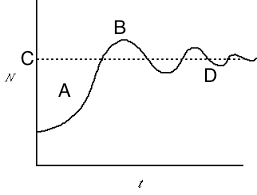
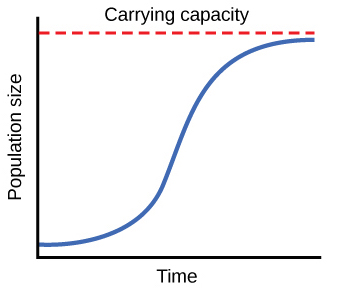

Which of the following statements best describes carrying capacity (K)?


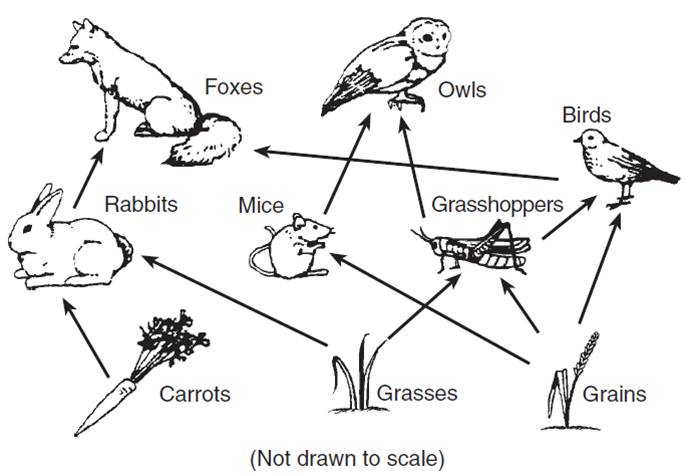

Where is energy converted from light energy to chemical energy
rabbits
snakes
eagle
grass

Which organisms compete for food?
hawk, lynx, and fox
hawk, lynx, and willow
hawk, shrew, and willow
hawk, insect, and willow
Why does increasing producers increase the populations of all trophic levels?
Producers increase the size of a habitat
Producers help keep predator populations in check
With more energy available the carrying capacity increases
Producers do not have a large impact on population sizes
What types of organisms are producers?
autotrophs
apex predators
heterotrophs
keystone species
What are limiting factors?
The maximum number of organisms an area can sustain
Scarce resources that limit the size of a population
Conditions that limit how much energy flows to the next trophic level
How diverse the populations of a community are
If the producer level of an ecosystem has 750,000 J of energy, how much energy would be passed on to the secondary consumers?
75,000 J
7,500 J
750 J
75 J
How do ecosystems obtain energy in environments that have no light?
Through chemosynthetic organisms
Without light the organisms will need to move or they may go extinct
Through photosynthetic organisms
All ecosystems have some light
Why are decomposers necessary in ecosystems?
They recycle essential nutrients back down to producers
They enrich soil with nitrogen
They help keep ecosystems clean
All of the above
Why does high biodiversity increase ecosystem stability?
Ecosystems do best when populations are as large as possible
High biodiversity increases the carrying capacity of an ecosystem
More diversity increases the chances that organisms can survive changes to an ecosystem
Ecosystems are most stable when biodiversity is low
How do invasive species impact ecosystems?
The increase density dependent limiting factors
They establish themselves as new keystone species in an area
The open up new niches in the ecosystem
They outcompete native species and overpopulate the area
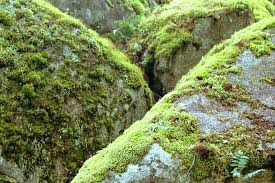

What is the most important function of pioneer species?
To function as decomposers
To create soil and add nutrients
Facilitation of the water cycle
Food for animals


The oceans affect the biosphere in all of the following ways EXCEPT
producing a substantial amount of the biosphere's oxygen.
removing carbon dioxide from the atmosphere.
moderating the climate of terrestrial biomes.
regulating the pH of freshwater biomes and terrestrial groundwater.
Which of the following causes populations to shift most quickly from an exponential to a logistic population growth?
favorable climatic conditions
removal of predators
decreased death rate
competition for resources

Use the graph to answer the following question.
What does the graph tell you about the effect of a keystone species?
A keystone species has little interaction with other species in an environment.
Removing a keystone species from the community drastically reduces species richness.
Adding a keystone species to the community will make it more diverse.
Removing a keystone species from the community will eventually allow for the invasion of a new species.
Consider the food chain of grass ® grasshopper ® mouse ® snake ® hawk. About how much of the chemical energy fixed by photosynthesis of the grass (100 percent) is available to the hawk?
0.01%
0.1%
1%
10%
Which biome, because of its climate and amount of rainfall, has the greatest biodiversity?
Temperate Forest

Which nutrient does not cycle through the atmosphere?
phosphorus
carbon
nitrogen
sulfur
Which is an example of where primary succession could occur?
a glacier melts and exposes new rocks
natural fire burns a prairie
a corn field is abandoned and left to overgrow
flood covers a piece of land

Mice might grow in population and destroy the community by eating all of the berry bushes if
wolves and snakes were removed from the food web
another predator migrated in to the community
the snake population grew
none of these

What best describes the term succession?
rapid changes that create an ecosystem overnight
gradual changes over time to fully create or restore and ecosystem
forest with the tallest trees
the rate species produce offspring
Which ecosystem provides most of the world's oxygen?
kelp forest
estuary
coral reef
open ocean
Which of the following statements is true about the nitrogen cycle?
Nitrogen has a critical role in ecosystems because it is the primary building block of fats and lipids.
Most of the nitrogen in the nitrogen cycle is held in living plants.
Nitrogen reenters the atmosphere through animal and plant respiration.
Plants take in nitrogen through their roots.
Every food chain begins with a(n) ____________ and ends with a(n) _____________.
primary consumer ; tertiary consumer
producer ; decomposer
producer ; scavenger
herbivore ; carnivore
Logistic population growth can be described as
growth when resources are limited
a s-shaped curve
reaching carrying capacity
all of the above
Which of the following is true of Earth's carrying capacity for humans?
it is infinitely expandable
It has already been reached
It grows larger as the population increases
Technology can increase it
A stable ecosystem typically has high biodiversity.
True
False
b. If there aren't all the different species, there will be resources that aren't being used
The greatest cause of biodiversity loss today is
Pollution
Habitat loss and change
Climate Change
Invasive species

Examine the food web. Suppose an herbicide(chemical that kills weeds) is used to kill some of the algae in this ecosystem. The herbicide does not break down in the environment. Inside the cells of which organism would you expect to find the highest amount of herbicide? *The arrow is wrong between algae and dragonfly.


Which of the following statements is supported by these data?


How does habitat fragmentation reduce genetic diversity in species?
Habitat fragmentation makes nonnative species introduction possible.
Habitat fragmentation opens migration routes.
Habitat fragmentation isolates a large population into smaller groups.
Habitat fragementation encourages open gene flow.
The breaking of habitats into smaller pieces is called...
habitat division
habitat corruption
habitat pollution
habitat fragmentation
Which two acids are responsible for causing acid rain?
carbonic acid
sulfuric acid
nitric acid
hydrochloric acid
Which two gases are most responsible for global warming?
What can be a source of nitrates for eutrophication in rivers?
fertilizers
plastic bottles
paper
sewage
Which is the correct order of changes that occur during eutrophication?
Aquatic plants die. Algal blooms blocks light. Fish and other aquatic organisms die. Bacteria decompose algae and use up oxygen. The algae die.
Algal blooms blocks light. Aquatic plants cannot photosynthesize and die. The algae die. Fish die. Bacteria decompose the algae use up oxygen.
Algal blooms blocks light. Aquatic plants die. The algae die. Bacteria decompose the algae and use up. The fish and other aquatic organisms die.
Zebras live in large herds. When attacked by a predator, such as a lion, some individual zebras will engage in combat with the lion, rather than trying to escape. This behavior increases the risk of injury and death to the individual zebra. Why might this type of behavior evolve if it is so clearly a disadvantage to the individual?
This behavior increases the survival advantage of other members of the herd and the species.
This behavior ensures that only the strongest and most aggressive zebras pass on their genes.
This behavior is an opportunity for zebras to prove themselves to potential mates.
This behavior frightens predators in the area and makes future attacks less likely.
Which of the following describes a survival advantage an individual organism derives from living in a large group with other individuals of the same species?
They are less likely to contract a disease.
They encounter reduced competition.
They are less visible to predators.
They can more easily find a mate.
Which of the following animal behaviors could be disadvantageous to the individual organism, but increase the survival advantage of other members of its social group?
Joeys stay within their mothers’ pouch for protection for several weeks.
Newly hatched sea turtles will automatically begin moving toward the ocean.
Squirrels vocalize loudly when they observe a predator in their habitat.
Male peacocks compete for females with elaborate plumage and behaviors.
The phenomenon by which toxins concentrate in the organisms at higher trophic levels within an ecosystem is known as...
Biotoxicity
Biomagnification
Eutrophication
Predation

Which organism in the food web shown to the right would
contain the lowest concentration of chemical pollutants?
producers
primary consumers
secondary consumers
tertiary consumers
How does carbon enter the biotic world?
through autotrophs
through heterotrophs
through decomposition
through cellular respiration

The arrows in a food chain or web represents what?
They point to the organism that is being eaten.
It shows how sunlight flows within an ecosystem.
They show what direction the energy is flowing between organisms.
They represent how water is transferred within a habitat.

How many autotrophs are in this food web?
3
6
4
2
Herbivores are
producers
primary consumers
secondary consumers
decomposers
The dividing of niches that enables similar species to coexist in a community
character displacement
climax community
resource partitioning
pioneer species

