wayground logo

Free Printable Worksheets

Font size

S
M
L
XL
Worksheets

Unit 8 Review -Evolution

Total questions: 60

Worksheet time: 1hrs 21mins
Name
Class
Date
1.
What is the term for a feature that allows an organism to survive in its environment?
a)
adaptation
b)
variation
c)
homologous structure
d)
vestigial structure
2.
What is the process of which humans breed organisms for certain traits?
a)
artificial selection
b)
descent without modification
c)
inheritance of acquired characteristics
d)
natural selection
3.
Vertebrate embryos pass through similar stages of development is evidence for
a)
use and disuse
b)
homologous structures
c)
common ancestry
d)
acquired characteristics
4.
All the individuals of a species that live in a particular area are called a 
a)
group
b)
population
c)
variation
d)
fossil
5.
The remnant of an organ that had a function in an early ancestor is known as a(n)
a)
vestigial structure
b)
analogous structure
c)
homologous structure
d)
fossil structure
6.
What is the study of the distribution of organisms around the world?
a)
geology
b)
biogeography
c)
paleontology
d)
geography
7.
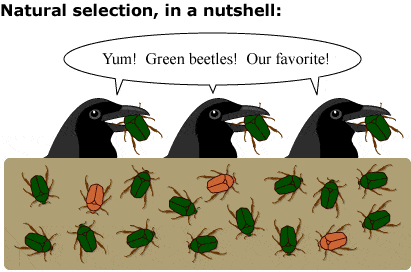
Which of the following is a factor in natural selection?
a)
Individuals of species compete with one another to survive.
b)
All species are genetically diverse.
c)
Individuals better able to adapt to changes leave more offspring.
d)
All are correct 
8.
The fossil record provides evidence that 
a)
Fossils cannot be dated.
b)
All species were formed during Earth’s formation and have changed little since then.
c)
The fossilized species have no connection to today’s species.
d)
Older species gave rise to more-recent species.
9.
Individuals that are better able to cope with the challenges of their environment tend to  
a)
Decrease in population over time.
b)
Leave more offspring than those less suited to the environment.
c)
Leave fewer offspring than those less suited to the environment.
10.
Which of the following statements gives the most likely explanation for the presence of two very similar species of squirrels living on opposite sides of the Grand Canyon?
a)
One squirrel traveled across the canyon and started a new population on the other side.
b)
One squirrel traveled across the canyon and interbred with a different population on the other side.
c)
Members of one single squirrel species were geographically separated by the formation of the canyon.
d)
Members of two different squirrel species migrated from two different places to opposite sides of the canyon. 
11.
What do you call all of the genes in a population?
a)
Gene pool
b)
Relative Frequency
c)
Genetic Drift
d)
Allele pool
12.
The measure of how common an allele is in a population is known as ___________.
a)
Allele Combination
b)
Allele Frequency
c)
Gene Pool
d)
Genotypic Frequency
13.
Which of the three graphs shows directional selection?
a)
A
b)
B
c)
C
14.
A population of pigs with small, medium, and long snouts lives on an island together with burrowing termites. Pigs that have the longest snouts tend to survive better. Over time, most of the pig population is made up of individuals that have very long snouts. This is an example of which type of selection?
a)
directional selection
b)
disruptive selection
c)
stabilizing selection
d)
sexual selection
15.
In the past, individuals in a population of seed eating birds had a wide variety of beak sizes. After many generations, the birds either have small beaks or large beaks, but medium size beaks are absent. If the number of birds with each beak size was graphed which example would it look like?
a)
A
b)
B
c)
C
16.
If finches with large beaks and finches with small beaks increase in a population while finches with average sized beaks decreases, which pattern of natural selection has occurred?
a)
Directional selection
b)
Disruptive selection 
c)
Stabilizing selection
d)
Sexual Selection
17.
If finches with average sized beaks increase in a population while finches with large and small sized beaks decrease, which pattern of natural selection has occurred?
a)
Directional selection
b)
Disruptive selection 
c)
Stabilizing selection
d)
Sexual Selection
18.
A chance occurrence that negatively affects a population because the population is small.
a)
genetic drift
b)
mutation
c)
speciation
d)
migration
19.
The type of genetic drift that follows the colonization of a new habitat by a small group of individuals is called
a)
the Hardy-Weinberg principle
b)
the founder effect
c)
directional selection
d)
the bottleneck effect
20.
Which of the following cannot introduce new alleles into a population's gene pool?
a)
Mutation
b)
Natural selection
c)
Gene Flow
d)
All of the above introduce new alleles into the population
21.
What are sources of genetic variation?
a)
mutations
b)
genetic recombination
c)
mutations and genetic recombination
d)
mutations and migrations
22.
There was once a large population of cheetah, but about 12,000 years ago most of the cheetahs were killed off because of human activity and only a few survived.  What is this an example of?
a)
Bottleneck Effect
b)
Genetic Drift
c)
Founder Effect
d)
Natural Selection
23.
Directional selection will favor...
a)
extreme traits.
b)
average traits.
c)
one phenotype over another.
24.
What is the correct explanation for what is happening in this graph?
a)
There are a lot of average-sized beaks
b)
There are no beaks
c)
There are a lot of small beaks only
d)
There are a lot of small and large beaks, but not average-sized ones
25.
Modern whales developed their traits through natural selection.  What occurs during the process of natural selection?
a)
Organisms choose mates from other species to create new species
b)
Breeders selectively cross organisms with desired traits
c)
Only the fittest organisms can survive and reproduce
d)
Organisms remain exactly the same over time.
26.
What is speciation?
a)
  The process by which populations become geographically isolated
b)
The process in which reproductively isolated populations evolve to become distinct species
c)
The process in which reproductively isolated populations do not evole
d)
None of these
27.
What is geographic isolation?
a)
Members of a population live together within an geographic boundary
b)
Members of a population may become isolated from one another by geographic boundaries
c)
An isolation that is geographic
d)
None of these
28.
Temporal isolation occurs when two different populations
a)
develop different mating behaviors
b)
become geographically separated
c)
reproduce at different times
d)
interbreed
29.
The cardinal and the blue jay do not reproduce due to a difference in their mating songs.  This is an example of 
a)
geographic isolation
b)
habitat isolation
c)
gametic isolation
d)
behavioral isolation
30.

Mutations that improve an individual's ability to survive and reproduce are

a)

harmful

b)

neutral

c)

beneficial

d)

chromosomal

31.

When two populations no longer interbreed what is the result?

a)

genetic equilibrium

b)

reproductive isolation

c)

stabilizing selection

d)

artificial selection

32.

Natural selection can act directly on

a)

alleles

b)

genes

c)

mutations

d)

phenotypes

33.
Which is an example of temporal isolation?
a)
flowers that bloom in different months 
b)
birds that have different mating calls
c)
fruit flies that mate in different locations
d)
squirrels that have different fur colors
34.

The scientific name consists of which two categories:

a)

Kingdom and Class

b)

Order and Family

c)

Genus and Species

35.

What is classification?

a)

the science of putting similar organisms into groups

b)

the science of putting dissimilar organisms into groups

c)

determining which classes will be in your schedule

36.

Carolus Linnaeus develop what for science?

a)

Punnett Squares for genetics

b)

The theory of evolution

c)

Binomial nomenclature

37.

What is the system of NAMING organisms with 2 names called?

a)

binomial nomenclature

b)

Eeny Meenie Miney Mo

c)

Heads or Tails

38.

What is the system called that helps you to figure out what an organism is, by grouping things based upon questions that have a "yes or no" answer?

a)

Dichotomous Key

b)

Graphing Key

c)

I can't find my key

39.

What is wrong with this scientific name: Homo sapien?

a)

They should both be capitalized.

b)

neither word should be italicized.

c)

The first word needs to be italicized.

40.

Which of the images below is a cladogram, which shows evolutionary relationships?

a)
b)
c)
41.
what did Charles Darwin observe in finch populations of the Galapagos Islands off the coast of South America?
a)
different species on different islands
b)
all species on one of the islands
c)
identical species on all the islands
d)
the same species as North America
42.
Natural selection can also be referred to as:
a)
Survival of the weakest
b)
Survival
c)
Survival of the fittest
d)
Artificial selection
43.
All of these finches have different shaped beaks, they are an adaptation to gain access of 
a)
Water
b)
Food
c)
Shelter
44.
This scientist developed the theory of evolution as he studied the finches.
a)
Charles Darwin
b)
Isaac Newton
c)
Albert Einstein
d)
Marie Curie
45.
Lamarck’s ideas about evolution include the concept that differences among the traits of organisms arise as a result of
a)
continual increases in population size.
b)
the actions of organisms as they use or fail to use body structures.
c)
an unchanging local environment.
d)
the natural variations already present within the population of organisms.
46.
Darwin realized that the economist Malthus’s theory of population control 
a)
applied only to humans.
b)
 could be generalized to any population of organisms.
c)
could be generalized only when populations lived in crowded conditions.
d)
explained why the number of deaths exceeded that of births.
47.
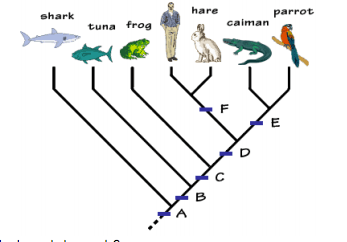
On the cladogram, which organism is the closest relative of the human?
a)
Frog
b)
Hare
c)
Caiman
d)
Parrot
48.

According to the diagram, what is the common ancestor of ALL organisms on the evolutionary tree?

a)

B

b)

C

c)

D

d)

E

49.

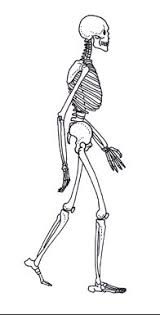
The ability to walk upright on two legs is called:

a)

bipedalism

b)

quadropedalism

c)

bicyclepedalism

d)

tripedalism

50.

All of these help us to be bipedal EXCEPT:

a)

S-shaped spine

b)

short, wide pelvis

c)

arched feet

d)

opposable thumbs

51.

Modern humans and their closest relatives belong to the same family. Members of this family are called:

a)

hominids

b)

primates

c)

homo sapiens

d)

Lucy

52.

Which is the oldest of these four species?

a)

Australopithecus

b)

Tool-making hominids

c)

Homo Neanderthalensis

d)

Homo Sapiens

53.
About 96% of the information in human DNA is found in gorilla DNA. This evidence supports which statement?
a)
Humans evolved from gorillas.
b)
Gorillas and humans diverged from a common ancestor.
c)
As gorillas evolve, they will become more similar to humans.
d)
Gorillas and humans are too different for meaningful genetic comparisons.
54.

Lucy was an example of

a)

Homo neanderthalensis

b)

Ardipithecus kadabba

c)

Australopithecus afarensis

d)

Homo habilis

55.

The first hominin that is thought to have made stone tools.

a)

Paranthropus robustus

b)

Homo habilis

c)

Homo erectus

d)

Homo sapiens

56.

Laetoli tracks were found in ...

a)

Kenya

b)

Ethiopia

c)

Tanzania

d)

Zambia

57.

The success or failure of a mutation to survive on earth depends on:

a)

man's laws

b)

the environment in which it occurs.

c)

whether it is a recessive gene.

d)

whether it is a dominant gene.

58.

Finches found on the Galapagos Islands represent which type of evolution?

a)

Adaptive Radiation

b)

Co-evolution

c)

Convergent Evolution

59.

The science that specializes in the classification of organisms is called taxonomy

a)

TRUE

b)

FALSE

60.

There has been 10 mass extinction in the past 500 million years.

a)

FALSE

b)

TRUE