
Font size
 Worksheets
Physics Semester 2 Test 2026
Total questions: 85
Worksheet time: 3hrs 32mins
What is needed to calculate work?
time and distance
speed and distance
force and direction
acceleration and velocity
What is the unit of measurement for work?
meters
newtons
m/s
Joules
You have to push with a force of 15 N to move it 10 meters. How much work do you do?
15 Joules
150 Joules
1.5 Joules
.67 Joules

What is the ideal mechanical advantage (IMA) of this pulley?
0
1
2
In physics, power is the rate at which ________ is used.
Current
Speed
Energy
Force
To solve for power, we use the formula: Power = Work divided by ________.
Velocity
Force
Distance
Time
Standard unit of Power
Ampere
Newton
Joule
Watt
If it takes 1000 J of work to climb the stairs in 5 seconds, what is the power?
2 W
5 W
250 W
200 W

A wrench is used to tighten a nut. A 15 N perpendicular force is applied 50 cm away from the axis of rotation and moves a distance of 10 cm as it turns. What is the torque applied to the wrench?
HINTS: Torque = Force × Distance
50 cm = 1/2 meter
7.5 Nm
1.5 Nm
750 Nm
150 Nm
Torque is the product of a force exerted on an object times the length of the lever arm.
True
False
At what angle should a force be applied to a wrench to produce maximum torque?
00 to the handle
900 to the handle
1800 to the handle
3600 to the handle

What happens to her angular velocity when a figure skater brings in her arms?
Increases her angular velocity
Decreases her angular velocity
Has no effect
The transfer of thermal energy between objects at different temperatures is called...
temperature
heat
internal energy
none of these

More rapidly at an increased distance from each other.

A substance with a high specific heat:
Is always extremely hot.
Requires a lot of energy to become hot.
Is not heavy.
Does not require a lot of energy to become hot.

Thermal energy always moves:
From a high-temperature object to a lower-temperature object.
From a lower-temperature object to a higher-temperature object.
From an object with lower kinetic energy to an object with higher kinetic energy.
From an object of higher mass to an object of lower mass.
The second law of thermodynamics states that the entropy of a system tends to ______________.
increase
decrease
stay constant
fluctuate wildly
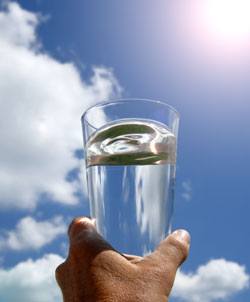
What do we call the amount of force exerted on a certain area?
fluid
pressure
buoyant force
normal force
When pressure is applied to a confined fluid, the increase in pressure is transmitted equally to all parts of the fluid. This fact is called ________.
Pascal's Principle
Newton's Principle
Archimedes' Principle
Bernoulli's Principle

What is transferred from place to place by waves?
matter
energy
particles
light

What does the arrow in the picture represent?
amplitude
wavelength
frequency
trough

What does the arrow in the picture represent?
wavelength
echolocation
amplitude
peak
Waves that require a medium to travel are:
mechanical waves
transverse waves
electromagnetic waves
light waves

What type of wave is shown below?
compressional wave
transverse wave
longitudinal wave
mechanical wave

Which wave is shown in the picture?
Transverse
Longitudinal
Electromagnetic
Light
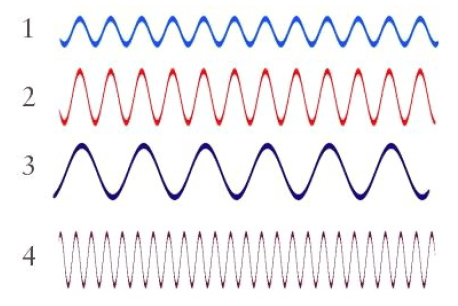
Which wave in the diagram has the highest frequency?
1
2
3
4
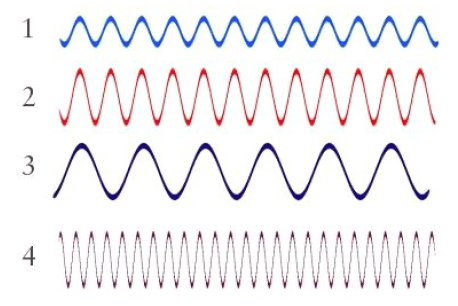
Which wave in the diagram has the longest wavelength?
1
2
3
4
Longitudinal waves move __________ to the direction of energy transfer of the wave (select all that apply).
Parallel
Perpendicular
At a 90 degree angle
In the same direction
Transverse waves move __________ to the energy in the wave (select all that apply).
Parallel
Perpendicular
At a 90 degree angle
In the same direction
What principle is responsible for light spreading as it passes through a narrow slit?
refraction
polarization
diffraction
interference

A student placed a pencil in a cup of water. The pencil appears broken because light-
always travels in a straight line
bends when it passes through water
makes the water in the glass evaporate
reflects the pencil on the water's surface
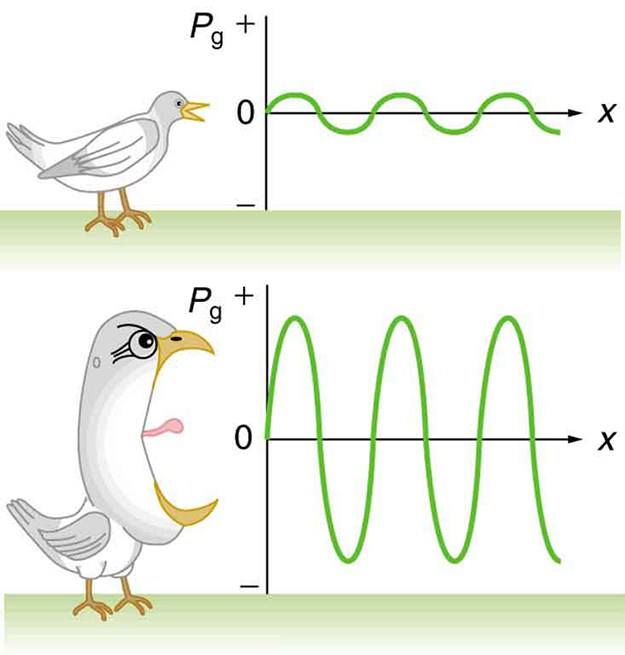
When a sound is louder, which measurement gets bigger?
Frequency
Amplitude
Wavelength
Crest

Sonar and echolocation use ----- to detect objects underwater.
Refraction
Reflection

The pitch of a sound is most closely related to the
frequency of the sound waves
distance from the sound source
medium through which the sound travels
intensity of the sound
What is the Doppler Effect?
A change in frequency due to the relative motion of a wave source and an observer
When a wave overlaps with another wave
When a wave bounces off another object
When a wave bends due to traveling through a different medium
Young's double slit relies on the _______ of light.
dampening
interference
refraction
reflection
Which figure represents the path light takes through a converging lens?
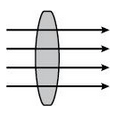
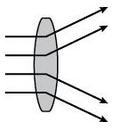
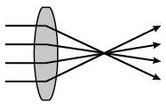
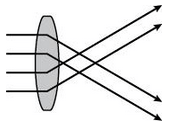

What type of interference is occurring in the picture?
Constructive
Destructive

What type of interference is shown in the picture?
Constructive
Destructive
Who, along with Thomas Edison, had a greater impact on the modern technologically advanced lifestyle we enjoy today?
Nikola Tesla
Albert Einstein
Marie Curie
Isaac Newton
What force is required to make current flow in electricity?
Power
Current
Resistance
Voltage
What was the primary reason Tesla's AC prevailed over Edison's DC in the early era of electrical transmission?
Ability to transform voltage easily
Higher efficiency in power delivery
Lower cost of transformers
Ability to power high-tech appliances
What is alternating current?
A current that always flows in the same direction
A current that reverses direction
A current that does not move

The voltage supplied to a circuit is 17 V, and the current running through it is 10 A. What is the power generated?
170 W
170 A
1.7 V
1.7 W

What type of circuit is shown in the diagram?
Parallel
Series
Open

How are the batteries connected in this circuit?
In series
In parallel
They are not connected

What is the main difference between AC and DC?
AC flows in one direction, DC alternates direction
AC alternates direction, DC flows in one direction
Both AC and DC alternate direction
Both AC and DC flow in one direction
Which component in an AC circuit is used to change the voltage level?
Capacitor
Transformer
Resistor
Inductor
An electric current that flows in only one direction.
fluctuating current
direct current
alternating current
simple current

In a parallel circuit, if one of the light bulbs burns out, the rest _________.
stop the flow of electricity
can still light up
will go out
of the light bulbs burn out also

The Coulomb is the unit for:
Charge
Force
Distance
Mass
Select all answers that apply:
What kinds of particles does Coulomb's Law apply to?
electrons
protons
neutrons
neutral atoms
A repulsive force exists between which two particles?
Two neutrons
An electron and a neutron
An electron and a proton
Two protons
An atom loses an electron. What type of charge does it have now?
positive
negative
The transfer of thermal energy between objects at different temperatures is called...
temperature
heat
internal energy
none of these
The second law of thermodynamics states that the entropy of a system tends to ______________.
increase
decrease
stay constant
fluctuate wildly
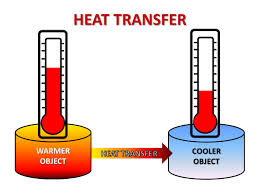
Heat transfers from an area of ____ temperature to an area of ____ temperature.
high to low
low to high
high to high
All
At constant pressure, the volume decreases. What happens to the temperature?
increases
decreases
stays the same
At a constant volume, the pressure increases. What happens to the temperature?
increases
decreases
stays the same
At a constant temperature, the volume decreases. What happens to the pressure?
increases
decreases
stays the same
P1V1=P2V2
Boyle's Law
T1V1=T2V2
Charles' Law
T1P1=T2P2
Gay-Lussac's Law
T1P1V1=T2P2V2
Combined Gas Law
PV=nRT
Ideal Gas Law
Time dilation occurs:
when traveling near the speed of light.
near massive bodies like black holes.
Hypersleep is similar to (a) . It slows down metabolism and aging. NASA has been studying bears in an attempt to replicate their ability.
Which wave behavior do noise-cancelling headphones use?
diffraction
refraction
constructive interference
destructive interference
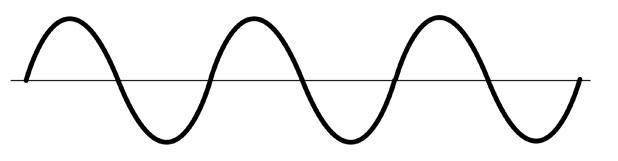
What is amplitude?
The number of vibrations per second
How high or low a sound is
The distance between the rest position and the peak of a wave
The back and forth movement of matter
What is frequency?
the number of vibrations per second
how high or low a sound is
the loudness or softness of a sound
the back-and-forth movement of matter

What can you say about this object's motion?
Moving to the North (up).
Moving to the South (down).
Moving to the West (left).
Moving to the East (right).

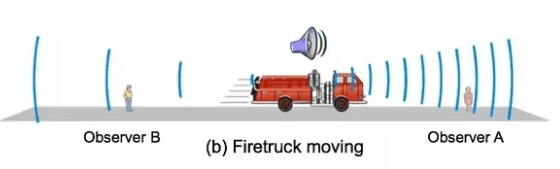
Look at the picture. Who is experiencing a higher-pitched sound?
Observer A
Observer B
There's no difference

