wayground logo

Free Printable Worksheets

Font size

S
M
L
XL
Worksheets

Biology - Semester 2 Final Review

Total questions: 117

Worksheet time: 1hrs 28mins

Name
Class
Date
1.

An organism's reproductive cells, sperm and egg cells, are called _____.

a)

bacteria

b)

prokaryotes

c)

gametes

d)

pathogens

2.

A _______ is a segment of DNA that controls our traits.

a)

gene

b)

gamete

c)

chromosome

d)

chromatid

3.

A _________ is DNA tightly coiled around proteins.

a)

gene

b)

chromosome

c)

trait

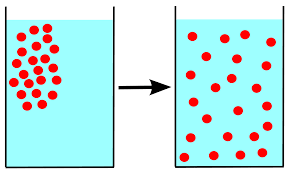
d)

mutation

4.

The 2 exact copies of DNA in a chromosome are called ________.

a)

chromatids

b)

genes

c)

mutations

d)

pathogens

5.

How many chromosomes does a human body cell have, total?

a)

48

b)

46

c)

23

d)

47

6.

Chromosomes that are organized in pairs, are the same size, and have the same genes are called _______ chromosomes.

a)

homeostasis

b)

homologous

c)

matching

d)

sister

7.

Body cells that contain both sets of chromosomes (from both parents) are called _________.

a)

diploid

b)

haploid

c)

triploid

d)

polyploid

8.

The 23rd pair of chromosomes that contain the genes to determine the sex of an individual are called ___________.

a)

sex chromosomes

b)

autosomes

c)

homologous

d)

genes

9.

The 2 female sex chromosomes are ___.

a)

XY

b)

XX

10.

The 2 male sex chromsomes are _____.

a)

XY

b)

XX

11.

How many chromosomes do we get from each parent?

a)

12

b)

23

c)

46

d)

78

12.

Chromosomes are only visible when a cell divides.

a)

True

b)

False

13.
How many DNA molecules make up a chromosome?
a)
1
b)
2
c)
23
d)
46
14.
In mitosis, the two resulting cells are
a)
different from the starting cell and identical to each other.
b)
different from the starting cell and different from each other.
c)
identical to the starting cell and different from each other.
d)
identical to the starting cell and identical to each other.
15.
In which type of cells will mitosis occur?
a)
egg cells
b)
sperm cells
c)
jail cells
d)
Body cells except the sperm and egg cells
16.
After meiosis is complete, the new cells:
a)
are all identical
b)
are all different
c)
are half identical and half different
d)
are all stretched out
17.
How many daughter cells are produced from meiosis ?
a)
10
b)
6
c)
4
d)
2
18.
Why do we need meiosis?
a)
To double the number of chromosomes going into sex cells
b)
To halve the number of chromosomes going into sex cells
c)
To triple the number of chromosomes going into sex cells
d)
To not change the number of chromosomes going into sex cells
19.
Name that process
a)
Mitosis
b)
Meiosis
c)
Mutation
d)
Cell Cycle
20.
During which phase of the meiotic cell cycle does DNA Replication occur?
a)
Interphase 
b)
Prophase 
c)
Metaphase 
d)
Telophase
21.
The stages of mitosis in order
a)
Metaphase, Anaphase, Prophase, Telophase
b)
Prophase, Anaphase, Metaphase, Telophase
c)
Prophase, Metaphase, Anaphase, Telophase
d)
Anaphase, Prophase, Telophase, Metaphase
22.
In Meiosis if the parent cells has 40 chromosomes, then how many will the daughter cells have 
a)
40
b)
10
c)
20
d)
18
23.
Another name for a sex cell is a:
a)
gamete
b)
embryo
c)
bone cell
d)
muscle cell
24.
Meiosis makes sperm and egg cells. In humans, sperm and egg cells each have _____ chromosomes. Therefore a fertilized human egg cell (sperm and egg cell combined) would create a cell with _____ chromosomes.
a)
23, 46
b)
46, 23
c)
2, 4
d)
50, 100
25.
If the Diploid number of Carrots is 18, the haploid number is
a)
18
b)
9
c)
27
d)
36
26.
Cystic Fibrosis (CF) is passed to the child from on a ____ from each parent
a)
sex chromosome
b)
autosome
27.

This type of mutation in DNA alters just one base in a DNA sequence

a)

point mutation

b)

translocation

c)

inversion

d)

trisomy

28.

In this type of point mutation, one nitrogen base is exchanged for another, different base

a)

substitution

b)

insertion

c)

deletion

d)

translocation

29.

In this type of point mutation, one extra base pair is inserted into a sequence of DNA

a)

substitution

b)

insertion

c)

deletion

d)

translocation

30.

In this type of point mutation, one base pair is lost/deleted

a)

substitution

b)

insertion

c)

deletion

d)

translocation

31.

This class of mutations changes the reading frame for transcription and translation

a)

substitution

b)

inversion

c)

translocation

d)

frameshift

32.
Describes the arrangement of the cell membrane as bendable and made of many parts. 
a)
The Fluid Mosaic Model 
b)
The Major Mobility Model 
c)
The Crazy Cell Model
d)
The Maze Model
33.
Controls the passage of materials inside and outside of the cell. 
a)
Cell Membrane
b)
Lipid Cleric Layer
c)
Membrane Gate
d)
Protein Receptors 
34.
The function of the plasma membrane is....
a)
to regulate what enters and leaves the cell.
b)
fight bacteria and viruses that enter the cell.
c)
provide rigid support and protection to the cell.
d)
make sure each cell can move
35.

When the number of water molecules outside of the cell is greater than inside the cell, which will most likely occur?

a)

Molecules of water will NOT MOVE either way.

b)

Molecules of water will move OUT of the cell.

c)

Molecules of water will move INTO the cell.

d)

Molecules of water will EVAPORATE.

36.

Cell membranes are described as selectively permeable.

Four students were asked to explain what this means. Which one is correct?

a)

Student 1: Cell membranes prevent all materials from entering the cell.

b)

Student 2: Cell membranes only provide structural support for the cell.

c)

Student 3: Cell membranes regulate which substances can enter and exit the cell.

d)

Student 4: Cell membranes allow water and water-soluble substances to enter the cell.

37.

The thin, semi-permeable membrane that encloses a cell allows nutrients to enter and wastes to be ____________________.

a)

digested

b)

recycled

c)

protected

d)

removed

38.
What is the definition of  Selective Permeability?
a)
The movement of materials across the cell membrane that requires NO ENERGY from the cell.
b)
The movement of materials through (or across) the cell membrane
c)
The ability of the cell membrane to allow some things to pass through while preventing other things from passing through.
d)
The movement of molecules from an area of high concentration (where the molecules are more crowded together) to a area of low concentration (where molecules are more spread apart)
39.
What is diffusion?
a)
when molecules move from a low concentration to a high concentration 
b)
when molecules move from a high concentration to a low concentration.
c)
no movement 
d)
molecules move everywhere
40.
Osmosis
a)
diffusion of water molecules through a semi-permeable mebrane from an area of low concentration to an area of high concentration
b)
the diffusion of particles from an area of high concentration to an area of low concentration
c)
diffusion of water molecules through a semi-permeable membrane from an area of high concentration to an area of low concentration
d)
the diffusion of particles from an area of low concentration to an area of high concentration
41.
If there is 5 percent water inside a cell and 5 percent water outside a cell
a)

more water will move into the cell

b)

more water will move out of the cell

c)

The amount of water moving into the cell is equal to the amount of water moving out of the cell
42.
The picture below is an example of _________________.
a)
osmosis
b)
isotonic
c)
diffusion
d)
active transport
43.
Which cell is placed into a hypotonic environment? 
a)
A
b)
B
c)
C
d)
D
44.
The cell below is in a _____________ solution.
a)
Hypertonic
b)
Hypotonic
c)
Isotonic
45.
What is the difference between active and passive transport?
a)
Active does not need energy and passive uses ATP (energy)
b)
Active uses ATP (energy) and passive does not need energy
c)
Active stores transport proteins and passive releases 
d)
Active uses hormones and passive does not 
46.

What is it called when large molecules move across the cell membrane from an area of high concentration to an area of low concentration through a protein channel?

a)

Diffusion

b)

Osmosis

c)

Active Transport

d)

Facilitated Diffusion

47.

When there is an equal number of molecules on the inside and outside of the cell, that is called-

a)

difference

b)

transportation

c)

homeostasis

d)

solution

48.
What type of transport is illustrated?
a)
facilitated diffusion
b)
active transport
c)
diffusion
d)
osmosis
49.
What type of transport is this?
a)
Endocytosis
b)
Diffusion
c)
Exocytosis
d)
Osmosis
50.

Active transport is movement of particles through the cell membrane from a region of ...1... to a region of ...2... using energy in the form of ...3...

a)

1: lower concentration, 2: higher concentration, 3: NADPH

b)

1: higher concentration, 2: lower concentration, 3: NADPH

c)

1: higher concentration, 2: lower concentration, 3: ATP

d)

1: lower concentration, 2: higher concentration, 3: ATP

51.

Active transport is the movement of large materials across a cell membrane from ______ to ______ concentration

a)

high to low

b)

low to high

c)

high to high

d)

low to low

52.
Which does NOT require energy to occur?
a)
Passive Transport
b)
Active Transport
c)
Endocytosis
d)
Exocytosis
53.
Which sequence of DNA bases would pair with this partial strand
ATG TGA CAG
a)
ATG TGA CAG
b)
TAC ACT GTC
c)
GTA AGT GAC
d)
CAT TCA CTG
54.
Which of the following units are repeatedly joined together to form a strand of DNA?
a)
amino acids
b)
nucleotides
c)
fatty acids
d)
polysaccharides
55.
In a molecule of double-stranded DNA, the amount of Adenine present is always equal to the amount of
a)
cytosine
b)
guanine
c)
thymine
d)
uracil
56.
Why is DNA important?
a)
it is very small and very complicated
b)
it's in everything
c)
it serves as the blueprint for traits of all living things
d)
because we eat it every day for energy
57.
Replicate the following strand of DNA: 
AATCATGGA
a)
AATCATGGA
b)
TTAGTACCT
c)
UUAGUACCU
d)
GGATAUCUA
58.
Place in order the steps which DNA replication occurs. 
a)
3, 2, 1, 4
b)
2, 1, 4, 3
c)
2, 3, 1, 4
d)
3, 4, 1, 2
59.
What are the three components of a nucleotide?
a)
sugar, hydrogen, nitrogen base
b)
sugar, oxygen, nitrogen base
c)
sugar, phosphate, nitrogen base
d)
sugar, phosphate, protein
60.
The image illustrates which of the following structures?
a)
Amino acid
b)
Nucleotide
c)
Protein
d)
Peptide Bond
61.
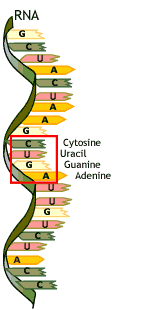
In RNA, Uracil pairs with ______. 
a)
cytosine
b)
adenine
c)
guanine
d)
thymine
62.
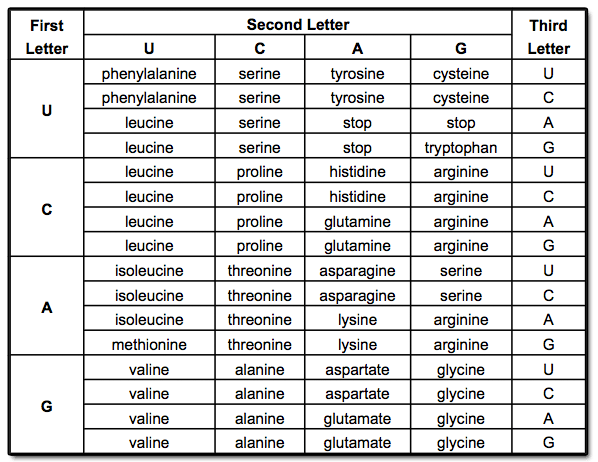
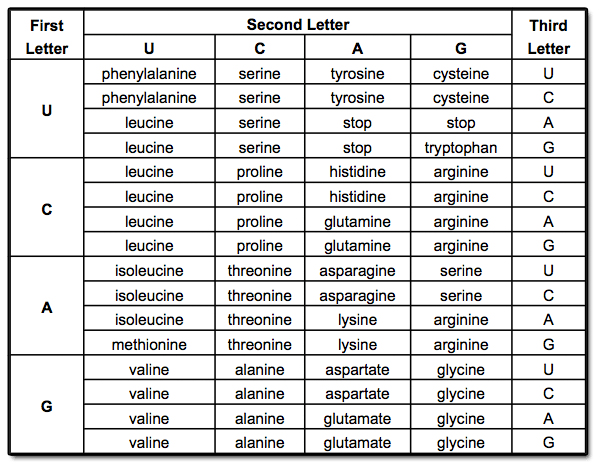
What is the correct amino acid sequence for the mRNA code AUGCCAGUAUGA
a)
Met-Pro-Ala-Val
b)
Met-Pro-Val
c)
Tyr-Gly-His
d)
Tyr-Gly-Arg-His
63.
How many amino acids are coded for by this sequence of nucleotides:
ATG GGA ACT CCA
a)
4
b)
2
c)
6
d)
12
64.
What is the location in the cell for transcription?
a)
nucleus
b)
cytoplasm
c)
ribosome
d)
mitochondria
65.
What is the location in the cell for translation?
a)
nucleus
b)
mitochondria
c)
ribosome
d)
chloroplast
66.
Which component of DNA determines the traits of an organism? 
a)
Nitrogen Bases
b)
Sugar-Phosphate Backbone
c)
Hydrogen bonds
67.
DNA holds the code for
a)
lipids
b)
carbohydrates
c)
protein
d)
sugar
68.
Choose the nucleotide sequence of the RNA strand that would be complementary to the following strand: 
GTAGTCA
a)
UATUAGA
b)
ACGACTG
c)
CAUCAGU
d)
CATCAGT
69.
What amino acid is represented by the codon UUA?
a)
Phenylalanine
b)
Tyrosine
c)
Leucine
d)
Stop codon
70.
Which is the mRNA molecule that would be transcribed from this DNA template:
TGGCAAGTACGT
a)
ACCGTTCATGCA
b)
UGGCAAGUACGU
c)
UCCGUUCUUGCU
d)
ACCGUUCAUGCA
71.
What process is going on in this photo? 
a)
Transcription 
b)
Translation 
c)
Replication 
d)
All the above 
72.
Which of these nitrogenous bases is NOT in RNA?
a)
Uracil
b)
Thymine
c)
Cytosine
d)
Guanine
73.
The end product of translation is what?
a)
amino acid
b)
protein
c)
sugar
d)
lipid
74.
What causes genetic variation in meiosis?
a)
chromosomes lining up
b)
crossing over of chromosomes
c)
separation of chromosomes
d)
chromosomes pulling apart
75.
Name the phase:
a)
Anaphase
b)
Telophase
c)
Metaphase
d)
Prophase
76.
What is the next phase of mitosis?
a)
Prophase
b)
Metaphase
c)
Anaphase
d)
Telophase
77.
What are the steps of the cell cycle in order?
a)
Interphase, Mitosis, Cytokinesis
b)
Interphase, Cytokinesis, Mitosis
c)
Mitosis, Cytokinesis, Interphase
d)
Cytokinesis, Mitosis, Interphase
78.
The diagram shows the process of cell specialization from a single stem cell. Which of the following statements is true about the process of specialization.
a)
Specilized cells (blood, skin, nervous etc) cannot be produced from a single stem cell
b)
Specilized cells are produced immediately following fertilization
c)
Even though all the cells in an organism come from one single cell, they can specialize into different cell types
d)
Sincce all the cells in an organism come from one single cell, they must all have the same structure and function
79.

What is a phenotype?

a)

The expression of a trait; physical appearance.

b)

refers to the genes of an individual

c)

An organism that has the same genes for a trait (ex. TT or tt)

d)

the passing of traits from parent to offspring
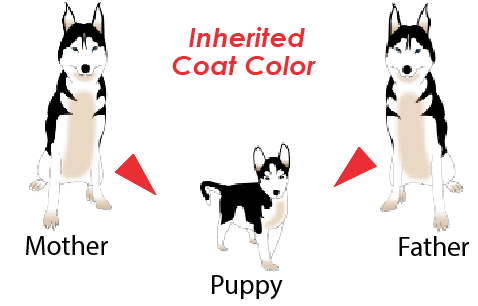
80.
What does heterozygous mean?
a)
An organism that has the same genes for a trait (TT or tt)
b)
An organism that has different genes for a trait (Tt)
c)
When neither gene is fully dominant; offspring is a mixture of both
d)
the different forms of a trait (hair color--> brown, blonde, red
81.
An allele whose trait only shows up when no dominant allele is present.
a)
hidden allele
b)
dominant allele
c)
recessive allele
d)
present allele
82.
An allele whose trait always shows up in the organism when the allele is present.
a)
recessive allele
b)
dominant allele
c)
hidden allele
d)
present allele
83.
Dominant alleles are represented by a:
a)
Male gene
b)
lowercase letter
c)
recessive trait
d)
capital letter
84.
Two brown eyed parents (Bb) have a baby. What is the chance the baby is blue eyed?
a)
0 %
b)
25%
c)
50%
d)
75%
85.

Passing on traits from parents to offspring

a)

Chromosome

b)

Genotype

c)

Heredity

d)

Allele

86.

The study of heredity

a)

Genetics

b)

Genome

c)

Allele

d)

Punnett Square

87.
Each parent contributes one of the genes for a particular trait. The genes of the pair are called:
a)
variables
b)
gametes
c)
hybrids
d)
alleles
88.

Some flowers are controlled by codominance. Red flowers (RR), blue flowers (BB) and Speckled flowers (RB).


Cross two speckled flowers.

a)

1 red, 2 speckled, 1 blue

b)

2 red, 2 blue

c)

2 blue, 2 speckled

d)

1 red, 1 speckled, 2 blue

89.

Some flowers are controlled by codominance. Red flowers (RR), blue flowers (BB) and Speckled flowers (RB).


Cross a red flower with a blue flower.

a)

1 red, 2 speckled, 1 blue

b)

2 red, 2 blue

c)

4 speckled

d)

1 red, 1 speckled, 2 blue

90.

Incomplete dominance occurs in cats, which allows them to be Black, White, or gray as shown on this Punnett square. What percentage of the offspring will be black?

a)

25

b)

50

c)

75

d)

100

91.
What is the genotype of a person with type A blood, who had a father with type O blood?
a)
AB
b)
AO
c)
AA
d)
OO
92.
What determines gender in humans? 
a)
the X and Y chromosome
b)
chromosome 21
c)
codominance
d)
epistasis
93.
Duchenne muscular dystrophy is a recessive x-linked disorder.
According to the Punnett square, what percentage of male offspring will have the disorder?
a)
0%
b)
25%
c)
50%
d)
100%
94.

Objective #13

This is a pedigree that follows blue eyes which is a recessive trait. What is the genotype of the father (square) in generation 1?

a)

Aa

b)

AA

c)

aa

d)

A?

95.

Huntington's Disease is a dominant trait.

What is the correct genotype for individual I-2?

a)

HH

b)

Hh

c)

hh

d)

H?

96.
The difference in the physical traits of an individual from those of other individuals in a group is called a(n)
a)
change
b)
adaption
c)
species
d)
variation
97.
What did Charles Darwin observe in finch populations of the Galapagos Islands off the coast of South America?
a)
different species on different islands
b)
all species on one of the islands
c)
identical species on all the islands
d)
the same species as North America
98.
Which of the following is a fossil?
a)
a plant that has recently died
b)
a group of organisms that can reproduce
c)
a structure or organ that no longer functions
d)
a trace of an organisms that existed in the past
99.
In natural selection, the selecting agent is the
a)
humans
b)
mutations
c)
breeders
d)
environment
100.
A bird  in a population that can easily outcompete other birds for food and that can produce many offspring has a high
a)
life expectancy
b)
mutation rate
c)
fitness
d)
adaptability
101.
Which of the folllowing is an exammple of a vestigial structure?
a)
the wings of a red-tailed hawk
b)
the hind limbs of a house cat
c)
the fins of sharks
d)
the wings of an ostrich
102.
What is suggested by the similarity of early embryos of different species of vertebrates? (i.e. humans, turtles, fish, chickens, salamanders, rabbits, etc.)
a)
no evolutionary relationships between the groups
b)
convergent evolution
c)
similar structures with different functions
d)
evolution from a distant common ancestor
103.
Some organisms that share a common ancestor have features that have different functions, but similar structures.  These are known as
a)
vestigial structures
b)
analogous structures
c)
homologous structures
d)
fossil structures
104.
Genetic variation can arise from a random change in the DNA of a gene.  This change is called a(n)
a)
mutation
b)
gene flow
c)
gene pool
d)
allele
105.
Mutations are important because they bring about
a)
death of the organism in which they develop
b)
genetic variation needed for a population to evolve
c)
benefits for the individual, not for the population
d)
Hardey-Weinberg equilibrium within a population
106.
What is the process in which humans breed organisms for certain traits? (Examples include: Cattle, Dogs, Crops)
a)
natural selection
b)
coevolution
c)
artificial selection
d)
convergent evolution
107.
Which of the following is a term for a group of similar organisms that can reproduce  and have fertile offspring?
a)
individual
b)
population
c)
species
d)
fossil
108.
The concept of gene flow is demonstrated when a cow is driven off from its herd, joins another herd, and reproduces. When the cow contributes to the gene pool of the new herd, which of these will most likely increase?
a)
Environmental fitness
b)
Reproductive mutations
c)
Natural selection
d)
Genetic variation
109.
The hypothesis that evolution of a species occurs gradually over time at a slow and constant process is known as
a)
speciation
b)
punctuated equilibrium
c)
gradualism
d)
microevolution
110.
The hypothesis that evolution of a species occurs in periods of rapid change separated by periods of little or no change is called
a)
divergence
b)
gradualism
c)
punctuated equilibrium
d)
isolation
111.
What is the image an example of?
a)
vestigial structures
b)
comparative embryology
c)
homologous structures (comparative anatomy)
d)
fossil record
112.
What is the study of organisms at the early stages of development?
a)
Biochemical/Molecular Evidence
b)
Comparative Embryology 
c)
Homologous Structures (Comparative Anatomy)
d)
Fossil Record
113.
The Asian shore crab invaded parts of the eastern coast of the United States about 15 years ago. The Asian shore crab preys on blue mussels. In the time since the Asian shore crab arrived, the average shell thickness of the blue mussel population has increased. Which of the following is the most likely reason that this increase in shell thickness has occurred? 
a)
Blue mussels with thick shells attract more crabs that mussels without thick shells.
b)
Blue mussels with thick shells grow in larger colonies than mussels without thick shells.
c)
Blue mussels with thick shells catch more food per day than mussels without thick shells.
d)
Blue mussels with thick shells survive and reproduce more successfully than mussels without thick shells.
114.
What type of natural selection is this? (Hint: one extreme is selected for)
a)
Disruptive Selection
b)
Directional Selection
c)
Stabilizing Selection
d)
Normalizing Selection
115.

Which of the following describes the function of the vibrant coloration found in the peacock feathers?

a)

behavioral isolation

b)

cryptic coloration

c)

intersexual selection

d)

intrasexual selection

116.
two species are in different environments and look very similar.  However, that are not closely related (analogous).  Their resemblance is most likely an example of.
a)
sexual selection
b)
temporal isolation
c)
convergent evolution
d)
divergent evolution
117.

Other insects cannot, but, a bumble bee has just enough weight to open up the snapdragon flower and pollinate. This adaption is ....

a)

convergent evolution

b)

co-evolution

c)

divergent evolution

d)

speciation