wayground logo

Free Printable Worksheets

Font size

S
M
L
XL
Worksheets

7th grade final exam '22

Total questions: 111

Worksheet time: 3hrs 34mins

Name
Class
Date
1.
The amount of water vapor present in the air is called ________________.
a)
weather
b)
humidity
c)
air mass
d)
dew point
2.
Because the earth is spinning on its axis, the global winds appear to curve. This is known as the __________ ________.
a)
Coriolis Effect
b)
Greenhouse Effect
c)
Climate Effect
d)
Atmosphere Effect
3.
What kind of weather is usually associated with a high pressure system?
a)
Sunny weather
b)
Precipitation (rain, snow, etc.)
c)

Hi pressure is not an indicator of the type of weather

4.
What is the condition of the Earth's atmosphere at a certain time and place?
a)
climate
b)
temperature
c)
weather
d)
air pressure
5.
They are highest clouds in the sky. They look curly, white and feathery. Usually mean good weather.
a)
Cumulus
b)
Cumulonimbus
c)
Cirrus
d)
Stratus
6.
This is sometimes called a thunderhead cloud. It looks very tall like mountains and heavy rain comes from it. 
a)
Cumulus
b)
Cirrus
c)
Stratus
d)
Cumulonimbus
7.

Warm air rises because it is __________

a)

More dense than cold air

b)

Less dense than cold air

c)

It has the same density as cold air

8.
Which weather tool measures air pressure?
a)
thermometer
b)
barometer
c)
anemometer
d)
psychrometer
9.
What heats the Earth's surface?
a)
the moon
b)
the sun
c)
the ocean
d)
the sky
10.
Before condensation can occur, the air must  be ____________________________.
a)
Humid
b)
Cold
c)
Hot
d)
Saturated
11.

What are the characteristics of a high-pressure system?

a)

Wind and rain

b)

Humidity and thunder

c)

Extremely hot temperatures

d)

Clear skies and sun

12.

If the air is only holding one-third as much moisture as it can possibly hold, what is the relative humidity?

a)

25 percent

b)

50 percent

c)

33 percent

d)

67 percent

13.

This tool measures the wind speed.

a)

barometer

b)

anemometer

c)

thermometer

d)

psychrometer

14.
Someone who studies the weather.
a)
rain gauge
b)
taxonomists
c)
meterologist
d)
satellites
15.

What kind of weather would you expect in a low pressure system?

a)

Warm temperatures

b)

Cool temperatures

c)

Clear conditions

d)

Cloudy/rainy conditions

16.
Rain, snow, sleet, and hail are all forms of _____.
a)
precipitation
b)
condensation
c)
evaporation
d)
climate
17.
What symbol is this?
a)
warm front
b)
cold front
c)
stationary front
d)
occluded front
18.
Does lightning or thunder come first?
a)
thunder
b)
lightning
c)
it depends
19.

This is the symbol for a _____________ weather front.

a)

Cold

b)

Warm

c)

Stationary

d)

Occluded

20.

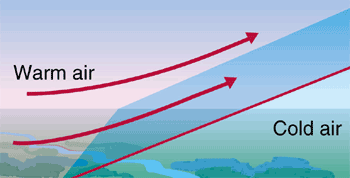
A _____________ weather front occurs when a cold air mass moves forward, pushing the warm air mass up.

a)

Cold

b)

Warm

c)

Stationary

d)

Occluded

21.

Why does warm air rise above cold air?

a)

Warm air is less dense

b)

Warm air is more dense

c)

Cold air is stronger than warm air

22.

The warm climate zone near the equator:

a)

Tropical Zone

b)

Polar Zone

c)

Temperate Zone

d)

Climate

23.

The area between the tropical and the polar zones with seasonal climate:

a)

Tropical Zone

b)

Polar Zone

c)

Temperate Zone

d)

Climate

24.

The average, year-after-year conditions of temperature, precipitation, winds, and clouds in an area:

a)

Tropical Zone

b)

Climate

c)

El Niño

d)

La Niña

25.

A warm-water event that can change weather patterns causing heavy rains or droughts:

a)

El Niño

b)

La Niña

c)

Sunspots

d)

Global Warming

26.

Near which city is the high pressure system located?

a)

Seattle

b)

Minneapolis

c)

Dallas

d)

Chicago

27.

Near which two cities are the low pressure systems located?

a)

Seattle & San Francisco

b)

Chicago & Seattle

c)

Dallas & Houston

d)

Chicago & Nashville

28.
a)

cold air moving into an area

b)

warm air moving into an area

c)

humid air over an area

d)

dry air over an area

29.
All the air surrounding the earth
a)
atmosphere
b)
hydrosphere
c)
mesosphere
d)
air
30.

A strong thunderstorm followed by clear skies and a drop in temperature is the result of a _____________ moving through.

a)

warm front

b)

cold front

c)

air mass

d)

pressure front

31.
The heat from a lamp allows a lizard to remain warm. This is an example of which type of heat transfer?
a)
radiation
b)
conduction
c)
convection
d)
insulation
32.
The cycle that powers the ocean currents, weather, and tectonic plates it called
a)
conduction current
b)
radiation
c)
condition current
d)
convection current
33.

In general, clear skies come with a high-pressure area and cloudier conditions in areas of low pressure.


Which city on the map is most likely experiencing CLOUDS but will see CLEAR SKIES soon?

a)

Omaha

b)

Atlanta

c)

Cleveland

d)

Los Angeles

34.

In which general direction is the cold front near Florida moving?

a)

north

b)

south

c)

east

d)

west

35.
What type of weather will central Texas have in the next couple of hours?
a)
Low pressure with cool and dry weather
b)
Low pressure with stormy weather.
c)
High pressure with cold clear skys
36.
What type of weather would you predict for Columbia, SC based on this weather map? 
a)
Cooler and potential for storms
b)
Warm and clear
c)
Consistently hot and sunny
d)
Record highs
37.
Which direction does weather generally move across the US?
a)
N to S
b)
W to E
c)
S to E
d)
E to W
38.
What direction is the cold front moving?
a)
Northwest
b)
Southeast
c)
Northeast
d)
Southwest
39.
Which city can expect to see an increase in temperatures over the next 24 hours?
a)
Billings, Montana
b)
Atlanta, Georgia
c)
Minneapolis, Minnesota
d)
Miami, Florida
40.
Water as a gas is called _________.
a)
water vapor
b)
tornado
c)
hibernate
41.
The changing of water (liquid) into water vapor (gas) is called ___________.
a)
condensation
b)
evaporation
c)
precipitation
42.
The changing of water vapor (gas) into water (liquid) is _____________________.
a)
water vapor
b)
tornado
c)
condensation
43.

What city will experience decreasing temperatures in the next day? cooler temperatures

a)

Denver

b)

El Paso

c)

Memphis

d)

Los Angeles

44.

It is defined as a push or a pull.

a)

Elements

b)

Force

c)

Friction

d)

Fracture

45.

Use the picture as reference. If the force of the girl pushing is 30N, and the force of the boy who is also pushing is 30N, what is the net force?

a)

0N

b)

60N

c)

900N

d)

1N

46.

Use the picture as reference. If the force of the girl pushing is 20N, and the boy who is also pushing is 15N, what is the net force?

a)

5N

b)

300N

c)

35N

d)

1.33N

47.

If you apply an unbalanced force to an object at rest, what will happen to that object?

a)

the object will remain at rest.

b)

the object will move.

c)

The object will stay.

d)

None of the above.

48.

If all forces acting on an object have equal magnitudes, what is the state of that object?

a)

the object is at rest.

b)

the object is moving.

c)

The object is accelerating.

d)

None of the above.

49.
Balanced or unbalanced?
a)
balanced
b)
unbalanced
50.

Walking down the hall and speeding up when you turn and go down the stairs is an example of ____________.

a)

acceleration

b)

weight

c)

gravity

d)

friction

51.

Letting go of a balloon full of air is demonstrating Newton's ______ _______ ________ _________ because the air comes out of the back and the balloon moves forward.

a)

1st law of motion

b)

2nd law of motion

c)

3rd law of motion

d)

13th law of motion

52.

What law is best described by inertia?

a)

1st

b)

2nd

c)

3rd

d)

law of conservation of mass

53.

A person not paying attention while skateboarding hits a rock. The skateboard stops...they don't.

a)

The Law of Inertia (1st law)

b)

The Law of Acceleration (2nd law)

c)

The Law of Conservation of Momentum

d)

Action Reaction Law (3rd law)

54.

What law is best described

a)

1st

b)

2nd

c)

3rd

d)

law of motion

55.

What law is best described

A magician pulls a tablecloth out from under dishes and glasses on a table without disturbing them.

a)

Newton's 1st Law

b)

Newton's 2nd Law

c)

Newton's 3rd Law

56.
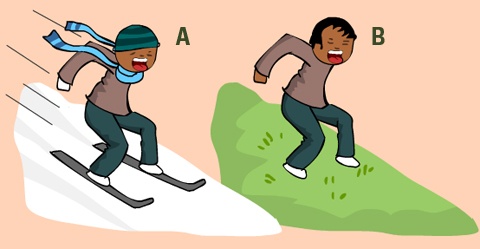
Why is it harder for the boy in Image B to get down the hill?
a)
Motion
b)
Friction
c)
Work
d)
Displacement
57.
It takes more force to accelerate the iron man on the left than the iron man on the right because the iron man on the left has more mass. This best describes
a)
Newton's first law, the law of inertia
b)
Newton's second law, the law of acceleration
c)
Newton's third law, the law of action reaction 
d)
The law of universal gravitation
58.
What is the attractive force that exists between all objects that have mass?
a)
Weight
b)
Mass 
c)
Gravity
d)
Viscosity
59.

What do all waves transfer?

a)

Matter

b)

Heat

c)

Electricity

d)

Energy

60.

Which of the following can waves transfer energy through?

a)

solid

b)

liquid

c)

gas

d)

empty space

e)

all of the above

61.

What are the two types of waves?

a)

longitudinal and transverse

b)

sound and light

62.

What is the number of complete waves passing a fixed point in a given amount of time?

a)

Amplitude

b)

Intensity

c)

Wavelength

d)

Frequency

63.

Which type of waves have the longest wavelength?

a)

Visible light

b)

Radio waves

c)

X-rays

d)

Gamma-Rays

64.

Shorter wave lengths can carry more energy. Which of these probably carries the MOST energy:

a)

Infrared light

b)

Visible light

c)

X-rays

d)

UV light

65.

What is the distance between the calm sea and the highest wave called?

a)

Wave

b)

Frequency

c)

Amplitude

d)

Magnitude

66.

What does #2 represent?

a)

Period

b)

Frequency

c)

Wavelength

d)

Amplitude

67.

Electromagnetic waves vary in

a)

the speed they travel in a vacuum

b)

wavelength and frequency

c)

the way they reflect

d)

the orientation of their electric and magnetic fields

68.

The visible light spectrum ranges between

a)

radio waves and X-rays

b)

infrared rays and ultraviolet rays

c)

television waves and infrared rays

d)

ultraviolet rays and gamma rays

69.

Which wave has a longer wavelength?

a)

wave C

b)

wave D

70.

a form of electromagnetic radiation that doesn't require a medium to pass through

a)

sound wave

b)

transverse wave

c)

light wave

d)

compressional wave

71.

Which section of the spectrum is the ONLY one we can see?

a)

X-rays

b)

Gamma Rays

c)

Visible Light

d)

Ultraviolet Rays

72.

Which is the best example that something has kinetic energy?

a)

a car parked on a steep hill

b)

a tennis ball rolling across the court

c)

a picture hanging on the wall

d)

a piece of coal before it's burned

73.

Conservation of energy means that

a)

energy can be created but not destroyed

b)

energy can be destroyed but not created

c)

energy can both be created and destroyed

d)

energy can neither be created nor destroyed

74.

At which point is potential energy greatest?

a)

W

b)

X

c)

Y

d)

Z

75.
What kind of energy is in a rock at the edge of a cliff?
a)
Potential
b)
Kinetic
c)
Both potential and kinetic energy
d)
none of the above
76.
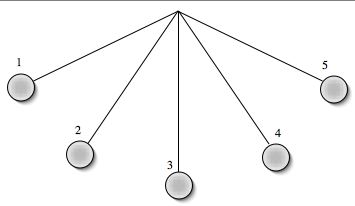
When a pendulum swings, at which point is kinetic energy highest?
a)
1
b)
2
c)
3
d)
4
77.

A diver just before she dives off the 30m platform.

a)

potential energy

b)

kinetic energy

78.
How does potential energy become kinetic energy?
a)
When something hot touches something cool, the potential energy in the hot object is turned into kinetic energy in the cool object
b)
When an outside force acts upon an object with potential energy, that force turns the potential energy into kinetic energy
c)
Potential energy becomes kinetic when an object remains in place and continues to build up more and more energy
d)
Potential energy has no relation to kinetic energy
79.
Why does the area around the equator stay the same temperature all year?
a)
The equator rotates slower than the poles 
b)
The equator remains the same distance from the sun.
c)
The equator always receives direct sunlight.
d)
The equator has 18 hour days.
80.

If a diagram shows the Earth's movement around the Sun. What is this diagram demonstrating?

a)

day and night

b)

seasons

81.
What happens when the area in which you live tilts away from the sun?
a)
It is summer.
b)
It is spring.
c)
It is winter.
d)
It is fall.
82.

Why do we experience the changing of the season on the earth?

a)

distance from the sun

b)

rotation of the earth

c)

change in solar output

d)

tilt of the earth's axis

83.
At position A, in the Northern hemisphere it would be _____?
a)
Summer
b)
Winter
c)
Spring
d)
Fall
84.
The imaginary line that separates the northern and southern hemispheres is called the....
a)
axis
b)
equator
c)
solstice
d)
equinox
85.
The Earth's _______ is an imaginary line that goes from the North Pole to the South Pole.
a)
vernal equinox
b)
axis
c)
solar eclipse
d)
solar flare
86.
At position A, in the Northern hemisphere it would be _____?
a)
Summer
b)
Winter
c)
Spring
d)
Fall
87.

Which of the following is NOT a factor that affects temperature in a certain spot on Earth?

a)

altitude

b)

latitude

c)

type of surface

d)

longitude

e)

nearby bodies of water

88.

What is a prototype?

a)

The final design that is ready to be manufactured.

b)

Drawing that show a single view of an object; in a way that makes it appear 3D.

c)

A model that is used to test certain aspects of a solution.

d)

All choices are correct.

89.

________ is the creative application of technology to design a system, product, or process to solve a given problem or meet a given need.

a)

Social Design

b)

Mechanical Design

c)

Engineering Design

d)

Problem Design

90.
______ is any modification of the natural world made to fulfill human needs or desires
a)
Engineering 
b)
Technology
c)
Application of Science
d)
All of the above
91.
_____ is a systematic and often iterative approach to designing objects, processes, and systems to meet human needs and wants. 
a)
Technology
b)
Engineering 
c)
Application of Science
d)
Exploration 
92.
Jacob has noticed that when he opens his bedroom door, the doorknob hits the wall. He decides to design a device to absorb the force of the opening door. He has identified the problem. What is the next step in his design process?
a)
Evaluate the design.
b)
Identify the criteria and constraints.
c)
Brainstorm solutions. 
d)
Sketch a possible prototype.
93.
Which of the following could be a design constraint? 
a)
Purpose 
b)
Durability
c)
How the system will function
d)
Available materials
94.

What is the First Step of the Engineering Design Process

a)

Testing Solutions

b)

Designing Solutions

c)

Identifying the Problem

d)

Planning Solutions

95.
An engineer has designed and built a prototype to improve the brake system of a car. What is the next step that the engineer should take in the process?
a)
Test the prototype.
b)
Make sketches of the prototype.
c)
Identify constraints.
d)
Collect and analyze the test results. 
96.

An inference is based on:

a)

both scientific observations and known facts

b)

known facts

c)

scientific observations

d)

a rumor you started in the bathroom

97.

What is the scientific method?

a)

A systematic procedure for how to conduct a scientific experiment

b)

The process of solving a problem

c)

A way of making non-scientific observations

d)

A way to summarize findings from multiple investigations

98.

Which of the following is NOT a testable question?

a)

How do rockets work?

b)

Does fertilizer help plants grow bigger?

c)

Does heart rate increase with exercise?

d)

Does the freezing point of water change at different elevations?

99.

What is a hypothesis?

a)

An educated prediction or answer to a testable question

b)

A random guess

c)

An observation based on feelings or emotions

d)
100.

What is the best way to collect and record data?

a)

In a data table

b)

On post-it notes

c)

On scrap paper

d)

interpretive dance

101.

An observation that is measurable and made with tools (such as a ruler or scale) is what type

a)

quantitative

b)

qualitative

c)

koalatative

102.

After the data is analyzed the hypothesis is stated as correct or incorrect in the __________

a)

conclusion

b)

experiment

c)

hypothesis

d)

table of contents

103.
This variable in an experiment is the one being changed by the scientist. 
a)
dependent variable
b)
independent variable
c)
data
d)
control group
104.
The name of the information that you get from your experiment (you organize it into charts and graphs).
a)
observations
conclusion
b)
data
c)
variables
d)
hypothesis
105.
The graph below shows atmospheric carbon dioxide levels since the year 1880.Which of the following conclusions can be drawn from this graph
a)
 Atmospheric carbon dioxide levels are responsible for global temperature change.
b)
 Atmospheric carbon dioxide levels have been rising at about the same rate for the past century.
c)
Atmospheric carbon dioxide levels have remained the same over the past century.
d)
 Atmospheric carbon dioxide levels have been rising at an increasingly higher rate as the past century has progressed.
106.
Carmen conducted an experiment to determine if listening to different types of music would affect a person’s pulse. Her hypothesis was that pulse rate would change with different types of music. Each person listened to seven different selections of music for 30 seconds each. Each person’s pulse was taken before the music and then after each 30-second interval of music. The pulses were taken again after the music selections were completed. Based on her experiment, Carmen concluded that a person’s pulse rate changed when the person listened to different types of music.  Which component is missing from Carmen’s experiment?
a)
a question
b)
a hypothesis
c)
a control group
d)
a description of the experiment
107.
In order to be accepted, a scientific theory must be
a)
 widely tested and supported by extensive data
b)
 based on the results of a single experiment
c)
 controversial and cause debate
d)
 in line with all previous historical ideas
108.
An experiment was carried out to determine whether drinking caffeinated soda increases pulse rate. The pulse rates of two groups of people at rest were measured. Group A was then given caffeinated soda and group B was given caffeine-free soda. One hour after drinking the soda, the pulse rates were measured. The participants in the experiment were all the same age, and they were all given the same amount of soda. The dependent variable in this experiment is the
a)
type of soda given to each group
b)
amount of soda given to each group
c)
 pulse rate of each group
d)
age of participants in each group
109.
As the air temperature increases, the air's capacity for water vapor: 
a)
increases
b)
decreases
c)
remains the same
d)
is unrelated to air temperature and can either increase or decrease
110.
The temperature to which air must be cooled in order to become saturated is the: 
a)
Relative Humidity
b)
Mixing Ratio
c)
Dew Point Temperature
d)
Wet-bulb Temperature
111.
Which environment will probably have the lowest relative humidity?
a)
swamp
b)
desert
c)
rain forest