
 Worksheets
Biotech Final Exam Review
Total questions: 95
Worksheet time: 2hrs 38mins
Wheat plants that produce the most grain are bred together to produce more grain. What is this an example of?
transgenic breeding
selective breeding
mutagenesis
recombinant organisms
Which government agency would most likely conduct research on preventing an outbreak of a disease?
Food and Drug Administration (FDA)
Centers for Disease Control (CDC)
National Institute for Health (NIH)
United States Department of Agriculture (USDA)
The collaborative, international project that aimed to sequence all of the bases of human DNA was called
The ENCODE Project
The Human Genome Project
1000 Genome Project
HapMap
Cotton that is pest resistant due to containing the Bt genes is and example of:
transgenic crop
genetically engineered enzyme
primer designed crop
monoclonal crop
Which of the following is an example of medical or pharmaceutical biotechnology?
using DNA analysis to identify poached organisms
inserting a gene for making human insulin into a bacterium to allow it to start producing insulin used to manage diabetes
inserting a gene into crops to make it disease resistant
identification of endangered species through DNA fingerprinting
Which government agency conducts and funds biomedical research?
Food and Drug Administration (FDA)
Centers for Disease Control (CDC)
National Institute of Health (NIH)
United States Department of Agriculture (USDA)
Biotechnology is _________________
the study and manipulation of living things to make products or services for human benefit.
the combination of different species DNA to make products or services for human benefit.
technology created to manipulate human DNA.
Scientific research whose main purpose is to enrich the scientific knowledge base is __.
applied science
pure science
protease
efficate science
How is recombinant chymosin produced?
It is extracted from the stomachs of nursing calves.
It is extracted from plants that naturally produce it.
The gene for chymosin is taken from a cow and added to yeast cells.
It is cultured by using a starter from previous batches of cheese.


An animal cell has the following except a/an...
Nucleus
Lysosome
Cell Wall
Endoplasmic reticulum
A sperm cell requires a significant amount of ATP to move through its environment. Which structures would be responsible for producing that ATP?
mitochondria
Golgi apparatus
rough endoplasmic reticulum
chloroplasts
If a cell's lysosomes were damaged, which of the following would most likely occur?
The cell would produce more proteins than it needs.
The cell would have chloroplasts that would appear yellow instead of green.
The cell would be less able to break down wastes in the cytoplasm.
The cell would produce less ATP than it needs.
Insulin is a protein that is produced in the cells of the pancreas. It leaves these cells and travels through the blood stream to collect extra sugar from the blood and take it to the liver. In which cell structure would hemoglobin be produced?
attached ribosomes
free ribosomes
Golgi apparatus
nucleus

These rectangular cells contain a nucleus and small organelles called chloroplasts. This information lets you know that these are
prokaryotic cells
bacteria cells
plant cells
animal cells
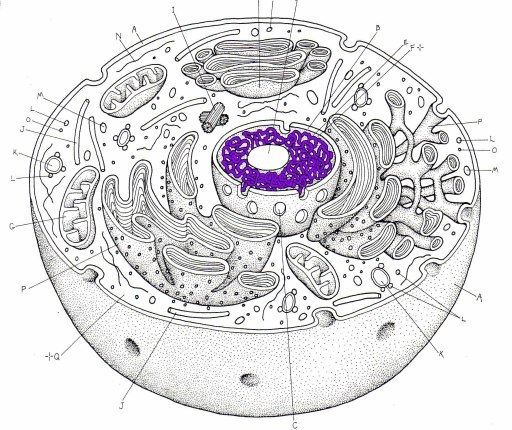
A single-celled organism that lacks a membrane-bound nucleus, mitochondria, or any other membrane -bound organelle is called a/an:
Prokaryote
Eukaryote
Nucleus
Several enzymes are involved in the process that converts solar energy into chemical energy while using carbon dioxide and water. Where are these enzymes located in the cell?
mitochondrion
chloroplast
cytoplasm
rough endoplasmic reticulum

The structure labeled "G" is responsible for storing food, water and waste. What is the name of structure "G"?
cell wall
chloroplast
central vacuole
nucleus
cell membrane

What are the two parts of the chromosome that are labeled with "?" called?
sister chromatids
genes
mutations
pathogens


During which phase of the cell cycle does DNA replicate?
During which phase of the cell cycle would anaphase occur?
During which phases of mitosis is this structure visible in this exact shape?
prophase and metaphase
metaphase and anaphase
anaphase and telophase
interphase and telophase
During which phase of the cell cycle would metaphase occur?

How many nucleotides are depicted in the image?
36
1
6
12
ATG TGA CAG

The picture below shows an enzyme unwinding and unzipping DNA.
What is the name of this enzyme?
DNA Helicase
DNA Ligase
DNA polyermase
RNA Polymerase
If a person suffers from a disorder where their DNA fragments are unable to fill in the missing slots in between the fragments of the lagging strand, they would most likely have a disorder that affects which enzyme?
DNA Helicase
DNA Ligase
DNA polyermase
RNA Polymerase
Chargaff's rules state that....
The amount of A's always = the amount of C's and the amount of T's always = the amount of G's.
The amount of A's always = the amount of A's and the amount of C's always = the amount of C's.
The amount of A's always = the amount of G's and the amount of C's always = the amount of T's.
The amount of A's always = the amount of T's and the amount of C's always = the amount of G's.

In the diagram, what is structure #1?
Topisomerase
Primase
Helicase
Single stranded binding protein
A gene is analyzed. It is determined that 30% of the nitrogen bases are adenine. What percent of the nitrogen bases would be composed of guanine?
70%
30%
35%
20%
Which of the following explains why DNA can fit into the nucleus of a cell?
DNA decondenses to form chromatin, which is small enough to fit inside of the nucleus.
DNA winds around histone proteins to form nucleosomes. The nucleosomes wind up to form a chromosome.
Nucleosomes wind around histones to form chromatin. This chromatin will then wind up to form a centriole.
Chromosomes wind around chromatin to form a nucleosome.
What is the mRNA sequence that complements the following DNA sequence: TAT-AAA-CGC-TAG-GCA
ATA-TTT-GCG-ATC-CGT
AUA-UUU-GCG-AUC-CGU
TAT-AAA-CGC-TAG-GCA
UTU-TTT-GCG-UTC-CGT

What process is happening in the diagram?
transcription
translation
dna replication
mitosis
The process of transcription takes place ________, and the process of translation takes place _________.
in the cytoplasm; on the nuclear membrane
In the nucleus; at a chloroplast
in the nucleus; at a ribosome
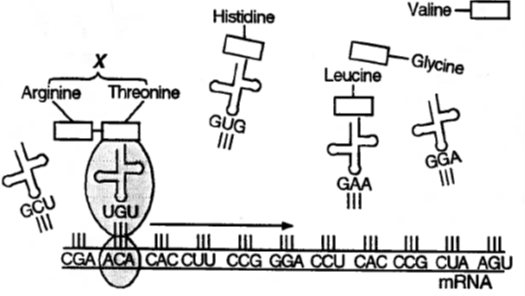

If the mRNA codons read ACA-GUA-GAA-UUG-AUC, what amino acids make up the protein sequence?
Cys-Val-Gly-Ser-Stop
Cys-His-Leu-Asn-Stop
Thr-Val-Glu-Leu-Iso
None of the above
What term describes when mRNA is read 3 consecutive letters (bases) at a time and it codes for a single amino acid?
Codon
Anticodon
Polypeptide
Gene
What is the mRNA sequence that complements the following DNA sequence: TAT-AAA-CGC-TAG-GCA
ATA-TTT-GCG-ATC-CGT
AUA-UUU-GCG-AUC-CGU
TAT-AAA-CGC-TAG-GCA
UTU-TTT-GCG-UTC-CGT


The DNA sequence ATC-AGC-GCT-GGC is part of a gene. how many amino acids are coded for by this message?
4
8
12
20

Why do we add detergent or soap to the squished strawberries?
to break up the cell walls
to dissolve the nuclear membrane and cell membrane
to clean the strawberry
to isolate the DNA


How many fragments resulted from the cut above?
1
2
3
4
From where does Taq polymerase come?
Bacteria that live in hydrothermal vents/hot springs (very hot environments).
Cambodia
The rain forest
The CDC
What happens in the denaturation step of PCR?
The DNA nucleotides are broken apart.
The base-pairing rules for DNA are reversed.
The double-stranded DNA is separated into two single strands of DNA.
The DNA is returned to its natural setting.
What is the purpose of the Extension step of PCR?
To create the primers.
To extend the time it takes to produce DNA.
To allow Taq polymerase to create the complementary strands of DNA.
After two rounds of PCR, how many DNA molecules would be present?
1
2
4
8


This is a pedigree that follows blue eyes which is a recessive trait. What is the genotype of the mother (circle) in generation 1?
Aa
AA
aa
A?
This is a pedigree that follows blue eyes which is a recessive trait. What is the genotype of the father (square) in generation 1?
Aa
AA
aa
A?
Some flowers are controlled by codominance. Red flowers (RR), blue flowers (BB) and Speckled flowers (RB).
Cross two speckled flowers.
1 red, 2 speckled, 1 blue
2 red, 2 blue
2 blue, 2 speckled
1 red, 1 speckled, 2 blue

Jim has type AB blood. His dad could be type O.
True
False

Grey fur (G) is dominant over white fur (g) and Black eyes (B) are dominant over red eyes(b).
A male rabbit GGbb crossed with a female rabbit with ggBb.
What percent would be expected to have grey fur and black eyes?
25%
50%
100%
0%

Based off this punnett square, what fraction of the offspring will have wrinkled, yellow seeds?
R = round seeds, r = wrinkled seeds Y = yellow seeds, y = green seeds
9/16
3/16
1/16
16/16
If two erminette (heterozygous) chickens were crossed, what is the probability that they would have a black chick? ____%
0%
25%
50%
100%
Given the crossover frequency of each of the following genes, construct a chromosome map.
Gene Frequency of Crossover
A-C 30%
B-C 45%
B-D 40%
A-D 25%
A - B - C - D
B - D - A - C
B - A - D - C
C - A - D - B
The recombination frequency between gene F and gene G is 10.4%, the recombination frequency between gene F and gene H is 8.0%, and the recombination frequency between gene G and gene H is 18.4%. Which is the correct arrangement of these genes?
FGH
FHG
HFG
A new variety of rice called golden rice has been genetically modified to have Vitamin A. People in starving countries can eat this rice and receive ample amounts of Vitamin A. Without this rice, people can go blind from Vitamin A deficiency. What word(s) below best describes this rice?
CODIS
antigen
vector
GMOs
What is CODIS?
the US national DNA database
a technology for gene editing
a biotechnology company that specializes in GMOs
an international database agreement dictating use of biotechnology
A working copy of a gene is added directly to the cells of a patient in order to treat a disease. This is called:
pharmacogenomics
transgenesis
gene therapy
cell therapy
The therapy for cancer that involves modifying a patient's own immune cells to be able to recognize and attack cancer cells is:
pharmacogenetics
CAR-T cell therapy
herceptin
TALENS
Pharmacogenetics is:
the study of evolutionary relationship
comparing the similarities and differences in genomes between two species ex: disease and non-disease causing organisms
the use of an individual's genomic information in the choice of drug types and dosage for treatment of disease.
the use of statistics and computer technology to analyze gene sequencing data.
A technique that removes, disrupts, or corrects faulty elements of DNA within a gene rather than replace the gene with a working copy is called __.
gene therapy
gene editing
cell therapy
STR
Allison gets a genetic test and finds out that she has a variant of the BRCA1 gene that increases her risk of developing breast or ovarian cancer. Her doctor recommends that she begins getting annual mammograms and pelvic exams. This is an example of:
gene therapy
personalized medicine
cell therapy
genomic pharmacology
True or False: Vaccines are always made from live, attenuated viruses.
True
False
Instead of deciding on cancer treatments purely based on where the cancer is located, scientists have been able to develop treatments that target cancer based on the mutations present. This is possible because of what project?
ClinVar
1000 Genomes
TCGA
International HapMap
A clinician has a patient with a rare mutation in their genome. Which project would provide information about how common this particular mutation is among the world's population?
HapMap
ENCODE
ClinVar
Human Genome Project
A clinician has a patient with a rare mutation in their genome. Which project provided the reference sequence to which this patient's genome is compared?
TCGA
ENCODE
ClinVar
Human Genome Project
Antibiotics
Why do we need a new flu vaccine every year?
Influenza mutates quickly and new strains result
Our bodies rid themselves of the vaccine yearly
When it gets warm outside, vaccines do not work anymore
Cooler temps often cause vaccines to mutate and not be effective
The viruses genetic material (DNA) starts to take over the functions of the cell.
The host cell bursts open, releasing the new viruses.
The virus injects its genetic material into the cell .
A virus attaches to the surface of a host cell.

True or False: A virus in the lysogenic state can be forced into the lytic cycle due to certain stressors.
True
False
Which of the following is NOT caused by a virus?
flu
COVID-19
common cold
strep throat

