wayground logo

Free Printable Worksheets

Font size

S
M
L
XL
Worksheets

Biology Semester 2 Review

Total questions: 64

Worksheet time: 32mins

Name
Class
Date
1.
Which organelle performs PHOTOSYNTHESIS?
a)
Chloroplast
b)
Mitochondria
2.
What is the pigment in chloroplasts that performs photosynthesis?
a)
Chlorosynthesis
b)
Chlorophyll
c)
ADP
d)
Electron Transport
3.
What are the products of photosynthesis?
a)
water and carbon dioxide
b)
oxygen and glucose
c)
oxygen and carbon dioxide
d)
oxygen and water
4.
How does carbon dioxide get into the leaves of a plant?
a)
It's absorbed by the roots
b)
It's made in a chemical reaction in the stem
c)
It enters through the stomata
d)
It goes through the flowers
5.
What is the function of NADPH and ATP?
a)
They absorb light
b)
They power the light-dependent reactions
c)
They are light-reflecting pigments
d)
They are short term energy carriers
6.

Which step in cellular respiration produces the most amount of ATP from a glucose molecule?

a)

glycolysis

b)

Krebs cycle

c)

Electron transport chain

7.

Photosynthesis _________ the energy that cell respiration ______.

a)

builds ; breaks

b)

breaks ; build

c)

eats ; builds

8.

Plants can only go through photosynthesis not respiration.

a)

True

b)

False

9.

Where does anaerobic respiration (fermentation) occur?

a)

thylakoids of the chloroplast

b)

mitochondrial inner membrane

c)

cytoplasm

10.
Lactic acid fermentation occurs in your muscles after a workout because your cells are struggling to get
a)
Glucose
b)
Sunlight
c)
Oxygen
d)
Water
11.
Which of the following is NOT made by fermentation
a)
Sauerkraut
b)
Bread
c)
Olive oil
d)
Yogurt
12.
What does NOT produce carbon dioxide?
a)
Photosynthesis
b)
Burning Fossil Fuels
c)
Animal respiration
d)
Plants decaying
13.
TRUE or FALSE?
All of the carbon in existence is continually recycled in the carbon cycle.
a)
True
b)
False
14.
Organisms that do not decompose can be buried and become what?
a)
water
b)
nutrients
c)
air
d)
fossil fuels
15.
Which of the following removes carbon from the atmosphere?
a)
Combustion
b)
Respiration
c)
Photosynthesis
d)
Death
16.
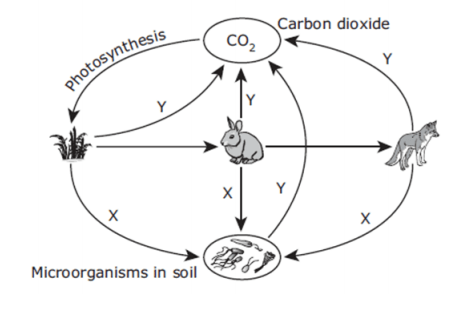
The diagram shows the flow of organic molecules through an ecosystem. What two processes are identified by the labels X and Y?
a)
X : Respiration
Y : Predation
b)
X : Adaptation
Y : Decomposition
c)
X : Fermentation
Y : Nitrogen Fixation
d)
X : Decomposition
Y : Respiration
17.
The average temperature of the surface of Earth has increased approximately 1°C in the past century. Which reason best explains this increase in temperature?
a)
lower levels of ozone in the atmosphere
b)
lower levels of nitrogen in the atmosphere
c)
higher levels of carbon dioxide and other greenhouse gases in the atmosphere
d)
higher levels of oxygen in the atmosphere
18.
All of the living and nonliving things in an area that interact with each other are called a/an ______.
a)
community
b)
habitat
c)
population
d)
ecosystem
19.
The living part of an ecosystem
a)
Biotic
b)
Abiotic
c)
Mother Earth
d)
Flowers
20.
Different populations living and interacting with each other in the same area
a)
Biome
b)
Ecosystem
c)
Community
d)
Niche
21.

What type of organism is at the beginning of every food chain?

a)

predator

b)

carnivore

c)

producer

d)

herbivore

22.
In an ecological pyramid, which type of organism always has the least amount of energy available?
a)
Producers
b)
Herbivores
c)
Carnivores
d)
Top Predator
23.
The mouse in this food web would be considered a:
a)
Decomposer
b)
Producer
c)
Secondary Consumer
d)
Primary Consumer
24.

Bacteria, fungi, and earthworms are examples of:

a)

scavengers

b)

predators

c)

prey

d)

decomposers

25.

If there is 1000 Kcal available in the producers in trophic level 1, approximately how much energy is available in the herbivores in trophic level 2?

a)

10 Kcal

b)

1 Kcal

c)

100 Kcal

d)

1000 Kcal

26.
Biodiversity refers to
a)
extinct species
b)
the variety of species on Earth
c)
nonrenewable resources
d)
the rate of species decline
27.
What effect will an invasive species have on the carrying capacity of an ecosystem?
a)
The carrying capacity will increase
b)
The carrying capacity for everyone will decrease
c)
The carrying capacity will only decrease for those in competition for same resource
d)
The carrying capacity for all animals will stay the same
28.
A population of an organism will only grow exponentially if:
a)
The resources are unlimited
b)
They want to
c)
The resources are limited
d)
They do not like to compete
29.

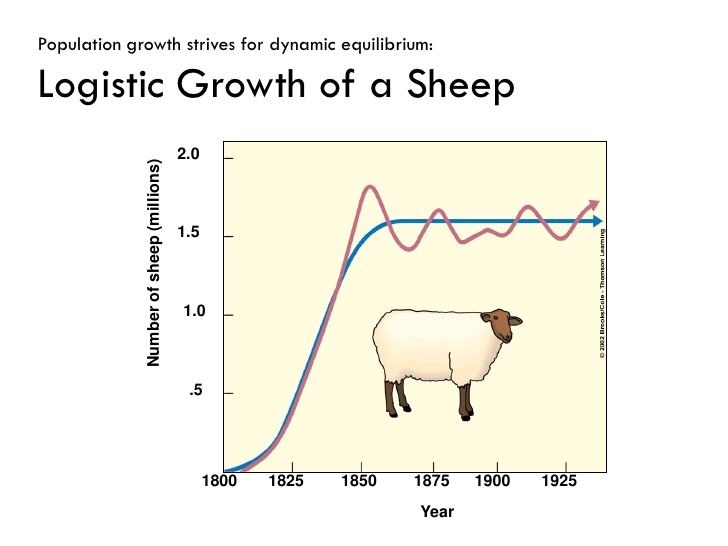
What is the carrying capacity for this sheep population?

a)

2.0 million

b)

1.0 million

c)

1.6 million

d)

0.5 million

30.

If a disease destroying wheat plants in a field swept through an ecosystem, what would happen to the bird population that feed off of the wheat in the the field ?

a)

The bird population would stay the same

b)

The bird population would increase

c)

The bird population would decrease

31.

Which of the following is a density dependent factor?

a)

volcanic eruption

b)

earthquake

c)

disease

d)

hurricane

32.
Which symbols best describe mutualism?
a)
+,+
b)
+,-
c)
+,0
d)
-,0
33.
Cattle egrets are birds that forage in fields among cattle. The egrets get easy access to food and the cattle don't care if they are there or not.
a)
mutualism
b)
commensalism
c)
competition
d)
parasitism
34.
What part of the cell cycle results in the splitting of the new cells?
a)
Interphase
b)
Mitosis
c)
Metaphase
d)
Cytokinesis
35.
In what phase do the chromosomes line up in the middle of the cell?
a)
Cytokinesis
b)
Metaphase
c)
Prophase
d)
Telophase
36.

What part of the cell cycle is considered interphase? Select all that apply.

a)

G1

b)

G2

c)

S

d)

M

37.
Why would it be important to replicate DNA before a cell divides in mitosis or meiosis?
a)
In order for genetic information to be transferred into daughter cells.
b)
In order for the cell to be able to increase in size.
c)
In order for the DNA to be contained in the nucleus.
d)
In order for the cell to re-order the DNA sequencing in the new cells.
38.
In mitosis, the two resulting cells are
a)
different from the starting cell and identical to each other.
b)
different from the starting cell and different from each other.
c)
identical to the starting cell and different from each other.
d)
identical to the starting cell and identical to each other.
39.
a)

INCREASES GENETIC VARIATION

b)

TAKES PLACE IN PROPHASE I

c)

CROSSING OVER

d)

ALL ARE TRUE

40.

MEIOSIS

a)

REDUCES THE NUMBER OF CHROMOSOMES BY ONE HALF

b)

PRODUCES UNIQUE SEX CELLS-1N

c)

ALLOWS TRAITS TO BE PASSED TO OFFSPRING

d)

ALL ARE TRUE

e)

INCREASE GENETIC VARIATION

41.

CANCER CELLS ARE DIFFERENT BECAUSE THE DON'T ENTER THE G-0 PHASE AND THEY ARE LIKELY TO DO WHICH OF THE FOLLOWING

a)

FAIL TO COMPLETE S PHASE

b)

MUTATE DURING G1 PHASE

c)

REPEAT THE CELL CYCLE CONTINUOUSLY

d)

DIE AFTER COMPLETING MITOSIS

42.
Non disjunction of chromosomes occurs during
?
a)
Meiosis
b)
Mitosis
c)
Replication 
43.

Mutations, which alter the DNA sequence, cause changes in traits because?

a)
mutations affect nucleosynthesis 
b)
Mutations affect gamete production 
c)
mutation affect meiosis
d)
mutations affect protein synthesis
44.
What situation causes a deletion?
a)
Part of the chromosome is missing
b)
Part of the chromosome is attached backwards
c)
Part of the chromosome breaks off and attaches to a different chromosome
d)
Part of a chromosome is duplicated 
45.
a)
Male
b)
Female
46.

Which type of RNA functions as a blueprint of the genetic code?

a)

mRNA

b)

rRNA

c)

tRNA

d)

RNA Polymerase

47.

The hereditary information in DNA is encoded in the sequence of

a)

nitrogen bases

b)

hydrogen bonds

c)

sugars

d)

phosphate groups

48.

The amino acids are actually carried by the rRNA.

a)

This statement is True.

b)

This statement is False - change the underlined word to mRNA.

c)

This statement is False - change the underlined word to tRNA.

d)

This statement is False - change the underlined word to DNA.

49.

What is produced during transcription?

a)

mRNA molecules

b)

DNA molecules

c)

RNA Polymerase

d)

proteins

50.

What happens during translation?

a)

Messenger RNA is made from a DNA code.

b)

The cell uses a messenger RNA code to make proteins.

c)

Transfer RNA is made from a messenger RNA code.

d)

Copies of DNA molecules are made.

51.

In eukaryotes, DNA

a)

is circular.

b)

is located in the ribosomes.

c)

floats freely in the cytoplasm.

d)

is located in the nucleus.

52.
Common ancestry relates to evolution because
a)
evolution only happens when there are common ancestors.
b)
Common ancestors make evolution happen more quickly.
c)
evolution can never take place with common ancestors.
d)
the more two organisms have in common, the more recent is their common ancestor during their evolution.
53.
Humans, birds, whales, and lizards all have similar arm bones. What is the reason for this?
a)
The function of these bones is the same in all animals
b)
They live in similar environments
c)
They have a common ancestor
d)
All organisms resemble humans
54.

What type of evidence are shown in the picture above?

a)

Fossils

b)

Embryology

c)

Homologous Structures

d)

Vestigial Structures

55.
The diagram shows fossils in different rock layers. Which of these statements about the age of these fossils is most likely correct?
a)
Fossil A and C are the same age
b)
Fossil B is older than fossil C
c)
Fossils A is older than fossil B
d)
Fossil D is older than fossil C
56.

Recently, scientists have been able to use ___________to find common proteins and amino acids to determine how closely related species are.

a)

DNA

b)

Vestigial structures

c)

Fossils

d)

Homologous structures

57.
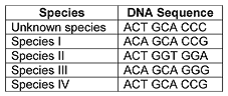
According to this data, the unknown bacterial species is most closely related to: 
a)
Species I
b)
Species II
c)
Species III
d)
Species IV
58.
Which of these is an example of natural selection?
a)
The largest animal in a population will have more opportunities for reproduction.
b)
Several species of organisms work together so that they all succeed.
c)
One species takes all the resources in an environment leaving none for others.
d)
Organism that are best suited to an environment tend to survive and reproduce more often.
59.
A large herd of goats lives in a field full of poison ivy.  Some goats are able to eat the poison ivy while others have become sick when they eat it. Over time the herd as a whole will tend to
a)
Become more likely to eat poison ivy.
b)
Become less likely to eat poison ivy.
c)
Not change in the proportion of goats that can and can not eat poison ivy.
d)
Eat all the poison ivy and leave only plants all the goats can eat.
60.
These cause variations.
a)
mutations
b)
adaptations
c)
a desire to change
d)
injuries
61.
Body parts that have lost their original function.
a)
embryos
b)
homologous structures
c)
analogous structures
d)
vestigial structures
62.
The flowers of pink tulips open in the morning, while the flowers of lavender tulips open in the early afternoon. The bees that pollinate these tulips cannot carry pollen back & forth between the two types of tulips because of their flowers being closed at different times of day. What type of reproductive barrier is this?
a)
behavioral isolation
b)
hybrid sterility 
c)
temporal isolation
d)
mechanical isolation 
63.

A new river forms and splits two populations, causing ______________ speciation

a)

Sympatric

b)

Allopatric

c)

Extreme

d)

Convergent

64.

The Western Skunk mates in the fall and the Eastern Skunk mates in the spring. This is a type of

a)

prezygotic barrier

b)

postzygotic barrier

c)

allopatric barrier

d)

polyploidy