Wayground logo

Free Printable Worksheets

Font size

S
M
L
XL
Worksheets

SEMESTER II BIOLOGY 2022

Total questions: 89

Worksheet time: 2hrs 31mins

Name
Class
Date
1.

Which of the following sequences best describes the flow of information that takes place when a gene directs the synthesis of a protein?

a)

protein --> RNA --> DNA

b)

DNA --> mRNA --> tRNA --> protein

c)

DNA --> amino acid --> RNA --> protein

d)

DNA --> tRNA --> mRNA --> protein

2.
A diploid cell of a normal male human contains 
a)
22 autosomes and two Y-chromosomes.
b)
22 pairs of autosomes and two Y-chromosomes.
c)
22 pairs of autosomes, one X and one Y-chromosome
d)
22 autosomes and two X-chromosomes
3.
In humans, mitosis produces____ chromosomes and _____ chromosomes after Meiosis
a)
46, 46
b)
92, 46
c)
46, 23
d)
23, 23
4.
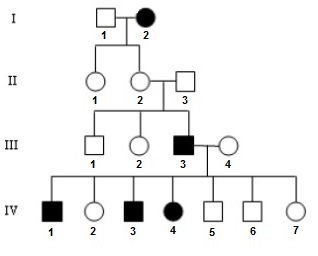
If this pedigree shows an autosomal recessive disorder, what MUST the genotype of individual II-3 be?
a)
HH
b)
Hh
c)
hh
d)
None of the above
5.
What causes mutations?
a)
Mistakes in replication or environmental substances
b)
The amino acids
c)
Passed down by genetics
d)
It's how your born
6.
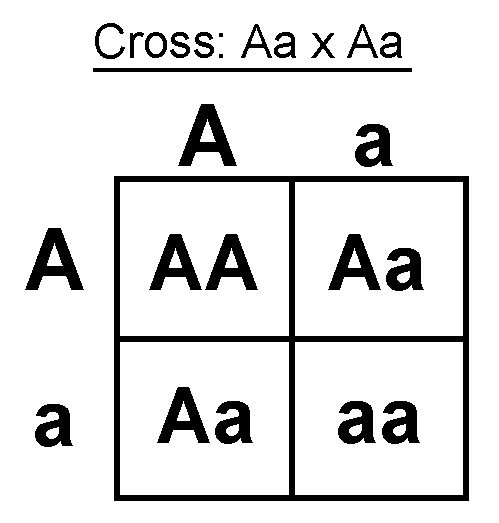
In the punnett square shown, what must the genotype of the missing parent be?
a)
BB
b)
Bb
c)
bb
d)
Tt
7.
What is the probability of heterozygous offspring?
a)
25%
b)
50%
c)
0%
d)
100%
8.
What is the phenotype of the offspring? (A-Brown hair; a-blond hair) 
a)
50 % Brown Hair and 50% Blond Hair 
b)
25 % Brown Hair and 75% Blond Hair 
c)
75 % Brown Hair and 25% Blond Hair 
d)
0% Brown Hair and 100% Blond Hair 
9.
Which individual in the first generation is a carrier?
a)
The male
b)
The female
c)
individual 1
d)
None of the above
10.
Huntington's Disease is a dominant trait.
What is the correct genotype for individual I-2?
a)
HH
b)
Hh
c)
hh
d)
H_
11.
Give the genotype for person II-1, for this autosomal trait.
a)
GG
b)
Gg
c)
gg
d)
we cannot be 100% sure of the genotype
12.
What kind of trait is colorblindness if females can be carriers without having the disease?
a)
Regular trait
b)
Sex-linked trait
c)
Co-dominant trait
d)
Incomplete dominant trait
13.
If hemophilia is a sex-linked recessive trait, what genotype would individual III-3 have?
a)
XbX
b)
XbXb
c)
XbYb
d)
XbY
14.
If this pedigree shows an autosomal recessive disorder, what MUST the genotype of individual II-3 be?
a)
HH
b)
Hh
c)
hh
d)
None of the above
15.

What is the Genotype for Homozygous "B" allele

a)

IᴬIᴮ

b)

Iᴮi

c)

IᴬIᴬ

d)

IᴮIᴮ

16.

What is the Genotype for person who can only get blood from a type O donor?

a)

IᴬIᴮ

b)

Iᴬi

c)

IᴬIᴬ

d)

ii

17.

Punnett Square: Type AB father and type O mother. What are the percentages of each offspring?

a)

Type A: 50%, Type B 0%, Type AB 50%, Type 0 0%

b)

Type A: 50%, Type B 50%, Type AB 0%, Type 0 0%

c)

Type A: 25%, Type B 25%, Type AB 25%, Type 0 25%

d)

Type A: 0%, Type B 0%, Type AB 50%, Type 0 50%

18.

Two parents think their baby was switched at the hospital. The mother has blood type O, the father has blood type AB and the baby has blood type B.

Complete a punnett square and then answer the question. What is the mother's genotype? What is the father's genotype?

a)

Mom genotype is IᴬIᴬ, Dad genotype is IᴬIᴮ

b)

Mom genotype is ii, Dad genotype is IᴮIᴮ

c)

Mom genotype is ii Dad genotype is IᴬIᴮ

d)

Mom genotype is ii Dad genotype is ii
19.
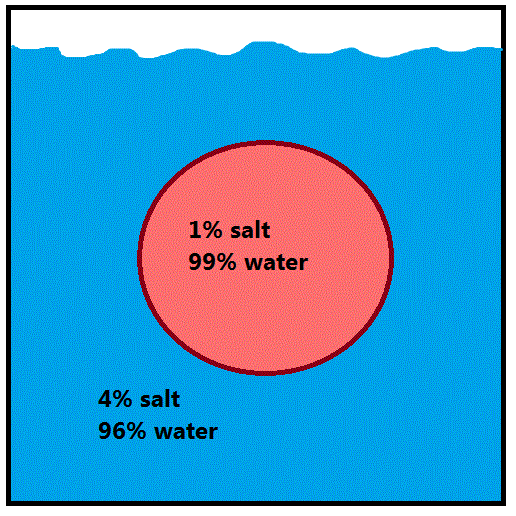
Where will the water go?
a)
Into the cell
b)
Out of the cell
c)
Equally in & out - it's isotonic
d)
There is no water
20.
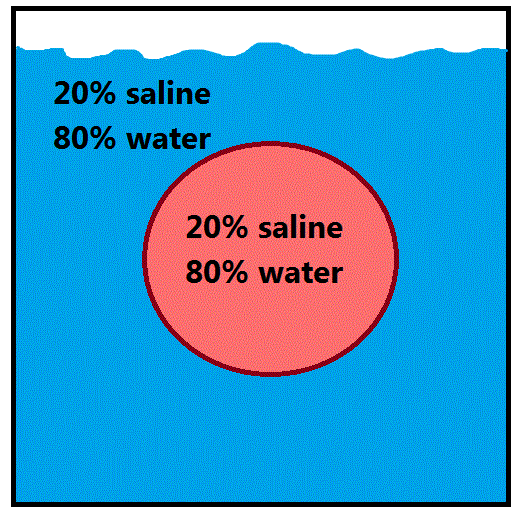
A blood cell is placed into the jar, as seen. Where will the water go?
a)
Into the cell
b)
Out of the cell
c)
Equally in & out - it's isotonic
d)
The water is a lie
21.
Why can't you drink salt water?
a)
It's hypertonic to your cells
b)
It's hypotonic to your cells
c)
It's isotonic to your cells
d)
It's paratonic to your cells
22.
During osmosis
a)
water moves from high to low concentration
b)
large or oddly shaped molecules move across a cell membrane
c)
water moves when energy is used
d)
proteins are built
23.

Particle of movement from an area of lower concentration to an area of higher concentration.

a)

Active transport

b)

Passive transport

24.

Which type of passive transport uses transport proteins to transport items such as glucose through the membrane?

a)

Facilitated diffusion

b)

Osmosis

c)

Diffusion

25.

Which type of active transport is displayed?

a)

Endocytosis

b)

Exocytosis

26.

Which of the following is TRUE about active transport?

a)

it requires energy

b)

it does not require energy

c)

It moves substances down their concentration gradient.

d)

It moves substances from a high to a low concentration.

27.

The Cell Membrane is shown. What is represented by letters C and E in the diagram?

a)

Lipids

b)

Transport Proteins

c)

Channel Proteins

28.
Osmosis is the movement of _____ across a membrane.
a)
food
b)
energy
c)
oxygen
d)
water
29.
A person should never drink salty water because their cells would
a)

shrink (and shrivel)

b)

expand (and burst)

30.
A person would never have pure water put into their veins in a hospital because their cells would...
a)
Shrink/Dehydrate
b)
Expand
31.

At 0.1 M, the environment is

a)

Hypertonic

b)

Hypotonic

c)

Isotonic

d)

Hydroponic

32.

At what molarity is the concentration inside the cells the same as it is outside? (isotonic)

a)

0 M

b)

0.23 M

c)

.53 M

d)

1 M

e)

.75 M

33.

What happens to cell size at equilibrium?

a)

The cells lyse

b)

The cells plasmolyze

c)

The cells gain mass from sugar; lose mass from water

d)

The cells remain unchanged

e)

The cells are turgid

34.

Which of the following is the correct equation for PHOTOSYNTHESIS?

a)

CO2 + light + H2O --> O2 + C6H12O6

b)

CO2 + C6H12O6 + H2O --> O2 + light

c)

O2 + light + H2O --> CO2 + C6H12O6

d)

CO2 + O2 + H2O --> Light+ C6H12O6

35.

What is the correct equation for cellular respiration?

a)

6O2 + C6H12O6 -> 6CO2 + 6H2O + Energy

b)

6O2 + C6H12O6 + Energy -> 6CO2 + 6H2O

c)

6CO2 + 6H2O -> 6O2 + C6H12O6 + Energy

d)

6CO2 + 6H2O + Energy -> 6O2 + C6H12O6

36.
In which way are photosynthesis and cellular respiration different?
a)
Cellular respiration stores ATP, while photosynthesis releases ATP.
b)
Cellular respiration produces oxygen, while photosynthesis uses oxygen.
c)
Photosynthesis releases energy, while cellular respiration stores energy.
d)
Photosynthesis uses carbon dioxide, while cellular respiration produces carbon dioxide.
37.
In cellular respiration, the electron transport chain takes place in
a)
the membrane of the mitochondrion
b)
the folds of the mitochondrion
c)
the cytoplasm
d)
the cell nucleus
38.

CHO

a)

carbohydrate

b)

lipid

c)

protein

d)

nucleic acid

39.

CHON

a)

carbohydrate

b)

lipid

c)

protein

d)

nucleic acid

40.

CHONP

a)

carbohydrate

b)

lipid

c)

protein

d)

nucleic acid

41.
The energy is stored 
a)
in the carbon bonds
b)
in the phosphate bonds
c)
in the hydrogen bonds
d)
in all of thesse
42.
What are the products of anaerobic respiration?
a)
Glucose and oxygen
b)
Carbon dioxide and water
c)
Lactic acid
d)
Carbon monoxide
43.
What are the products of aerobic respiration?
a)
Glucose and oxygen
b)
Carbon dioxide and water
c)
Lactic acid
d)
Carbon monoxide
44.
Where in the cell does aerobic respiration take place?
a)
Nucleus
b)
Cytoplasm
c)
Mitochondria
d)
Cell membrane
45.

Happens without oxygen

a)

aerobic

b)

anaerobic

c)

both

46.

Makes alcohol

a)

anaerobic

b)

aerobic

c)

both

47.

makes lactic acid

a)

aerobic

b)

anaerobic

c)

both

48.

requires mitochondria

a)

aerobic

b)

anaerobic

c)

both

49.

causes muscle cramps

a)

aerobic

b)

anaerobic

c)

both

50.

used to make yogurt

a)

aerobic

b)

anaerobic

c)

both

51.

makes more energy

a)

aerobic

b)

anaerobic

c)

both

52.
Which is NOT a process of the water cycle?
a)
precipitation
b)
freezing
c)
transpiration
d)
evaporation
53.
The process of plants losing water through their leaves is called ____.
a)
condensation
b)
evaporation
c)
transpiration
d)
exhaling
54.

Why do living things need nitrogen?

a)

To get energy

b)

To make amino acids

c)

To make proteins

d)

To make proteins AND amino acids

55.
What is the only process that removes carbon from the atmosphere?
a)
combustion
b)
cellular respiration
c)
photosynthesis
d)
decomposition
56.
Where is carbon stored in the environment?
a)
Fossil fuels
b)
Wood of trees
c)
Calcium carbonate (shells and bones)
d)
All of the above
57.
These gases, such as carbon dioxide, trap heat in the Earth's atmosphere causing global warming
a)
Global warming gases
b)
Hot House gases
c)
Green House gases
d)
Thermal pollution
58.
A particular golf course is using large amounts of nitrogen fertilizer. What process could move this nitrogen into a local stream?
a)
volatilization
b)
nitrogen fixation
c)
runoff
d)
ammonification
59.
What converts nitrogen into a useable form for plants and animals?
a)
bacteria
b)
fungi
c)
rain
60.
Which nutrient is not cycled through the atmosphere?
a)
carbon
b)
nitrogen
c)
phosphorous
d)
water
61.
This is released by the weathering of rocks.
a)
Carbon
b)
Oxygen
c)
Phosphorus
d)
Nitrogen
62.

What cycle are fossil fuels part of ?

a)

carbon

b)

oxygen

c)

nitrogen

d)

phosphorus

63.

What is the largest reservoir for water?

a)

the ocean

b)

rocks and minerals

c)

the atmosphere

d)

glaciers

64.

Where is the largest reservoir for the phosphorus cycle?

a)

rocks and minerals

b)

the ocean

c)

the atmopshere

d)

fossil fuels

65.

What is the largest reservoir for nitrogen?

a)

the ocean

b)

rocks and minerals

c)

the atmosphere

d)

bacteria

66.
Carbon dioxide is added to the atmosphere by
a)
Burning fossil fuels 
b)
Cellular respiration
c)
Decomposing organic matter
d)
All answers are correct
67.
How are decomposers important in the cycling of matter?
a)
A.Decomposers kill nutrients
b)
B.They break down dead organisms and put nutrients back into the soil
c)
C.Decaying matter takes a long time to recycle
d)
D.Decomposers are composed of hydrogen and titanium
68.

In this Food Web Pyramid, which type of consumer gets only 10% of the energy stored in plants?

a)

Primary Consumer

b)

Secondary Consumer

c)

Tertiary Consumer

d)

Quaternary Consumers

69.

If there is 1000 Kcal for the producers, how much energy would be transferred to the Primary Consumers?

a)

10 Kcal

b)

1 Kcal

c)

100 Kcal

d)

1000 Kcal

70.

Why are energy pyramids never inverted?

a)

because energy is always lost from one trophic level to the next

b)

because energy is always gained from one trophic level to the next

c)

because energy cannot be measured as it transfers from one trophic level to the next

d)

because it just never is

71.
What is formed during primary succession that doesn't need to be formed during secondary succession?
a)
pioneer species
b)
soil
c)
climax community
d)
lichens
72.
What type of succession is shown going from figure A to figure B?
a)
primary succession
b)
eutrophication
c)
secondary succession
d)
intermediate
73.
After a forest fire, an ecosystem would start regrowth through -
a)
primary succession
b)
secondary succession
c)
climax community
d)
limiting factors
74.
Which catastrophic event will most likely have the effect of returning an ecosystem to primary succession?
a)
A tornado
b)
A volcanic eruption
c)
A flood
d)
A drought
75.
succession that occurs in an area with no soil
a)
ecological succession 
b)
primary succession 
c)
secondary succession
d)
pioneer speciles
76.
succession that occurs in an area where soil is already present
a)
ecological succession 
b)
primary succession 
c)
secondary succession
d)
pioneer speciles
77.
starts with bare rock followed by lichen
a)
primary succession 
b)
secondary succession
c)
both types of succession
78.
this type of succession occurs after a forest fire
a)
primary succession
b)
secondary succession
c)
both
79.

Which experiences the least change over time?

a)

Pioneer Species

b)

Primary Succession

c)

Aquatic Succession

d)

Climax Community

80.

What term best relates to equilibrium?

a)

pioneer species

b)

primary succession

c)

secondary succession

d)

climax community

81.

If farmers use a controlled burn to prevent forest fires, what would most likely be the first plants to return?

a)

trees

b)

shrubs

c)

mosses

d)

grasses

82.

Breaking News! A new island has formed off of Hawaii! What must occur for it to become an ecosystem?

a)

Secondary Succession

b)

Aquatic succession

c)

Primary Succession

d)

Ferns must grow

83.

Which would result in primary succession?

a)

volcano destroying habitat leaving only soil and ash

b)

Tornado destroying a crop leaving very little soil

c)

Glacier retreating exposing bare rock

d)

limiting factors

84.

If you visited a forest in 2015 and there was only small plants there when revisited in 2019, what likely happened?

a)

passing of a glacier

b)

preservation of a habitat

c)

occurrence of a forest fire

d)

development of a parking lot

85.

Primary succession occurs in areas with:

a)

very little soil

b)

lots of soil

c)

no soil

d)

soil that has been disturbed

86.

What best describes the term succession?

a)

rapid changes that create an ecosystem overnight

b)

gradual changes over time to fully create or restore and ecosystem

c)

forest with the tallest trees

d)

the rate species produce offspring

87.

What point on the graph represents the carrying capacity?

a)

A

b)

B

c)

C

d)

D

88.

According to the graph, what is causing the deer population to decrease

a)

They got sick

b)

The wolf population is decreasing

c)

The wolf population increased

d)

They ran out of food

89.

Predator population lags behind prey population because......

a)

Increase in predators leads to decrease in prey

b)

Increase in predators leads to increase in prey

c)

Increase in predators leads to decrease in producers

d)

Increase in producers leads to increase in prey