Wayground logo

Free Printable Worksheets

Font size

S
M
L
XL
Worksheets

Chemistry 1 Second Semester Review

Total questions: 100

Worksheet time: 2hrs 10mins

Name
Class
Date
1.
Two Reactants and One Product
a)
Decomposition
b)
Synthesis
c)
Combustion
d)
Single Replacement
2.
Always starts with a Hydrocarbon that reacts with oxygen and produces carbon dioxide and water. 
a)
Decomposition
b)
Synthesis
c)
Combustion
d)
Single Replacement
3.
One reactant into several products.
a)
Decomposition
b)
Synthesis
c)
Combustion
d)
Single Replacement
4.
One element replaces another in a compound.
a)
Synthesis
b)
Combustion
c)
Single Replacement
d)
Double Replacement
5.
Ions in two compounds switch. 
a)
Synthesis
b)
Combustion
c)
Single Replacement
d)
Double Replacement
6.
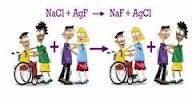
What is the type of reaction shown at the top?
a)
Synthesis
b)
Decomposition
c)
Single Replacement
d)
Double Replacement
7.
This pictures simulates what type of reaction?
a)
Synthesis
b)
Decomposition
c)
Single Replacement
d)
Double Replacement
8.
H2O + C yields H2 + CO2
1. Balance the equation,
2. what type reaction is this
a)
4:2:4:2
Decomposition
b)
1:1:1:2
Single Replacement
c)
2:1:2:1
Double Replacement
d)
2:1:2:1
Single Replacement
9.
Ca(OH)2 yields CaO + H2O
1. Balance the equation
2. What type reaction is this?
a)
1:1:1
Synthesis
b)
1:1:1 
Double Replacement
c)
1:1:1
Decomposition
d)
1:2:1
Decomposition
10.
What symbol is used to indicate a heated reaction?
a)
Triangle
b)
Square
c)
Circle
d)
fire
11.
What does (l) mean when seen in a reaction equation?
a)
Light
b)
Liquid
c)
Laugh
d)
Long
12.
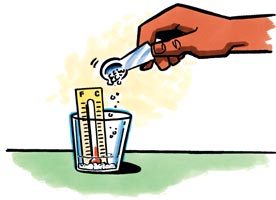
What type a reaction is taking place in this picture?
a)
Synthesis
b)
Decomposition
c)
Single Replacement
d)
Double Replacement
13.

The arrow in a chemical reaction indicates what?

a)

Yields

b)

Begins

c)

Catalyst

d)

nothing

14.
What does aq mean in a chemical reaction?
a)
aqua dancing
b)
aqua lungs
c)
aqualirious
d)
aqueous
15.
Which of the following examples shows that a chemical reaction has occurred? 
a)
A rock breaks into smaller pieces when it is struck with a hammer.
b)
Rust forms on a hammer that has been left outside to long. 
c)
A cup of water turns pink when a few drops of red food coloring are added. 
d)
A solid is formed when heat is removed from a sample of water. 
16.
A student places a piece of a potato into a container of hydrogen peroxide. One observation the student makes is that bubbles form around the potato. The presence of bubbles might indicate the formation of a new substance because bubbles - 
a)
could show that a gas is forming
b)
always rise to the top of a liquid. 
c)
are almost always perfectly spherical.
d)
usually burst after a few minutes.
17.
Four students performed four different investigations by combining different substances. Their results are shown in the table provided. In which experiment are new substances being formed?
a)
Experiment 1
b)
Experiment 2
c)
Experiment 3
d)
Experiment 4
18.
Hydrogen peroxide breaks down to form water and oxygen gas. Which observation is evidence that a chemical reaction has occurred?
a)
The mass of the solution remains the same.
b)
 Phase changes are observed.
c)
 The color of the solution remains clear.
d)
The temperature of the solution increases. 
19.
A clear liquid from a flask is poured into another clear liquid in a beaker. Which of the following results of this procedure would indicate a new substance was formed?
a)
The level of the substance in the beaker is higher after the other liquid is added.
b)
A yellow solid forms and then settles to the bottom of the beaker.
c)
Small white crystals are left behind in the flask that held the first liquid.
20.
Which of the following is an example that includes evidence of a chemical reaction?
a)
A sample of zinc is placed in water and it settles to the bottom
b)
A solid block of ice is heated and it completely melts into a liquid. 
c)
Sugar that is burned gives off an odor and turns brown and then black.
d)
A tomato is placed into a blender and chopped up into smaller pieces.
21.
Describes the number of molecules in a compound and is used to balance a chemical reaction. 
a)
coefficient 
b)
subscript
c)
superscript
d)
SI unit
22.
Provides evidence that a chemical reaction has occurred. 
a)
dissolving 
b)
melting
c)
formation of a gas
d)
bending
23.

The law of conservation of mass says substances can neither be _______ nor ___________.

a)

Built; torn down

b)

Blended together; separated

c)

Created; destroyed

d)

Condensed; extracted

24.
What coefficient should be used to make the following equation balanced?
N2+O2--> _NO 
a)
1
b)
2
c)
3
d)
4
25.

Which equation is balanced?

a)

PbO2 + 2H2

b)

SO2 + H20 --> H2SO4

c)

2Na + 2H2O --> 2NaOH + H2

26.
How many HCl molecules do you need to balance this equation? 
Mg +  __HCl --->  MgCl2 + H2
a)
1
b)
2
c)
3
d)
4
27.

What law governs the balancing of chemical equations?

a)

Law of Energy

b)

Law of Conservation of Matter/Mass

c)

Law of Gravity

d)

Law of Matter Movement

28.

What are the coefficients that would properly balance this equation?

__Al + __O2--> __Al2O3

a)

4,1 --> 2

b)

4,3 --> 4

c)

3,4 --> 1

d)

4,3 --> 2

29.
What is the mole ratio of H2O to H3PO4 in the following chemical equation?   P4O10 + 6 H2O --> 4 H3PO4 
a)
6:4
b)
4:6
c)
1:3
d)
3:1
30.
2Al + 3H2SO4 -> Al2(SO4)3 + 3H2
How many grams of aluminum sulfate would be formed if 250g H2SO4 completely reacted with aluminum?
a)
0.85 g
b)
290 g
c)
450 g
d)
870 g
31.
2H2   +   O2  →  2H2O
How many moles of water can be produced if 8 moles H2 are used?
a)
4 moles
b)
8 moles
c)
16 moles
d)
2 moles
32.
CH4 + 2 O2 → CO2 + 2 H2O
How many moles of carbon dioxide are produced from the combustion of 110 g of CH4?
a)
13.7 mol
b)
2.75 mol
c)
6.11 mol
d)
6.85 mol
33.
How many moles are in 19.82 g Mg? 
a)
1.226mol Mg
b)
481.7mol Mg
c)
1.000mol Mg
d)
 0.82 mol Mg
34.
If a chemist calculates the maximum amount of product that could be obtained in a chemical reaction, he or she is calculating the
a)
theoretical yield
b)
mole ratio
c)
actual yield
d)
percentage yield
35.
What is the measured amount of a product obtained from a chemical reaction?
a)
mole ratio
b)
theoretical yield
c)
percentage yield
d)
actual yield
36.
Mole ratios are obtained from the
a)
balanced chemical equation
b)
periodic table
c)
molar mass
37.
When does a chemical reaction stop?
a)
When the lab is finished
b)
When the excess reactant is used up
c)
When the limiting reactant is used up
d)
Chemical reactions never stop
38.
9. Complete the equation for the percent yield of a chemical reaction:
Percent yield=(________)
÷(________)×100%
a)
actual yield; theoretical yield
b)
theoretical yield; actual yield
39.
Fe (s) + S (l) --> FeS (s)  

In the experiment above, 7.62 g of Fe are allowed to react with 8.67 g of S.
How much FeS is formed?
a)
14.8 g
b)
12.2 g
c)
13.7 g
d)
19.9 g
40.
How many grams are in 7.8 moles of NaCl?
a)
476grams
b)
460 grams
c)
452 grams
d)
462 grams
41.

3NH4NO3 + Na3PO4 --> (NH4)3PO4 + 3 NaNO3


Assuming we start with 30 g of NH4NO3 and 50 g of Na3PO4, identify the limiting reactant.

a)

ammonium phosphate

b)

sodium phosphate

c)

ammonium nitrate

d)

sodium nitrate

42.
What is a limiting reactant?
a)
the reactant that determines how much product can be made
b)
the reactant that is in excess
c)
the product that you can make the most of
d)
the amount of reactants that react with each other
43.
You need 2 pieces of bread, 1 tablespoon of peanut butter and 2 tablespoons of jelly to make a sandwich.  If you have 10 pieces of bread, 4 tablespoons of peanut butter and 20 tablespoons of jelly, what is the limiting reactant?
a)
bread
b)
jelly
c)
peanut butter
d)
sandwich
44.
A catalyst  
a)
is added to a reaction to make it slow down 
b)
breaks apart and is changed 
c)
provides an energetic short cut to the products 
45.
Chemical Formulas ...
a)
are written in alphabetical order 
b)
represent the destruction or creation of atoms 
c)
represent how atoms are arranged in a chemical reaction 
46.
The compounds or elements present at the end of a reaction 
a)
reactants
b)
catalyst
c)
products
d)
energy 
47.
The compounds and elements that are present at the beginning of a reaction:
a)
reactants
b)
catalyst
c)
products
d)
energy 
48.
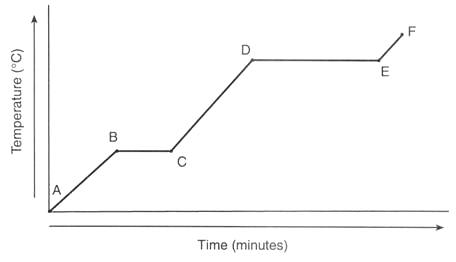
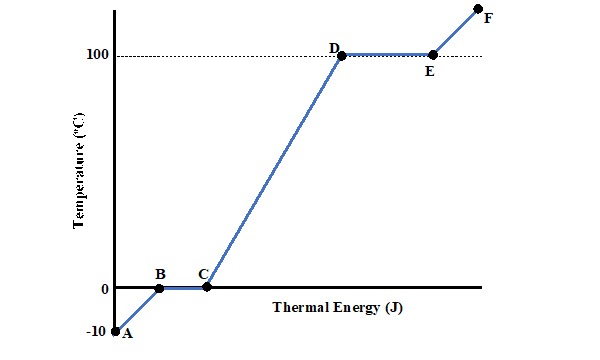
What line segment represents only the solid state?
a)
A-B
b)
B-C
c)
C-D
d)
D-E
49.
What line segment represents only the solid state?
a)
A-B
b)
B-C
c)
C-D
d)
D-E
50.
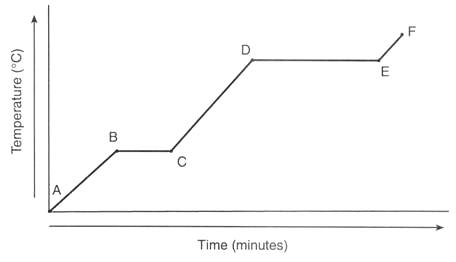
Which segment represents the heat of fusion?
a)
A-B
b)
B-C
c)
C-D
d)
D-E
51.
In which segment is the kinetic energy remaining constant?
a)
A-B
b)
B-C
c)
C-D
d)
E-F
52.
Which process takes the longest to occur?
a)
melting
b)
boiling
c)
freezing
d)
heating the solid
53.
What state(s) of matter are present at D-E?
a)
Solid-liquid
b)
Liquid
c)
Liquid-gas
d)
Gas-Solid
54.
Between which points is the temperature of the substance remaining constant?
a)
A-B only. 
b)
A-B, C-D, E-F
c)
B-C only. 
d)
B-C, D-E
55.
Between which points is the temperature of the substance increasing?
a)
A-B only. 
b)
A-B, C-D, E-F
c)
B-C only. 
d)
B-C, D-E
56.
Between which points is the substance changing state?
a)
A-B only. 
b)
A-B, C-D, E-F
c)
B-C only. 
d)
B-C, D-E
57.
This type of graph is called a:
a)
Phase diagram
b)
Heating curve
c)
State of matter
d)
Temperature chart
58.
What line segment represents only the solid state?
a)
A-B
b)
B-C
c)
C-D
d)
D-E
59.
Between which points is the temperature of the substance remaining constant?
a)
A-B only. 
b)
A-B, C-D, E-F
c)
B-C only. 
d)
B-C, D-E
60.

Between which two points is Heat of Fusion?

a)

A <----> B

b)

B <----> C

c)

C <----> D

d)

D <----> E

e)

E <----> F

61.

Between which two points is Heat of Vaporization?

a)

A <----> B

b)

B <----> C

c)

C <----> D

d)

D <----> E

e)

E <----> F

62.
In which segment is the kinetic energy remaining constant?
a)
A-B
b)
B-C
c)
C-D
d)
E-F
63.
A substance's heating curve is shown in the graph.  What is its boiling point?
a)
100 C
b)
60 C
c)
80 C
d)
20 C
64.
The graph shows a cooling curve for an unknown substance.  What is happening during segment DE?
a)
boiling
b)
condensation
c)
freezing
d)
melting
65.

Which equation do you use to solve for the energy of segment D-E?

a)

q= mCΔT

b)

q= Hv*m

c)

PV=nRT

d)

q= Hf*m

66.

Which equation do you use to solve for segment B-C?

a)

q=mCΔT

b)

q= Hv*m

c)

q= Hf*m

d)

PV=nRT

67.

The energy of which segments can be found using the equation q=mCΔT?

a)

A-B, D-E, E-F

b)

B-C, D-E ,E-F

c)

B-C, C-D, E-F

d)

A-B, C-D, E-F

68.

Which equation do you use to solve for the energy of segment C-D?

a)

q=mCΔT

b)

q= Hv*m

c)

q= Hf*m

d)

PV=nRT

69.

Which equation would you use to solve the following: Calculate the heat necessary to change 10 g of ice(s) at 0°C to 10 g of water(l) at 0°C.

a)

q=mCΔT

b)

q= Hv*m

c)

q= Hf*m

d)

PV=nRT

70.

Which equation would you use to solve the following: Calculate the heat necessary to change 10 g of H2O(l) at 0 °C to 10 g of H2O(l) at 100°C.

a)

q=mCΔT

b)

q=Hv*m

c)

q= Hf*m

d)

PV=nRT

71.

What equation would you use to solve the following:

How much heat is absorbed by 20g granite boulder as energy from the sun causes its temperature to change from 10°C to 29°C?

a)

q=mCΔT

b)

q=Hv*m

c)

q= Hf*m

d)

PV=nRT

72.

What equation would you use to solve the following:

Calculate the heat necessary to change 10 g of H2O(l) at 100°C to 10 g of H2O(g) at 100°C.

a)

q=mCΔT

b)

q=Hv*m

c)

q=Hf*m

d)

PV=nRT

73.

What equation would you use to solve the following:

Calculate the heat necessary to change 10 g of H2O(l) at 100°C to 10 g of H2O(g) at 100°C.

a)

q=mCΔT

b)

q=Hv*m

c)

q=Hf*m

d)

PV=nRT

74.

What equation would you use to solve the following:

How much heat is absorbed by 20g granite boulder as energy from the sun causes its temperature to change from 10°C to 29°C?

a)

q=mCΔT

b)

q=Hv*m

c)

q= Hf*m

d)

PV=nRT

75.

Critical Thinking! If gas particles in a tire are moving slowly, your tire pressure will drop because the gas particles are not pressing against the walls of the tire. What temperature change do you think would cause this pressure drop?

a)

The temperature will have become colder

b)

The temperature will have become hotter

c)

Temperature and pressure have no relation
76.
Are there molecules moving in a solid brick?
a)
yes
b)
no
c)
maybe
d)
not sure
77.
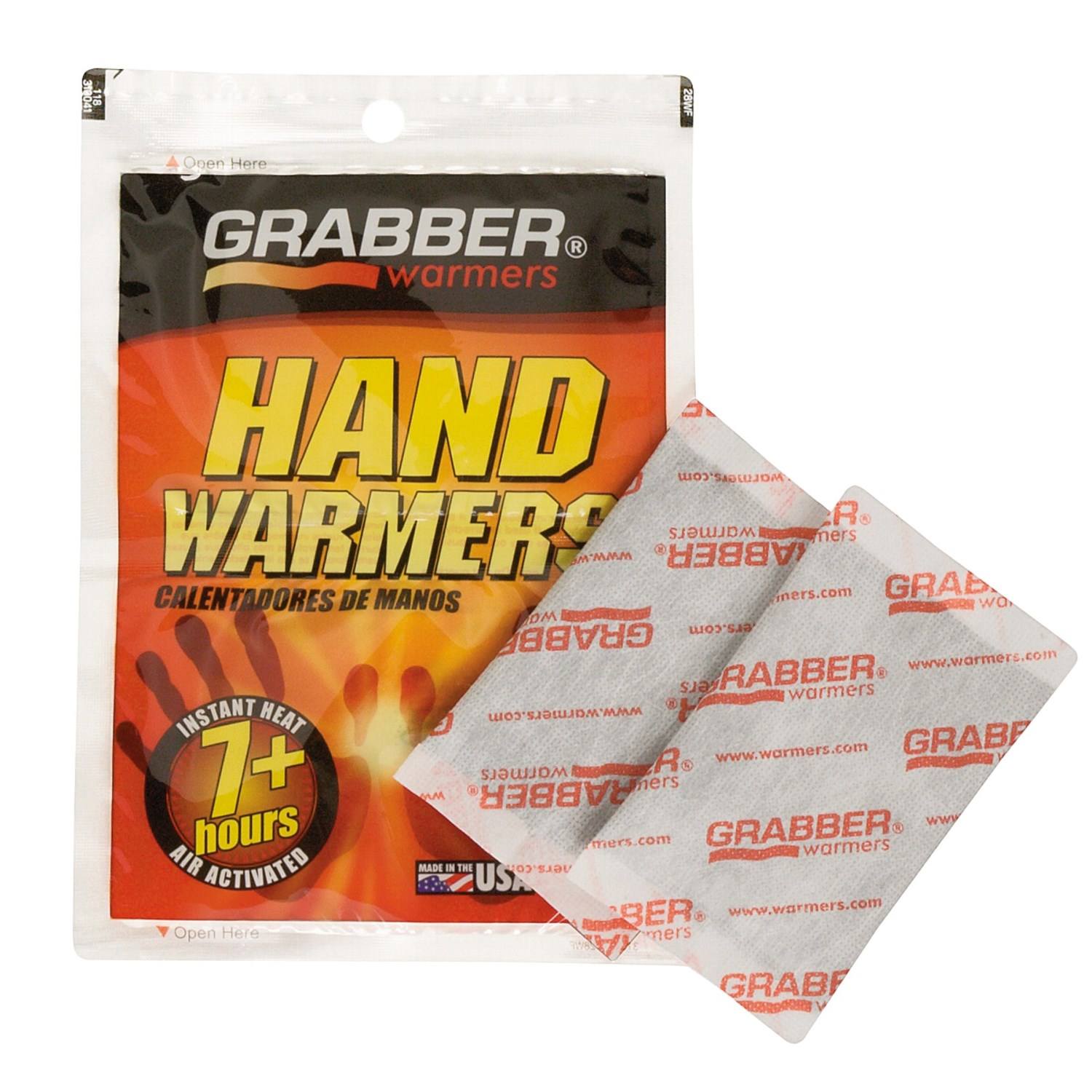
What type of reaction occurs in a hand warmer
a)
exothermic
b)
endothermic
78.
In an endothermic reaction, heat is ...
a)
taken in or absorbed
b)
given out or released 
79.

O2(g) + 2 H2 (g) → 2 H2O (g) + EnergyO_2\left(g\right)\ +\ 2\ H_2\ \left(g\right)\ \rightarrow\ 2\ H_2O\ \left(g\right)\ +\ Energy  

a)

endothermic

b)

exothermic

80.

6 CO2+ 6 H2O + Energy → C6H12O6 + 6 O26\ CO_2+\ 6\ H_2O\ +\ Energy\ \rightarrow\ C_6H_{12}O_6\ +\ 6\ O_2

a)

endothermic reaction

b)

exothermic reaction

81.
ΔH value in an endothermic reaction is a positive number.
a)
True
b)
False
82.

What type of reaction is this?

a)

Exothermic

b)

Endothermic

c)

Energy Producing

d)

No way to tell

83.

What kind of equation is this: 2KI + MgCl2 + 200KJ ----> 2KCl + MgI2

a)

Endothermic

b)

Exothermic

84.
Human blood has a pH between 7.35 and 7.45. Which of the following best describes human blood?
a)
strongly acidic
b)
slightly acidic
c)
strongly basic
d)
slightly basic
85.

Zn(OH)2 is an example of a...

a)

acid

b)

base

c)

salt

d)

water

86.

H3PO4 is an example of a ...

a)

acid

b)

base

c)

salt

d)

non-electrolyte

87.

At what pH would all three indicators appear as yellow?

a)

1.7

b)

2.7

c)

4.7

d)

8.7

88.
An indicator will ______________ when it is in contact with an acid or base
a)
Bubble
b)
Form a new substance
c)
Change color
d)
Stay the same color
89.

According to the diagram, which part of the digestive system has the most basic enviroment?

a)

Mouth

b)

Stomach

c)

Pancreas

d)

Small intestine

90.
What might happen if you mixed a strong acid with an equally strong base?
a)
You would see an explosive chemical reaction.
b)
The acid would destroy the base.
c)
The base would destroy the acid.
d)
You'd wind up with a pH-neutral substance.
91.

Which is NOT a property of acids?

a)

slippery

b)

pH below 7

c)

dissociate in water

d)

contain H1+ ions

92.

What gas forms when an acid reacts with a metal?

a)

O2

b)

H2

c)

H

d)

CO2

93.

As the pH of a solution gets lower, the solution becomes more _____.

a)

acidic

b)

basic (or alkaline)

c)

neutral

d)

ionic

94.

What does pH measure?

a)

strength of an acid

b)

strength of a base

c)

strength of both acids and bases

d)

concentration of H+ ions

95.

Which terms refer to how well an acid or base ionizes in a solution?

a)

strong or weak

b)

concentrated or dilute

c)

neutral or charged

d)

acid or base

96.

A chemical reaction between an acid and a base, forming a salt and water is known as ____.

a)

ionization

b)

concentration

c)

neutralization

d)

animation

97.

Hydrochloric acid (HCl) is known as a strong acid. Which statement describes a strong acid after dissolving in solution?

a)

few H+ ions: many acid molecules

b)

many H+ ions; few acid molecules

98.

What characteristic of a substance has to change in order for it to act as an indicator?

a)

concentration

b)

color

c)

temperature

d)

taste

99.

Equal amounts of an acid and a base are mixed in a beaker. When neutralization is complete, what is in the beaker besides salt?

a)

acid only

b)

base only

c)

water

100.

Which salt is formed in a reaction between HBr and LiOH?

a)

LiBr

b)

BrLi

c)

NaCl

d)

NaOH