wayground logo

Free Printable Worksheets

Font size

S
M
L
XL
Worksheets

Essential Physical Science Final Exam Review

Total questions: 86

Worksheet time: 2hrs 32mins

Name
Class
Date
1.
During which interval is the object not moving?
a)
B to C
b)
C to D
c)
D to E
d)
only at point A
2.
During which interval is the object traveling at a constant velocity?
a)
B to C
b)
D to E
c)
F to G
d)
it traveling at a constant velocity during all of the intervals shown.
3.
During which interval is the object speeding up?
a)
A to B
b)
B to C
c)
D to E
d)
E to F
4.
Acceleration occurs when an object changes its speed or ______.
a)
direction
b)
force
c)
inertia
d)
mass
5.
Which runner won the race?
a)
Albert
b)
Bob
c)
Charlie
6.
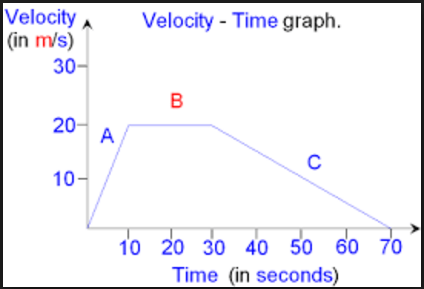
This is a velocity-time graph.  What is the object doing in segment A?
a)
Positive acceleration
b)
Negative acceleration
c)
Constant Velocity
d)
Not moving
7.
What does this graph represent?
a)
Constant speed
b)
Acceleration
c)
Not moving
8.
Wheels on a skateboard most likely experiences-
a)
Rolling Friction
b)
Sliding Friction
c)
Fluid Friction
d)
Static Friction
9.
Which graph shows an object not moving?
a)
A
b)
B
c)
C
d)
D
10.
Morgan walks 10 miles South. Trevor walks 10 miles North in the same amount of time.  They have:
a)
Different average speeds
b)
Different velocities
c)
Same velocity
d)
Same motion
11.

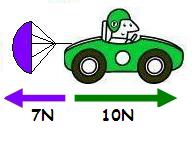
What is the net force?

a)

3 N

b)

3 N, right

c)

17 N, right

d)

3 N, left

12.
What is the net force?
a)
20 N 
b)
0 N 
c)
400 N 
d)
40 N 
13.

A ____________ is a push or a pull on an object.

a)

friction

b)

force

c)

magnet

d)

gravity

14.
What will cause an object to move?
a)
Applied forces
b)
Balanced forces
c)
Unbalanced forces
15.
What is a Force?
a)
The distance
b)
Mass
c)
A push or pull
d)
Give me a  failing grade 
16.

If you apply an unbalanced force to an object at rest, what will happen to that object?

a)

the object will remain at rest.

b)

the object will move.

c)

The object will stay.

d)

None of the above.

17.

You are pushing a wheelbarrow. What happens to the wheelbarrow's motion if more mass is added and you push with the same force?

a)

The motion will remain the same

b)

The motion will increase.

c)

The motion will decrease.

d)

The motion will change directions.

18.

An object in motion tends to stay in motion and an object at rest tends to stay at rest until acted on by an unbalanced force is which of Newton's laws?

a)

1st

b)

2nd

c)

3rd

d)

4th

19.

The acceleration of an object is dependent upon the net force acting upon the object and the mass of the object is which of Newton's laws?

a)

1st

b)

2nd

c)

3rd

d)

4th

20.

For every action there is an equal and opposite reaction is which of Newton's laws?

a)

1st

b)

2nd

c)

3rd

d)

4th

21.

Calculate the net force

a)

5

b)

10

c)

15

d)

0

22.

What is the net force?

a)

400

b)

800

c)

200

d)

600

23.

What can be said of friction?

a)

it works against you as you are trying to move an object

b)

it works with you as you are trying to move an object

c)

it lifts up an object as you are trying to move it

d)

it is never noticeable as you try to move an object

24.
____________ is the ability to cause change. 
a)
Energy 
b)
Force 
c)
Friction
d)
Motion
25.
Energy due to motion is ____________ energy. 
a)
Potential 
b)
Energy
c)
Kinetic
d)
Friction
26.
__________ is stored energy. 
a)
Potential
b)
Kinetic
c)
None of the above 
d)
All of the above 
27.
Gravitational potential energy depends on the ________ and ________ of the object. 
a)
Height and mass
b)
Friction and movement
c)
Mass and Movement
d)
Height and Friction 
28.
Energy can not be created or destroyed, only converted from one form to another.
a)
true
b)
false
29.
At which point is potential energy greatest?
a)
W
b)
X
c)
Y
d)
Z
30.
At which point is kinetic energy greatest? 
a)
W
b)
X
c)
Y
d)
Z
31.
What is energy?
a)
the ability to do work
b)
mass and volume
32.
Which situation is work not done?
a)
lifting a 20 pound box off the floor
b)
holding a 20 pound box above the floor
c)
sliding a 20 pound box across the floor
d)
sliding a 20 pound box up an inclined plane
33.
What type of energy is in this picture?
a)
Kinetic
b)
Potential
c)
Chemical
d)
Sound
34.
A battery converts what type of energy to another?
a)
sound to kinetic
b)
light to heat
c)
mechanical to electrical
d)
chemical to electrical
35.

The SI Unit for Energy is

a)

Joule

b)

Newton

c)

Calorie

d)

Watt

36.
A particle that carries a negative electric charge is called a(n) ______.
a)
neutron
b)
atom
c)
proton
d)
electron
37.
An example of a voltage source is a _____.
a)
voltmeter
b)
battery
c)
resistance
d)
switch
38.

Electric current flows from

a)

detect electric current

b)

negative terminal to positive terminal

c)

positive terminal to negative terminal

d)

the flow rate of electric charges through a conductor
39.

Electrons flows from

a)

detect electric current

b)

negative terminal to positive terminal

c)

positive terminal to negative terminal

d)

the flow rate of electric charges through a conductor

40.
Electricity that flows in a closed path is called a
a)
path
b)
current
c)
circuit
41.
What is voltage measured in?
a)
Ω (Ohms)
b)
V (Volts)
c)
A (Amps)
d)
W (Watts)
42.
What is current measured in?
a)
Ω (Ohms)
b)
V (Volts)
c)
A (Amps)
d)
W (Watts)
43.
What is resistance measured in?
a)
Ω (Ohms)
b)
V (Volts)
c)
A (Amps)
d)
W (Watts)
44.
____________ stops the flow of electricity.
a)
A conductor
b)
An insulator
c)
A magnet
45.
Two types of circuits are
a)
parallel and magnetic
b)
electromagnetic and series
c)
series and parallel
46.
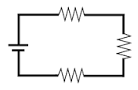
What type of circuit is pictured?
a)
series
b)
parallel
47.
What kind of circuit is this?
a)
Series
b)
Consecutive
c)
Parallel
d)
Training
48.
Electricity is the flow of _________.
a)
protons
b)
neutrons
c)
electrons
49.

Is the image shown the switch is closed, are the lights on or off?

a)

all lights are off

b)

all lights are on

50.

You can hear sounds around the corner of a door due to the wave property called diffraction.

a)

True

b)

False

51.

In the figure shown, point A is called a ____.

a)

amplitude

b)

crest

c)

rarefaction

d)

trough

52.

In the figure shown, point B is called a ____.

a)

amplitude

b)

crest

c)

rarefaction

d)

trough

53.

In the figure shown, number 2 is called the ____.

a)

amplitude

b)

crest

c)

rarefaction

d)

trough

54.

You see yourself in a mirror because light ____ of the surface of the mirror.

a)

absorbs

b)

reflects

c)

transmits

55.

What characteristics feature of wave is indicated by the letter C on the diagram?

a)

amplitude

b)

loudess

c)

frequency

d)

wavelength

56.

What do all waves transfer?

a)

Matter

b)

Heat

c)

Electricity

d)

Energy

57.

Which type of waves have the longest wavelength?

a)

Visible light

b)

Radio waves

c)

X-rays

d)

Gamma-Rays

58.

Shorter wave lengths can carry more energy. Which of these probably carries the MOST energy:

a)

Infrared light

b)

Visible light

c)

X-rays

d)

UV light

59.

What is the distance between the calm sea and the highest wave called?

a)

Wave

b)

Frequency

c)

Amplitude

d)

Magnitude

60.

What do all waves transfer?

(a)  

61.

A wave that can travel through matter and empty space is a:

a)

electromagnetic wave

b)

longitudinal wavy

c)

transverse wave

62.
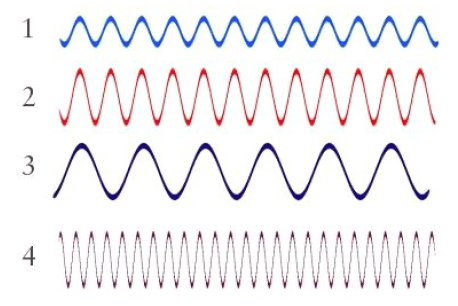
Which wave in the diagram has the greatest wavelength?
a)
1
b)
2
c)
3
d)
4
63.

Which image represents a longitudinal wave?

a)

A

b)

B

64.
The most commonly accepted theory that explains the beginning of our known universe is the -
a)
Theory of Evolution
b)
Big Bang Theory
c)
Cell Theory
d)
Blackhole theory
65.
Why did people believe in the Geocentric vs the Heliocentric solar system?
a)
Geocentric system had been around for a LONG time.
b)
People don't like change.
c)
There wasn't enough proof  to support the Heliocentric system.
d)
all of these answers are correct.
66.
This image shows the:
a)
Geocentric Solar System
b)
Heliocentric Solar System
67.

Which scientific instrument did Galileo use to change the world?

a)

telescope

b)

spyglass

c)

mirror

d)

magnifying glass

68.

Which object is the center of the solar system according to Galileo?

a)

Earth

b)

Moon

c)

Sun

d)

Neptune

69.

Our galaxy is called

a)

Centaurus A

b)

Andromeda

c)

the Milky Way

d)

Triangulum

70.

Which type of galaxy is illustrated?

a)

spiral

b)

elliptical

c)

irregular

d)

it's not a galaxy

71.

According to latest theories, the Big Bang happened

a)

3 million years ago

b)

about 13.8 billion years ago

c)

3 billion years ago

d)

4.5 billion years ago

72.

The light from most distant galaxies is ____.

a)

always infrared

b)

shifted toward the red end of the spectrum

c)

always ultraviolet

d)

shifted towards the blue end of the spectrum

73.

Our universe is made up of at least a

a)

million galaxies

b)

million stars

c)

billion galaxies

d)

hundred planets

74.

Which describes the location of star A correctly?

a)

Star A is less bright than the Sun and has a surface temperature above 25,000 K

b)

Star A is brighter than the Sun and has a surface temperature below 25,000 K

c)

Star A is less bright than the Sun and has a surface temperature of above 11,000 K

d)

Star A is brighter than the Sun and has a surface temperature below 11,000 K.

75.

Why does our Sun, an average sized star, appear so much brighter than other more massive stars?

a)

The Sun is lit

b)

The Sun is closer to Earth than other stars

c)

The Sun is made of different elements

d)

The Sun is prettier so it shines brighter

76.
According to this Hertzsprung-Russell Diagram which stars are brightest?
a)
Purple
b)
Red
c)
Blue
d)
Yellow
77.
Black Holes are thought to be remnants of ______________ explosion.
a)
Death Star
b)
The Big Bang Theory
c)
Supernova
d)
Planetary Nebula
78.
The Sun's position in the Milky Way galaxy is on the _______ of a spiral away from the center.Skip
17
a)
Center
b)
Edge
c)
Middle
d)
Outside
79.
Huge clouds of dust and gas are called
a)
Star
b)
Nebulae
c)
Neutron Star
d)
Comets
80.
Which stars have the highest surface temperature?
a)
Yellow
b)
Red
c)
Blue
d)
Orange
81.
What element made up about 75% of the early universe
a)
Hydrogen
b)
Helium
c)
Oxygen
d)
Carbon
82.
What is the second most abundant element in the Universe?
a)
Hydrogen
b)
Helium
c)
Cargon
d)
Oxygen
83.
What type of wavelengths could a telescope use to see through a cloud?
a)
visible light
b)
radio waves
c)
optical waves
d)
it cannot happen
84.
Our universe is
a)
expanding, but the pace is slowing
b)
expanding, and the rate is increasing
c)
static and unchanging
d)
contracting
85.
The sun and all of the planets and other bodies that travel around it. 
a)
Universe 
b)
Galaxy 
c)
Star
d)
Solar System 
86.
A gigantic explosion in which a massive star collapses and throws its outer layers into space.
a)
Black Hole 
b)
Supernova
c)
Neutron Star 
d)
Nebula