
 Worksheets
IPC Spring Semester Exam
Total questions: 73
Worksheet time: 1hrs 4mins
___ refers to how fast an object is moving.
Speed
Velocity
Acceleration
Motion
Which two factors does speed depend on?
distance and direction
direction and time
distance and time
distance, time and direction
What two factors does velocity depend on?
speed and direction
distance and time
speed and time
distance and direction
Which is an example of speed?
A car driving 55 miles per hour south.
A bicyclist traveling 10 meters per hour toward the next town.
A roller coaster is traveling 10 meters per second.
A rocket blasting off at 2,500 meters per second toward space.
Which is an example of velocity?
A car driving 55 miles per hour south.
A bicyclist traveling 10 meters per hour.
A roller coaster is traveling 10 meters per second.
A rocket blasting off at 2,500 meters per second.
True or False: You are standing at the bus stop and not moving at all. Since you are not moving, your acceleration would be 0 (zero). Support with how you know.
True since you are not speeding up, slowing down or changing directions.
True since you are traveling no distance in a certain amount of time.
False since you are speeding up, slowing down and/or changing directions.
False since you were going to get on a moving bus.

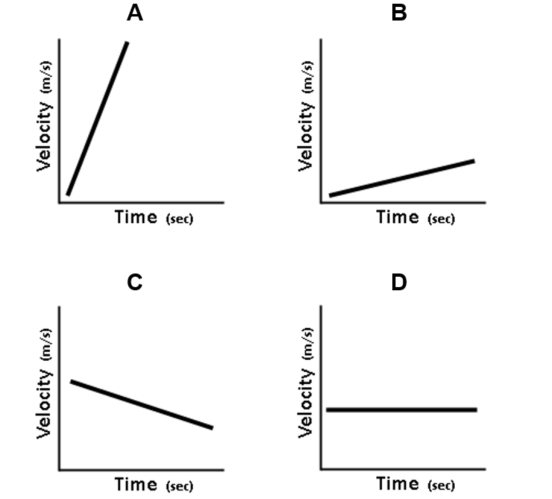

If you traveled from Point A to Point B to Point C, what would your DISPLACEMENT be?
3 miles
4 miles
5 miles
7 miles
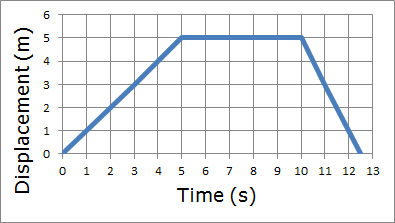

The turtle speeds up from 0m/s to 20m/s in 2 seconds. What is his acceleration?
40m/s2
20m/s2
10m/s2
2m/s2
Dave runs a 400 m race with a speed of 4 m/s. What time will it take him to finish the race?
400 minutes
100 minutes
100 seconds
.25 seconds
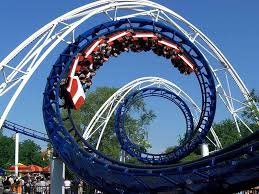

What type of force is this man using to push his grocery cart?
Normal Force
Gravity
Air Resistance
Applied Force
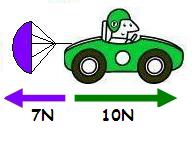
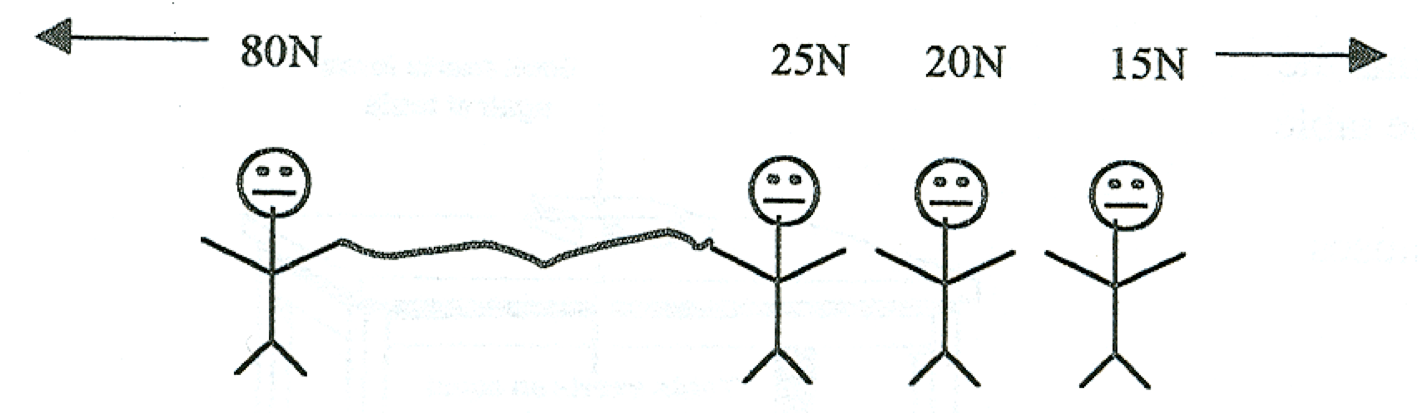
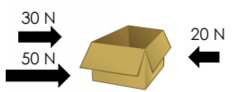
What is the net force?
3 N
3 N, right
17 N, right
3 N, left

What is the unit to MEASURE force?
Kilogram
Meter
Pounds
Newton

A ____________ is a push or a pull on an object.
friction
force
magnet
gravity
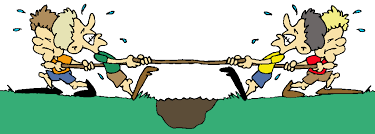

Forces that have a net force of zero Newtons
Balanced force
Unbalanced force
An object in motion tends to stay in motion and an object at rest tends to stay at rest until acted on by an unbalanced force is which of Newton's laws?
1st
2nd
3rd
4th
The acceleration of an object is dependent upon the net force acting upon the object and the mass of the object is which of Newton's laws?
1st
2nd
3rd
4th
For every action there is an equal and opposite reaction is which of Newton's laws?
1st
2nd
3rd
4th

If you are pushing a 1200 kg car with an acceleration of 0.5 m/s2 , what is the force you have applied to the car?
600
2400
4.16
60

calculate the force applied to a 5 kg shopping cart if it accelerates at 3 m/s2
15
1.67
0.6
1.57

If you INCREASE the force applied to a 50 kg crate, what happens to the ACCELERATION of the crate
acceleration increases
acceleration decreases
force increases
this cannot be determined

Based on Newton's 2nd Law of Motion, which statement is true about the acceleration of wagon A and wagon B if both are being pulled with the same external force
wagon A will have a greater acceleration than wagon B
wagon B will have a greater acceleration than wagon A
wagon A and B will have the same accelerations
the wagons will both have and acceleration of zero

What can be said of friction?
it works against you as you are trying to move an object
it works with you as you are trying to move an object
it lifts up an object as you are trying to move it
it is never noticeable as you try to move an object
Energy is measured in…
Newtons (N)
Joules (J)
Grams (g)
Meters (m)
Potential energy is the energy due to the…
Motion of an object.
Speed of an object.
Position of an object.
Velocity of an object

A roller coaster at the top of the first hill has mostly what kind of energy?
Heat energy
Kinetic energy
Potential energy
Chemical energy
An example of chemical energy is…
Water held by a dam
Batteries
A fast moving car
A volcano

Electrical energy is a form of…
Potential energy
Kinetic energy

Chemical energy is a form of…
Potential energy
Kinetic energy

Elastic energy is a form of…
Potential energy
Kinetic energy

Gravitational energy is a form of…
Potential energy
Kinetic energy

Sound energy is a form of…
Potential energy
Kinetic energy

Thermal energy is a form of…
Potential energy
Kinetic energy

What is the kinetic energy of a 1560 kg car parked in a garage?
1560 J
0 J
156 J
15600 J

What kind of energy transformation could occur in this image?
nuclear to mechanical
chemical to electrical
GPE to chemical
electrical to light

If kinetic energy decreases,...
potential energy will decrease the total energy
potential energy will increase while total energy stays the same
mechanical energy will add to the total energy output
potential energy will stay the same while the total energy decreases
A material that reduces the transfer of thermal energy is a(n) .
conductor
insulator
solar collector
radiator
All of the following are good thermal conductors EXCEPT .
silver
copper
air
aluminum
Which answer best represents what a fluid is?
liquid and gases
liquids
gases and solids
solids and liquids
The transfer of energy that does not require matter is _________ .
conduction
convection
radiation
combustion
The ______________ of an object is a measure of the average kinetic energy of the particles in
the object.
heat
temperature
conductivity
charge
The sum of the kinetic and potential energy of the particles in an object is the of the object.
heat
state
temperature
thermal energy
The energy of moving particles is called _____.
sound energy
heat or thermal energy
light energy
mechanical energy
When particles are heated they begin to ____.
move faster
mover slower
move up
jump out of the pot

Convection can take place in ____________.
solids only.
liquids only.
liguids and gases only.
solids, liquids and gases.
What is transferred from place to place by waves?
matter
energy
particles
light
What is the boiling point of water on the Celsius scale?
0oC
373oC
100oC
212oC
What is the freezing/melting point of water of the Fahrenheit scale?
−273oF
0oF
32oF
273oF
What is the freezing/melting point of water of the Celsius scale?
−273oC
0oC
32oC
273oC
What happens when molecules reach absolute zero?
The molecules move and stop alternately.
The molecules stop moving.
The molecules start moving.
The molecules continue to move.

