
Font size
 Worksheets
Physical Science
Total questions: 128
Worksheet time: 2hrs 35mins
What causes our sunrises and sunsets to appear red and orange?
refraction of light through cold air
reflection of light through cold air
refraction of light through hot air
small particles scatter shorter blue wavelengths more than red-orange so we see more red-orange
How do sunglasses work?
Gradually refracting light as it passes through the lenses
Bending light as it passes from air into the lenses
Blocking light waves that vibrate in one plane
Reflecting most of the light that strikes the sunglasses
How do sunglasses work?
Polarized sunglasses absorb all light coming in
polarized sunglasses have horizontally polarized filters to block the horizontally polarized light.
polarized sunglasses have vertically polarized filters to block the horizontally polarized light.
polarized sunglasses have vertically polarized filters to diffract the horizontally polarized light.

opaque
translucent
transparent
An object that allows ALL light to pass through clearly and easily
translucent
opaque
transparent
reflect

transparent
opaque
translucent

transparent
opaque
translucent
What are the three light transmitting capabilities?
reflective, refractive, diffractive
converse, inverse, diverse
direct, indirect, codirect
transparent, translucent, opaque
An object that allows NO light to pass through which creates a shadow behind the object
opaque
transparent
translucent
translated
What type of reflection of light would occur on a lake with high waves?
regular
diffuse
irregular
instantaneous
What type of reflection would occur off of a mirror
regular
diffuse
scattered
criss cross
What causes a mirage?
refraction of light through cold air
reflection of light through cold air
refraction of light through hot air
diffraction of light
An object that allows SOME light to pass through, but not all of it. Objects appear fuzzy/blurry on the other side
translucent
transparent
opaque
optical
In what two ways do electromagnetic waves vary?
The speed they travel in a vacuum
Wavelength and frequency
the way they reflect
their direction
Light behaves like
a wave
a particle
a wave and a particle
neither a wave or a particle
Photons travel outward from a light source in
a single straight line
increasing intensity
a small, dense area
all directions
The full range of frequencies of electromagnetic radiation is called
visible light
radio waves
electromagnetic spectrum
invisible radiation
The visible light spectrum ranges between
Radar waves and x-rays
Television waves and infrared rays
Infrared rays and ultraviolet rays
Ultraviolet rays and gamma rays
What are the three light transmitting capabilities from NONE to ALL?
Transparent, opaque, translucent
Opaque, transparent, translucent
Opaque, translucent, transparent
Translucent, transparent, opaque
Which of the following occurs as a light wave bends when it passes from one medium into another?
Constructive interference
Refraction
Destructive interference
Reflection
Newton’s prism experiment showed that white sunlight is made up of
The full electromagnetic spectrum
Only blue light
All the colors of the visible spectrum
Only the longest wavelength
The primary colors of light are
Green, blue, black
Cyan, magenta, and yellow
Red, yellow, and blue
Blue, green, and red
What are the colors of visible light from longest wavelength to shortest?
red, orange, yellow, grey, blue, indigo, violet
violet, indigo, blue, green, yellow, orange, red
red, orange, yellow, green, black, indigo, violet
red, orange, yellow, green, blue, indigo, violet
What causes a rainbow?
water droplets act like a prism and separate the light
the clouds block the light and make it visible
the rain and sun make everything brighter
sunlight bounces off the rain
What makes a green shirt green to your eyes?
the green light is absorbed by the shirt
the shirt absorbs black light and reflects green
the green light is reflected back to your eyes by the shirt
all white light is absorbed by the shirt
The three secondary colors of light are...
red, blue, green
red, blue, yellow
cyan, magenta, yellow
white, black, red
What are complimentary colors of pigments?
any two colors of pigments that make green
any two colors of pigments that make red
any two colors of pigments that make white
any two color of pigments that make black
Natural pigments can come from which of the following?
Metal oxides
plants
minerals
all of the above
If you combine equal amounts of red, blue, and green, what type of light will you form?
black
white
yellow
indigo

When you place things into water they sometimes look bent (see the image below). What is this an example of?
Refraction
Diffraction
Transmission
Absorption

Which type of interaction is shown in the image?
Destructive Interference
Absorption
Constructive Interference
Reflection

Which type of interaction is this?
reflection
refraction
diffraction

Which type of interaction is this?
reflection
refraction
diffraction

Which type of interaction is this?
reflection
refraction
diffraction
Reflection occurs when a wave
bends due to a change in speed
hits a surface and bounces back
passes through an opening
bends around a barrier
Interference in which waves combine to form a wave with larger amplitude than either wave originally had is called
destructive interference
amplitude enhancement
constructive interference
resonance
A wave that appears to stand in one place
diffraction
constructive interference
standing wave
resonance

In the diagram which letters represent the nodes
A B C
A C E
B D
B D E
A C D


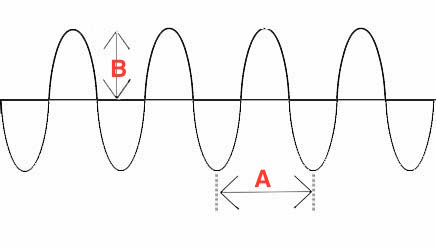
What property of this wave is represented by the letter "A"
amplitude
crest
trough
wavelength
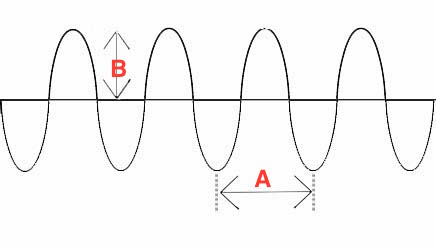

A wave with a large wavelength will have a ______ frequency and _____ energy
high, low
high, high
low, high
low, low

Which of these waves has the highest frequency?
1
2
3

This illustration demonstrates which wave property?
diffraction
frequency
amplitude
Doppler Effect

Which wave has the greatest wavelength?
Red Wave
Orange Wave
Green Wave
Purple Wave

Which wave has the lowest wavelength?
Red
Violet
Orange
Green
The bigger the amplitude, the ________ energy carried by the wave.
more
less
The length of one complete wave cycle is...
frequency
wave speed
amplitude
wavelength
What does a wave carry from place to place?
energy
matter
people
An area where coils are far apart
rarefaction
raresteak
rarefind
faction
An area where coils are close together
compression
compressor
conductor
composer
Amplitude is measured from
crest to crest
trough to trough
rest to crest
crest to crest or trough to trough
Wavelength is measured from
crest to crest
trough to trough
rest to crest
crest to crest or trough to trough
A period is that what between two successive crests?
length
time
amplitude
distance
Which of these would NOT be a wave property?
Period
Frequency
Transmission
Amplitude
Transverse waves move mediums
at a right angle
in a circle
and matter too
at an acute angle
Longitudinal waves move:
at a right angle compared to the direction the wave is traveling
in a circle compared to the direction the wave is traveling
matter
in the same direction as the wave is traveling
What type of wave is the most damaging in an earthquake?
transverse
surface waves
longitudinal
calculated
What causes an echo?
diffraction of sound waves
refraction of sound waves
reflection of sound waves
interference of sound waves
Through which medium does sound travel the fastest through?
solid
liquid
gas
BEC
Sound travels faster through cold air than warm air.
True
False
The rate at which a wave's energy flows through a given area is called
loudness
pitch
amplitude
intensity
The loudness of something depends on the person who hears it.
True
False
Most people can hear between what frequencies?
2-20 Hertz
25000-30000 Hertz
20-20000 Hertz
1-5 Hertz
If a wave has a high frequency, it also has a high what?
pitch
wavelength
trough
crest
Ultrasound is sounds that are higher than most people can hear.
True
False
Infrasound is sound that is higher than most people can hear.
True
False
The doppler effect occurs because
destructive interference
there is a change in frequency of sound due to movement
constructive interference
sound is reflected
What part of your ear contains the smallest three bones of the body?
outer ear
inner ear
middle ear
distant ear
What part of your ear uses nerve endings to send sound signals to the brain?
outer ear
middle ear
inner ear
distant ear
What does newtons first law states
An object at rest will remain at rest unless a force is applied
An object is moving
An object has stopped
An moving object will keep going when a force is applied to it
The tendency of objects to resist a change in motion is called:
Friction
Inertia
Gravity
Velocity
Which hits the ground first if they start at the same height: a dropped ball or a ball launched with a
horizontal velocity?
the launched ball
the dropped ball
they both hit at the same time
An object of mass 10 kg is accelerated upward at 2 m/s2. What force is required?
20 N
2 N
5 N
0 N
When force is 20 N, mass is 5 kg, what is acceleration?
F = ma
25 m/s^2
5 m/s^2
100 m/s^2
4 m/s^2
1st
Law of Motion
2nd
Law of Motion
3rd
Law of Motion

Describe the motion in the graph:
Constant Speed (positive slope)
Stopped (at rest)
Acceleration (increasing speed)
Return Home (negative slope)
Jane jogs 18 km in 2 hours. Then she walks for 6 km in 2 hours. Find her average speed.
9
3
12
6

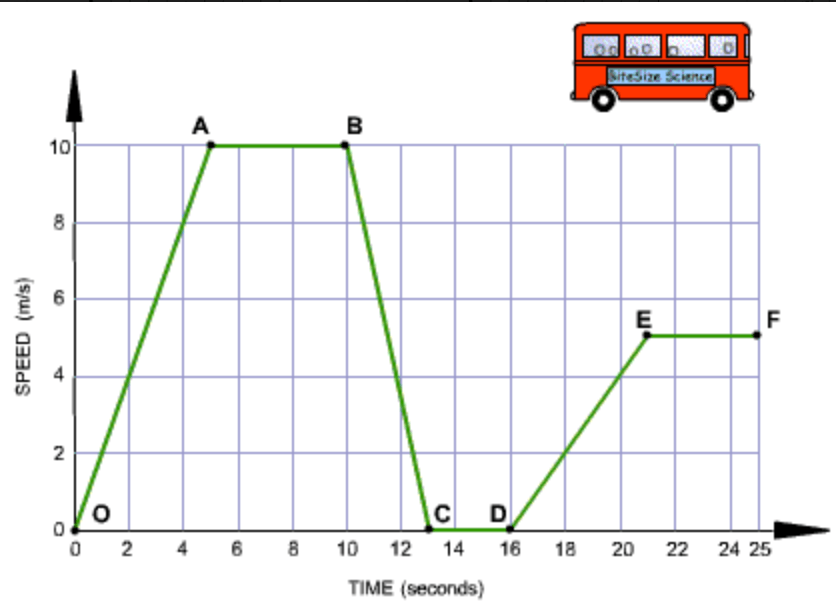
Segment A-B: The bus is __
accelerating
decelerating
moving at constant speed
at rest
Segment D-E: The bus is _________________.
accelerating
decelerating
constant speed
at rest

Describe the motion in the graph:
Constant Speed (positive slope)
Stopped (at rest)
Acceleration (increasing speed)
Return Home (negative slope)
Which law best describes inertia
1
2
3
All of the above
F= mass * acceleration
A 20 kg bike accelerates at 10 m/s2. what is the force acting upon it?
25 Newtons
20 Newtons
200 Newtons
10 Newtons

Two cars collide, the force of car A on car B is equal to the force of car B on car A
1st Law
2nd Law
3rd Law


What type of friction helps the child?
static
sliding
rolling
fluid

What type of friction does the man have to overcome to get the box moving>
static
sliding
rolling
fluid
Any change in velocity (speed and/or direction) of motion . . .
speed
velocity
acceleration
force
The force of attraction between two objects; increases as the mass of the objects increase; decreases as the distance between the objects increases . . .
gravity
friction
balanced forces
unbalanced forces

