wayground logo

Free Printable Worksheets

Font size

S
M
L
XL
Worksheets

Animal Science review

Total questions: 126

Worksheet time: 5hrs 29mins

Name
Class
Date
1.
A tapeworm lives inside of a host's body. This means that tapeworms are _______________. 
a)
Ectoparasites
b)
Endoparasites
c)
Free-living
d)
Flukes
2.
How many types of tapeworms are known to infect humans?
a)
1
b)
2
c)
4
d)
6
3.
Flatworms have no true body cavity. This means they are ____________________. 
a)
Symmetrical
b)
Sessile
c)
Coelomates
d)
Acoelomates
4.
The bodies of flatworms are flattened ___________________. 
a)
Laterally
b)
Bilaterally
c)
Radially
d)
Dorso-ventrally
5.
What is a definitive host? 
a)
An organism that any parasite can live on.
b)
The last organism that a parasite uses to live.
c)
The organism that parasitic eggs are laid on. 
d)
An organism that parasites find easily. 
6.
Which of the following terms does not relate to flatworm reproduction?
a)
Dimorphism 
b)
Hermaphroditic 
c)
Monoecious
d)
Cross-fertilization
7.
A brightly colored flatworm, swimming with a wavelike motion, likely belongs to which class?
a)
Cestoda
b)
Trematoda 
c)
Turbellaria 
d)
Monogenea 
8.
The small segments behind a scolex that reproduce quickly, making a tapeworm longer and longer are called...
a)
Cilia
b)
Hooks
c)
Proglottids
d)
Snaps
9.
What is cephalization? 
a)
Having male and female parts.
b)
A concentration of sense organs and nervous system at the anterior end of the body. 
c)
Feeding off of another organism.
d)
Breathing through the skin.
10.
Which type of roundworm is the most life-threatening canine worm?
a)
Heartworm
b)
Pinworm
c)
Hookworm
d)
Liverworm
11.
What structure protects parasitic flatworms in harsh environments like a digestive system?
a)
Neodermis
b)
Proglottids
c)
Flukes
d)
Cilia
12.
What structure do planaria use for feeding?
a)
Cilia
b)
Scolex
c)
Proglottids
d)
Pharynx
13.
Of the following options, where would you most expect to find an ectoparasite?
a)
In the blood.
b)
In your liver.
c)
Inside an elephant.
d)
On the outside of a fish.
14.
Which of the following is not a class of the Phylum Platyhelminthes?
a)
Nematoda
b)
Trematoda
c)
Cestoda
d)
Turbellaria 
15.
Why is it so important that Platyhelminthes worms have a flattened body?
a)
So they can fit in small spaces.
b)
It's easier for them to move that way. 
c)
Their cells absorb oxygen through their skin, so they have to be close to the outside. 
d)
It makes reproduction more simple. 
16.

What kind of worm is a platyhelminthes?

a)

Flat worm

b)

Round worm

c)

Special ed worm

d)

School worm

17.

What type of symmetry do Platyhelminthes have?

a)

Bilateral

b)

Asymmetrical

c)

Round

d)

Small

18.

Which class ISNT in Platyhelminthes?

a)

Trematoda

b)

Cestoda

c)

Monogenea

d)

Adenophorea

19.

Which Class has Tapeworms

a)

Cestoda

b)

Monogenea

c)

Trematoda

d)

Nematoda

20.

Which ISNT a type of flatworm?

a)

Flukes

b)

Planarians

c)

Tapeworms

d)

Mealworms

21.

Do Platyhelminthes depend on host or not?

a)

Depend on Host

b)

Don’t Depend on Host

22.

Flat worms don’t need another host to survive

a)

True

b)

False

23.

True or False: Platyhelminthes are acoelomate

a)

True

b)

False

24.

True or False: Platyhelminthes have hard bodies

a)

True

b)

False

25.

What structures do tapeworms have for attaching themselves to the intestinal lining of their host? (multiple answers possible)

a)

suckers

b)

pharynx

c)

hooks

d)

silk glands

26.

Which structure is used by a planarian for feeding?

a)

cilia

b)

scolex

c)

sucker disc

d)

pharynx

27.

This type of flatworm (pictured) is free-living in freshwater and marine environments.

a)

sheep liver fluke

b)

planarian

c)

hookworm

d)

tapeworm

28.

How does a tapeworm get its nutrition?

a)

Through its mouth and complex digestive system.

b)

Absorbs food in the host's intestine directly through its skin.

29.

What type of symmetry do all worms have?

a)

bilateral

b)

radial

c)

asymmetry

d)

spherical

30.

The image shows which type of worm?

a)

fluke

b)

flatworm

c)

roundworm

d)

segmented worm

31.

Which of the following are true of worms in Phylum Nematoda? (multiple answers possible)

a)

they are very flat

b)

they have a two-way, incomplete digestive system

c)

they are hermaphrodites

d)

they move with thrashing, snake-like movements

32.

A single organism that has both testes and ovaries is called _____________________ .

a)

hermaphroditic

b)

dioecious

c)

heterotrophic

d)

homozygous

33.

The extendable throat of a planarian is the _____________ .

a)

intestine

b)

acetabulum

c)

pharynx

d)

gizzard

34.

To which phylum does a planarian belong?

a)

Cnidaria

b)

Platyhelminthes

c)

Nematoda

d)

Annelida

35.

Which of the following are true of worms? (multiple answers possible)

a)

they are unicellular

b)

they are vertebrates

c)

they have long, narrow bodies

d)

they have bilateral symmetry

36.

An organism in which the sexes are separate (i.e. different male and females organisms) is _________________ .

a)

autotrophic

b)

dioecious

c)

hermaphroditic

d)

invertebrate

37.

Which worm phylum includes planarians, tapeworms, and flukes?

a)

Platyhelminthes

b)

Nematoda

c)

Onychophora

d)

Annelida

38.

Which worm is pictured?

a)

dog tapeworm

b)

planarian

c)

earthworm

d)

Chinese liver fluke

39.

Which name best describes an organism that lives in or on another and feeds from that organism's tissues or fluids?

a)

decomposer

b)

host

c)

parasite

d)

scavenger

40.

They two eyespots of a planarian are _________________ .

a)

posterior

b)

ventral

c)

anterior

d)

lateral

41.

Which of the following are true of this marine flatworm? (multiple answers possible)

a)

It belongs to Phylum Platyhelminthes

b)

It has a complete, one-way digestive tract

c)

It has male and female reproductive organs

d)

It has a round body with pointed ends

42.
Which phylum of worms has a bilateral symmetry, one-way digestive system, respiration through skin, hydrostatic skeleton and segmented body?
a)
Annelida
b)
Platyhelminthes
c)
Nemotoda
d)
Nemertea
43.
If present, which type of skeleton is found in worms?
a)
Longitudinal
b)
Circular
c)
Exoskeleton
d)
Hydrostatic
44.
Which phylum of worms are pseudoceolomates?
a)
Platyhelminthes
b)
Nematoda
c)
Annelida
45.
Which of the following is the evolutionary advancement first found in annelids?
a)
Three germ layers
b)
A complete digestive system
c)
Cephalization
d)
Coelomates (tube within a tube)
46.
Which phylum includes flatworms, planarians and liver flukes?
a)
Platyhelminthes
b)
Nematoda
c)
Annelida
47.
Which phylum contains segmented worms like earthworms and leeches?
a)
Platyhelminthes
b)
Nematoda
c)
Annelida
48.
Which phylum is the first to exhibit a closed circulatory system?
a)
Platyhelminthes
b)
Nematoda
c)
Annelida
49.

Worms take in oxygen through their

a)

lungs

b)

skin

c)

hearts

d)

mouth

50.

What word means the "front" of the worm?

a)

dorsal

b)

ventral

51.
Which of the following phyla contains  mostly parasitic roundworms?
a)
Annelida
b)
Cnidara
c)
Nematoda
d)
Platyhelminthes
52.
Earthworms have setae, which are like bristles that help them ___.
a)
move
b)
eat
c)
reproduce
53.
The three main phlya of worms include
a)
roundworms, tube worms, and flat worms
b)
roundworms, flatworms, and segmented worms
c)
flatworms, segmented worms, and marine worms
54.
The structure that a planarian extends for feeding
a)
crop
b)
proglottid
c)
scolex
d)
pharynx
55.
In a complete digestive tract
a)
the food moves only one way
b)
nutrients are able to be absorbed more efficiently
c)
the anterior end contains the mouth; the posterior end contains the anus
d)
all of these
56.

The long fleshy tube ribbon worms use to entangle their prey is called

a)

Parapodia

b)

Proboscis

c)

Pharynx

d)

Setae

57.
butterflies have
a)
radial symmetry
b)
bilateral symmetry
c)
no symmetry
58.
humans have
a)
radial symmetry
b)
bilateral symmetry
c)
no symmetry
59.
sponges have
a)
radial symmetry
b)
bilateral symmetry
c)
no symmetry
60.
sea anemones have
a)
radial symmetry
b)
bilateral symmetry
c)
no symmetry
61.
A good title for a book of animals that feature only vertebrates would be
a)
Earth's Invertebrate Animals
b)
Earth's Animals
c)
The Animal Kingdom
d)
Animals with Backbones
62.
Polyps and Medusa are  
a)
cnidarians
b)
sponges
c)
platyhelminthes
d)
roundworms
63.
What is one of the four key functions of animals?
a)
obtaining food and oxygen
b)
swimming
c)
making sound
d)
caring for young
64.
What is the correct order of relationships from basic to more complex?
a)
cells, tissues, organs, systems
b)
tissues, organs, systems, cells
c)
organs, systems, cells, tissues
d)
cells, organs, tissues, systems
65.
Some parasites of dogs include
a)
tapeworms
b)
planaria
c)
medusa
d)
earthworms
66.
Budding is a form of _________.
a)
sexual reproduction.
b)
asexual reproduction.
67.
A tissue is a group of _______ that work together to perform a job.
a)
organs
b)
system
c)
cells 
d)
organisms
68.
An animal without a backbone is called a(n)
a)
vertebrate
b)
invertebrate
c)
larva
d)
parasite
69.
The highest level of organization in an animal is a(n)
a)
cell
b)
tissue
c)
organ
d)
system
70.
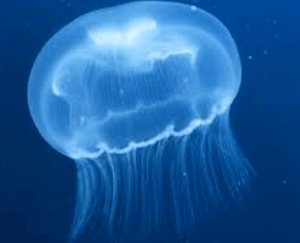
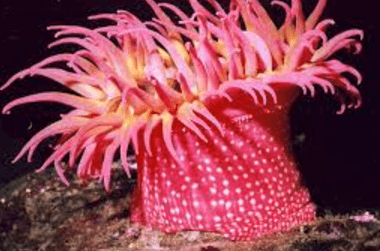
This form of cnidaria is known as a _______.
a)
polyp
b)
medusa
71.
This form of cnidaria is known as a __________.
a)
medusa
b)
polyp
72.
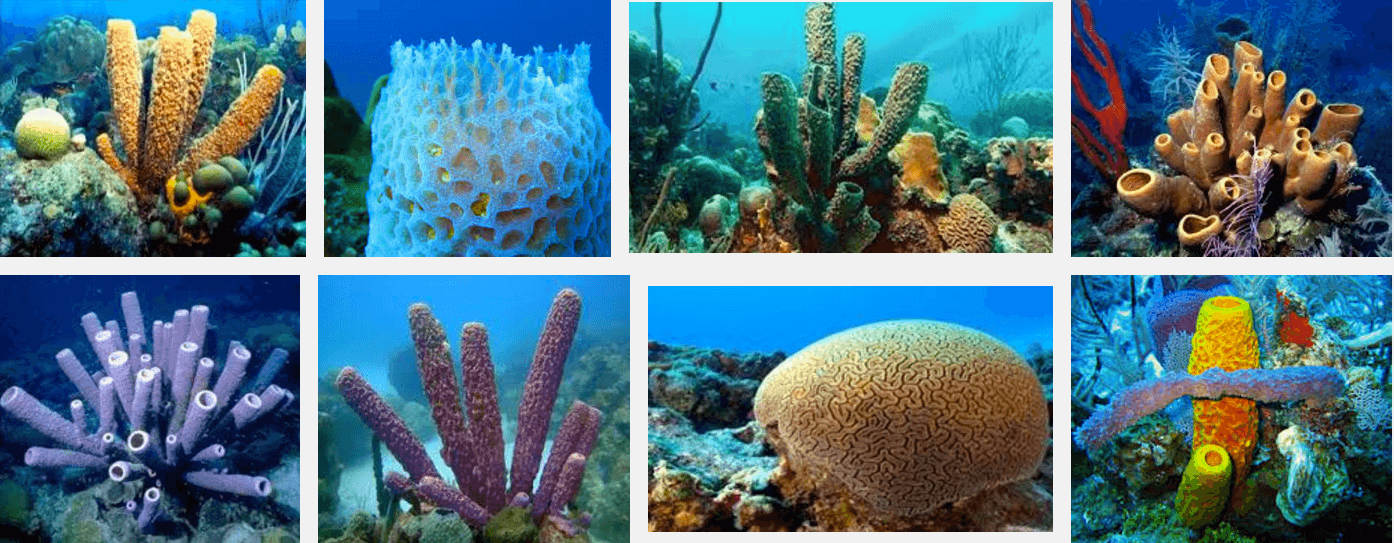
These belong to __________ phylum.
a)
porifera (sponges)
b)
cnidaria
c)
echinodermata
d)
mollusca
73.
Between 97% of all animals on earth can be classified as _____.
a)
invertebrates
b)
vertebrates
c)
reptiles
d)
mammals
74.
______________ are invertebrates that have two different body plans – polyp and medusa
a)
Cnidarians 
b)
Worms
c)
Sponges
75.
One characteristic by which animals are classified is
a)
Their body structure
b)
Where they are found
c)
How they get their oxygen 
76.
Which of the following is not a characteristic of a sponge
a)
Has collar cells
b)
Can reproduce sexually and asexually
c)
Has stinging cells 
d)
Filters water 
77.
Cnidarians capture food and defend themselves by 
a)
stinging cells
b)
collar cells
c)
budding
d)
forming a hard skeleton 
78.
The highest level of organization in an animal is 
a)
cell
b)
tissue
c)
organ
d)
system 
79.
Which of the following organisms has a closed circulatory system 
a)
round worms
b)
flatworms 
c)
segmented worms
d)
sponges 
80.

Cnidarians have what type of symmetry?

a)

Asymmetry

b)

Radial

c)

Bilateral

d)

No symmetry

81.

Jellyfish have what type of body structure

a)

Medusa

b)

Polyp

c)

Hydra

d)

Branched

82.

Sea anemones have what type of body structure?

a)

Medusa

b)

Polyp

c)

Down

d)

Sessile

83.

Cnidarians hunt with

a)

Nematocysts

b)

Polyps

c)

Statocysts

d)

Cnidocytes

84.
What is an invertebrate?
a)
An animal with a backbone
b)
a mammal
c)
An animal without a backbone
d)
birds
85.
Between 90-95% of all animals on earth can be classified as _____.
a)
invertebrates
b)
vertebrates
c)
reptiles
d)
mammals
86.
Which phylum is mainly asymmetrical?
a)
cnidaria
b)
porifera (sponges)
c)
echinodermata
d)
arthropoda
87.
Most animals have this type of symmetry?
a)
radial
b)
asymmetrical
c)
bilateral
d)
trilateral
88.
These organisms all have nematocysts.
a)
cnidaria
b)
mollusca
c)
arthropoda
d)
porifera
89.
This form of cnidaria is known as a _______.
a)
polyp
b)
medusa
90.
This form of cnidaria is known as a __________.
a)
medusa
b)
polyp
91.
Sponges use pores to 
a)
move from place to place.
b)
filter food from the water.
c)
defend themselves.
92.
Sponges are members of the ________ Kingdom.
a)
Animal
b)
Larva
c)
Porifera
d)
Sessile
93.
Anemones belong to which phylum?
a)
Cnidaria
b)
Porifera
c)
Echinodermata
d)
Platyhelminthes
94.

How does the size of most invertebrates compare to the size vertebrates?

a)

invertebrates are generally larger than vertebrates

b)

they are about the same size

c)

invertebrates are generally smaller than vertebrates

d)

no one knows

95.
Invertebrates have a (less/more) complex body structure than vertebrates.
a)
less
b)
more
96.
Most sponges are hermaphrodites.  What does this mean?
a)
sponges can produce their own food
b)
sponges can produce both eggs and sperm
c)
sponges cannot reproduce
d)
sponges can swim around
97.
What is the correct order of relationships from basic to more complex?
a)
cells, tissues, organs, systems
b)
tissues, organs, systems, cells
c)
organs, systems, cells, tissues
d)
cells, organs, tissues, systems
98.

The main difference between a cladogram and a phylogenic tree is that...

a)

a cladogram does not produce a new branch for every unique trait being observed

b)

Phylogenetic tree also shows evolutionary time. This allows you to track how a species has changed over time.

c)

a cladogram represents distance of relatedness in time and trait similarities

d)

a phylogenic tree produces a new branch for every unique trait being observed

99.

The diagram below represents possible genetic relationships between groups of organisms.

Which statement is a valid conclusion that can be drawn from the diagram?

a)

Insects are more complex than mammals.

b)

Earthworms and sea stars have a common ancestor.

c)

Snails appeared on Earth before corals.

d)

Sponges were the last new species to appear on Earth.

100.
Based on the phylogenic tree, which of these shows a correct ancestral lineage?
a)
E is an ancestor to F and G
b)
C is an ancestor to D and E
c)
B is an ancestor to A
d)
E is an ancestor to H and I
101.

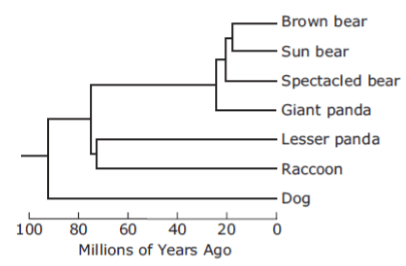
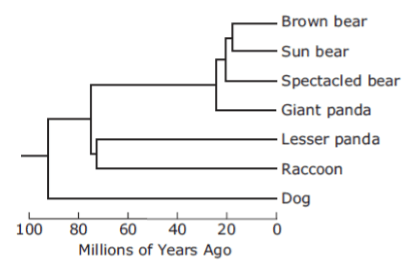
Based on this phylogenetic tree, which statement is true?

a)

Lesser pandas are more genetically similar to giant pandas than they are to raccoons

b)

Brown bears are more genetically similar to giant pandas than they are to sun bears

c)

Lesser pandas are more genetically similar to raccoons than they are to giant pandas

d)

The bear species are all more genetically similar to dogs than they are to giant pandas
102.

Who is the closest relative to the brown bear?

a)

Giant panda

b)

Dog

c)

Lesser panda

d)

Sun bear

103.

What number is the common ancestor of C and D

a)

1

b)

2

c)

3

d)

4

104.

What is the common ancestor of Letters A, B, C, D, E?

a)

1

b)

2

c)

3

d)

4

105.

According to this tree, which of these animal phyla are most closely related?

a)

Arthropoda & Mollusca

b)

Arthropoda & Chordata

c)

Chordata & Mollusca

106.
What is the correct sequence for Taxonomic Classification?
a)
Kingdom,Phylum,Oorder,Class,Genus,Family,Species
b)
Kingdom,Order,Class,Family,Species,Phylum,Genus
c)
Kingdom,Phylum, Class,Order,Family,Genus,Species
d)
Kingdom,Species,Genus,Order,Phylum,Family,Class
107.
What is classification?
a)
organizing things into groups according to shared characteristics
b)
making a list of organisms
c)
the process of identifying different types of animals
d)
the study of animals
108.

The grizzly bear is most related to the

a)

squirrel

b)

snake

c)

fox

d)

sea star

109.

Which of the following is an example of binomial nomenclature?

a)

Ditch cougar

b)

Alley cat

c)

Chrysaora fuscescens

d)

Cnidarian

110.
If two organisms are in the same phylum, they must also be in the same
a)
class
b)
species
c)
family
d)
kingdom
111.

A wolf's scientific name is Canis rufus. Which genus does it belong to?

a)

Canis

b)

rufus

c)

wolf

d)

animal

112.

The wildcat's scientific name is Felis silvestris. What taxonmic levels do the scientific name include?

a)

genus & species

b)

phylum & genus

c)

kingdom & phylum

d)

class & species

113.
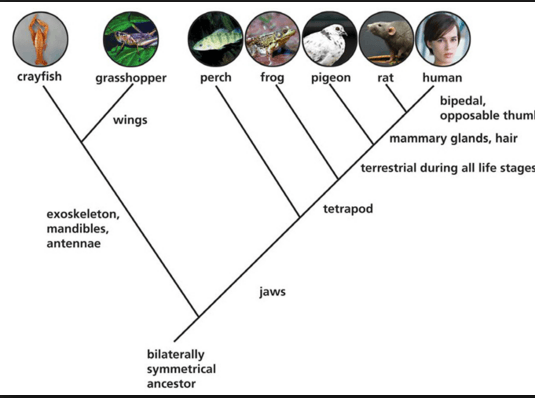
Which trait do only humans have, according to the cladogram?
a)
jaws
b)
mammary glands & hair
c)
terrestrial during all life stages
d)
bipedal & opposable thumbs
114.
Based on the phylogenic tree, which of these shows a correct ancestral lineage?
a)
E is an ancestor to F and G
b)
C is an ancestor to D and E
c)
B is an ancestor to A
d)
E is an ancestor to H and I
115.
What are the three domains?
a)
Archaea, Bacteria, and Eubacteria
b)
Archaea, Protists, and Eubacteria
c)
Archaea, Bacteria, and Eukarya
d)
Archaea, Fungi, Animalia
116.
How many kingdoms are there?
a)
3
b)
4
c)
6
d)
9
117.

This domain contains organisms that have a true nucleus in each of their cells.

a)

Eukarya

b)

Archaea

c)

Bacteria

118.
I am single celled, and I only have one parent.  My cell does not have an organized nucleus.  Sometimes I cause diseases.  Other times I am a decomposer.
a)
Bacteria
b)
Archaea
c)
Animalia
119.
Which domain contains cells which all contain a nucleus?
a)
Bacteria
b)
Archaea
c)
Eukaryota
120.
What are the names of the domains?
a)
Eukarya, Bacteria, Archaea
b)
Eubacteria, Archaebacteria, Protista, Animalia, Fungi, Plantae
121.
Which Domain contains members who are prokaryotic?
a)
Archae and Bacteria
b)
Archae and Protista
c)
Bacteria and Animalia
d)
Bacteria  and Fungi
122.

The BROADEST level of classification within Taxonomy is.....

a)

Order

b)

Domain

c)

Species

d)

Genus

123.
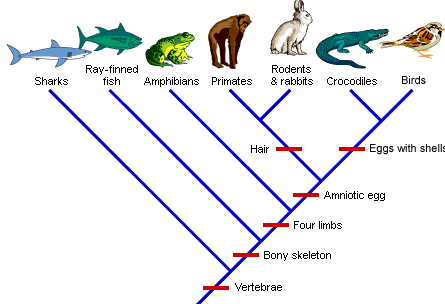
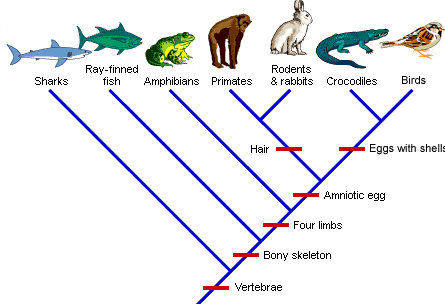
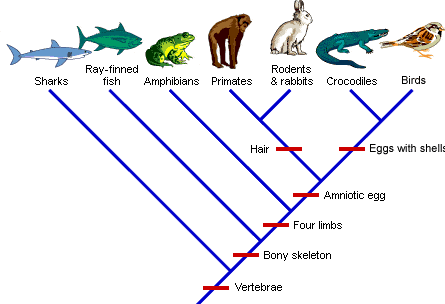
According to this cladogram, sharks are MOST closely related to which organism? 
a)
Amphibians
b)
Ray finned fish
c)
Crocodiles
d)
Birds
124.
Which two orgainsms have hair? 
a)
Sharks & Ray Finned Fish
b)
Primates & Rodents
c)
Birds & Crocodiles
d)
Rabbits & Birds
125.
According to this cladogram, birds are LEAST related to: 
a)
Amphibians
b)
Sharks
c)
Ray Finned Fish
d)
Crocodiles
126.

Which traits do humans have, according to the cladogram?

a)

jaws

b)

mammary glands & hair

c)

hair

d)

jaws, bipedal terrestrial during all life stages, mammary glands & hair & opposable thumbs