
 Worksheets
Environmental Science - Water Pollution& Cycles of Matter/Energy
Total questions: 131
Worksheet time: 1hrs 26mins
What is the main thing that carries out Nitrogen Fixation?
Lightning
Bacteria
Plants
Humans
How do non-human living things participate in the nitrogen cycle? (fill in the blank/short answer)
Bacteria decompose organic matter (decomposition)
animals move nitrogen during consumption
Bacteria convert waste into ammonia (ammonification)
All of the above
How does nitrogen get replenished in the atmosphere from the ground?
nitrification
denitrification
nitrogen assimilation
nitrogen fixation
What role do humans and other living things play in the nitrogen cycle?
they burn fossil fuels releasing nitrogen into the atmosphere
they store nitrogen in their bodies and release it into the ground when they die
they consume large amounts of nitrogen, preventing it from reacting with other atoms in the atmosphere
animals play no role in the nitrogen cycle
Why are autotrophs important factors in the carbon cycle?
they consume large amounts of producers and trap carbon
they hold carbon in their cells as glucose, preventing it from entering the atmosphere
they burn fossil fuels, releasing carbon into the atmosphere
autotrophs play no role in the carbon cycle
The release of water vapor from plants is called
combustion
transpiration
evaporation
condensation
The remains of ancient plants and animals that have been pressurized and buried for millions of years can be mined as
limestone.
calcium carbonate.
wood.
fossil fuels.
Which processes help to cycle carbon through ecosystems?
cellular respiration and photosynthesis
photosynthesis and transpiration
transpiration and the calvin cycle
calvin cycle and krebs cycle
Denitrifying bacteria are responsible for changing
N2 gas into ammonia
N2 gas into nitrates
proteins and DNA into ammonia
ammonia and nitrates into N2 gas
Phosphorus is important in living cells to make
carbohydrates
proteins
DNA and RNA
storage vacuoles
Phosphorus is found in all of the following except
soil and rocks.
fertilizer and matches.
the air.
human cells.
Clouds are formed from
precipitation and evaporation.
evaporation and condensation.
transpiration and evaporation.
infiltration and condensation.
Water flowing over the land, carrying nutrients and pollution as it drains into larger rivers and the ocean is called
condensation.
evaporation.
runoff.
percolation.
The process that involves bacteria and fungi breaking down large compounds to return smaller molecules to the environment is called
nitrification.
decomposition.
erosion.
photosynthesis.
The process where bacteria that convert nitrogen gas into ammonia and nitrites & nitrates compounds is called
nitrogen fixation.
denitrification.
infiltration.
nodule formation.
All of the nutrient cycles contain a pathway where molecules enter the atmosphere EXCEPT the
nitrogen cycle.
phosphorus cycle.
carbon cycle.
water cycle.
The hydrologic cycle is also known as the
nitrogen cycle.
water cycle.
carbon cycle.
phosphorus cycle.


What happens when there is more water than the air can hold?
The water turns into vapor and rises up.
The water falls to the ground as precipitation.
The water evaporates and turns into clouds.
Photosynthesizing plants affect the carbon cycle by...
Creating more carbon atoms
Reducing the amount of carbon in the soil
Absorbing CO2 from the atmosphere, lowering atmospheric levels of carbon
None of the above; plants do not affect the carbon cycle

The burning of fossil fuels contributes to the carbon cycle in what way?
Increases the amount of CO2 in the atmosphere
Increases the amount of O2 in the atmosphere
Decreases the amount of CO2 in the atmosphere
Decreases the amount of O2 in the atmosphere

Decomposers contribute to the carbon cycle in what way?
They turn oxygen into CO2.
They take carbon from living organisms and return it to the atmosphere as carbon dioxide.
They turn CO2 into organic, living carbon molecules.
They create organic carbon and keep it stored in the earth forever.

Choose the answer that best describes what this graph is showing.
Atmospheric carbon dioxide levels have been steadily decreasing since 1960.
Atmospheric carbon dioxide levels do not show a change over time.
Atmospheric carbon dioxide levels were at their lowest levels in 1980.
Atmospheric carbon dioxide levels have been steadily increasing since 1960.

Climate change is due primarily to what?
Increase in O2 and CO2 in our atmosphere.
Increase in ocean water temperatures.
Increase CO2 in the atmosphere.
Increase in nitrogen and phosphorous in our lakes and estuaries.
Eutrophication is caused by what?
Increase in CO2 in the atmosphere.
Increase of nitrogen and phosphorous in lakes and estuaries.
Driving our cars and using too many electronics.
Increasing air and water temperatures on earth.

Nitrogen is part what important molecule(s)?
DNA
Proteins
All of these
ATP
Denitrification is the process by which...
bacteria convert nitrates into N gas, releasing it into the atmosphere
animals convert N gas into nitrates, releasing it into the atmosphere
dead organisms break down and return carbon to the soil and atmosphere
organic N is converted into oxygen during photosynthesis

Phosphorous is the primary make-up of what cell part?
Chloroplasts
Mitochondria
Cell membrane
Ribosomes
Which nutrient(s) are what we call "limiting nutrients"?
Phosphorous because of long process of the rock cycle
Carbon because its always available
Glucose its in plants
Nitrogen because it relies on bacteria to "fix"it
What is the largest reservoir for nitrogen?
the ocean
rocks and minerals
the atmosphere
bacteria
An organism that breaks down the remains of dead plants or animals without the need for internal digestion
Decomposer
Consumer
Sun
Producer
An organism that gets energy from eating plants or animals (or both)
Producer
Consumer
Decomposer
Sun
An organism that uses sunlight to make its own food or energy
Producer
Consumer
Decomposer
Sun
The source of all energy is
(a)
Fill in the blank: Sun -> __________ -> Consumer -> Decomposer
Producer
Herbivore
Omnivore
Rain
Decomposers give energy and nutrients back to...
The Sun
The Soil
Consumers
Herbivores

If the hawk population decreases, what will happen to the snakes and rabbits?
Snakes and rabbits will increase
Snakes and rabbits will decrease
Snakes will decrease, rabbits will increase
Snakes will increase, rabbits will decrease

Choose the MOST ACCURATE term for:
Organism that feeds itself by making food using energy from the sun
Plant
Autotroph
Decomposer
Heterotroph

Choose the MOST ACCURATE term for:
Consumers that break down dead organisms into smaller compounds that can be absorbed by autotrophs
Decomposers
Scavengers
Predators
Tertiary Consumers
What does the flow of energy through an ecosystem always begin with?
Primary Producers
Primary Consumers
Heterotrophs
Grass

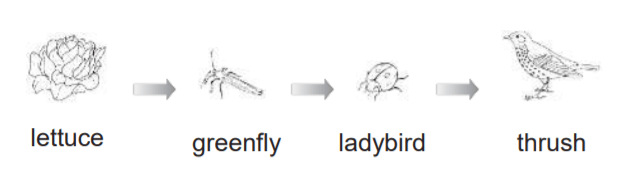
Who is the producer?
lettuce
greenfly
ladybird
thrush

Arrows in a food web show
eating
sunlight
energy flow
matter

This microscopic organism is an example of a decomposer.
algae
bacteria
dinosaurs
amoeba

A field mouse eats seeds,
a snake eats the field mouse, & a hawk eats
a snake
This is called a...
food web
food link
energy chains
food chain


Which animal is the top predator?
hawk
lizard
snake
grass

Which of the following correctly shows an energy pyramid?
A
B
C
D

How much energy is transferred from one trophic level to the next in an energy pyramid?
1%
10%
100%
90%
What is 10% of 55,000?
55,000
5,500
550
55

Kilocalories (kCal) is a measure of energy. If there are 1000 kCal available for the producers in trophic level #1, how much energy is available for the secondary consumers trophic level #3? (Hint: use the Rule of 10s)
10 kCal
1 kCal
100 kCal
1000 kCal


What is a fitting description for this diagram?

The Mayfly is a food source for which 3 organisms?

The trout is a source of food for the human and the eagle. When there are more than one organism vying for the same source we call this____?


A rapid growth of algae could lead to... (Check all that apply.)
A reduction of oxygen levels in the water.
Water that can support more life.
Waters that are devoid of life.
An increase in oxygen levels.
Source of pollution that can be traced to back to a single source.
runoff
sediment
point source pollution
nonpoint source pollution
Pollution source that cannot be traced to a single point because comes from many sources
thermal
toxic
nonpoint source pollution
point source pollution
Farmers increase their use of pesticides and herbicides. What type of pollution would this cause?
Sediment
Nutrient
Toxic
Bacterial
Thermal
Someone drains used car oil and anti-freeze onto the ground. What type of pollution would this cause?
Toxic
Bacterial
Thermal
Nutrient
Sediment
Untreated sewage is released into the environment. What type of pollution would this cause?
Nutrient
Bacterial
Toxic
Thermal
Sediment
A parking lot is build near a stream. Cars in the parking sometimes leak oil and anti-freeze onto the parking lot. What source of pollution is this?
Point source
Nonpoint source
In order to grow a nice, green lawn, Kahkwa uses a lot of fertilizers. What type of pollution would this cause?
Toxic
Nutrient
Bacterial
Thermal
Sediment
Which of the following is the best example of a source of Point Source Pollution?
Pet owners leaving waste on the ground.
Runoff from farms that brings animal waste into a stream.
Home owners washing cars near a storm drain.
A fabric company that pours extra dye into a nearby stream
Which of the following statements best explains why nonpoint pollution is so difficult to prevent?
Because nonpoint pollution can be traced to only one source.
Because the source of nonpoint pollution is difficult to identify.
Because the source of nonpoint pollution may be a factory that can afford large fines.
Because nonpoint pollution is mainly from high temperature, which is impossible for us to affect.
What element was the biggest problem in Lake Erie's issues? (Especially in the 1950s-1970s.)
Hydrogen
Nitrogen
Phosphorus
Sulfur
Eutrophication has been controlled in Lake Erie.
True
False
Which of the following is NOT a problem that Lake Erie continues to struggle with?
Invasive Species
Toxic, point source pollution
Contaminated sediments
Bacterial pollution that closes beaches
What is the most common type of pollution?
Toxic
Bacterial
Thermal
Nutrient
Sediment

causes algal blooms in lakes
sulfur dioxide
nitrous oxide
carbon dioxide
ammonia
Sewage leaking from a pipe.
Point Source Pollution
Non-point source pollution
Chemicals dumped into a river from an unknown source.
Point Source Pollution
Non-point source pollution
Fertilizer farm runoff
Point Source Pollution
Non-point source pollution

Leaking fuel tank: Point source or Nonpoint source?
Point source
Nonpoint source
Both of them
Check all that apply. What are the two types of pollution sources?
Nonpoint-source
Direct source
Point-source
Water
Which of the following is NOT a source of nitrates and phosphates into a river?
Fertilizers
Animal waste
Wastewater
Burning fossil fuels
True or False: Fertilizers used for growing crops always stay within the boundaries of the farm.
True
False
In a dead zone, _________ levels are really low such that living organisms are not able survive.
nitrogen
oxygen
fertilizer
carbon dioxide
The long term effects of a dead zone includes all of the following except for
Fisherman may struggle to catch any fish.
The crops of farmers stop growing.
The health of the fish population declines.
There is an increase in the population of decomposers such as bacteria.
The natural process of eutrophication is accelerated when you add...
phosphates and nitrates
nitrates and oxygen
biodiversity
oil and heat

A new mall and movie theatre are being built on the outskirts of suburbia. Trees and brush are cleared away, the land is bulldozed, and a silt fence is installed across part of the development. However, construction is delayed for a year, leaving the land exposed to the elements.
Toxic
Sediment
Nutrient
Bacterial
What is called when an industry removes water from a source and then returns the heated water to its source?
Water pollution
Soil pollution
Air pollution
Thermal pollution

A ship carrying gasoline runs into shore and spills large amount of gasoline.
Point
Non-Point

Acid Rain
Point
Non-Point

Construction sites sediments wash away into a stream.
Point
Non-Point

An abandoned mine leaking minerals into groundwater
Point
Non-Point
Water that seeps into soil and enters through aquifers is called _____?
Reservoir
Standing Water
Running Water
Groundwater
An underground layer of rock or soil that has connected pores, or holes, that water can pass through.
aquifer
reservoir
lake
pond
There is only _________ percent of freshwater on earth.
2
3
4
5
What is the driving force of the water cycle?
wind
sun
soil
clouds
When the sun warms plants, it causes water to evaporate out of the leaves through the small openings. This process is called
collection
transpiration
absorption
run off
The land that water flows across or under on its way to a stream, river, or lake is called...
conservation
land form
runoff
watershed

If a well is over-pumped... what could happen?
there will be more groundwater
less groundwater + aquifers will dry out
the water table does not change

All bodies of fresh water, salt water, ice, and snow that are found above ground
Groundwater
Surface water
Runoff
Swimming pool
A _________________ source of pollution is a water pollution source that happens in a specific area, such as a spot where chemicals are being directly dumped in the water.
point
nonpoint
aquifer
gravity
A __________________ source of water pollution is water pollution over a larger area, such as roadways, agricultural areas, and industrial sites.
point
nonpoint
aquifer
gravity
What is the original, and primary reservoir of inorganic phosphate (PO43-)in terrestrial ecosystems?
live plants and animals
groundwater
the atmosphere
rocks

In general, algal blooms occur when
toxins accumulate in shellfish.
nutrients decrease in the water.
nutrients increase in the water.

What converts nitrogen gas into a usable form for plants and animals?
bacteria
rain
fungi
car exhaust
How do animals get the nitrogen they need?
From the air they breathe
From the water they drink
From the food they eat
From the sun
What process occurs when dead plant and animal matter decomposes and nitrogen is released back into the atmosphere?
Assimilation
Fixation
Ammonification
Denitrification
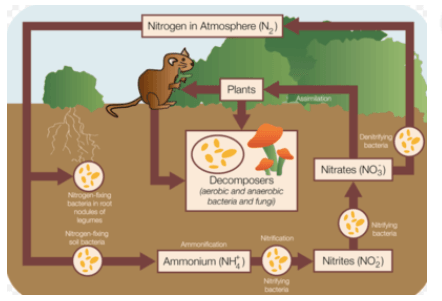
A correct path that nitrogen could take would be
air -> animals -> plants -> bacteria
animals -> air -> bacteria -> plants
bacteria -> air -> plants -> animals
air -> bacteria -> plants -> animals
The physical and chemical breakdown of rocks causes phosphate ions to be released.
Decomposition
Sedimentation
Uplift
Weathering
Why do living things need nitrogen?
To get energy
To make amino acids
To make proteins
To make proteins and DNA /RNA
What cycle are fossil fuels part of ?
carbon
oxygen
nitrogen
phosphorus
What is the largest reservoir for nitrogen?
the ocean
rocks and minerals
the atmosphere
bacteria
Nitrogen fixation is the process in which certain bacteria convert nitrogen gas into
liquid nitrogen
nitrates
nitrites
ammonia and then Nitrates
Plant roots directly obtain water from
Water vapor
Groundwater stored below the soil
Precipitation
Water runoff from rivers and streams

Decomposition is part of all cycles except _______
the carbon cycle
the nitrogen cycle
the water cycle
the phosphorus cycle
The only ways to fix atmospheric nitrogen into useable chemical compounds are what?
virus
bacteria and lightening
carbon
none of these

