wayground logo

Free Printable Worksheets

Font size

S
M
L
XL
Worksheets

Acc Bio Biology MCAS Review

Total questions: 135

Worksheet time: 2hrs 27mins

Name
Class
Date
1.

The Metric System is based on powers of:

a)

5's

b)

10's

c)

20's

d)

50's

2.
The metric unit of measurement for length is ____________________. 
a)
Liter
b)
Meter
c)
gram
d)
inch
3.
The metric unit of measurement for weight or mass is ________________.
a)
Gram
b)
Liter
c)
Pound
d)
Meter
4.

42 L = ? mL

a)

4,200

b)

.0042

c)

4.20

d)

42,000

5.
40 mL =  ? cL
a)
400
b)
4000
c)
4
d)
0.4
6.

3 cm = ? mm

a)

30

b)

300

c)

3000

d)

0.3

7.

75.2 cm = ? m

a)

0.752

b)

7.52

c)

75.2

d)

752

8.

The one factor that a scientist controls during an experiment. This goes on the x-axis.

a)

Independent Variable

b)

Dependent Variable

9.

Changes in the _________ variable cause changes in the _________ variable.

a)

independent; dependent

b)

dependent; independent

10.
On a graph, which axis shows the independent variable?
a)
x-axis
b)
y-axis
c)
neither
d)
it changes
11.
The y-axis shows
a)
time
b)
carbon dioxide concentration
c)
Mauna Loa volcano
d)
science
12.
This data set shows that
a)
there is more CO2 in the atmosphere now than ever before
b)
Hawaii will be most affected by global warming
c)
global temperatures are rising
d)
there is more CO2 in Hawaii than anywhere else
13.

What is matter?

a)

Anything that has mass and takes up space.

b)

The building blocks of mass.

c)

A pure substance that cannot be broken down.

d)

A pure substance made of 2 or more elements combined.

14.

What charge does an electron have?

a)

Positive charge

b)

Neutral charge

c)

Negative charge

d)

None of the above

15.

Which reaction absorbs energy during a chemical reaction?

a)

Endothermic

b)

Exothermic

c)

Both endothermic and exothermic

d)

None of the above

16.

This biological catalyst speeds up the rate of chemical reactions.

a)

Activation Energy

b)

Enzymes

c)

Substrates

d)

All of the above.

17.

Sand and water is an example of which of the following because the particles will settle out over time?

a)

Suspension

b)

Colloid

c)

Solution

d)

Mixture

18.

Which element is a component of all biological molecules?

a)

Phospherous

b)

Nitrogen

c)

Oxygen

d)

Carbon

19.

Are the building blocks of matter__________

a)

elements

b)

atoms

c)

compounds

20.

Atoms of the same element with different numbers of neutrons are called

a)

atomic numbers

b)

isotopes

c)

atomic neutrons

21.
A charged atom that has lost or gained electrons is called a(n)_________
a)
Acid
b)
catalyst
c)
ion
d)
isotope
22.
an organic compound is a compound that contains________
a)
carbon
b)
hydrogen
c)
oxygen
d)
sodium
23.
A bond that is formed when electrons are shared.
a)
Carbon-14
b)
Covalent
c)
Ionic
d)
James
24.
Which is an example of a solute
a)
soil suspended in water
b)
sugar that is dissolved in water
c)
water that dissolves salt
d)
water with undissolved soil
25.
What property of water lets it bond to other molecules in other surfaces?
a)
cohesion
b)
adhesion
c)
polarity
d)
solvent
26.
When OH- ions are released, ______ are produced.
a)
bases
b)
acids
c)
molecules
d)
substrates
27.
Our stomach has a pH level of 1, while orange juice has a pH level of 3. Which is more acidic?
a)
stomach acid
b)
orange juice
28.
The chemical energy used by cells in many reactions is called _____.
a)
glucose
b)
phospate group 
c)
ATP
d)
amino group
29.
Carbon can make up to _____ bond(s).
a)
one
b)
two
c)
three
d)
four
30.
Enzymes are considered to be 
a)
Lipids
b)
Carbohydrate
c)
Protein
d)
Nucleic Acid
31.
What 3 letters do enzymes typically end in?
a)
-ose
b)
-ase
c)
-ese
d)
-tic
32.
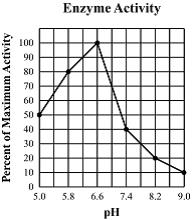
Which of the following conclusions can be drawn from this graph?
a)
The optimum pH of the enzyme is 6.6.
b)
The optimum pH of the enzyme is 5.8
c)
The enzyme’s activity increases as pH increases 5.0 to 9.0
d)
The enzyme’s activity is greater around pH of 8.0 .
33.
Which of these is NOT true?
a)
Enzymes can denature (change shape) when the temperature gets too high.
b)
Enzymes can only be used once in a chemical reaction. 
c)
Extreme pH can denature enzymes.
d)
Enzymes speed up chemical reactions. 
34.

Which macromolecule is used as our main source of energy?

a)

Lipids/Fats

b)

Nucleic Acids

c)

Proteins

d)

Carbohydrates

35.

Match the MACROMOLECULES and their MONOMERS.

Hint: Monomer = a single unit

a)

carbohydrate

1.

monosaccharide

b)

lipid

2.

fatty acid & glycerol

c)

protein

3.

amino acid

d)

nucleic acid

4.

nucleotide

36.

Which macromolecule gives LONG-TERM energy?

a)

lipid

b)

carbohydrate

c)

nucleic acid

37.
DNA and RNA are examples of 
a)
Carbohydrates
b)
Lipids
c)
Proteins
d)
Nucleic Acids
38.

Type of cells that are simple and has NO nucleus and NO membrane-bound organelles in it.

a)

prokaryotic cell

b)

eukaryotic cell

c)

plant cell

d)

animal cell

39.

Which is an example of a prokaryotic organism

a)

all unicellular organisms

b)

all multicellular organisms

c)

bacteria

d)

plant

40.

The smallest unit of living matter are

a)

cells

b)

atoms

c)

molecules

41.

Which organelle is responsible for the removal of waste and foreign particles?

a)

Plasma Membrane

b)

Lysosomes

c)

Peroxisomes

d)

Mitochondrion

42.

What is the name of this organelle?

a)

Mentos

b)

Mitochondrion

c)

Chlorophyll

d)

Chloroplast

43.

Which of the following converts food into energy for the cell?

a)

vacuole

b)

mitochondria

c)

cytoplasm

d)

cell membrane

44.
If you were some bad guy trying to sneak into an animal cell, who would be there to stop you?
a)
nucleus
b)
mitochondria
c)
cell membrane
d)
cell wall
45.
Osmosis is the diffusion of _____ across a selectively permeable membrane.
a)
food
b)
air
c)
water
d)
oxygen
46.
During diffusion
a)
substances (things) moves from high to low concentration
b)
water moves when energy is used
c)
large or oddly shaped molecules move across a cell membrane
d)
water moves from high to low concentration
47.
 An animal cell placed in a hypertonic (salty) solution will
a)
Stay the same
b)
Shrink- get smaller
c)
Swell- get bigger
48.

What is the purpose of photosynthesis?

a)

To release energy

b)

To create glucose

c)

To grow

d)

To get oxygen for respiration

49.

Identify what is shown in the picture

a)

chlorophyll

b)

stomata

c)

carbon dioxide

d)

veins

50.
The main source of energy for all life comes from ____.
a)
the Earth
b)
the moon
c)
the sun
d)
the food we eat/make
51.
Most plants appear green because chlorophyll
a)
absorbs green light.
b)
absorbs violet light.
c)
reflects green light.
d)
does not absorb violet light.
52.
What is the main purpose of the light dependent reactions?
a)
To provide the energy for the calvin cycle
b)
To capture energy and make sugar
c)
To reflect green light
d)
To make sugars
53.
What is the name of the 1st step of cellular respiration?
a)
Glycolysis
b)
Kreb's Cycle
c)
ETC
d)
Anaerobic respiration
54.
Where does glycolysis take place?
a)
Cytoplasm
b)
Stroma
c)
Thylakoid
d)
Mitochondria
55.
Aerobic respiration is different from anaerobic respiration in that aerobic respiration needs...
a)
chlorophyll
b)
carbon dioxide
c)
glucose
d)
oxygen
56.
What is the correct equation for cellular respiration?
a)
6O2 + C6H12O6 -> 6CO2 + 6H2O + Energy
b)
6O2 + C6H12O6 + Energy -> 6CO2 + 6H2O
c)
6CO2 + 6H2O -> 6O2 + C6H12O6 + Energy
d)
6CO2 + 6H2O + Energy -> 6O2 + C6H12O6
57.
Where in the cell does aerobic respiration take place?
a)
Nucleus
b)
Cytoplasm
c)
Mitochondria
d)
Cell membrane
58.

The DNA molecule's structure is described as a double helix. Some people describe it as looking like a twisted ladder.

Which component of the DNA molecule would make up the rungs (or steps) on the ladder?

a)

nitrogenous bases

b)

5' ends

c)

phosphate groups

d)

deoxyribose sugar

59.

Match each nitrogenous base to the nitrogenous base it typically pairs with in DNA.

Adenine binds with ​ (a)  

Guanine binds with ​ (b)  

Choose from the below words
Thymine
Cytosine
60.

Which choice is the most accurate definition of a gene?

a)

a combination of DNA and proteins condensed into chromosomes

b)

a combination of a nitrogenous base, sugar, and phosphate group

c)

a segment of DNA that carries the code for a genetic trait

d)

a short segment of DNA wrapped around histone proteins

61.

How many chromosomes do human cells have?

a)

46

b)

23

c)

2

d)

44

62.

Bundled up, organized DNA is called a

a)

gene

b)

trait

c)

chromosome

d)

nucleotide

63.

The type of weak bond found between the complementary base pairs in a strand of DNA.

a)

hydrogen bond

b)

base pair

c)

nucleotide sequence

d)

nucleotide

64.
Which sequence of DNA bases would pair with this partial strand
ATG TGA CAG
a)
ATG TGA CAG
b)
TAC ACT GTC
c)
GTA AGT GAC
d)
CAT TCA CTG
65.

The 2 exact copies of DNA in a chromosome are called ________.

a)

chromatids

b)

genes

c)

mutations

d)

pathogens

66.

Which phase is this in?

a)

Interphase

b)

Metaphase

c)

Anaphase

d)

Telephase

67.

Which phase is this in?

a)

Prophase

b)

Metaphase

c)

Anaphase

d)

Telephase

68.

Which phase is this in?

a)

Prophase

b)

Interphase

c)

Anaphase

d)

Cytokinesis

69.

Reorder the following

a)

Prophase

b)

Metaphase

c)

Anaphase

d)

Telephase

e)

cytokenises

1)
2)
3)
4)
5)
70.

Identify part A of the cell cycle.

a)

G1

b)

S

c)

G2

d)

M

71.

A, B & C together make up which part of the cell cycle?

a)

S

b)

Cytokinesis

c)

Mitosis

d)

Interphase

72.

Cancer is defined as the

a)

uncontrolled division of mutated cells

b)

normal division of cells

c)

normal DNA replication

d)

abnormal ATP synthesis

73.

The invasion of the bloodstream by a malignant cell that takes up residence in a new location is called.

a)

Metastasis

b)

Metaphase

c)

Benign tumor relocation

d)

cancer relocation

74.

The end of mitosis results in  ____ to each other.

a)

2 cells that are identical

b)

4 cells that are identical

c)

2 cells that are not identical

d)

4 cells that are not identical

75.
The end of meiosis results in  ____ to each other.
a)
2 cells that are identical
b)
4 cells that are identical
c)
2 cells that are not identical
d)
4 cells that are not identical
76.
What phase is shown here?
a)
Anaphase I
b)
Prophase I
c)
Metaphase II
d)
 Metaphase I
77.
What phase is this?
a)
Interphase II
b)
Prophase I
c)
Metaphase I
d)
Anaphase II
78.
The process of crossing over occurs in what phase of meiosis?
a)
anaphase 1
b)
prophase 1
c)
prophase 2
d)
telophase 1
79.
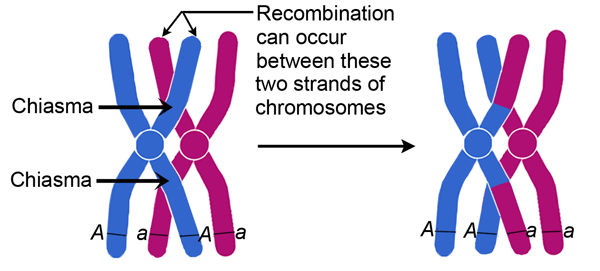
This image shows chromosomes during Prophase 1. Which of the following correctly describes the process shown?
a)

segregation of sister chromatids

b)

condensation and segregation of alleles

c)

mutationin which the DNA content of the gene is altered

d)

crossing - over in which genes are exchanged

80.

A pair of homologous chromosomes (a tetrad) is composed of ​ ​ (a)   matching chromosomes, and ​ (b)   sister chromatids.

Choose from the below words
two
four
one
three
81.

During meiosis, if an organism has 10 chromosomes, how many will the new daughter cells have?

a)

10

b)

8

c)

5

d)

2

82.

During mitosis, if an organism has 10 chromosomes, how many will the new daughter cells have?

a)

10

b)

8

c)

5

d)

2

83.

In mitosis the ​ (a)   daughter cells that are created are ​ (b)   . In meiosis the ​ (c)   daughter cells that are created are ​ (d)  

Choose from the below words
two
diploid
four
haploid
84.

The following genotypes are ​ (a)   ​ : Tt, Mm and Gg​ ​

Choose from the below words
heterozygous
homozygous
85.

Which of the following would produce a recessive phenotype?

a)

hh

b)

Rr

c)

Ww

d)

BB

86.

If your genotype is Bb, then you can only pass a B or b to your child but you can't pass both.

a)

Law of Dominance

b)

Law of Segregation

c)

Law of Independent Assortment

87.
If green is dominant over purple, then what is the genotype for this individual?
a)
Purple
b)
Green
c)
GG
d)
gg
88.

What is the predicted percentage of homozygous recessive offspring in this cross?

a)

0%

b)

25%

c)

50%

d)

75%

89.
This type of inheritance pattern shows BOTH traits in possible offspring
a)
complete dominance
b)
incomplete dominance
c)
co-dominance
d)
dominant pattern
90.
Why do we see only tall plants in the second generation?
a)
The gene for tall height is dominant
b)
The gene for short height is dominant
c)
The gene for tall height is recessive
d)
The parents did not have the tall gene
91.
this image is an example of
a)
codominance
b)
dominance
c)
incomplete dominance
92.
A breed of chicken shows codominance for feather color. One allele codes for black feathers, another codes for white feathers. The feathers of heterozygous chickens of this breed will be:
a)
all black
b)
all white
c)
all gray
d)
speckled black and white
93.

A cell that results from fertilization is called a _?

a)

gamete

b)

sperm

c)

yolk

d)

zygote

94.

A man with type AB blood is accused of being the father of a type O baby. The mother is type A. Could this man be the father?

a)

Yes

b)

No

95.
polygenic means that _________ control a characteristic
a)
many genes
b)
single genes
c)
3 genes
d)
no genes
96.
What is NOT a possible genotype for someone with type B blood?
a)
BB
b)
AB
c)
BO
97.
What blood type would an individual have if this was one of the cells seen under a microscope?
a)
Type A
b)
Type B
c)
Type AB
d)
Type O
98.
What do half colored symbols represent?
a)
The individual is a carrier (heterozygous).
b)
The individual expresses the trait.
c)
The individual has both recessive alleles.
d)
The individual has both dominant alleles.
99.
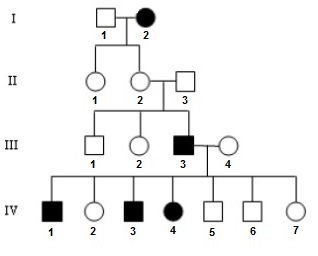
This pedigree represents the inheritance of hemophilia in this family. How many of the females have the hemophilia trait?
a)
8
b)
5
c)
2
d)
3
100.

Is this individual male or female?

a)

Male

b)

Female

101.

In a duplicated chromosome, sister chromatids are attached by what structure?

a)

centromere

b)

centriole

c)

chromatin

102.
A process in which DNA has the unique ability to make an exact copy of itself.
a)
Replication
b)
Translation
c)
Transcription
103.
RNA contains the sugar
a)
ribose
b)
deoxyribose
c)
glucose
d)
lactose
104.

Transcribe the following DNA strand: CTG AAT

a)

GAC TTA

b)

CTG AAT

c)

GAC UUA

d)

CUG AAU

105.
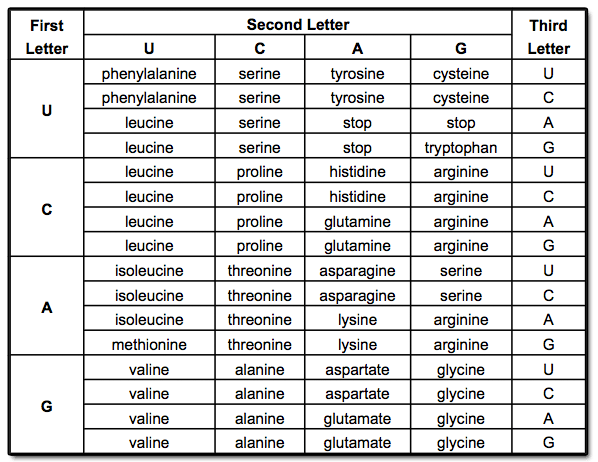
What is the correct amino acid sequence for the mRNA code AUGCCAGUAUGA
a)
Met-Pro-Ala-Val
b)
Met-Pro-Val
c)
Tyr-Gly-His
d)
Tyr-Gly-Arg-His
106.
The anti-codon 
a)
contains a sequence the same as the codon
b)
contains a sequence complementary to the codon 
c)
contains the base thymine
107.
tRNA is involved in
a)
carrying amino acids 
b)
carrying ribosomes
c)
carrying glucose
d)
carrying lipids
108.

Which of the following best describes what the image represents?

a)

Natural Selection

b)

Artificial Selection

c)

Mutation

d)

Genetic Drift

109.

Which scientist is considered the father of evolution?

a)

Jean-Baptist Lamarck

b)

Hershey and Chase

c)

Charles Darwin

d)

Carleous Linnaeus

110.
Where the better adapted organisms survive to pass traits along to offspring.
a)
Evolution
b)
Natural Selection
c)
Extinction
d)
Artifical Selection
111.
Why are advantageous traits more likely to be passed onto offspring?
a)
Because they are more likely to survive and reproduce.
b)
Because they come from dominant alleles.
c)
Because they come from recessive alleles.
d)
Because the trait is an acquired phenotype.
112.

Structures such as human tail bone and hind legs of whale that serve no purpose in an organism today, but has a purpose in the past is called...

a)

Homologous

b)

Analogous

c)

Fossilized

d)

Vestigial

113.

The similarity of bone structure in the forelimbs of many vertebrates is an example of...

a)

Homologous Structures

b)

Analogous Structures

c)

Convergence

d)

Embryo Development

114.

The similarity in forelimb structure of humans, bats, and moles is evidence that they...

a)

Use their forelimbs in similar ways

b)

Evolved from each other

c)

Are members of the same species

d)

Share a common ancestor

115.

What does descent with modification mean?

a)

The offspring will be like their parents, but with a slight change

b)

The offspring will go down into caves

c)

The offspring will ascend into the light

d)

The offspring will overproduce

116.
Which fossil layer is the youngest? 
a)
A. Layer A
b)
B. Layer B
c)
C. Layer C
d)
D. Layer D
117.

What type of evidence is shown with the diagram above?

a)

Molecular

b)

Anatomical

c)

Embryological

d)

Fossil

118.
Place the following in order starting with the OLDEST
1  Paleozoic
2  Cenozoic
3  Precambrian
4  Mesozoic
a)
1 3 2 4 
b)
3 1 4 2
c)
4 3 2 1 
d)
2 3 1 4
119.
Comparing human hemoglobin of chimpanzees, horses, kangaroos, and chickens, reveal that humans have the fewest amino acid differences with 
a)
Kangaroos
b)
Horses
c)
chickens
d)
chimpanzees
120.
A frog eats a fly. The frog and fly are demonstrating ________.
a)
mutualism
b)
competition
c)
predator/prey
d)
parasitism
121.

The scientific name for water bear is Hypsibius dujardini.  What is its species?

a)

Hypsibius 

b)

dujardini

c)

water 

d)

tardigrade

122.
Who is the closest relative to the birds?
a)
crocodiles
b)
sharks
c)
fish
d)
amphibians
123.
Which one is NOT an example of a decomposer?
a)
mushroom
b)
leaves
c)
mold
d)
worm
124.
Examples of a producer
a)
frog
b)
algae
c)
worm
d)
mouse
125.
In the energy pyramid here, which organisms have the most energy available?
a)
Producers
b)
Carnivores
c)
Herbivores
d)
Top Predator
126.
If there is 1000 Kcal available in the producers in trophic level 1, how much energy is available in the herbivores in trophic level 2?
a)
10 Kcal
b)
1 Kcal
c)
100 Kcal
d)
1000 Kcal
127.
A third-level consumer has to be which type?
a)
Carnivore.
b)
Decomposer.
c)
Producer.
d)
Herbivore.
128.

What amount of percentage does the energy decrease as it goes up the pyramid?

a)

100%

b)

1000%

c)

10%

d)

1%

129.
Which is the smallest level of an ecosystem?
a)
organsism
b)
population
c)
community
d)
ecosystem
130.
Barnacles grow on whales.  Whales give the barnacles a place to live but the barnacles do not help or harm the whale.  Which type of relationship is this?
a)
commensalism
b)
mutualism
c)
parasitiesm
131.

What are the 6 kingdoms?

a)

phylum, class, Order, Family, Genus, Species

b)

Humans, Plants, Protists, Archaea, Fungi, Bacteria

c)

Trees, Animals, Protists, Archaea, Fungi, Bacteria

d)

Plants, Animals, Protists, Archaea, Fungi, Bacteria

132.

Virus belongs to the Bacteria Kingdom.

a)

True, it is a one-celled organism.

b)

True, it is a many-celled organism.

c)

False, it is not a living-thing.

d)

False, it belongs to the Protists kingdom.

133.

The Linnaean taxonomic system classifies organisms into divisions called taxa. If two organisms belong to the same taxonomic group, they are related. Similarity at which of these levels indicates the closest relationship?

a)

Kingdom

b)

Class

c)

Order

d)

Genus

134.

What is the genus name here:

Canis lupus

a)

Canis

b)

lupus

135.
The 2 kingdoms that make up Prokaryotes are?
a)

Animals and Plants 

b)

Protists and Fungi

c)

Archaea and Bacteria