
NEW
Font size
 Worksheets
DNA/RNA and Genetics
Total questions: 76
Worksheet time: 54mins


What is the correct order to make a protein?
Protein, DNA, RNA
RNA, DNA, Protein
DNA, RNA, Protein
Protein, RNA, DNA
What enzyme does transcription use?
DNA polymerase
ligase
RNA polymerase
helicase
Which RNA carries the message?
mRNA
rRNA
tRNA
ATG GGA ACT CCA

How many nucleotides equal make up a codon?
1
2
3
4
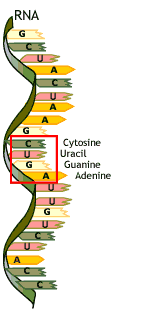
Nucleic acids are the building blocks of...
DNA
RNA
Atoms
Nucleotides
Where does transcription take place in PROKARYOTIC cells?
nucleus
cytoplasm
ribosome
What is the difference between the sugar in DNA and RNA?
In DNA, the sugar is Deoxyribose while in RNA the sugar is Ribose
In DNA, the sugar is Ribose while in RNA the sugar is Deoxyribose
In DNA, it is a 5 carbon sugar while in RNA it is only a 4 carbon sugar.
There is no difference between the sugars
WHERE does TRANSLATION occur?
ribosome
cytoplasm
nucleus
cell
Which organelle makes proteins?
ribosome
nucleus
mitochondria
chloroplast
The triplets of mRNA read by a ribosome are called _____.
anticodons
coded gene
codons
rRNA
Which type of RNA is the message of the decoded gene from DNA?
mRNA
rRNA
tRNA
rDNA
Which type of RNA is the carrier of amino acids?
mRNA
rRNA
tRNA
DNA
Which type of RNA reads the coded gene and makes a protein?
mRNA
rRNA
tRNA
DNA
What is translation?
the process in which DNA is copied to make another molecule of DNA
the process in which DNA is coded into mRNA
the process in which mRNA is decoded into a protein
the process in which enzymes break down mRNA
What are the building blocks of proteins called?
Nucleic Acids
Glucose
Amino Acids
Phosphate Groups
What is the name of a chain of amino acids?
hydrogen bonds
polypeptide
amino acid chain
double helix

Which amino acid matches with the following codon:
GAU
GLU
SER
ASP
ILE
Which amino acid matches with the following codon:
CAC
STOP
HIS
LYS
ARG

Use the mRNA below to select the correct amino acid sequence:
AUG-UCA-AAA-UAG
MET-SER-LYS-STOP
MET-THR-LYS-TYR
LEU-SER-CYS-STOP
ILE-LYS-SER-STOP
True or False: RNA is double stranded.
True
False
What does tRNA stand for?
transition RNA
transcription RNA
transfer RNA
translation RNA
mRNA is read into amino acids during what process?
transcription
transfer
translation
transition
Where would you find the anti-codon?
tRNA
mRNA
ribosome
rRNA
What do tRNA bring to the ribosome?
glucose
fatty acids
nucleotides
amino acids


When the mRNA sequence leave the nucleus, what organelle does it travel to?
mitochondria
smooth ER
ribosome
vacuole
What best explains the interaction between tRNA and mRNA during translation?
anticodons on the mRNA line up with complementary codons on the tRNA
anticodons on the tRNA line up with complementary codons on the mRNA
tRNA attach amino acids to the complementary mRNA sequence
mRNA attach amino acids to the complementary tRNA sequence
What does tRNA "transfer"?
amino acids
nucleic acids
nucleotides
AUG
What do amino acids come together to join?
a growing polypeptide chain (protein)
a growing lipid
a growing carbohydrate
a growing nucleic acid
A polypeptide only becomes a functioning protein after it has folded into its exact 3D shape.
True
False

This laboratory procedure is known as
CLONING
gel electrophoresis
chromatography
use of a dichotomous key
In preparation for an electrophoresis procedure, enzymes are added to DNA in order to
convert the DNA into gel
cut the DNA into fragments
change the color of the DNA
produce longer sections of DNA

A student performed a gel electrophoresis experiment. The results are represented in the diagram
below. Compared to the fragments at the top of the gel, the fragments at the lower end are
larger, and move slower
larger, and move faster
smaller, and move faster
smaller, and move slower
Which chemicals are used to cut DNA into fragments for a gel electrophoresis procedure?
enzymes
molecular bases
hormones
ATP molecules

This technique used to analyze DNA involves the
synthesis of new DNA strands from subunits
separation of DNA fragments based on size
production of genetically engineered DNA molecules
removal of defective genes from DNA


Once DNA has been extracted from the nucleus of a cell, it is exposed to ______ ______ that act like biochemical scissors to cut the DNA.
restriction enzymes
gel agarose
clotting factors
electric shock

A circular piece of DNA, found in bacteria, is called:
A plasmid
mRNA
Ribosome
Nucleotide

The process of man choosing organisms with the most desirable traits and mating them is known as
Cloning
Natural selection
Selective breeding
If the diploid (2n) chromosome number of a
cloned plant is 12, what is the chromosome
number of the plant cell used to produce the
cloned plant?
3
12
6
24
Breeders can increase the genetic variation in a population by introducing __________?
Reductions
Inductions
Mutations
Additives
What is the process of making changes in the DNA code of living organisms?
Selective Breeding
Genetic Engineering
Cell Transformation
Cell Editing
A member of a population of genetically identical cells produced from a single cell is a...
Clone
Plasmid
Mutant
Sequence
Which one of the following statements is an accurate description of genes?
DNA is made of carbohydrates that code for genes
Genes are made of DNA and code for proteins.
Genes are made of proteins that code for nitrogen bases.
Proteins are made of genes and code for DNA
When comparing a skin cell, eye cell, and leg cell; Every cell in each of these structures contains
proteins that are all identical
organelles for the synthesis of glucose
equal amounts of ATP
identical genetic information
Although a liver cell and a muscle cell in a human developed from the same single cell, their appearance and functions are different. This is because the liver cell
expresses different genes than the muscle cell
contains different genes than the muscle cell
lacks the genes found in muscle cells
destroys the muscle cell genes it contains
In the summer, the arctic fox appears brown because its cells produce a dark pigment. However, in the winter, the arctic fox appears white because the dark pigment is not produced. The color change is most likely due to the effect of
poor nutrition on cell growth and development
increased pollution on genetic mutations
environmental conditions on gene expression
different genes produced in the different seasons

