wayground logo

Free Printable Worksheets

Font size

S
M
L
XL
Worksheets

Earth Science B Finals Review

Total questions: 206

Worksheet time: 4hrs 24mins
Name
Class
Date
1.
A plate boundary where two plates move away from each other is called
a)
Divergent Boundary
b)
Convergent Boundary
c)
Transform Boundary
d)
Subduction
2.
A plate boundary where two plates move away from each other is called
a)
Divergent Boundary
b)
Convergent Boundary
c)
Transform Boundary
d)
Subduction
3.
Scientists hypothesize that a super continent existed 200 million years ago.  This continent is called
a)
America
b)
Super Earth
c)
Pangea
d)
Eurasia
4.
A Plate Boundary where two plates move toward each other is called
a)
Convergent Boundary
b)
Divergent Boundary
c)
Transform Boundary
d)
Subduction
5.
What is the difference between the lithosphere and asthenosphere that makes up the mantle?
a)
The lithosphere is ismade of dense solid meal whle the asthenosphere is made of liquid molten metal
b)
The lithosphere is a mixture of gasses while the asthenosphere is made of solid rock
c)
The lithosphere is molten rock that moves while the asthenosphere is ridid and thin
d)
The lithosphere is made of solid rock while the asthenosphere is more flexible hot rock that moves.
6.
A Plate Boundary where two plates move toward each other is called
a)
Convergent Boundary
b)
Divergent Boundary
c)
Transform Boundary
d)
Subduction
7.
_______________ Currents within the mantle cause the earth's plates to move and shift s molten material rises and falls due to density and gravity
a)
Convection
b)
Radiation
c)
Conduction
d)
Wind
8.
Divergent Plate movement can create
a)
Convection Currents
b)
Conduction
c)
Mountains
d)
Rifts and ocean ridges
9.
When pressure builds between two tectonic plates, it can suddenly release causing a (an) ______________________
a)
Earthquake
b)
Volcano
c)
Convection Current
d)
Gravitational Pull
10.
The movement of metals within the earth's outer core cause a ____________________________ that is detectable on the earth's surface using a compass
a)
Gravitational Pull
b)
Volcanic Eruption
c)
Magnetic field
d)
Convection Current
11.
There are three types of plate boundaries. Which choice is NOT a type of plate boundary?
a)
convergent
b)
thrust
c)
divergent
d)
transform
12.

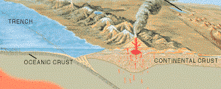
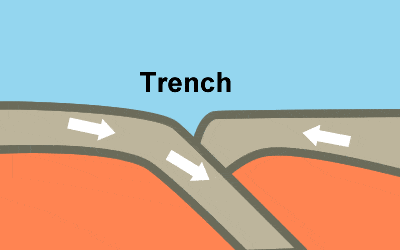
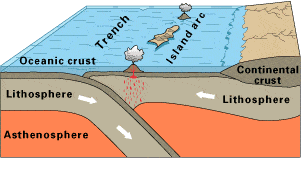
Observe this diagram of a plate boundary. One statement BEST describes what is happening. It is that

a)

the oceanic crust is melting.

b)

the denser ceanic crust is subducting under the less dense oceanic crust

c)

volcanic islands are forming.

d)

the tectonic plates are moving away from each other.
13.

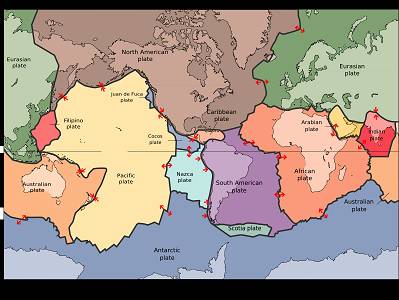
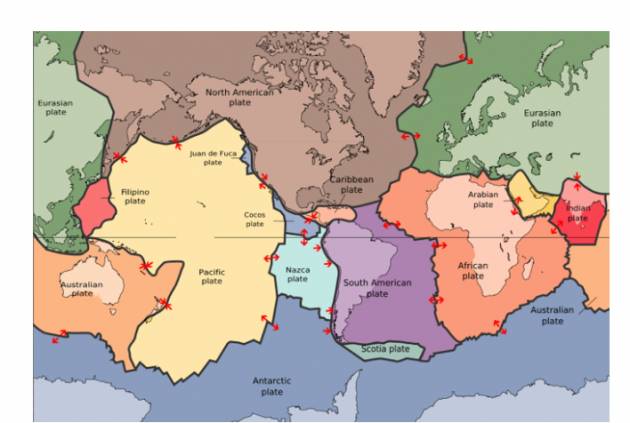
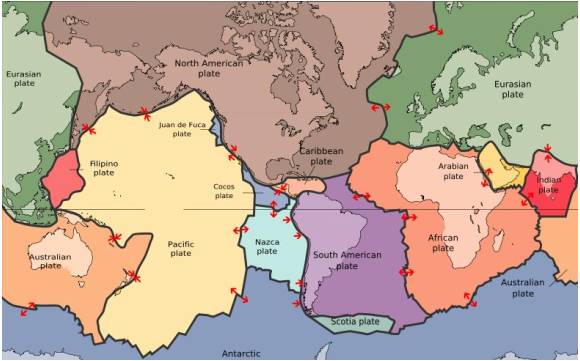
The map in the picture shows tectonic plate boundaries. This map would be useful in predicting the location of future

a)

droughts

b)

hurricanes

c)

earthquakes

d)

tornadoes

14.
What geological forces might be responsible for this range of mountains?
a)
diverging tectonic plates
b)
erosion of the land by the ocean
c)
converging tectonic plates
d)
deposition of sediments by the ocean
15.

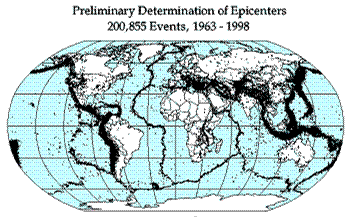
Earthquake epicenters (center of where the earthquakes started) were mapped for a 35 year period in the diagram above. The black dots indicate these epicenters. The black dots appear along what feature on Earth?

a)

hot spots

b)

plate boundaries

c)

rift zones

d)

sea floor spreading

16.
The Earth’s surface is not a solid surface but is divided into
a)
several oceanic plates.
b)
continental and crustal plates.
c)
seven continental plates.
d)
continental and oceanic plates.
17.
Geologists have long recognized that earthquakes are not randomly distributed on Earth but occur in concentrated areas that coincide with __________ and provide evidence for the theory of ___________ .
a)
mountain ranges; fault zones.
b)
continental borders; supercontinents.
c)
plate boundaries; plate tectonics
d)
areas of liquid magma; sea floor spreading.
18.
Which geological features MOST LIKELY prompted the development of the theory of plate tectonics?
a)
river deltas
b)
mountain ranges
c)
glacier fields
d)
tropical rainforests
19.

Where are earthquakes MOST LIKELY to occur?

a)

close to the equator

b)

close to the center of tectonic plates

c)

at divergent or convergent plate boundaries

d)

at transform plate boundaries

20.

The 2004 Indian Ocean tsunami was caused by a shift in two plates that pushed one section of the sea floor under another section of the sea floor by 5 meters. What type of boundary is this?

a)

divergent

b)

convergent

c)

transform

d)

metamorphic

21.
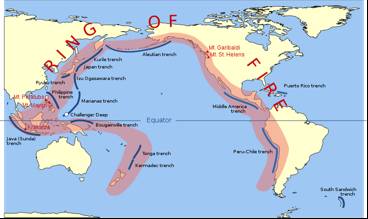
The image shows the Pacific Ring of Fire, a region of high tectonic activity. What evidence supports the theory that the tectonic activity of the region is due to the subduction of tectonic plates?
a)
The region is bound by many oceanic trenches.
b)
North America seems to be colliding with Asia at the north of the ring.
c)
The Asia-Pacific region is dotted by many small and large islands
d)
The landmasses look like they would fit together like the pieces of a jigsaw puzzle.
22.
The Atlantic Ocean gets about 3-5 ______ wider each year.
a)
centimeters
b)
kilometers
c)
miles
d)
meters
23.

___________ currents in the Earth's asthenosphere cause plate to shift at their boundaries. This movement also causes earthquakes and volcanic activity.

a)

conduction

b)

convection

c)

radiation

d)

ocean

24.
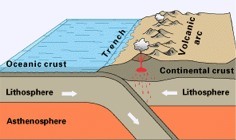
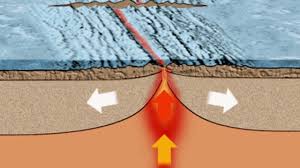
Observe the plate boundary shown here. What type of plate boundary is this? Many geologic events occur at these boundaries. Some are shown, but one is missing. What geologic event would you predict would occur at this plate boundary?
a)
convergent oceanic-oceanic plate boundary; volcano
b)
divergent oceanic-oceanic plate boundary; sea floor spreading
c)
convergent oceanic-continental plate boundary; earthquake
d)
convergent continental-continental plate boundary; mountain building
25.

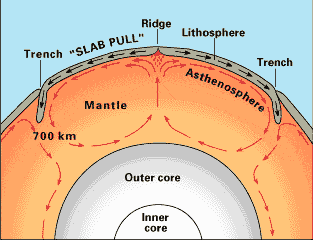
What is the source of energy that drives plate movement?

a)

the subducton of the sea floor

b)

the different densities of the oceanic and crustal plates

c)

convection currents in the asthenosphere

d)

the friction force between the plates that move past each other
26.

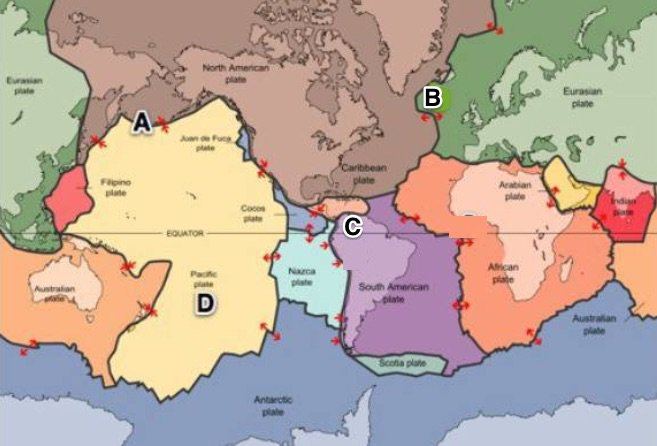
Where would sea floor spreading most likely occur?

a)

At convergent boundaries (oceanic vs. oceanic)

b)

At convergent boundaries (oceanic vs. continental)

c)

At divergent plate boundaries (oceanic vs. oceanic)

d)

At transform plate boundaries

27.

The Marianas Trench, where the Pacific Plate descends under the leading edge of the Eurasian Plate, is the deepest sea floor in the world. These ocean trenches form when two oceanic plates collide

a)

and the older, less dense of the two plates rides over the edge of the older plate.

b)

when convection currents in the mantle force the older plate downward.

c)

and the younger, denser of the two plates, rides over the edge of the older plate.

d)

and the plates are approximately the same age and density.

28.

Breaks in the crust called __________ form where plates meet.

a)

mountains

b)

rift valleys

c)

faults

d)

trenches

29.

A __________ forms where plates diverge on land.

a)

rift valley

b)

mid-ocean ridge

c)

mountain

d)

trench

30.

What is the motion of Earth's plates like?

a)

fast and in stages

b)

slow and in stages

c)

fast and constant

d)

slow and constant

31.

The San Andreas fault is an example of which type of boundary?

a)

transform

b)

divergent

c)

convergent

d)

universal

32.
Created by a divergent boundary.
a)
Rocky Mountains
b)
Mariana Trench
c)
Mid Atlantic ridge
33.
During sea floor spreading, molten material rises up from the mantle...
a)
along the continents
b)
at the mid ocean ridges
c)
deep ocean trenches
d)
at north and south poles
34.
Which of the following is where one plate slides under another plate?
a)
submarine zone
b)
divergence zone
c)
subduction zone
d)
lower zone
35.
The area around the pacific plate where boundaries form is called...
a)
death ring
b)
fire zone
c)
ring of fire
d)
zone of fire
36.
This land formation occurs at a divergent continental/ continental boundary.
a)
mid ocean ridge
b)
deep ocean trench
c)
pacific hot spot
d)
rift valley
37.
What happens to temperature as you go deeper in the Earth?
a)
decreases
b)
increases
c)
fluctuates
d)
remains the same
38.
Name the boundary
a)
convergent boundary
b)
divergent boundary
c)
transform boundary
d)
sergent boundary
39.
What is represented by the picture? 
a)
Sea-floor spreading
b)
Pangea
c)
How the continents are arranged today
d)
Volcanoes
40.
Name the boundary
a)
convergent boundary
b)
divergent boundary
c)
transform boundary
d)
sergent boundary
41.
Name the boundary
a)
convergent boundary
b)
divergent boundary
c)
transform boundary
d)
sergent boundary
42.
Which type of crust is more dense and thinner?
a)
Continental
b)
Asthenosphere
c)
Oceanic
d)
Byers
43.
Which answer below correctly describes the formation of a volcanic island arc?
a)
Islands are created along the mid ocean ridge as new oceanic crust is formed.
b)
Islands are created one at a time as the plate moves across a hot spot in the mantle.
c)
Islands are created along a subduction zone as oceanic crust is forced back down in to the mantle.
d)
Islands are created as pressure is released when two tectonic plates are pulled apart.
44.

What is the correct order (starting from the surface) of Earth’s layers?

a)

crust, outer core, inner core, mantle

b)

mantle, outer core, inner core, crust

c)

crust, mantle, outer core, inner core

d)

outer core, inner core, crust, mantle

45.

In sea-floor spreading, molten material rises from the mantle and erupts

a)

along the edges of all the continents.

b)

along mid-ocean ridges.

c)

in deep-ocean trenches.

d)

at the north and south poles.

46.
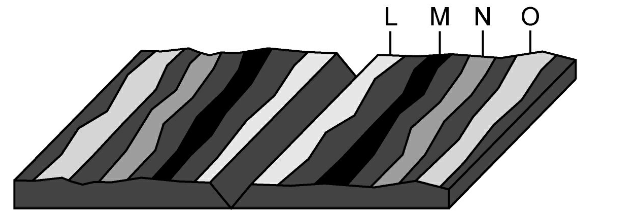
Where would the oldest rock be found?
a)
L
b)
M
c)
N
d)
O
47.
How is it possible for new crust to be formed without increasing the surface area of the Earth?
a)
Crust is destroyed at the same time it is created
b)
New crust is underwater where it sinks
c)
New crust breaks more easily than old crust
48.
This layer of Earth is the thickest part
a)
crust
b)
outer core
c)
mantle
d)
inner core
49.
What are the two types of crust
a)
continental and oceanic
b)
ocean and upper
c)
lower and upper
d)
pizza and subway
50.
The Himalayas in Asia are an example of what type of plate boundary?
a)
divergent
b)
continent-to-continent convergent
c)
ocean-to-continent convergent
d)
transform
51.

What is weathering?

a)

A process that breaks down rocks into smaller pieces

b)

A shift in weather patterns

c)

The process by which mountains are formed

d)

The process by which the seasons change

52.

How might a weathered mountain appear different from an unweathered mountain?

a)

The weathered mountain would be taller

b)

The weathered mountain would appear rounder in shape

c)

The weathered mountain would appear more jagged

d)

The weathered mountain would contain fewer trees

53.

How is mechanical weathering different from chemical weathering?

a)

Chemical weathering happens over a much shorter time frame than mechanical weathering

b)

Chemical weathering occurs in the tropics; mechanical weathering occurs in temperate climates

c)

Chemical weathering occurs in mountains; mechanical weathering occurs on flat surfaces

d)

Chemical weathering changes the chemical composition of materials; mechanical weathering does not

54.

What might cause mechanical weathering?

a)

Acid rain

b)

Violent earthquakes

c)

Growing plants and expanding ice

d)

Volcanic eruptions

55.

What impact does weathering have on soil formation?

a)

Chemical weathering adds helpful chemicals to the soil

b)

Rocks are broken down into smaller pieces, and finally into sediment

c)

Mechanical weathering adds ice to the soil, which turns into water

d)

Volcanic eruptions contribute metamorphic rocks to the soil

56.

What types of rocks are formed by weathering?

a)

Metamorphic rocks

b)

Igneous rocks

c)

Sedimentary rocks

d)

Volcanic rocks

57.

Carbonic acid is a mixture of:

a)

Water and carbon dioxide

b)

Calcite and quartz

c)

Oxygen and hydrogen

d)

Water and limestone

58.

What process hollows out limestone caves?

a)

Mechanical weathering

b)

Chemical weathering

c)

Spatial weathering

d)

Cave weathering

59.

What type of changes does erosion cause?

a)

Physical changes

b)

Chemical changes

c)

Electrical changes

d)

Magnetic changes

60.

How do sandy beaches form?

a)

Waves pounding pebbles int smaller and smaller pieces

b)

Wind eroding pebbles into smaller pieces

c)

Water freezing and thawing the cracks of pebbles

d)

Rain wearing away rocks into smaller and smaller pieces

61.

Which of the following features would be most affected by weathering?

a)

A

b)

B

c)

C

d)

D

62.

Why is it hard to see glacial erosion in action?

a)

Because glaciers are so big

b)

Because light from glaciers refracts too much

c)

Because glaciers move very, very slowly

d)

Because glacial erosion is usually very subtle

63.

What would be a simple way to prevent erosion?

a)

Blocking the wind

b)

Planting trees

c)

Preventing rainfall

d)

Preventing the flow of rivers

64.

What can you infer about the type of erosion that formed the Grand Canyon?

a)

Wind erosion

b)

Water erosion

c)

Sandblasting

d)

Glacial erosion

65.
Which of the following is NOT a type of chemical weathering?
a)
water
b)
carbon dioxide
c)
ice wedging
d)
living organisms secreting acid to break down rocks
66.
What is weathering?
a)
The process by which
water, ice, wind or gravity
moves fragments of rock
and soil.
b)
The process by which
water, ice, wind or gravity
deposit rock sediments
and soil in a new place.
c)
The breaking down of
Earth’s crust into smaller
and smaller pieces.
67.
What is erosion?
a)
The process by which
water, ice, wind or gravity
moves fragments of rock
and soil.
b)
The process by which
water, ice, wind or gravity
deposit rock sediments
and soil in a new place.
c)
The breaking down of
Earth’s crust into smaller
and smaller pieces.
68.
Which of the following is NOT a type of physical weathering?
a)
burrowing plants
b)
ice wedging
c)
plant roots
d)
acid rain
69.
A marble statue is left exposed to the weather.  Within a few years, the details on the statue have begun to weather away.  This weathering probably is caused by...
a)
oxygen in the air
b)
carbonic acid in rainwater
c)
lichens
d)
abrasion
70.
Which of the following is an example of mechanical weathering?
a)
Acidic groundwater dissolving limestone
b)
frost wedging
c)
Paper being burned
71.
The diagrams  shows a natural process that weathers rock.
 Which statement best explains why this process results in weathering?
a)
frozen water acts as a solute
b)
water expands when it freezes
c)
the mass of water increases when it freezes
d)
frozen water dissolves most types of rock
72.
What is mechanical weathering?
a)
Process through which rocks are physically broken into smaller pieces.
b)
Rocks are broken down through chemical changes.
c)
Rocks are worn away from acid in plant roots.
d)
Rocks broken down by machinery.
73.
Which type of climate will have faster chemical weathering?
a)
Hot and Wet
b)
Cold and Dry
c)
Hot and Cold
d)
Cold and Wet
74.
How do plants weather rocks?
a)
during photosynthesis
b)
when roots grow into cracks of rocks and expand the rock
c)
when the plant moves water from the roots to the leaves
75.
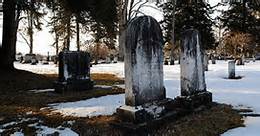
These gravestones have slowly broken down and turned a blackish color due to the action of:
a)
ice wedging
b)
abrasion
c)
acid rain
d)
mechanical weathering
76.
oxidation produces rust on some rocks containing iron
a)
chemical weathering
b)
mechanical weathering
c)
erosion
d)
deposition
77.
rock particles wear away rock
a)
mechanical weathering
b)
chemical weathering
c)
erosion
d)
deposition
78.
carbon dioxide dissolves in water then weathers marble and limestone
a)
chemical weathering
b)
mechanical weathering
c)
erosion
d)
deposition
79.
wind erosion forms what type of landform?
a)
meander
b)
drumlin
c)
sand dune
d)
sand bar
80.
When wind, water, or ice leave materials in a location, this is known as:
a)
Weathering
b)
Erosion
c)
Deposition
d)
Transportation
81.
What is deposition?
a)
The process by which
water, ice, wind or gravity
moves fragments of rock
and soil.
b)
The process by which
water, ice, wind or gravity
deposit rock sediments
and soil in a new place.
c)
The breaking down of
Earth’s crust into smaller
and smaller pieces.
82.
Which of the following is not a form of erosion?
a)
Frost Wedging
b)
Wind
c)
Glacial
d)
Water
83.
What type of erosion causes landslides
a)
wind
b)
waves
c)
water
d)
gravity
84.
Is the growth of vegetation a form of physical or chemical weathering?
a)
Physical
b)
Chemical
85.
A rock containing iron becomes soft and crumbly and reddish-brown in color.  It probably has been chemically weathered by -
a)
abrasion
b)
carbon dioxide
c)
oxygen
d)
acid rain
86.
A hot wet climate causes weathering to take place -
a)
slowly
b)
rapidly
c)
unevenly
d)
at the same rate as when the climate is dry and cool
87.
The most important factors in determining the rate of weathering are - 
a)
carbon dioxide and acid rain
b)
abrasion and acids from plant roots
c)
animal actions and oxygen
d)
rock type and climate
88.
Process where outer rock layers are stripped away. 
a)
Soil horizon
b)
Deposition
c)
Exfoliation
d)
Rill erosion
89.

Which seismic wave travels the fastest, always being the first detected by seismic stations?

a)

P waves

b)

S waves

c)

Surface waves

d)

Tsunami waves

90.
The most destructive type of wave is a 
a)
P-wave
b)
S-wave
c)
Surface wave
d)
transverse wave
91.

How does the Richter Magnitude Scale calculate its measurements?

a)

Eyewitnesses

b)

Amount of damage caused

c)

The amount of time the earthquake lasted

d)

The strength of the seismic waves recorded by a seismograph machine.

92.

What does a seismograph measure?

a)

The amount of oil and gas underground.

b)

The amount of damage an earthquake causes.

c)

The temperature of the earth's core.

d)

The amount of shaking of the crust.

93.

What happens to P-waves and S-waves from an earthquake when they reach the outer core?

a)

S-waves are transmitted through the outer core, but P-waves are not transmitted.

b)

P-waves are transmitted through the outer core, but S-waves are not transmitted.

c)

Both P-waves and S-waves are transmitted through the outer core.

d)

Neither P-waves nor S-waves are transmitted through the outer core.

94.

A seismic station recorded the P-waves, but no S-waves, from an earthquake because S-waves were

a)

absorbed by Earth’s outer core

b)

transmitted only through liquids

c)

weak and detected only at nearby locations

d)

not produced by this earthquake

95.

Which evidence recorded at seismic stations following an earthquake supports the inference that Earth’s interior changes from solid rock to molten iron and nickel at the mantle-core boundary?

a)

P-waves arrive earlier than S-waves.

b)

P-waves and S-waves are both recorded at all stations.

c)

Only S-waves are recorded at all stations.

d)

Only P-waves are recorded on the opposite side of Earth.

96.

Only P-waves were recorded at seismic station C because P-waves travel

a)

only through Earth’s interior, and S-waves travel only on Earth’s surface

b)

fast enough to penetrate the core, and S-waves travel too slowly

c)

through iron and nickel, while S-waves cannot

d)

through liquids, while S-waves cannot

97.

Which layer contains the oldest fossil?

a)

Layer 1

b)

Layer 2

c)

Layer 3

d)

Layer 4

98.

Which of the following would be an example of absolute age?

a)

Fossil A is older than Fossil B

b)

Fossil A and Fossil B are the same age

c)

Fossil A is 10 million years old

99.

Which of the following is an example of relative age

a)

Fossil A is older than Fossil B

b)

Fossil A is about 10 million years old

c)

Fossil B is 2 million years old

100.

Which layer contains the youngest fossil?

a)

layer 1

b)

layer 2

c)

layer 3

d)

layer 4

101.

Organisms D and C clearly lived in an aquatic (water) environment. Organism A does not look like it lived in the water. What is the most likely explanation for this?

a)

The fossil in layer A died on land and was carried to the water

b)

The fossils in layer C and D did not live in the same location as the fossil in layer A

c)

The environment changed over a long period of time. It used to be under water, but is not anymore

102.

What is a likely event that occurred between fossil layers B and D?

a)

explosion of new species

b)

mass extinction

c)

can not tell from the image

d)

small changes to the environment

103.

Starting at layer H (at the bottom) what pattern do you notice as you move up towards layer B

a)

organisms become more complex

b)

random arrangement of organisms

c)

organisms go from water only to land only

d)

organisms become more simple

104.

450 million year old rocks contain fossils of jawless fish. 400 million year old rocks contain fossils of jawless fish AND fish with jaws. What does this evidence suggest?

a)

fish with jaws appeared earlier in the fossil record

b)

fish with jaws and jawless fish appeared at the same time in the fossil record

c)

jawless fish appeared first in the fossil record

d)

fish with jaws no longer exist

105.

The trend for a certain type of fish is that over time, the species increases in the number of teeth they have. A new fossil is found to have 34 teeth. Use the chart to estimate the age of this fossil.

a)

20 million years old

b)

30 million years old

c)

70 million years old

d)

100 million years old

106.

The permanent disappearance of a species from Earth

a)

law of superposition

b)

diversity

c)

extinction

d)

petrification

107.

The mineralized remains of organisms, showing how long-dead organisms lived and how their bodies were structured

a)

law of superposition

b)

sedimentary layers

c)

fossils

d)

petrification

108.

Scientific law that states fossils located in deeper sediment layers are older than ones deposited in layers closer to the surface

a)

law of superposition

b)

diversity

c)

chronological order

d)

petrification

109.

Technique used to determine how old a rock is by analyzing the amounts of a radioactive isotope and its decay products in the rock

a)

radioactive dating

b)

fossils

c)

diversity

d)

petrification

110.

Why would a FISH fossil be in the DESERT?

a)

A desert formed in an area that was once covered by an ocean.

b)

A bird must have dropped the fish as it flew over the desert.

c)

Water, wind, and ice must have brought the fish to the desert.

d)

The fossil came from a volcano that started on the ocean floor.

111.

Fossils can provide evidence that some environments on Earth have changed greatly over time.

a)

true

b)

false

112.

Fossils are often found in sedimentary rock. In undisturbed sedimentary rock, where would the oldest fossils be found?

a)

the bottom layer

b)

the middle layer

c)

the top layer

113.

Fossils are most often formed from the hard parts of organisms.

a)

true

b)

false

114.

This type of fossil (like a footprint) shows evidence of past behaviors.

a)

cast fossil

b)

mold fossil

c)

inclusion fossil

d)

trace fossil

115.

Fossils are more likely to occur in which type of rock?

a)

igneous

b)

metamorphic

c)

sedimentary

116.

This type of fossil shows an impression of an organism in rock...

a)

cast fossil

b)

mold fossil

c)

trace fossil

d)

inclusion fossil

117.

Which of the following can be learned by using the fossil record?

a)

When organisms changed or evolved

b)

when organisms appeared on Earth

c)

when organisms became extinct

d)

All the above

118.

Geologists use radioactive dating to..

a)

determine the relative ages of rock layers.

b)

tell the difference between molds and casts.

c)

tell where one soil horizon ends and the next one begins.

d)

determine the absolute ages of rocks.

119.

What are the oldest fossils and why?

a)

B, C- because they are closest to the top

b)

A, B- because they are closest to the bottom

c)

They are all the same age- because they are all found on layer 2

d)

A, B- because they are found closest to the top

120.
Which layer formed first?
a)
Rock Layer W
b)
Rock Layer X
c)
Rock Layer Y
d)
Rock Layer Z
121.
In what way can scientists determine the ages of fossils?
a)
relative dating
b)
radioactive dating
c)
law of superposition
d)
All of the above
122.

When did fossil A become extinct?

a)

Layer 1

b)

Layer 2

c)

Layer 3

d)

Layer 4

123.
Relative dating can only help scientists determine whether one fossil is older than another.
a)
True
b)
False
124.
Scientists use unstable elements that decay, called _________ elements, to determine the actual age of a fossil.
a)
radioactive
b)
cation
c)
anion
d)
petrified 
125.
What is the half-life of a radioactive element?
a)
How old it is when it is middle aged
b)
The time it takes for half of the atoms to decay
c)
The time it takes for half of the atom to form
d)
How old it is when the Earth is middle aged
126.
What is the largest span of time in the Geologic Time Scale?
a)
Eras
b)
Periods
c)
Years
d)
Precambrian Time
127.
What is NOT a name of one of the three eras on the Geologic Time Scale?
a)
Jurassic 
b)
Paleozoic
c)
Mesozoic
d)
Cenozoic
128.
What is a mass extinction?
a)
the extinction of all of Earth's species at ones time
b)
the extinction of many types of organisms at the same time
c)
the end of days
d)
the creation of many species at one time
129.

Which of the following can be learned by using the fossil record?

a)

When organisms changed or evolved

b)

when organisms appeared on Earth

c)

when organisms became extinct

d)

All the above

130.

An example of a catastrophic event that could lead to mass extinction.

a)

Large Meteor Strike

b)

Rising Sea Levels

c)

Global Warming

d)

Falling Sea Levels

131.

Which two events could lead to mass extinction?

a)

An ice age

b)

Hurricane

c)

Massive volcanic eruption

d)

Tsunami

132.

Why are similar fossils found all over the world?

a)

The animals swam to new parts of the world before going extinct

b)

The land masses were once connected

c)

The organisms were transported to different areas of the world

d)

They are not similar fossils.

133.

Why do you think there are not fossil for every organism that has every lived?

a)

Many organisms decompose too quickly to become fossils

b)

They do, the fossils are just destroyed

c)

Some plants and animals do not have carbon in them

d)

Many organisms are too large to form fossils

134.

According to most scientists, what is the ultimate cause of most mass extinctions?

a)

overhunting

b)

evolution of new species to replace old ones

c)

major change in environment

d)

asteroid impact

135.

This type of fossil forms when a mold is filled with sand or mud that hardens into the shape of the organism.

a)

Mold

b)

Cast

c)

Trace

d)

Petrified

136.

This type of fossil forms when minerals soak into the buried remains, replacing the remains, and changing them into rock.

a)

Cast

b)

Mold

c)

Petrified

d)

Trace

137.

Hardened tree sap is called.

a)

tar

b)

diamond

c)

amber

d)

syrup

138.

These fossils are distinguishable from other fossils because they were scattered over a large region, very common, and lived during a short span of geologic time

a)

Mold

b)

Cast

c)

Trace

d)

Index

139.

What type of fossil is pictured?

a)

Cast

b)

Mold

c)

Trace

d)

Petrified

140.
What does this say?
"60 mya"
a)
Sixty male, young, antelopes
b)
60 miles per hour
c)
sixty million years ago
d)
60 minutes
141.
A carbonized fossil is quickly buried and flattened by the pressure of the sediments on top of it.  What remains is____________________
a)
Just bones
b)
a trace fossil
c)
a thin black film
d)
amber
142.

What is the law of superposition?

a)

The age of sedimentary rock not found in the original layers.

b)

Metamorphic rock is younger than the nearby igneous rock.

c)

Sedimentary rock in it's original position is older than layers above it.

d)

Metamorphic rock is older because it was deposited to nearby sedimentary rock.

143.

What are the relative ages of the features in order from oldest to youngest?

a)

Limestone, Basalt, Fault, Siltstone

b)

Siltstone, Fault, Basalt, Limestone

c)

Limestone, Fault, Basalt, Siltstone

d)

Limestone, Siltstone, Fault, Basalt

144.

Length of time for half the atoms of an isotope to decay

a)

Isotope

b)

Half-Life

c)

Radiometric Dating

d)

Absolute Dating

145.

Scientists use radiometric dating (radioactive decay) to measure...

a)

relative time (dating)

b)

absolute time (dating)

c)

half-lives

d)

time of day

146.
By saying: "I am older than my sister," is an example of which type of dating used in Geology:
a)
Relative Age/Dating
b)
Absolute Age/Dating
c)
Chronological Sibling Timelies
d)
Fossil Age/Dating
147.
Radiometric dating is possible because the rates of decay of radioactive isotopes _____.
a)
change over time
b)
change from place to place
c)
are constant
d)
vary widely
148.
If the half-life of a radioactive group of atoms is 100 years, then how old is the rock if there have been two half-lives?
a)
25 years
b)
200 years
c)
400 years
d)
800 years
149.
How old is the Earth?
a)
4.6 billion years
b)
1.4 billion years
c)
4.6 million years
d)
6000 years
150.
What percent of carbon-14 would be left after 11,460 years? (2 half lives)
a)
100%
b)
75%
c)
50%
d)
25%
151.
Which of the following is the oldest?
a)
Layer L
b)
Intrusion D
c)
Intrusion H
d)
Layer E
152.
Which of the following correctly lists the layers in order from oldest to youngest?
a)
A, B, C, D, E
b)
E, B, C, D, A
c)
E, D, C, B, A
d)
C, B, A, D, E
153.

Layer B on side #1 (left) is a match to which layer on side #2 (right)?

a)

z

b)

y

c)

w

d)

there is no match

154.

Analyze the seashell found in the white layer. Which statement is true of the rock layer that contains this fossil?

a)

It could also contain a fossil from the bottom layer.

b)

It is older than the layers below it.

c)

It is younger than the layers above it.

d)

It is older than the layers above it.

155.

Is intrusion V older or younger than layer W?

a)

younger

b)

older

156.

What law states that any geologic feature that cuts across other layers is younger than layers it cuts across?

a)

Law of superpostion

b)

Law of layers

c)

Law of inclusion

d)

Law of crosscutting

157.

Unstable atoms that decay (change) and are considered radioactive

a)

Isotope

b)

Half-Life

c)

Absolute Dating

d)

Radiometric Dating

158.
Why are isotopes with short half-lives not useful for dating very old rocks?
a)
because not enough of the parent isotope remains to measure accurately
b)
because not enough of the daughter product has formed to be detectable
c)
because neither the parent isotope nor the daughter product will be detectable
d)
because very old rocks would never have contained these isotopes
159.
What element is usually used to date fossils?
a)
uranium-235
b)
carbon-14
c)
mercury-203
d)
thorium-234
160.
All plants and ANIMALS contain carbon.
a)
True
b)
False
161.

What part of an organism is most likely to become a fossil?

a)

heart

b)

bones

c)

skin

162.
The best index fossils have which two traits?
a)
widespread geographically, long lifespan
b)
widespread geographically, short lifespan
c)
specific place, long lifespan
d)
specific place, short lifespan
163.
The original element that undergoes radioactive decay is known as the...
a)
daughter element
b)
half-life
c)
parent element
d)
carbon-14
164.
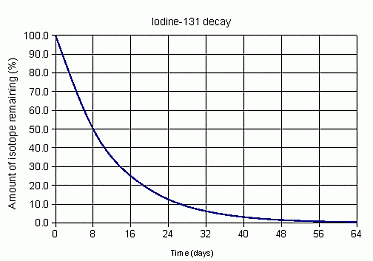
If 10 mg of iodine 131 is given to a patient, how much is left after 24 days? The half-life of iodine-131 is 8 days.
a)
1.25mg
b)
1.25g
c)
10g
d)
10mg
165.
The half-life of strontium-90 is 25 years. How much strontium-90 will remain after 100 years if the initial amount is 4.0 g?
a)
3.0g
b)
0.25mg
c)
0.3g
d)
0.25g
166.
What is the half-life of iodine-131?
a)
32 days
b)
8 days
c)
16 days
d)
24 days
167.

The % of the parent isotope remaining after 2 Half Lives.

a)

50%

b)

25%

c)

12.5%

d)

6.25%

168.

The % of the parent isotope remaining after 1 Half Life.

a)

50%

b)

25%

c)

12.5%

d)

6.25%

169.

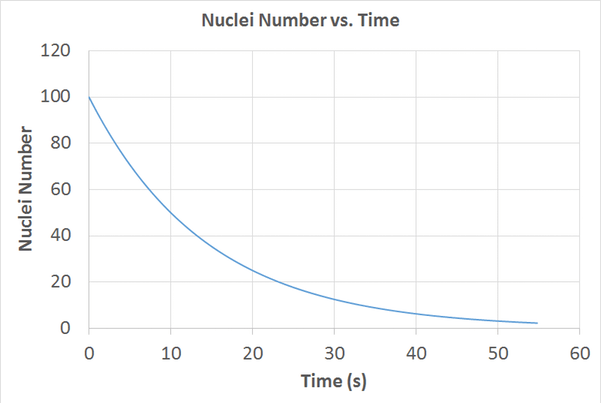
What is the Half life of this isotope?

a)

5 seconds

b)

10 seconds

c)

15 seconds

d)

20 seconds

170.

What is the half life of Carbon-14?

a)

5730 yrs

b)

1.2 billion years

c)

713 million years

d)

1.3 billion years

171.

The element that is the product of radioactive decay is known as the...

a)

daughter element

b)

half-life

c)

parent element

d)

carbon-14

172.

The average, year-after-year conditions of temperature, precipitation, winds, and clouds in an area:

a)

Tropical Zone

b)

Climate

c)

El Niño

d)

La Niña

173.

Cold periods in Earth's history during when glaciers covered large parts of the surface:

a)

Sunspots

b)

Ice Age

c)

La Niña

d)

Global Warming

174.

A gradual increase in the average temperature of Earth's atmosphere:

a)

Global Warming

b)

Greenhouse Gas

c)

El Niño

d)

Climate

175.

Gases in the atmosphere that trap heat; carbon dioxide (CO2) is a major one:

a)

Greenhouse Gas

b)

Global Warming

c)

Sunspot

d)

CFCs

176.
Visible light reaches Earth’s surface while infrared light is trapped as heat. Which characteristic of Earth’s atmosphere causes this to happen?
a)
the hole in the ozone
b)
the greenhouse effect
c)
atmospheric pressure
d)
the inversion layer
177.
Which of the following is the best conclusion that can be made from this graph?
a)
atmospheric carbon dioxide levels have been decreasing since 1960
b)
Hawaii has a lot of carbon dioxide
c)
humans have been working hard to decrease carbon dioxide levels
d)
atmospheric carbon dioxide levels have increased steadily since 1960
178.
Compared to other greenhouse gases, carbon dioxide is very effective in trapping heat near the surface of the Earth.
a)
true
b)
false
179.
Which of the following have been linked to climate change?  
a)
droughts
b)
flooding
c)
melting of polar ice caps
d)
all of the above
180.
Which is a primary energy source used by power plants to generate electricity?
a)
coal
b)
wood
c)
gasoline
d)
batteries
181.
Changes in temperature are expected to be greatest
a)
near the equator
b)
near the poles
c)
between the equator and the North Pole
d)
between the equator and the South Pole
182.
The main human activity that releases greenhouse gases is
a)
using bottled water
b)
burning fossil fuels
c)
texting on cellphones
d)
eating meat
183.
Some greenhouse gases are naturally present in the Earth's atmosphere
a)
True
b)
False
184.
Worldwide, temperatures have been increasing for more than 100 years.  Is this evidence of global warming?
a)
yes
b)
no
185.
Which of the following is contributing to an increase in carbon dioxide in the atmosphere?
a)
deforestation
b)
photosynthesis
c)
oceans
d)
all of the above
186.
Melting of glaciers and polar ice caps....
a)
will result in cooler temperatures in the Arctic
b)
will result in sea-levels rising
c)
Will have no effect on ecosystems
d)
None of the above
187.
What is the definition of weather?
a)
a period of abnormally dry weather that lasts at least 2 years
b)
the specific condition of the atmosphere at a particular place and time
c)
a complex community of organisms and the community's environment
d)
a release of toxic gas
188.
Carbon is stored in
a)
Trees and other living things
b)
Oceans
c)
underground in soil and fossil fuels
d)
All are correct
189.
Increasing quantities of CO2 (Carbon Dioxide) in the atmosphere will cause air temperatures to be _____. 
a)
warmer
b)
cooler
190.
Which natural process removes carbon dioxide from the atmosphere?
a)
forest fires
b)
volcanic eruptions
c)
cellular respiration
d)
photosynthesis
191.

All living things on earth are part of the....

a)

Biosphere

b)

Lithosphere

c)

Hydrosphere

d)

Cryosphere

192.
The impact on the planet due to global warming is called...
a)
climate change
b)
the seasons
c)
the weather
d)
natural change
193.
The conditions in an area over a long period of time?
a)
Climate
b)
Weather
194.
Changes from minute-to-minute, hour-to-hour, day-to-day
a)
Climate
b)
Weather
195.
Texas has long, hot summers.
a)
Climate
b)
Weather
196.
A tornado warning was issued for Kansas City this morning.
a)
Climate
b)
Weather
197.
Changes from minute-to-minute, hour-to-hour, day-to-day
a)
Climate
b)
Weather
198.
Winters in Minnesota frequently experience temperatures below zero.
a)
Climate
b)
Weather
199.

Climatologists get clues about the climate of the past by studying what? There is more than one answer.

a)

Rocks

b)

Fossils

c)

TikTok

d)

Glaciers

200.

Hundreds of millions of years ago, nearly the whole planet was covered with what?

a)

lush vegetation

b)

ice

c)

water

d)

desert

201.

Which of these are fossil fuels? Select all fossil fuels listed.

a)

steam

b)

coal

c)

gas

d)

oil

202.

Is the Greenhouse Effect a completely bad thing?

a)

yes

b)

no

203.

Through research and data, scientists have found that Earth's temperature has been

a)

increasing

b)

decreasing

204.

What causes the ice bubbles found in samples by scientists?

a)

lava

b)

oxygen

c)

methane

d)

carbon dioxide

205.

True or False: there is less carbon dioxide in the atmosphere now than there has been in the past 650,000 years.

a)

True

b)

False

206.

What are some signs of climate change? Choose all signs on the list.

a)

change in rain and snow patterns

b)

lowering ocean levels

c)

more precipitation overall

d)

weaker storms