wayground logo

Free Printable Worksheets

Font size

S
M
L
XL
Worksheets

Important Chemistry Concepts

Total questions: 128

Worksheet time: 10hrs 4mins

Name
Class
Date
1.

3 subatomic particles that makeup an atom.

a)

Positive, negative, neutral

b)

Positron, Neutral, Electron

c)

Proton. Neutron, Electron

2.

This subatomic particle has a positive charge.

a)

Proton

b)

Neutron

c)

Electron

3.

The subatomic particle holds the atom together.

a)

Proton

b)

Neutron

c)

Electron

d)

Nucleus

4.

The subatomic particles found in the nucleus.

a)

Electron, Neutron

b)

Proton, Neutron

c)

Electron, Proton

d)

Proton, Neutron, Electron

5.

The subatomic particle that identifies the element.

a)

Proton

b)

Positron

c)

Neutron

d)

Electron

6.

The subatomic particle that determines reactivity.

a)

Electron

b)

Proton

c)

Shell

d)

Neutron

7.

A neutron has a _____ charge.

a)

Positive

b)

Negative

c)

Neutral

d)

1/2 charge

8.

A electron has a ______ charge.

a)

No charge

b)

Positive

c)

Neutral

d)

Negative

9.

The atomic number tells you the number of

a)

Neutrons

b)

Protons

c)

Neutrons plus Protons

10.

A piece of paper contains_______ of atoms.

a)

Hundreds

b)

Tens

c)

Millions

11.

In a stable element the number of _____________ equals the number of ______________.

a)

protons, electrons

b)

neutrons, electrons

c)

protons, neutrons

12.

The mass number is the number of ___________ plus ___________.

a)

protons, neutrons

b)

protons, protons

c)

electrons, protons

13.

Electrons in the outermost shell are called _______________.

a)

lost electrons

b)

neutral electrons

c)

reactive electrons

d)

valence electrons

14.

The modern periodic table is arranged by this subatomic particle.

a)

proton

b)

neutron

c)

electron

15.

A _______________ runs horizontally(left to right) on the periodic table

a)

Period

b)

Group

c)

Neutron

16.

A _____________ runs up and down on the periodic table.

a)

Group

b)

Period

c)

Sub Shell

17.

Elements in a group react similarly because they have the same number of_______________.

a)

Protons

b)

Shells

c)

Valence Electrons

18.

Group 1 elements are called___________________.

a)

Non Metals

b)

Alkali Earth

c)

Alkali

19.

Group 18 elements are called___________________.

a)

Noble Gases

b)

Alkali

c)

Halogens

d)

Transition Metals

20.

Group 2 elements are called__________________.

a)

Alkali Earth

b)

Protons

c)

Stable

d)

Halogens

21.

Group 17 elements are called_______________.

a)

Halogens

b)

Noble Gases

c)

Alkali

d)

Metals

22.

The most reactive elements are in groups___________

a)

2 and 18

b)

17 and 18

c)

1 and 2

d)

1 and 17

23.

The most stable elements are in group______.

a)

1

b)

5

c)

13

d)

18

24.
a)
Periods
b)
Groups
25.
a)
Periods
b)
Groups
26.
a)
energy levels
b)
valence electrons
c)
protons
d)
neutrons
27.
a)
energy levels
b)
valence electrons
c)
protons
d)
neutrons
28.
a)
Same group
b)
Same period
29.
a)
Group 1
b)
Group 17
c)
Group 2
d)
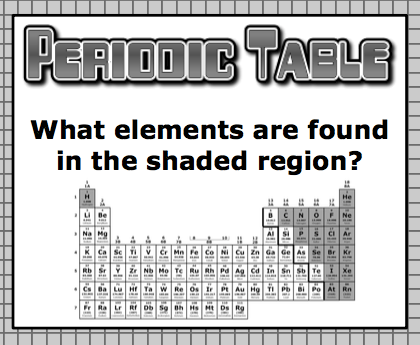
Group 18
30.
a)
Group 1
b)
Group 17
c)
Group 18
d)
Group 2
31.
a)
Group 1
b)
Group 17
c)
Group 18
d)
Group 2
32.
a)
Metals
b)
Nonmetals
c)
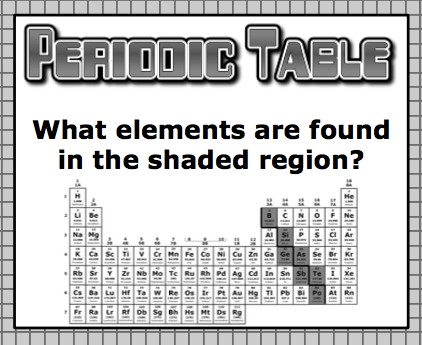
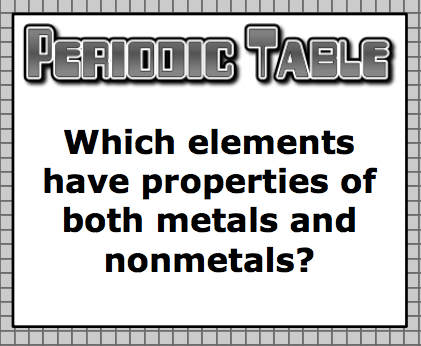
Metalloids
33.
a)
Metals
b)
Nonmetals
c)
Metalloids
34.
a)
Metals
b)
Nonmetals
c)
Metalloids
35.
a)
Metals
b)
Nonmetals
c)
Metalloids
36.

What happens to the number of shells as you move down a group?

a)

They decrease by 1

b)

They increase by 1

c)

Nothing

37.
The majority of elements on the periodic table are
a)
man made.
b)
nonmetals.
c)
metals.
d)
gases.
38.
Electronegativity is...
a)
how good an atom is at attracting electrons
b)
the ability of an atom to lose electrons
c)
the energy required to remove an electron from a specific atom
d)
how easy it is to make friends. 
39.
a)
metric ruler
b)
Celsius thermometer
c)
graduated cylinders
d)
pan balances
40.

What is used to swirl, mix, or store chemicals?

a)

Beaker

b)

Flask

c)

Test Tube

d)

Graduated Cylinder

41.
What is used to measure the volume of liquids more precisely in milliliters?
a)
Beaker
b)
Flask
c)
Graduated Cylinder
d)
Test tubes
42.
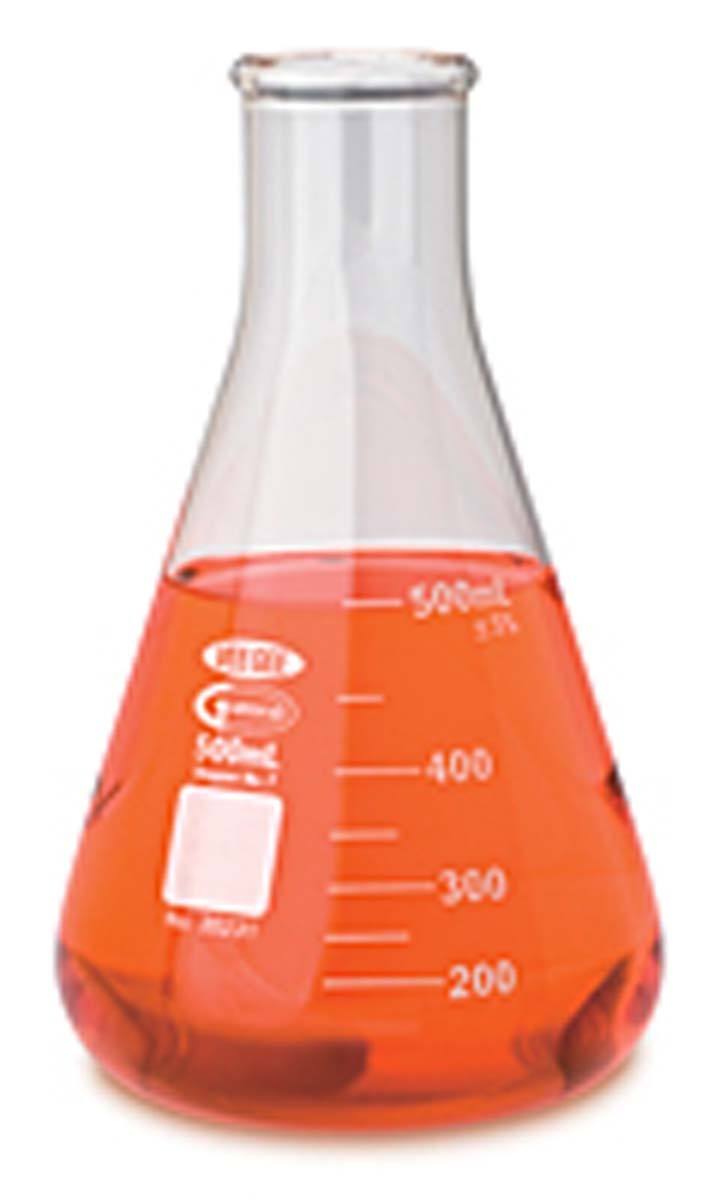
Identify the primary function of the lab equipment seen in the image.
a)
Mixing liquids
b)
Measuring liquid volume
c)
Mixing solids
d)
Measuring mass
43.
This item is used to simply hold or approximately measure a liquid.
a)
beaker
b)
flask
c)
graduated cylinder
d)
test tube
44.
Solids are described as having a 
a)
definite shape and indefinite volume
b)
indefinite shape and indefinite volume
c)
definite shape and definite volume
d)
indefinite shape and definite volume
45.
Liquids are described as having a 
a)
definite shape and indefinite volume
b)
indefinite shape and indefinite volume
c)
definite shape and definite volume
d)
indefinite shape and definite volume
46.
Gases are described as having a 
a)
definite shape and indefinite volume
b)
indefinite shape and indefinite volume
c)
definite shape and definite volume
d)
indefinite shape and definite volume
47.

The base unit for mass in the metric system.

a)

Gram

b)

Meter

c)

Liter

d)

Pound

48.

The base unit for volume in the metric system.

a)

Liter

b)

Meter

c)

Gallon

d)

Gram

49.

An ionic compound is between a __________ and a ___________.

a)

metal and metal

b)

nonmetal and nonmetal

c)

metal and nonmetal

d)

metalloid and metalloid

50.

A covalent compound is between a ___________ and _________.

a)

metal metal

b)

metal nonmetal

c)

nonmetal nonmetal

d)

metalloid metal

51.

In an ionic bonds electrons are ____________.

a)

transferred

b)

shared

c)

transferred and shared

d)

arrange like a sea of electrons

52.

In a covalent bond electrons are _____________.

a)

transferred

b)

shared

c)

depends on ionization energy

d)

connect through a sea of electrons

53.

Valence electrons determine___________.

a)

the reactivity of the atom

b)

the identity of the atom/element

c)

the atomic number of the atom

d)

the charge of the atom in a neutral sphere

54.

According to the octet rule most elements need _______ valence electrons.

a)

2

b)

8

c)

6

d)

18

55.

Why do all bonds form?

a)

so the number of protons equals the number of electrons

b)

so an atom can become unstable

c)

to fill the outermost energy level

56.
If I gain electrons I become
a)
Positive because I've added to my atom
b)
negative because I've added electrons
c)
same because i'm balanced
d)
equal because now I have electrons
57.
In chemical compounds, covalent bonds form when
a)
the electronegativity difference between two atoms is very large.
b)
electrons are completely transferred between two metals.
c)
pairs of electrons are shared between two nonmetal atoms.
d)
two nonmetal atoms are attracted to each other by opposite charges.
58.
What region of the periodic table contains atoms that form covalent bonds?
a)
the left side
b)
the middle
c)
the right side
d)
top left
59.

What is an ion?

a)

An atom that gains or loses electrons

b)

Pieces of the atom that are atoms of the same element

c)

An atom that is the sum of the number of protons and neutrons in an element.

60.
Electronegativity is...
a)
how good an atom is at attracting electrons
b)
the ability of an atom to lose electrons
c)
the energy required to remove an electron from a specific atom
d)
how easy it is to make friends. 
61.

How close a measurement is to the accepted value is called..

a)

Accuracy

b)

Precision

c)

Significant

d)

Estimate

62.

What is used to represent the number of particles in a substance?

a)

mole

b)

gram

c)

kelvin

d)

atmosphere

63.

Avogadro’s number is:

a)

6.02 x 10²²

b)

6

c)

6.02 x 10²³

d)

3.01 x 10²³

64.

The law of conservation of mass states that

a)

the mass of the products is greater than the mass of reactants

b)

the mass of the products = the mass of the reactants

c)

the reactants are less than the products

65.
It is a measure of how close measurements come to each other when they are made in the same way
a)
Accuracy
b)
Precision
c)
Error
d)
Extrapolation
66.

How close a measurement is to the accepted value is called..

a)

Accuracy

b)

Precision

c)

Significant

d)

Estimate

67.
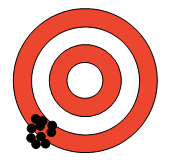
This bullseye demonstrates...
a)
High Accuracy & High Precision
b)
High Accuracy & Low Precision
c)
Low Accuracy & High Precision
d)
Low Accuracy & Low Precision
68.
?
a)
High Accuracy & High Precision
b)
High Accuracy & Low Precision
c)
Low Accuracy & High Precision
d)
Low Accuracy & Low Precision
69.
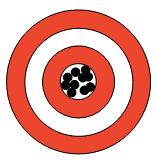
Describe the accuracy and precision of the image
a)
Accurate and Precise
b)
Accurate and not precise
c)
Not Accurate and Precise
d)
not accurate and not precise
70.

How close a measurement is to the true value is called..

a)

Accuracy

b)

Precision

c)

Significant

d)

Estimate

71.
This image is an example of...
a)
precision ONLY
b)
accuracy ONLY
c)
BOTH precision and accuracy
d)
NEITHER precision and accuracy 
72.
A set of data are all close to each other, but they are not close to the actual value.  This set of data can be described as...
a)
accurate
b)
precise
c)
both precise and accurate
73.
A set of data are all close to each other, and they are close to the actual value.  This set of data can be described as...
a)
accurate
b)
precise
c)
both precise and accurate
74.
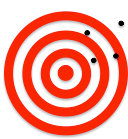
Describe the accuracy and precision of the image
a)
Accurate and Precise
b)
Accurate and not precise
c)
Not Accurate and Precise
d)
not accurate and not precise
75.

Which is the more precise measurement?

a)

4 mL

b)

4.3 mL

c)

4.30 mL

d)

4.300 mL

76.

Mixing bleach with ammonia is

a)

a strong cleaning solution

b)

dangerous

c)

a good idea

77.

It is safe to mix different cleaning chemicals.

a)

True

b)

False

78.

In an endothermic reaction, energy is _________.

a)

absorbed

b)

released

79.

Endo means in or _______.

a)

absorbed

b)

released

80.

Exo means out or ________.

a)

absorbed

b)

released

81.

A mole is a

a)

unit of measurement

b)

a little mouse

c)

a dozen

d)

100 grams

82.

What is Avogadro's number?

a)

6.02 x 10²³

b)

1 mole

c)

600 million

d)

6.02

83.

A mole is:

a)

The SI unit for mass

b)

The SI unit for the amount of a substance

c)

The SI unit for volume

d)

The SI unit for area

84.
a)
Bunsen burner
b)
Ring stand
c)
Graduated cylinder
d)
Test tube holder
85.
a)
test tube
b)
graduated cylinder
c)
micropipet
d)
watch glass
86.
a)
buret
b)
thermometer
c)
graduated cylinder
d)
Erlenmeyer flask
87.
a)
scoopula/spatula
b)
forceps
c)
tongs
d)
iron ring
88.

In gas laws the temperature must be in

a)

Kelvin

b)

Celcius

c)

Torr

d)

Atmosphere

89.
When Pressure increases then the Volume must...
a)
Increase
b)
decrease
90.
What type of relationship to pressure and volume have?
a)
direct
b)
inverse
c)
no relationship
d)
I don't know
91.

When Temperature of a gas increases, the Volume will ____________________

a)

Increase

b)

Decrease

c)

Stay the Same

92.

When Temperature of a gas increases, the Pressure will ____________________

a)

Increase

b)

Decrease

c)

Stay the Same

93.

What does the unit atmosphere, atm, measure?

a)

Pressure

b)

Temperature

c)

Volume

d)

Moles

94.

What is the Standard for Temperature and Pressure?

a)

273 K and 1 atm

b)

273 C and 1 kPa

c)

273 F and 1 mmHg

d)

273 K and 1 Torr

95.

Gas particles are in constant motion. They travel in straight lines, and they constantly bounce off the walls of any container that holds them.

What does this constant bombardment of particles against the walls of the container create?

a)

Pressure

b)

Density

c)

Temperature

d)

Magnetism

96.
If a balloon is cooled what will happen to the volume?
a)
Volume will increase
b)
Volume will decrease
c)
Volume will not change
97.
Which container will have lower pressure?
a)
left
b)
right
c)
they both have the same pressure
98.

If a hairspray can is heated, what can be expected of the pressure of the gas inside the can?

a)

The pressure will increase

b)

The pressure will decrease

c)

The pressure will remain constant

d)

The pressure will equalize

99.
In order to convert to Kelvin, you add ______ to the Celsius measurement.
a)
372
b)
273
c)
237
d)
732
100.
Which of the following would increase the (gas) pressure of a system?
a)
Increase the Temperature
b)
Pump in more gas
c)
Decrease the volume
d)
All of these
101.
Metals tend to 
a)
gain electrons
b)
lose electrons
102.
Nonmetals tend to 
a)
gain electrons
b)
lose electrons
103.
When metals bond with non-metals they form what type of bonds
a)
covalent
b)
ionic
c)
cooperative
d)
lewis
104.
How do the following two elements bond together?
Cr3+  O2-         
a)
CrO
b)
Cr3O2
c)
Cr2O3
d)
CrO3
105.
When an ionic compound is formed, its charge is 
a)
negative
b)
neutral (no charge)
c)
positive
106.
How many valence electrons does a bromine atom have?
a)
1
b)
2
c)
6
d)
7
107.

USE THE PERIODIC TABLE

How many valence electrons does sodium have?

a)

1

b)

2

c)

3

d)

4

108.

USE THE PERIODIC TABLE

How many valence electrons does Phosphorus have?

a)

31

b)

5

c)

15

d)

4

109.

Group 1 elements have a charge of

a)

+1

b)

0

c)

-1

d)

-2

110.

Group 2 elements have a charge of

a)

+2

b)

+3

c)

-2

d)

0

111.

Groups 3-12, transition metals, have a charge

a)

that varies

b)

+1

c)

+3 to +12

d)

0

112.

Group 16 elements have a charge of

a)

16

b)

-6

c)

-2

d)

-16

113.

Group 17 elements have a charge of

a)

-1

b)

0

c)

17

d)

17 positive

114.

Group 18 elements have a charge of

a)

18

b)

0

c)

+8

d)

-8

115.

Group 15 has _________ valence electrons.

a)

5

b)

15

c)

-15

d)

+5

116.

Group 16 has _________ valence electrons.

a)

16

b)

6

c)

-16

d)

unknown

117.

Group 17 has _________ valence electrons.

a)

7

b)

17

c)

+7

d)

0

118.

Group 18 has _________ valence electrons.

a)

8

b)

18

c)

-18

d)

unknown

119.

Group 2 has _________ valence electrons.

a)

2

b)

10

c)

12

d)

22

120.

Group 18 has _________ valence electrons.

a)

8

b)

18

c)

-18

d)

unknown

121.

Flammable materials, like alcohol, should never be dispensed or used near

a)

another student

b)

an open flame

c)

an open door

d)

a sink

122.

Approved eye protection devices (such as goggles) are worn in the laboratory

a)

to avoid eye strain

b)

to improve your vision

c)

anytime heat, chemicals, or glassware is used

d)

only if you don't have glasses

123.

You are heating a substance in a test tube. Always point the open end of the tube

a)

toward yourself

b)

away from all people

c)

toward your lab partner

d)

toward another classmate

124.

The following footwear is best in the laboratory

a)

close-toed shoes

b)

open-toed shoes

c)

sandals

d)

whatever is appropriate for weather

125.

In a laboratory, the following should NOT be worn

a)

sandals

b)

dangling jewelry

c)

loose clothes

d)

all the answers are correct

126.
a)
test tube
b)
graduated cylinder
c)
micropipet
d)
watch glass
127.
a)
iron ring
b)
utility clamp
c)
wire gauze
d)
circle clamp
128.
a)
safety goggles
b)
fancy glasses