wayground logo

Free Printable Worksheets

Font size

S
M
L
XL
Worksheets

Spring Final Review 2026

Total questions: 117

Worksheet time: 2hrs 0mins

Name
Class
Date
1.
Which is the name of the kind of solid substance formed in this figure?  
a)
aqueous 
b)
precipitate
c)
acid
d)
synthesis 
2.
An element plus additional element reacts to form one product is an example of which type of chemical reaction? 
a)
combustion
b)
decomposition 
c)
synthesis 
d)
single replacement
3.
Describes the number of molecules in a compound and is used to balance a chemical reaction. 
a)
coefficient 
b)
subscript
c)
superscript
d)
SI unit
4.
Which type of reaction takes place in the presence of oxygen and produces carbon dioxide and water?
a)
double replacement 
b)
decomposition 
c)
combustion 
d)
single replacement
5.
Provides evidence that a chemical reaction has occurred. 
a)
dissolving 
b)
melting
c)
formation of a gas
d)
bending
6.
A compound is reacted and forms two new substances. What type of reaction is this? 
a)
combustion 
b)
synthesis 
c)
decomposition 
d)
single replacement 
7.
Describes the number of atoms in a compound of each element. 
a)
coefficient 
b)
superscript 
c)
subscript 
d)
SI unit 
8.
What are the correct coefficients when this equation is balanced?
KClO3  --> KCl  +  O2
a)
2,2,2
b)
2,2,3
c)
1,2,3
d)
3,3,3
9.

What term is given to a reaction which transfers heat energy to the surroundings?

a)

Endothermic

b)

Reversible

c)

Exothermic

d)

Exotermic

10.

When barium hydroxide and ammonium chloride react, the temperature of the mixture decreases. What kind of reaction is this?

a)

Endothermic

b)

Decomposition

c)

Exothermic

d)

Indothermic

11.

if more heat energy is released in making bonds in the products than is taken in when breaking bonds in the reactants

a)

Exothermic

b)

Endothermic

c)

Exotermic

d)

Endotermic

12.

When new chemical bonds form, energy ____________.

a)

is taken into the system.

b)

is released from the system.

c)

stays the same in the system.

13.

Which of the following is not a sign of a chemical reaction?

a)

Gas Produces

b)

Mass changes

c)

Temperature changes

d)

Formation of a solid

14.
What describes the reactant atoms in the equation shown?
a)
Al= 4, O= 3
b)
Al= 1, O= 1
c)
Al= 4, O= 6
d)
Al= 6, O= 1
15.

How does the mass of products compare to the mass of reactants in a chemical reaction?

a)

reactants = products

b)

reactants > products

c)

reactants < products

16.

The law of conservation of mass can be demonstrated by a chemical reaction. Which of the following models of a chemical reaction best represents the law of conservation of mass?

a)
b)
c)
d)
17.
This appears on the left side of a chemical formula, and represents how many molecules there are. 
a)
An Atom
b)
The Subscript
c)
A Molecule
d)
The Coefficient
18.
When a scientist mixed two chemicals, an exothermic reaction takes place. Which of the following would be proof that the reaction was exothermic?
a)
a change of color
b)
a change of state
c)
a temperature decrease
d)
a temperature increase
19.
In any chemical reaction, the mass of the products is always:
a)
slightly less than the mass of the reactants
b)
much less than the mass of the reactants
c)
the same as the mass of the reactants
d)
greater than the mass of the reactants
20.
How do chemical reactions turn substances into new substances?
a)
with burning acid
b)
the molecules mix together and create new substances
c)
the atoms break apart and combine back together in new ways
d)
the ionic compounds mix in water to form solutions
21.

Whose atomic model is this?

a)

Bohr

b)

Rutherford

c)

Democritus

d)

Dalton

22.
James Chadwick discovered the ________.
a)
proton
b)
neutron
c)
electron
d)
nucleus
23.
What did Thomson discover?
a)
electron
b)
proton
c)
neutron
d)
electron cloud
24.

Subatomic particles with a negative charge

a)

Electrons

b)

Neutrons

c)

Protons

d)

Quarks

25.
Subatomic particles with a positive charge
a)
neutrons
b)
atomic mass
c)
protons
d)
isotopes
26.

He claimed that matter was made of small, hard particles that he called “atomos.”

a)

Democritis

b)

Dalton

c)

Moseley

d)

Einstein

27.
The scientist responsible for "discovering" the nucleus is:
a)
Bohr
b)
Rutherford
c)
Schroedinger
d)
Einstein
28.
Discovered the neutron
a)
Chadwick
b)
Rutherford
c)
Thomson
d)
Bohr
29.
Gold foil experiment
a)
Dalton
b)
Bohr
c)
Rutherford
d)
Schrondinger
30.
What happens when my glass of water is sitting in the sun and disappears into a gas?
a)
evaporation
b)
burning
c)
melting
d)
freezing
31.
Which form of matter does not take the shape of its container?
a)
liquid
b)
gas
c)
solid
d)
air
32.
How is a gas defined?
a)
Indefinite shape, indefinite volume
b)
Definite shape, definite volume
c)
Found in stars
d)
Definite volume, indefinite shape
33.
What term describes a liquid changing to a solid?
a)
Deposition
b)
Sublimation
c)
Evaporation
d)
Freezing
34.
______________________ takes place when a liquid changes to a solid.
a)
freezing
b)
melting
c)
boiling
d)
sublimation
35.
Molecules are closest together in a 
a)
Solid
b)
Liquid
c)
Gas
36.
The state of matter that has no definite size or shape is
a)
Solid
b)
Liquid
c)
Gas
37.
Which state of matter has the lowest compressibility?
a)
Solid
b)
Liquid
c)
Gas
d)
Plasma
38.
When a gas changes directly to a solid, the process is known as what?
a)
Sublimation
b)
Condensation
c)
Deposition
d)
Evaporation
39.
Water can be a solid, liquid, and a gas.
a)
True
b)
False
liquid
40.
Define a liquid.
a)
Indefinite shape, indefinite volume
b)
Definite shape, definite volume
c)
Found in stars
d)
Definite volume, indefinite shape
41.
melting ice cream
a)
physical change
b)
chemical change
42.
glass breaking
a)
physical change
b)
chemical change
43.
a rusting bicycle
a)
physical change
b)
chemical change
44.
mowing the lawn
a)
physical change
b)
chemical change
45.
frying an egg
a)
physical change
b)
chemical change
46.
a)
physical change
b)
chemical change
47.
freezing chocolate covered bananas
a)
physical change
b)
chemical change
48.
corroding metal
a)
physical change
b)
chemical change
49.
separating sand and gravel
a)
physical change
b)
chemical change
50.
What kind of properties can only be observed when a substance changes into a different substance?
a)
physical properties
b)
chemical properties
51.
Which type of property is the ability to conduct electricity?
a)
physical property
b)
chemical property
52.
Example of a physical property
a)
magnetism
b)
reactivity with oxygen
c)
flammability
d)
non-reactive
53.
Properties that can be observed without changing the identity of the substance.
a)
Physical
b)
Chemical
54.
Example for physical property
a)
odor
b)
burns in air
c)
reacts with water to create hydrogen gas
d)
rust
55.
Example for chemical property
a)
color
b)
hardness
c)

reactivity

d)
solubility
56.
Example for physical property
a)
reacts with an acid
b)
explodes
c)
flammibility
d)
taste
57.
Example for physical property
a)
melting point
b)
flammability
c)
reactivity 
d)
combustion
58.
Example for chemical property
a)
malleability
b)
texture
c)
combustion
d)
sour taste
59.
Example of a physical property
a)
reactivity
b)
 color
c)
combustion
d)
ability to burn
60.
Example of physical property
a)
electromotive force
b)
boiling point
c)
combustion
d)
reactivity with water
61.

Definition of malleability?

a)
Tendency of a material to break under stress
b)
The ability of material to be reshaped into thin sheets of metal.
c)
The ability of material to be drawn into wire.
d)
The ability of material to be bent.
62.
Example of physical property
a)
freezing point
b)
ability to blow up
c)
toxicity
d)
radioactivity
63.
Example of a physical property
a)
flammability
b)
luster
c)
ability to rust
d)
ability to explode
64.
Solubility is the 
a)
the rate that a solvent can evaporate
b)
ability of a metal to bend
c)
shininess of an object
d)
amount of solute that can be dissolved into a solvent
65.
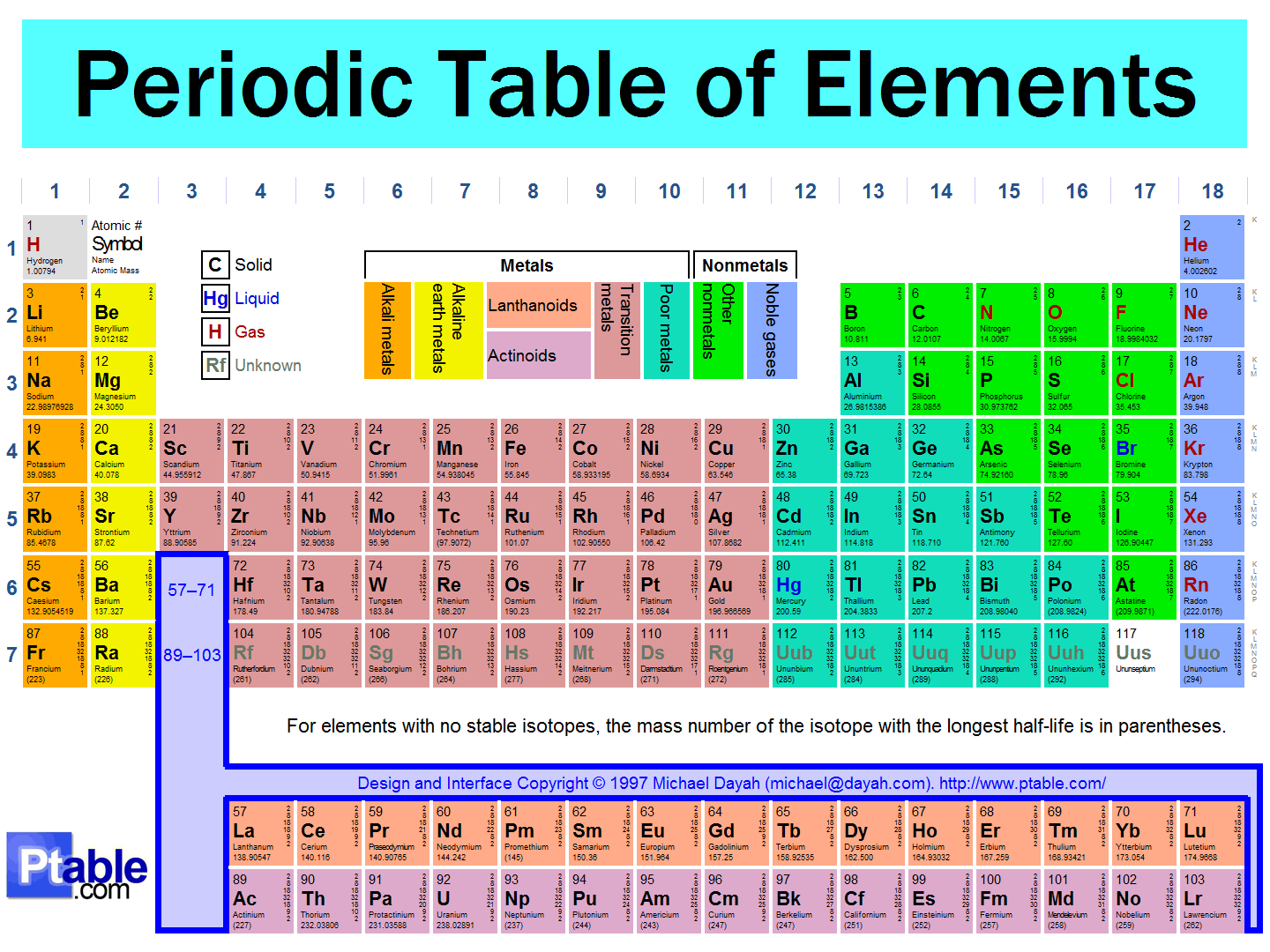
Each column in the periodic table is called a 
a)
period
b)
group
c)
cluster
d)
unit
66.
The atomic number tells you what?
a)
number of electrons
b)
number of protons
c)
number of neutrons
d)

both neutrons and protons in an atom.
67.
What is the name of the group that never reacts--ever ever they are stable with a full outermost ring!!!
a)
noble gases
b)
transition
c)
halogens
d)
borons
68.
What is the chemical symbol for Lithium?
a)
H
b)
He
c)
Li
d)
N
69.
The horizontal row on the periodic table is called a
a)
group
b)
family
c)
period
d)
atomic number
70.

What are the three main groups of the periodic table?

a)

groups

b)

metal

c)

nonmetals

d)

metalloids

e)

periods

71.

What do the Roman Numerals above the vertical columns on the periodic table tell us?

a)

The number of orbitals

b)

The number of valence electrons (electrons on the outer most shell)

72.

How do you calculate the number of neutrons? *

a)

Mass = Atomic number - Neutrons

b)

Mass - Atomic number = Neutrons

c)

Atomic number = Neutrons

73.

How many protons and electrons does nickel have?

a)

28

b)

58.69

74.

What is the atomic mass?

a)

58.693

b)

28

75.

How light reacts with the surface of a material:

a)

Malleability

b)

reactiveness

c)

luster

d)

density

76.

What does the atomic number of an element tell us?

a)

Protons and Neutrons

b)

Protons and Electrons

c)

Electrons and Neutrons

77.

What type of mixture is salsa

a)

compound

b)

heterogeneous

c)

homogeneous

78.

What type of mixture is trail mix?

a)

compound

b)

heterogeneous

c)

homogeneous

79.
A pure substance...
a)
is an element or a compound
b)
is an element or a mixture
c)
is a compound or a mixture
d)
is a mixture
80.

1 A substance made up of two or more chemically combined elements is —

a)

an element

b)

mixture

c)

compound

d)

solution

81.
NaHCO3 is an example of —
a)
an abbreviation
b)
a compound
c)
a mixture
d)
an element
82.

Brass is a metal that is bright red and gold. It is formed by combining, not chemically, two elements, zinc and copper. Based on the information, how would brass be classified?

a)

an element

b)

compound

c)

mixture

d)

suspension

83.
Which of the following is an element?
a)
Sugar
b)
Salt
c)
Water
d)
Oxygen
84.
A mixture that appears to be evenly mixed throughout:
a)
an atom
b)
a compound
c)
a homogeneous mixture
d)
a heterogeneous mixture
85.
Which of the following is NOT a pure substance?
a)
milk
b)
oxygen
c)
water
d)
carbon dioxide
86.
Two classifications of a pure substance are
a)
homogeneous and heterogeneous
b)
atoms and elements
c)
elements and compounds
d)
solutions and colloids
87.
What word describes when water is attracted to other substances?
a)
cohesion
b)
adhesion
c)
capillary action
d)
surface tension
88.
What two elements make up water?
a)
Helium and oxygen
b)
Hydrogen and oxygen
c)
helium and carbon
d)
oxygen and carbon
89.

When water and other liquids stick together to form drops or thin films called ________________.

a)

adhesion

b)

capillary action

c)

cohesion

d)

surface tension

90.
molecule in which opposite ends have opposite electric charges
a)
cohesion
b)
polar molecule
c)
hydrogen bond
d)
solution
91.
The reason the water balloon did NOT pop while held over a flame is water's _________.
a)
Less dense than air.
b)
Hydrogen bonds between water molecules.
c)
polarity.
d)
high specific heat capacity.
92.
Water is a universal solvent because it...
a)
It can be found anywhere
b)
It freezes when it gets cold
c)
floats when frozen
d)
Dissolves most substances
93.
The fact that ice floats on liquid water is due to the fact that water's solid is ___________ than it's liquid form
a)
less polar
b)
more polar
c)
less dense
d)
more dense
94.
A general definition of cohesion is the attraction of:
a)
particles of the same substance
b)
particles of a different substance
c)
particles of both the same and different substances
d)
particles of neither the same or different substances
95.
Which term refers to water having partial positive and a partial negative charge?
a)
cohesion
b)
surface tension
c)
polarity
d)
adhesion
96.
A high specific heat means...
a)
It heats up quickly with energy added
b)
It requires more energy to change temperature
97.

What do you call any substance that dissolves another substance?

a)

Solvent

b)

Height

c)

Atoms

d)

Oxygen

98.

Capillary Action

a)

The property of water that allows ice to float on the surface of liquid water

b)

The property of water that allows it to dissolve polar substances

c)

When water molecules stick to other surfaces

d)

The property of water that allows water to move up a thin tube (or the stem of a plant) by itself

99.

What property of water allows water to flow against gravity?

a)

Polarity

b)

Cohesion

c)

Capillary Action

d)

Adhesion

100.

The temperature at which a substance changes from a liquid to a solid (for water, this is 0 degrees Celsius, 32 degrees Fahrenheit)

a)

freezing point

b)

boiling point

c)

melting point

d)

evaporation

101.

The temperature at which a substance changes from liquid to gas (for water this is 100 degrees Celsius, 212 degrees Fahrenheit)

a)

boiling point

b)

melting point

c)

evaporation

d)

condensation

102.

Which would NOT increase the rate at which a sugar cube dissolves?

a)

Reducing the amount of solvent

b)

Crushing the sugar cube

c)

Stirring the solution

d)

Heating the solvent

103.

A solution that contains all of the solute it can hold at a given temperature is

a)

diluted.

b)

saturated.

c)

supersaturated.

d)

unsaturated.

104.

The amount of solute that can be dissolved in a specific amount of solvent at a given temperature is its

a)

concentration.

b)

density.

c)

dilution.

d)

solubility.

105.

A student pours mineral salts into a bottle of cold water. Which of the following best explains why shaking the bottle will affect the dissolving rate of the salt?

a)

Shaking exposes the salts to the solvent more quickly.

b)

Shaking helps more water evaporate.

c)

Shaking equalizes the water temperature.

d)

Shaking causes more ions to precipitate out of solution.

106.

A solution that is able to dissolve additional solute is best described as

a)

supersaturated.

b)

concentrated.

c)

saturated

d)

unsaturated.

107.
The substance being dissolved in a solution.
a)
sands
b)
solute
c)
solvent
d)
alloy
108.
The substance in which a solute is dissolved
a)
sands
b)
solvent
c)
alloy
d)
negative particles
109.
Solutions are composed of __________ .
a)
salts and solutes
b)
solvents and salts
c)
solutes and alloys
d)
solutes and solvents
110.
In a sample of salt water, NaCl would be considered the ______.
a)
Solution
b)
Solute
c)
Solvent
d)
Solvation
111.
If we are making Kool-aid with sugar, Kool-aid powder, and water, which part is the solvent?
a)
water
b)
powder
c)
sugar
d)
powder and sugar
112.
What is it about the water molecule that makes it a great solvent?
a)
water demonstrates polarity; a partial charge on each side of the molecule
b)
due to its molecular formula
c)
it has a liner molecular shape
d)
due to it's non-polar molecular structure
113.
Which of the following would result in being able to dissolve a greater amount of gas in a
solution?
a)
Heat the gas and solution
b)
Decrease the pressure of the solution
c)
Make the gas an electrolyte
d)
Cool the gas and solution
114.
Students are asked to make statements about the solubility graph above. Which student does
the best job of communicating the general features of the graph?
a)
Most salts require 100 grams of water in order to dissolve completely.
b)
Table salt has the average solubility of all salts.
c)
The solubility of most salts increases with increasing temperature.
d)
Most curves show a decreasing slope as the temperature rises.
115.
The amount of solute actually dissolved in a given amount of solvent.
a)
dilution
b)
concentration
c)
saturated solution
d)
supersaturated mixture
116.
What does it mean to dilute a solution?
a)
lower the concentration of solute per solvent
b)
increase the concentration of solute per solvent
117.

Which of these pH values would indicate that a solution is a weak base?

a)

4

b)

5.6

c)

8

d)

13