Wayground logo

Free Printable Worksheets

Font size

S
M
L
XL
Worksheets

QAM 4 Practice

Total questions: 90

Worksheet time: 3hrs 8mins

Name
Class
Date
1.
What does every food chain start with? (Even if it's not drawn or written there!)
a)
producers
b)
sun
c)
consumer
d)
decomposers
2.
An organism that needs to eat other organisms to obtain energy is known as a:
a)
Autotroph
b)
Producer
c)
Consumer
d)
Mutualist
3.
Consumer that eats plants
a)
heterotroph
b)
herbivore
c)
producer
d)
community
4.
What does a food web represent?
a)
All connections of energy flow throughout all organisms in a habitat.
b)
The specific ways that mutualism is carried out.
c)
A single pathway or energy flow between organisms. 
d)
How carnivores get their food. 
5.
relationship in which two species live closely together
a)
resource
b)
mutualism
c)
succession
d)
symbiosis
6.
The rabbit in this food web would be considered a:
a)
Decomposer
b)
Producer
c)
Secondary Consumer
d)
Primary Consumer
7.
Where an organism lives
a)
habitat
b)
niche 
c)
heterotrogh
d)
biosphere
8.
In this Food Web Pyramid Which type of consumer gets only 10% of the energy stored in plants?
a)
Herbivore
b)
Carnivore
c)
Omnivore
d)
Secondary Consumer
9.
Which one is not a consumer?
a)
anemone 
b)
bear
c)
shark
d)
vulture
10.
What is the term for each step in the transfer of energy and matter within a biological community?
a)
energy path
b)
food web
c)
trophic level
d)
food pyramid
11.
The image provided is an example of a(n):
a)
Carnivore
b)
Herbivore
c)
Producer
d)
Autotroph
12.
The amount of energy that usually transfers from one trophic level to the next...
a)
10%
b)
20%
c)
80%
d)
50%
13.
An illustration that uses arrows to show the MANY possible directions in which matter and energy can pass through the organisms in an ecosystem.
a)
Food chain
b)
Food web
c)
Energy Pyramid
d)
Succession Map
14.
The nonliving aspects of an ecosystem.
a)
Abiotic factors
b)
Biotic factors
15.
The living portions of the ecosystem.
a)
Biotic factors
b)
Abiotic factors
16.
A graphic illustration that shows each trophic level and the amount of useable energy contained within.
a)
Food chain
b)
Food web
c)
Energy Pyramid
d)
All of these
17.
A collection of organisms that make up a community as well as all of the nonliving aspects of the environment.
a)
Population
b)
Community
c)
Habitat
d)
Ecosystem
18.
As you move upward, from level to level, in an energy pyramid, energy _____.
a)
increases
b)
decreases
c)
stays the same
d)
increases exponentially
19.
 plants that convert energy from the sun
a)
decomposer
b)
primary consumer
c)
secondary consumer
d)
producer
20.
What are the Abiotic factors in this image? 
a)
water, sunlight, dirt, air
b)
birds and plants
c)
birds, water, dirt
d)
plants, water
21.

_________ is the process of change by which species of organism change over time.

a)

Nucleotides

b)

Evolution

c)

Mutation

d)

Carbon

22.

Birds are eating all the green beetles. Because the brown beetles are surviving they reproduce more and make more brown beetles. This is called ___________

a)

Artificial Selection

b)

The Theory on the Origin of Species

c)

Natural Selection

d)

Mutation

23.

Darwin wrote that the organisms best suited to their environments will .....

a)

Increase in Number

b)

Go Extinct

c)

Mutate More often

24.

Which trait did Darwin pay most attention to about the finches in the galapagos islands?

a)

Their Feathers

b)

Their Horns

c)

Their Size

d)

Their Beak Shape

25.

Why were the beaks on Darwin's finches so Important?

a)

They showed the finches always existed as Darwin found them.

b)

They showed that the finches could mutate their beaks whenever they want.

c)

They showed variability in the finches species. All finches were equally adaptable to all islands.

d)

They show that the finches adapted to their environments. Their beak shape matched the food available on each island.

26.

4. When the industrial revolution started, the trees have been covered in soot from coal factories. Which moth will be more successful in this environment?

a)

White Moth

b)

Dark Moth

c)

Both are Equally Successful in this Environment

27.

Why could the same species of moth be two different colors?

a)

Their color was based on their DNA. Sometimes a mutation would cause the moth to be born with a different color.

b)

Their color was caused by the environment. The soot from the factories would fuse with the moth's skin.

c)

Bacteria inside the moth's stomach would sometimes give the moth stomach the ability of the moth to have "active camouflouge." This allowed the moths to change their color at will.

28.

If scientists find fossils of a type of mosquito on the bottom layer and find fossils of beetles towards the top layer, what can scientists infer?

a)

Mosquitos ate the beetles

b)

Mosquitos are older fossils than beetles

c)

Beetles are older fossils than mosquitos

d)

Both mosquitos and Beetles must have lived at the same time.

29.

When scientists compare fossils to see about old they are in a certian environment, this is called ____________

a)

Comparing

b)

Absolute Dating

c)

Relative Dating

d)

Comparative Dating

30.

Darwin's ship was called ________

a)

HMS Bugle

b)

HMS Beetle

c)

HMS Asparagus

d)

HMS Beagle

31.

Which of the following do scientists not use as evidence for evolution?

a)

Fossils

b)

Vestigial Structures

c)

Embryology

d)

Radiation

32.

When we examine this whale fossil, we can see that the whale has a pelvic bone that doesn't seem to be used by the whale. What do scientists infer?

a)

The whale had an ancestor with legs

b)

The whale must use the pelvis for an unknown reason

c)

The whale was born with an extra bone and has a disorder

d)

The whale had an ancestor with wings

33.

In evolution, these are body parts of species that have similar features.

a)

Adaptable features

b)

Vestigial Structures

c)

Nucleal Structures

d)

Homologous Structures

34.

Why are homologous structures important to the theory of evolution?

a)

Scientists use them as evidence that many species must have had a common ancestor.

b)

Scientists use them as evidence that many species must have independently evolved and are not related to other species.

c)

Scientists use them as evidence to show that all kinds of structures in our bodies work to help us survive.

35.

Why are vestigial structures evidence for evolution?

a)

They are useful in the organism and show natural selection at work.

b)

They are not useful in the organism but they were probably useful in some ancestor of that species.

c)

They show that these organs or behaviors help an organism adapt to new environments

36.

Scientists believe horses evolved over a period of 50 million years. How did they change?

a)

They became much larger

b)

Their toes eventually were replaced by a hoof

c)

Their environment changed from a forest to a grassland environment

d)

all the other answers!

37.

How do scientists use embryology to support the theory of evolution?

a)

Embryos of many species have a lot of similar characteristics when they are first forming showing different creatures must have a common ancestor

b)

Embryos of many species have very little in common until they start developing for long periods of time

c)

Features like gills and tails prove that all animals are really just fish

38.

What would you want to learn about the most?

a)

Hybrid Animals

b)

Human Evolution

c)

History of Life on Earth

39.
All the individuals of a species that live in a particular area are called a 
a)
group
b)
population
c)
variation
d)
fossil
40.
Individuals that are well adapted to their environment will survive and produce
a)
better traits
b)
stronger genes
c)
more offspring
d)
fewer mutations
41.
Vertebrate embryos pass through similar stages of development is evidence for
a)
use and disuse
b)
homologous structures
c)
common ancestry
d)
acquired characteristics
42.
What is the process of which humans breed organisms for certain traits?
a)
artificial selection
b)
descent without modification
c)
inheritance of acquired characteristics
d)
natural selection
43.
a)
analogous structures
b)
homologous structures
c)
vestigial structures
d)
none of the above
44.
What is the term for a feature that allows an organism to survive in its environment?
a)
adaptation
b)
variation
c)
homologous structure
d)
vestigial structure
45.

If a strand reads: A A A T T T C

The complementary DNA strand would read...

a)

T T T A A A G

b)

T T T A A A G

c)

A A A T T T C

d)

U U U A A A G

46.
Replicate the following strand of DNA: 
AATCATGGA
a)
AATCATGGA
b)
TTAGTACCT
c)
UUAGUACCU
d)
GGATAUCUA
47.
Why is DNA important?
a)
it is very small and very complicated
b)
it's in everything
c)
it serves as the blueprint for traits of all living things
d)
because we eat it every day for energy
48.

What are the 4 nitrogen bases in DNA?

a)
adenine, thymine, cytoplasm, and guanine
b)
adenine, thymine cytosine, and guanine
c)
adenine, thymine, cytosine, and gylcerol
d)
adenine, thymine, cytosine, and glucose
49.
A process in which DNA has the unique ability to make an exact copy of itself.
a)
Replication
b)
Translation
c)
Transcription
50.
Which organelle is DNA usually found in?
a)
cell membrane
b)
vacuole
c)
chloroplast
d)
nucleus
51.
Describes the twisted ladder-like shape of a DNA molecule
a)
Nitrogen Base
b)
Hexagon
c)
Double Helix
52.
What term names the process during which DNA is copied prior to cell division?
a)
DNA polymerase
b)
DNA replication
c)
DNA regneration
d)
DNA redistribution
53.

RNA contains a nitrogenous base that is different from DNA. What is the name of the nitrogenous base?

a)

Thymine

b)

Uracil

c)

Adenine

d)

Cytosine

e)

Guanine

54.

True or False: RNA is double stranded.

a)

True

b)

False

55.

What is the process called when DNA is made into mRNA.

a)

translation

b)

transcription

c)

transcribe

d)

translate

56.

What type of RNA moves to the ribosome to start protein synthesis?

a)

tRNA

b)

mRNA

c)

rRNA

d)

nRNA

57.

Which macromolecule is made up of amino acids?

a)

carbohydrate

b)

lipid

c)

nucleic acid

d)

protein

58.

DNA and RNA are which type of macromolecule?

a)

carbohydrate

b)

lipid

c)

nucleic acid

d)

protein

59.

mRNA is read into amino acids during what process?

a)

transcription

b)

transfer

c)

translation

d)

transition

60.

What makes up a codon?

a)

2 amino acids

b)

3 amino acids

c)

2 nucleotides

d)

3 nucleotides

61.

What do tRNA bring to the ribosome?

a)

glucose

b)

fatty acids

c)

nucleotides

d)

amino acids

62.

The genetic code can help you translate mRNA into ___________?

a)

nucleotides

b)

fatty acids

c)

amino acids

d)

glucose

63.

Where does transcription occur

a)

nucleus

b)

cytoplasm

c)

ribosome

d)

endoplasmic reticulum

64.

Where does translation occur?

a)

nucleus

b)

golgi

c)

endoplasmic reticulum

d)

cytoplasm at the ribosome

65.

During transcription:

a)

a DNA template is used to make DNA

b)

a DNA template is used to make mRNA

c)

mRNA is used to make a polypeptide/amino acid chain

d)

proteins are made

66.

During translation:

a)

a DNA template is used to make DNA

b)

a DNA template is used to make mRNA

c)

mRNA is used to make an amino acid/polypeptide chain

d)

DNA is replicated

67.

RNA does not contain which base?

a)

Adenine (A)

b)

Cytosine (C)

c)

Thymine (T)

d)

Uracil (U)

e)

Guanine (G)

68.
When DNA is transcribed to RNA.... 
a)
A pairs with U
b)
C pairs with U
c)
A pairs with T
d)
C pairs with T
69.

What is the process to code for protein?

a)

DNA --> mRNA --> Protein

b)

mRNA--> DNA--Protein

c)

Protein-->DNA-->mRNA

d)

DNA--> Protein -m-RNA

70.

If a strand reads: A A A T T T C

The complementary RNA strand would read...

a)

T T T A A A G

b)

T T T A A A G

c)

A A A T T T C

d)

U U U A A A G

71.
Which statement best describes the process of evolution?
a)
Populations can survive in different locations on earth
b)
Environmental conditions limit the number of species on Earth
c)
Populations grow when resources are abundant
d)
The traits of a species can change over time
72.
Natural selection can also be referred to as:
a)
Survival of the weakest
b)
Survival
c)
Survival of the fittest
d)
Artificial selection
73.
The term that best describes  "the better adapted organisms survive to pass traits along to offspring".
a)
Evolution
b)
Natural Selection
c)
Extinction
d)
Artifical Selection
74.
Which is NOT a factor of  Natural Selection?
a)
variation
b)
competition
c)
mutation
d)
acquired characteristics
75.
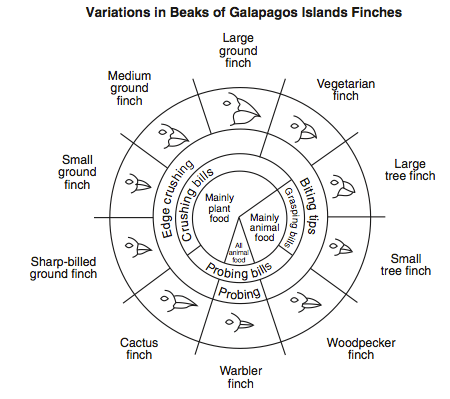
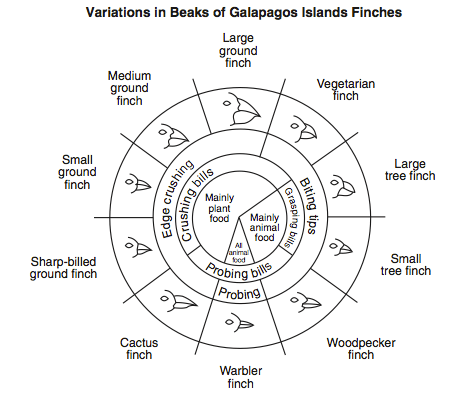
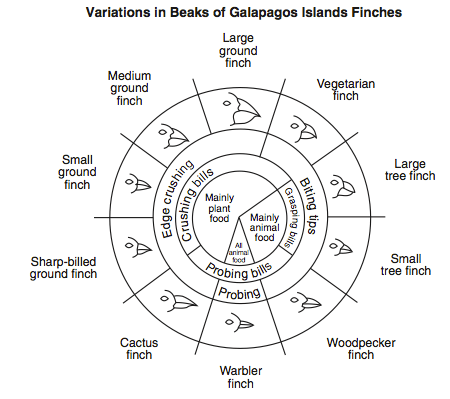
Base your answer(s) to the following question(s) on the diagram below that shows variations in the beaks of finches in the Galapagos Islands and on your knowledge of biology. 
The diversity of species seen on the Galapagos Islands is mostly due to 
a)
gene manipulation by scientists 
b)
gene changes resulting from mitotic cell division 
c)
natural selection 
d)
selective breeding 
76.
According to the theory of natural selection, why are some individuals more likely than others to survive and reproduce? 
a)
Some individuals pass on to their offspring new characteristics they have acquired during their lifetimes. 
b)
Some individuals are better adapted to exist in their environment than others are. 
c)
Some individuals do not pass on to their offspring new characteristics they have acquired during their lifetimes. 
d)
Some individuals tend to produce fewer offspring than others in the same environment. 
77.
Base your answer(s) to the following question(s) 8. on the diagram below and on your knowledge of
biology.
Several of the Galapagos Islands are inhabited by grasshoppers, beetles, flies, bees, and butterflies. Finches that feed on these consumers would have beaks adapted for 
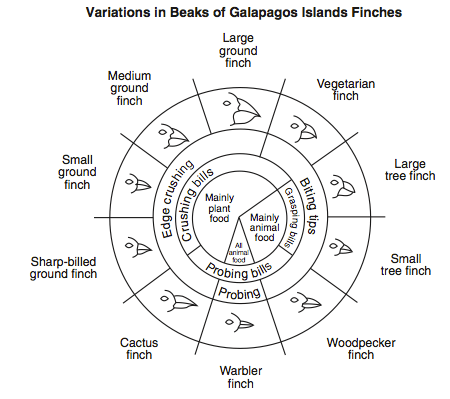
a)
probing, only 
b)
probing or grasping 
c)
crushing or probing 
d)
parrotlike feeding or grasping 
78.
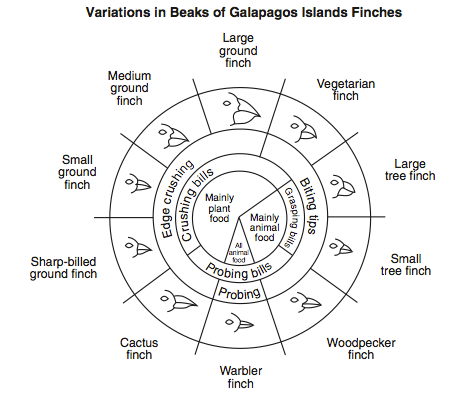
Base your answer(s) to the following question(s) on the diagram below and on your knowledge of biology.
Which two finches would compete the least for food? 
a)
small ground finch and large ground finch 
b)
large ground finch and sharp-billed ground finch 
c)
small tree finch and medium ground finch 
d)
vegetarian finch and small ground finch 
79.
Base your answer(s) to the following question(s) on the diagram below and your knowledge of biology.  Which species of finch has an edge-crushing bill that can also probe into plants for food? 
a)
cactus finch 
b)
sharp-billed ground finch 
c)
warbler finch 
d)
large ground finch 
80.
Base your answer to the following question on the finch diversity diagram below and on your knowledge of biology.  Warbler finches are classified as 
a)
producers 
b)
herbivores 
c)
carnivores 
d)
decomposers 
81.
Base your answer(s) to the following question(s) on the information below and on your knowledge of biology. The diagram below represents the relationship between beak structure and food in several species of finches in the Galapagos Islands. 
Which factor most directly influenced the evolution of the diverse types of beaks of these finches? 
a)
predation by humans 
b)
available food sources 
c)
oceanic storms 
d)
lack of available niches 
82.

Ink can be separated by a method of -----------------------------------------------

a)

distillation

b)

filtration

c)

chromatography

d)

sedimentation

83.

A substance is soluble if it can be dissolved.


In paper chromatography, the most soluble solute _____________________ .

a)

does not move from the start point

b)

stays closest to the start point

c)

travels furthest away from the start point

d)

can be found in the middle of the chromatogram

84.

What is the correct image of paper chromatography???

a)
b)
c)
85.

This laboratory procedure is known as

a)

CLONING

b)

gel electrophoresis

c)

chromatography

d)

use of a dichotomous key

86.

A student performed a gel electrophoresis experiment. The results are represented in the diagram

below. Compared to the fragments at the top of the gel, the fragments at the lower end are

a)

larger, and move slower

b)

larger, and move faster

c)

smaller, and move faster

d)

smaller, and move slower

87.

In preparation for an electrophoresis procedure, enzymes are added to DNA in order to

a)

convert the DNA into gel

b)

cut the DNA into fragments

c)

change the color of the DNA

d)

produce longer sections of DNA

88.

This technique used to analyze DNA involves the

a)

synthesis of new DNA strands from subunits

b)

separation of DNA fragments based on size

c)

production of genetically engineered DNA molecules

d)

removal of defective genes from DNA

89.
DNA fingerprinting works because
a)
Most genes are dominant
b)
All organisms contain RNA
c)
The most important genes are different among most people
d)
No two people, except identical twins, have exactly the same DNA 
90.
What is the purpose of gel electrophoresis?
a)
helps cut DNA
b)
count the genes in DNA
c)
separates DNA based on size
d)
allows for an exact replicated organism