
 Worksheets
Biology B Semester Review
Total questions: 120
Worksheet time: 1hrs 28mins
What is the function of DNA?
to provide carbohydrates for cellular functions
provide instructions for making proteins
to fight off infections
allows us to communicate


What process is steps 1-3 referring to?
DNA Replication
Transcription
Translation
Nucleus
Why must transcription occur where DNA can be found?
because DNA can't leave
because ribosomes are in the nucleus
because DNA polymerase is found there
because helicase unzips the DNA
How many nucleotides equal 1 amino acid?
1
2
3
4
TRANSLATE this RNA sequence: AUGCAAUGA
Met-Glu-Stop
Met-His-Stop
Thr-Glu-Stop
Thr-Pro-Stop


a photograph or picture of chromosomes grouped in ordered pairs is a ______________
pedigree
Punnett Square
Venn Diagram
Karyotype


If the Diploid number for carrots is 18, the haploid number is
18
9
27
36
Which term means "same alleles"?
heterozygous.
genes.
homozygous.
DNA.
A genotype is
the physical appearance of an organism.
a made up word for genes.
not even a word.
two alleles that an organism possesses.

This trait is
autosomal recessive.
sex-linked.
autosomal dominant.
If the person is filled in
they don't have the disorder.
they are homozygous dominant.
they are heterozygous.
they are homozygous recessive.



Artificial Selection
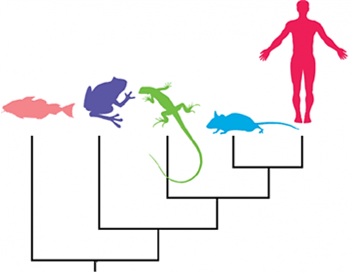
According to this phylogenetic tree, which creature is the least related out of all pictured?
Fish
Frog
Salamander
Human

Which group of animals on this tree are most closely related to birds?
Saurischian dinosaurs
Ornithischian dinosaurs
Crocodiles
None of these are related to birds

What number is the common ancestor of C and D
1
2
3
4

Phylogeny is usually represented by a tree diagram called a _________ - _____
Genetic Line
Phylogenetic Tree
Photographic Queue
Future Babies

What is the common ancestor of Letters A, B, C, D, E?
1
2
3
4
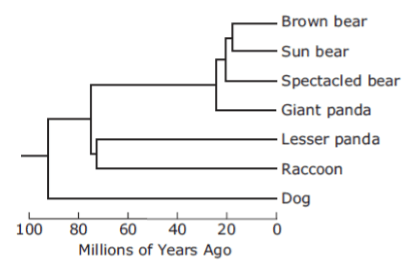
Who is the closest relative to the brown bear?
Giant panda
Dog
Lesser panda
Sun bear

individuals with alleles for an extreme type are more likely to survive and reproduce
stabilizing selection
directional selection
disruptive selection
genetic drift

the selection pressure favors the extreme phenotypes, dividing the population into 2 distinct groups
directional selection
stabilizing selection
geographic selection
disruptive selection

Individuals with intermediate traits are more likely to survive and reproduce
stabilizing selection
directional selection
adaptive radiation
disruptive selection
Aspen trees that are over 25 m tend to blow over in high winds; aspen that are under 15 m don't get enough sun
directional selection
stabilizing selection
disruptive selection
artificial selection
sexual selection

snails with a forward spiral and snails with a backward spiral have an advantage in their environment
directional selection
stabilizing selection
disruptive selection
artificial selection
sexual selection
Fish that produce 40,000+ eggs have greater fitness than fish that produce less than this number
directional selection
stabilizing selection
disruptive selection
artificial selection
sexual selection
Ground finches born following a severe drought tend to have larger beaks (on average) than the previous generation.
directional selection
stabilizing selection
disruptive selection
artificial selection
sexual selection
Forming of a new species by evolution from pre-existing species.
Speciation
Extinction
Gradualism
Punctuated equilibrium
When unrelated species evolve similar characteristics because they live in similar environments.
Convergent Evolution
Coevolution
Adaptive Radiation
Divergent Evolution
Two organisms change in response to each other forming a specialized relationship.
Coevolution
Convergent Evolution
Gradualism
Extinction

Hummingbirds have a beak just the right length to reach the nectar in a cardinal flower and as they feed their foreheads bump into the pollen structure. Cardinal flowers are red which hummingbirds can see but bees can’t. Cardinal flower’s pollen structure is just the right length for the hummingbird to pick up pollen as it feeds
Convergent
Divergent
Coevolution
In the ocean surrounding Antarctica, there are fish that survive the cold water by using a molecule made of glycoproteins that circulates the blood and keeps it from freezing. Certain kinds of worms that live in the Arctic ocean also make antifreeze proteins that help them live in icy water.
Convergent Evolution
Divergent Evolution
Coevolution
The beaver in North America and the capybara in South America share a common ancestor, but have evolved over time to look different
Convergent Evolution
Divergent
Coevolution
The Galápagos tortoises share a common ancestor, but have necks of different lengths to best reach the food they need in their environment.
Convergent
Divergent
Coevolution
Whales, sharks, and penguins all have streamlined bodies and fins/flippers for moving in water even though they belong in different classes of animals (mammals, fish, and birds)
Convergent
Divergent
Coevolution


The largest number of individuals that an environment can support long term is...
carrying capacity
emigration
immigration
population density

What happens if a population grows past its carrying capacity?
The population keeps growing
The population starts to die off
The entire species will go extinct
The carrying capacity just increases
This may cause a population to increase
increase of food supply
removal of predators
removal of disease
all of these
What are factors that affect carrying capacity?
Biotic only
Biotic and abiotic
Depends on the ecosystem
Abiotic only

What is the carrying capacity of the graph?
1000
8000
800
600
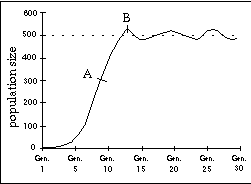
What is the carrying capacity of the graph?
around 500
more than 800
less than 300
around 700

A scientist was studying a population of fish in a pond over a period of 10 years. He observed that the population increased each year for 3 years, and then remained nearly constant for the rest of the study. The best explanation for this observation is that the population had
stopped reproducing
reached carrying capacity
mutated into a different species
run out of food and all died

Which group is not represented in the food web?
producers
primary consumers
secondary consumers
decomposers

What do the arrows in the food chain indicate about the flow of energy in an ecosystem?
Energy is continuously recycled by the organisms in an ecosystem.
Energy flows in one direction in an ecosystem, from producers to consumers.
More of the available energy in an ecosystem is given to large animals than to small animals.
Organisms at the end of the food chain receive more energy than those at the beginning.

In this energy pyramid, which organism would most likely be in level 2?
bird
fox
caterpillar
tree

How would the removal of earthworms from the food chain affect the other organisms?
The number of bass will increase.
The number of crayfish will decrease.
The crayfish will get their energy directly from the sun.
The number of bass and ospreys (bird) will increase.

The diagram shows part of an aquatic food web for a stable lake ecosystem in Connecticut. What is the source of energy for the algae?
waves
sunlight
bacteria
rotifers, water fleas and tadpoles

Suppose that a new predator of the rabbit migrated to this ecosystem. What is the most likely initial effect on the other organisms?
More competition among the mice for food
More competition among the hawks for food
Less competition among snakes for food
Less grass available for food

For the food chain shown, which of the following changes would have the most severe consequences?
a drastic decrease in rainfall, causing a drought
the poaching of predatory hawks by game hunters
the introduction of a second predator that eats field mice
a parasitic infestation that reduces the cricket population

The picture shows an energy pyramid. What will most likely happen to the foxes and the wolves if the rabbits are removed?
The foxes will eat more wolves.
The foxes will eat fewer wolves.
There will be more foxes and wolves.
There will be fewer foxes and wolves.
Which of these organisms would most likely be found at the top of an energy pyramid?
clams
sardines
sharks
kelp (seaweed)
A chemical pesticide was applied to an area of this ecosystem by a landowner to control the mouse population. There was a decrease in the mouse population due to the presence of this pesticide. Which one of the following would most likely occur due to this change in the ecosystem?
The amount of grass would decrease.
The snake population would increase.
The rabbit food supply would increase.
The snake food supply would increase.

