wayground logo

Free Printable Worksheets

NEW

Font size

S
M
L
XL
Worksheets

Electricity & Magnetism

Total questions: 72

Worksheet time: 1hrs 12mins

Name
Class
Date
1.
The force that pushes the electricity through a circuit is called...
a)
resistance
b)
voltage
c)
current
d)
switch
2.
The flow of electricity through a conductor is called...
a)
resistance
b)
voltage
c)
current
d)
source of electric current
3.
The best conductors for electricity are made of...
a)
wood
b)
plastic
c)
rubber
d)
metal
4.
This measures the speed of the current in a circuit
a)
voltage
b)
ammeter
c)
switch
d)
resistance
5.
What slows down the flow of electricity in a circuit?
a)
resistance
b)
voltage
c)
current
d)
source of electric current
6.
Which circuit (s) are parallel?
a)
A
b)
A and B
c)
B and C
d)
C
7.
Which one will still function if one light bulb goes out?
a)
A-Series
b)
B-Parallel
c)
A-Parallel
d)
B-Seriese
8.
Security alarms are made of _______ circuits because they turn on when the circuit is broken.
a)
Parallel
b)
Series 
c)
Fancy 
9.
If I add more light bulbs to a series circuit what happens?
a)
The current speeds up and the lights get brighter
b)
The current slows down and the lights dim lower
c)
The current speeds up and the lights dim lower
d)
The current slows down and the lights get brighter
10.
This circuit has more than one loop. When one light goes out, the others stay on. 
a)
closed circuit
b)
series circuit
c)
parallel circuit
d)
open circuit
11.
What kind of circuit is this?
a)
series
b)
parallel
12.
What type of circuit is show in the image?
a)
Series Circuit
b)
Parallel Circuit
13.
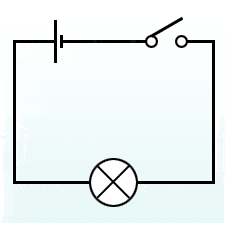
this circuit is .....?
a)
open
b)
parallel
c)
closed
d)
The cutest little circuit evah!
14.
When all parts of the circuit are connected it is a ______ circuit. 
a)
open
b)
closed
15.
When you flip a light switch on and off you are closing and opening a circuit.
a)
true
b)
false
16.
What is a Parallel circuit? 
a)
Has only one path 
b)
Has more than one path 
c)
Allows energy to travel through easily 
d)
Has only one light bulb
17.
Batteries convert what type of energy into electricity?
a)
Chemical energy
b)
Mechanical energy
c)
Both
d)
Kinetic energy
18.
If the current is going up on the front side of the coil then what side of the electromagnet is north?
a)
Up
b)
Down
c)
Left
d)
Right
19.

Using the right hand grip rule, A represents the direction of the

a)

current

b)

magnetic field

20.

Using the right hand rule, B represents the direction of the

a)

current

b)

magnetic field

21.
Ms Jo Jo rubbed two balloons with a piece of wool. What will happen when the balloons are brought near each other?
a)
The balloons will repel each other.
b)
The balloons will attract each other.
c)
The balloons will become positively (+) charged.
d)
The balloons will pop.
22.
What types of charges attract?
a)
Positive and Positive
b)
Positive and Neutral
c)
Negative and Neutral
d)
Positive and Negative
23.
What charge does an electron have?
a)
negative (-)
b)
positive (+)
c)
neutral or no charge (0)
24.
What charge does a proton have?
a)
negative (-)
b)
positive (+)
c)
neutral or no charge (0)
25.
What subject is attracted to a magnet?
a)
Silver
b)
Water
c)
Metal
d)
Iron
26.
What happens when two north poles of a magnet are placed together?
a)
they repel
b)
they attract
c)
they cancel each other out
d)
the strength of the magnet is doubled
27.
A north pole and a south pole will attract.
a)
True
b)
False
28.
True or False: All metals stick to magnets.
a)
True
b)
False
29.
Magnetism is a type of ____________
a)
force
b)
book
c)
plant
d)
animal
30.

A device that uses a free-moving magnetic needle to show direction is a:

a)

Lodestone

b)

Magnet

c)

Compass

d)

Magnetic field

31.

Where is the force of attraction the strongest on a magnet?

a)

At the poles.

b)

In the middle of the magnet.

c)

Above the magnet.

d)

Below the magnet.

32.

Why does a compass needle, point towards the north?

a)

The compass is a bar magnet.

b)

North is up.

c)

It deflects.

d)

It lines up with the Earth's magnetic field.

33.

The Earth is one big giant magnet.

a)

True

b)

False

34.

The space around a magnet is called its ____________.

a)

electrical field

b)

baseball field

c)

magnetic field

d)

soccer field

35.

Which statement is true?

a)

I. All electromagnets are permanent magnets.

b)

II. Increasing the number of coils in an electromagnet decreases it strength.

c)

III. Increasing the batteries increases the strength of an electromagnet.

d)

Both I and II

36.

Which can increase the strength of an electromagnet?

a)

increasing the number of coils around the nail

b)

increasing the number of batteries

c)

making the core bigger

d)

all of the above

37.

Which of the electromagnets would have the greatest magnetic field?

a)
b)
c)
d)
38.

It is a kind of magnet that works only when there is a flow of electricity.

a)

Electromagnet

b)

Bar Magnet

c)

Horse Shoe Magnet

d)

Magnetite

39.

Electromagnets are ___________________.

a)

permanent

b)

instant

c)

temporary

d)

stable

40.

The pattern of magnetic field depends on the shape of conductor.

a)

True

b)

False

41.

Direction of current in the wire is

a)

Upwards

b)

Downwards

42.

Diagram shows meyhod to determine magnetic pole around a

a)

Straight wire

b)

Coil

c)

Solenoid

43.

When number of turns in solenoid increase, electromagnetic strength ...

a)

Increase

b)

Decrease

44.

When more current flows in solenoid, strength of magnetic field ...

a)

Decrease

b)

Increase

45.

The components of an electromagnet are?

a)

a power source

b)

wire

c)

iron core

d)

all of these

46.

When the electric current in wire XY is in the direction shown, there is an upward force on the wire.

If the north and south poles of the magnet exchange positions, in which direction will the force on the wire act?

a)

downwards

b)

upwards

c)

to the left

d)

to the right

47.

A current-carrying coil in a magnetic field experiences a turning effect.

How can the turning effect be increased?

a)

increase the number of turns on the coil

b)

reduce the size of the current

c)

reverse the direction of the magnetic field

d)

use thinner wire for the coil

48.

The diagram shows a simple DC electric motor which is rotating.

Which change will make the motor rotate more quickly?

a)

reversing the polarity of the magnets

b)

reversing the battery

c)

removing the magnets

d)

using more powerful magnets

49.

A simple DC electric motor is fitted with a coil that rotates in a magnetic field. A commutator connects the power supply to the coil.

What is the purpose of the commutator?

a)

It converts AC into DC in the coil.

b)

It prevents the current from becoming too great, because the coil has a low resistance

c)

It reverses the direction of the current in the coil after every 180° rotation of the coil

d)

It switches the current off momentarily after every 90° rotation of the coil

50.

What does not alter the size of the turning effect on the coil of an electric motor?

a)

the strength of the magnetic field

b)

the direction of the current in the coil

c)

the number of turns in the coil

d)

the size of the current in the coil

51.
As the resistance in a circuit increases, the electric current __________.
a)
increases
b)
decreases
c)
stays the same
52.
Electricity is the flow of _________.
a)
protons
b)
neutrons
c)
electrons
53.

What would happen if in a circuit the voltage is increase?

a)

The time would increase

b)

The current would increase

c)

The current would decrease

d)

The current would stay the same

54.

What would happen if in a circuit, the resistance increases but the voltage stays the same?

a)

The current would decrease

b)

The current would increase

c)

The voltage would decrease

d)

The voltage would increase

55.

Why electrical wiring usually are covered with a layer of plastic?

a)

To make it look pretty

b)

To help electricity flow along the wire

c)

To make it safe

d)

To add more energy

56.

What unit is used to measure current?

a)

Ohms

b)

Omega

c)

Volts

d)

Amps

57.

What unit is used to measure resistance?

a)

Ohms

b)

Omega

c)

Volts

d)

Amps

58.

What is the resistance of a lightbulb that experiences 9 Volts and 3 amps of current?

a)

1/3 ohms

b)

3 ohms

c)

27 ohms

d)

9 ohms

59.

What is the voltage of a circuit with 4 ohms of resistance and 3 amps of current?

a)

12 V

b)

21 V

c)

4/3 V

d)

3/4 V

60.
What is the Voltage of a circuit that has a resistance of 5 Ω and a current of 2 A?
a)
25 V
b)
10 V
c)
2.5 V
d)
0.4 V
61.
The mathematical relationship among Voltage, Current, and Resistance
a)
Faraday's Law
b)
Tesla's Law
c)
Edison's Law
d)
Ohm's Law
62.

What is the formula for ohms law?

a)

1+2=3

b)

R X E = I

c)

V =I x R

d)

E= MC squared

63.

What unit is used to measure the voltage?

a)

Ohms

b)

Omega

c)

Volts

d)

Amps

64.

Voltage divided by Resistance

(V / R)

a)

Current

b)

Power

c)

Ohms

d)

Watts

65.
How many Volts would we need to produce a current flow of 8 Amps through a 6 Ohm resistor
a)
12 volts
b)
24 volts
c)
1.3333
d)
48 volts
66.
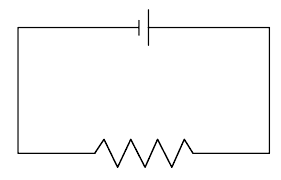
This circuit has a 24 volt battery and the resistor is 8 ohms. How many amps are running through the circuit?
a)
3 Amps
b)
192 Amps
c)
2 Amps
d)
4 Amps
67.
a)

Battery

b)

Lines

c)

Resistor

d)

bulb

68.
a)

resistor

b)

Ammeter

c)

Voltmeter

d)

Switch

69.
a)

Ampere

b)

Switch

c)

Bulb

d)

Battery

70.
a)

voltage

b)

Voltmeter

c)

Volume

71.
a)

Ammeter

b)

Ampere

c)

And

72.
a)

zig zag

b)

Resistor

c)

Ammeter