Worksheets
Practice Quizizz for Atoms, Elements, Periodic Table Test
Total questions: 70
Worksheet time: 1hrs 27mins
Which subatomic particle has a positive charge?
Proton
Neutron
Electron
Gluon
Which subatomic particle has no charge?
Proton
Neutron
Electron
Gluon
Which subatomic particle has a negative charge?
Proton
Neutron
Electron
Gluon
What holds the protons and neutrons together in the nucleus?
Gluon
Quark
Electron
Atom
This is the messenger particle of the strong nuclear force.
Proton
Neutron
Electron
Quark
What is the center of an atom called?
Nucleus
Electron cloud
Atomic mass unit
Average atomic mass
Where are electrons found in an atom?
Nucleus
Electron cloud
Atomic mass unit
Average atomic mass
What is the unit used to measure atomic mass?
AMU
ASM
AAM
MM
What is an atom or group of atoms that has the same number of protons but different numbers of neutrons called?
Ion
Isotope
Cation
Anion
What is a positively charged ion called?
Ion
Isotope
Cation
Anion
What is a negatively charged ion called?
Ion
Isotope
Cation
Anion
Which subatomic particle has a fractional charge? (bonus!)
Proton
Neutron
Electron
Quark
What are the particles that make up protons and neutrons?
Gluons
Quarks
Protons
Electrons
Which is a characteristic of nonmetals?
They have low density
They do not have luster
They are dull
They are ductile
Which is NOT a characteristic of metals?
They are brittle
They are ductile
Metalloids
Have properties of metals only
Have properties of metals and nonmetals
Do not conduct electricity
Are not ductile
Oxygen is a nonmetal. This means it
It is ductile
It is malleable
It is not conductive
It is shiny
Metals in general have
A high melting point
A low melting point
Nonmetals have
Low density
High density
When an atom gains electrons, it becomes
Positive
Negative
Neutral
When an atom loses electrons, it becomes
Positive
Negative
Neutral
To find the number of neutrons, you subtract
The atomic number from the mass number
The number of electrons from protons
The mass number from the atomic number
Nonmetals usually have
5 or more valence electrons
3 or fewer valence electrons
4 or more valence electrons
1 valence electron
The number of ______ determines the identity of the element.
Electrons
Protons
Gluons
Neutrons
You can change the number of protons and still have the same element.
True
False
You can change the number of neutrons and still have the same element.
True
False
You can change the number of electrons and still have the same element.
True
False
Using your periodic table, how many protons does carbon have?
6
12
4
1
Using your periodic table, how many valence electrons does carbon have?
1
6
12
4
Using your periodic table, how many electrons does a neutral atom of lithium have?
3
2
7
1
Using your periodic table, how many protons does oxygen have?
8
16
6
2
Using your periodic table, how many electrons does a neutral atom of potassium have?
19
39
2
1
Using your periodic table, how many valence electrons does an atom of potassium have?
2
1
39
19
I am a transition metal with 95 electrons.
Americium
Palladium
Gallium
Fermium
I am a member of the Nitrogen family with 16 neutrons.
Nitrogen
Arsenic
Gallium
Phosphorus
I am a noble gas with 4 energy levels.
Neon
Argon
Gallium
Krypton
The horizontal rows on the periodic table are called
levels
periods
groups
idks
The vertical columns on the periodic table are called
levels
periods
groups
idks
I am a transition metal with 91 protons and electrons.
protactinium
curium
terbium
erbium
I am a metalloid in the oxygen family with 5 energy levels.
Polonium
Sulfur
Tellurium
Selenium
I have seven energy levels, but only 1 valence electron.
Francium
Radium
Bismuth
Barium
I am a liquid metal with 80 electrons.
Gallium
Mercury
Lead
Barium
I have 1 valence electron in my 5th shell.
Lithium
Rubidium
Strontium
Magnesium
I am a halogen (halide) with 4 energy levels.
Bromine
Krypton
Arsenic
Germanium
I am in group 14 and have 3 energy levels.
Silicon
Germanium
Indium
Boron
How many energy levels does Radon have?
5
6
8
18
I have 26 protons, 26 electrons, and 30 neutrons.
Cobalt
Rhodium
Aluminium
Iron
I am a transition metal with 4 energy levels and an atomic mass of 48.
Cadmium
Germanium
Titanium
Vanadium
What is an atom or group of atoms that has lost or gained electrons and has a charge called?
isotope
ion
period
group
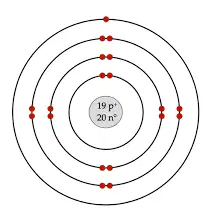
The following image is the planetary model of what element?
Oxygen
Calcium
Potassium
Magnesium
In a covalent bond, electrons are _________.
shared
given up
taken
disintegrated


The elements in Group 2 are classified as
metals
metalloids
nonmetals
noble gases
How do covalent bonds form?
Donating & receiving valence electrons between atoms
Oppositely charged ions attract each other & form bonds
Scientists are still not sure how they form
Sharing valence electrons between atoms

Chlorine is a diatomic element which means in nature, it is found in two's. (Cl2) Chlorine shares one pair of electrons to make sure each atom complete the octet rule. This creates a...
single bond
double bond
triple bond

What does this picture illustrate? (Select all that apply)
Sharing valence electrons
Covalent bonding
transferring valence electrons
ionic bonding
two nonmetals
Ca Cl
H H
Which part of the atom is responsible for chemical bonding?
Core Electrons
Valence Electrons
Protons
Neutrons