
 Worksheets
Unit 1 Test Review
Total questions: 79
Worksheet time: 43mins
Place the variables on the axis where they should be graphed:
Dependent Variable
Independent Variable
True or False: Scientific research contains biased data.
True
False
You are heating a piece of glass and now want to pick it up. You should
use a rag or paper towels
pick up the end that looks cooler
use tongs
pour cold water onit
Long hair in the laboratory must be
cut short
held away from the experiment with one hand
always neatly groomed
tied back or kept entirely out of the way with a hair band, hairpins, or other confining device
In the laboratory, the following should not be worn
loose clothing
dangling jewelery
sandals
all of the above
The following footwear is the best in the laboratory
sandals
open-toed shoes
closed-toe shoes
shoes appropriate for the weather
Horseplay or practical jokes in the laboratory are
always against the rules
okay
not dangerous
okay if you are working alone
When you finish working with chemicals, biological specimens, and other lab substances, always
treat your hands with skin lotion
wash your hands thoroughly with soap and water
wipe your hands on a towel
wipe your hands on your clothes
True or False: Laboratory work can be started immediately upon entering the laboratory even if the instructor is not yet present.
True
False
True or False: Never remove chemicals or other equipment from the laboratory.
True
False
True or False: Read all procedures thoroughly before entering the laboratory
True
False
True or False: It’s okay to pick up broken glass with your bare hands as long as the glass is placed in the trash.
True
False
True or False: Work areas should be kept clean and tidy.
True
False
True or False: Chipped or cracked glassware is okay to use.
True
False


When is it OK to eat or drink during a lab?
always
when my group is cleaning up
never
during lab procedures

These objects are called...?
metric ruler
Celsius thermometer
graduated cylinders
pan balances

beaker
graduated cylinder
test tube
metric ruler

What is this?
graduated cylinder
flask
test tube
beaker

Using your prefixes and suffixes, BIOLOGY can be defined as
science
subject in school
study of life
study of growth
The characteristics of life describe
Living Organisms
Nonliving Organisms

What characteristic is shown: A giraffe gives birth to a healthy calf
Reproduce
Genetic Code
Change Over Time
Acquire and Use Energy

Which characteristic is shown: An American alligator kills and eats a fish.
Change Over Time
Acquire and Use Energy
Grow and Develop
Made of Cells

Which characteristic is shown: A corn field absorbs sunlight to produce food.
Made of Cells
Respond to a Stimulus
Acquire and Use Energy
Genetic Code

Which characteristic is shown: A chocolate lab puppy becomes a fully grown dog.
Respond to a Stimulus
Grow and Develop
Homeostasis
Change Over Time

Which characteristic is shown: A tadpole grows legs and becomes a fully grown frog.
Homeostasis
Grow and Develop
Acquire and Use Energy
Change Over Time

Which characteristic is shown: A deer runs from a dog after hearing barking.
Made of Cells
Respond to a Stimulus
Acquire and Use Energy
Homeostasis

Which characteristic is shown: A plant switches position and follows the sunlight throughout the day.
Grow and Develop
Respond to a Stimulus
Acquire and Use Energy
Reproduce

Which characteristic is shown: Your body sweats to maintain body temperature.
Respond to a Stimulus
Homeostasis
Made of Cells
Change Over Time

Which characteristic is shown: Carbon Dioxide is used in your blood to maintain the blood pH.
Respond to a Stimulus
Homeostasis
Reproduce
Grow and Develop

Which characteristic is shown: A flower is shown to have a cell wall and other cellular organelles.
Made of Cells
Homeostasis
Respond to a Stimulus
Reproduce
Stimulus is
organisms that are made up of more than one cell
a membrane-covered structure that contains all of the materials necessary for life.
a change that affects the activity of an organism.
the maintenance of a stable internal environment.
Living things are based on a universal genetic
code. What molecule is responsible for that code?
RNA
Lipid
Protein
DNA
True or False: Living things must be multicellular.
True
False
True or False: Living things must contain all characteristics of life.
True
False
An observable fact or event used to ask questions that lead to scientific experiments or explorations
Phenomenon
Hypothesis
Stimuli
Observation


Which two types of substances make up the nucleus of an atom?
Electrons and Neutrons
Protons and Neutrons
Electrons and Protons
None of these
When an isotope is created, the number of which substance is changed?
Protons
Neutrons
Electrons
None of these
Label the parts of an atom
Electron
Neutron
Proton
Which type of chemical bonding SHARES electrons between elements?
Ionic bonding
Covalent bonding
Hydrogen bonding
Van der Waals forces
Which type of chemical bonding TAKES electrons between elements?
Ionic bonding
Covalent bonding
Hydrogen bonding
Van der Waals forces
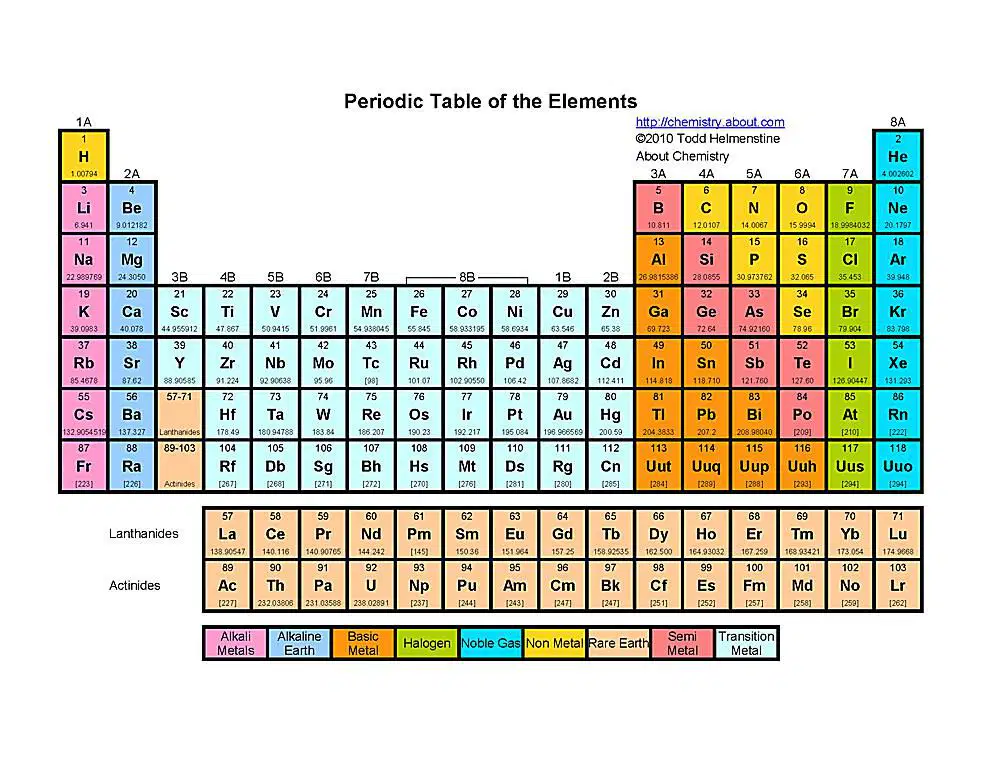
How many groups are on the Periodic Table?
7 groups
9 groups
16 groups
18 groups
Which property of water leads to an attraction between the SAME type of molecules?
Cohesion
Adhesion
Density
Solvency
Which property of water leads to an attraction between DIFFERENT types of molecules?
Cohesion
Adhesion
Density
Solvency
True or False: Ice is less dense than liquid water due to its crystalline structure.
True
False

On the pH scale, acids can be found at which end of the scale?
Lower numbers (0-6)
Middle numbers (7)
High numbers (8-14)
On the pH scale, bases can be found at which end of the scale?
Lower numbers (0-6)
Middle numbers (7)
High numbers (8-14)
Decide whether the following liquids are acids or bases:
Lemon juice
Tomato juice
Water
Vinegar
Bleach
Soap
Baking soda
Match the following macromolecules to their composition:
Carbohydrate
CHO
Lipid
CHO
Protein
CHON
Nucleic Acid
CHONP
(a) are simple monosaccharides, such as sugars and starches, that are made up of CHO
(a) are fatty acids, such as fats and oils, that are made up of CHO
(a) are amino acids held together by peptide bonds made of CHON
(a) are essential to cells and viruses to express genetic information, such as DNA
Match the following monomers to their polymers:
Carbohydrates
Monosaccharides
Lipids
N/A
Proteins
Amino acids
Nucleic Acids
Nucleotides
What is "a biological catalyst that speeds up the rate of chemical reactions in a cell"?
Protein
Lipid
Enzyme
Atom
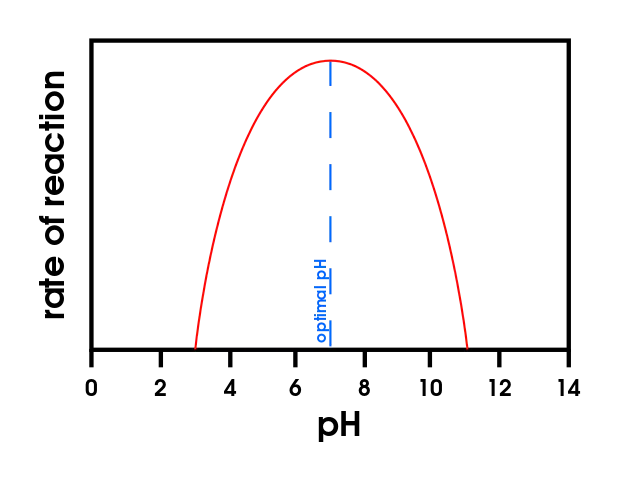
What is the optimal pH for this enzyme?
pH 3
pH 6
pH 7
pH 11
A non-competitive inhibitor will bond at which enzyme site to catalyze a reaction?
Active site
Allosteric site
A competitive inhibitor will bond at which enzyme site to catalyze a reaction?
Active site
Allosteric site

