
 Worksheets
8th Grade #1: Atoms & the Periodic Table
Total questions: 40
Worksheet time: 36mins

This symbol represents
proton
positive charge
electron
negative charge
neutron

This symbol represents
proton
positive charge
electron
negative charge
neutral charge

This symbol represents
neutron
neutral charge
electron
proton
positive charge
Why was it difficult for scientists to figure out that there were neutrons present in atoms?
neutrons have no charge, so they aren't influenced by other charged particles
neutrons and protons are mixed together in the nucleus, so it was hard to tell them apart
protons, neutrons, and electrons all act similarly, making it hard to tell them apart
neutrons are in the cloud surrounding the nucleus, so they are often too far away to study
How is the periodic table and a calendar similar?
They both have rows and columns.
They both have repeating events.
They have no predictable patterns,
They have the same shape.
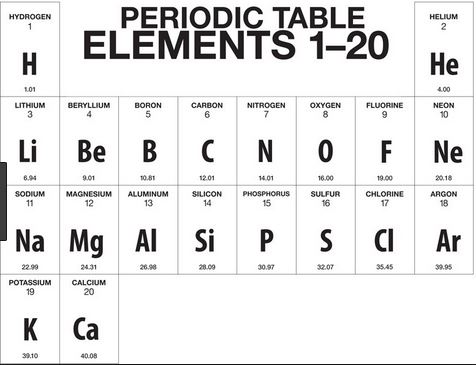
How many valence electrons does Hydrogen Have?
1 Valence electron
2 Valence electron
3 Valence electron
4 Valence electron
5 Valence electron
How many valence electrons does Helium Have?
1 Valence electron
2 Valence electron
3 Valence electron
4 Valence electron
5 Valence electron
How many valence electrons does Nitrogen Have?
1 Valence electron
2 Valence electron
3 Valence electron
4 Valence electron
5 Valence electron
How many valence electrons does Aluminum Have?
1 Valence electron
2 Valence electron
3 Valence electron
4 Valence electron
5 Valence electron
How many valence electrons does Argon Have?
4 Valence electron
5 Valence electron
6 Valence electron
7 Valence electron
8 Valence electron


The family in the periodic table that contains the most reactive metals is the_______
alkali metal
alkali earth metals
transition metals
group 1 metal
Metals like copper and iron are good for wires because they have high conductivity. They are classified as
transition metals
alkali metals
alkali earth metals
group 1 metals
Alkali metals like sodium would be bad for use in wires because
it is too reactive (KABOOM)
It is unreactive (BORING)
It is malleable (BENDY)
It is ductile (STRETCHY)

Which elements are colored red?
nonmetals
metals
metalloids

Which elements are to the right of the zig zag?
metals
nonmetals
metalloids
metalloids and nonmetals
Neon is colorless, a poor conductor of heat and is not able to be stretched. How would it be classified?
Nonmetal
Metalloid
Metal
None of the above
Manganese is shiny, conducts heat and electricity, and can be hammered into thin sheets. What is is?
Nonmetal
Metal
Metalloid
None of the above
Silicon has a dull, metallic luster, conducts heat well, and is brittle. What is it?
Nonmetal
Metal
Metalloid
None of the above

Metal
Nonmetal
Metalloid

Metal
Nonmetal
Metalloid

Metal
Nonmetal
Metalloid

Metal
Nonmetal
Metalloid

Metal
Nonmetal
Metalloid


Which elements are to the LEFT of the zigzag?
metals
nonmetals
metalloids
Acids have a pH of _______________.
below 7
above 7
exactly 7
Bases have a pH of _______________.
below 7
above 7
exactly 7
Neutral solutions have a pH of _______________.
below 7
above 7
exactly 7
Which one of the following is NOT a property of basic solutions?
Feels soapy/slippery
Tastes sour
Conducts electricity
Turns red litmus paper blue
Which one of the following is NOT a property of acids.
Tastes sour
Corrodes metals
Conduct electricity
Turns red litmus paper blue
Baking soda is an awesome ingredient in cake because
it causes an acid and a base to react
causes carbon dioxide gas to form
causes hydrogen gas to form
it causes and acid and a metal to react

How many neutrons would oxygen-16 have?
8
16
6
24
How many neutrons would oxygen-14 have?
8
16
6
24
how Rutherford discovered that the atom consists of a small, massive, positively charged nucleus
reading quantum mechanics books
by mixing substances
thanks to the The gold-foil experiment
exposing it to the heat
What did Ernest Rutherford’s gold foil experiment demonstrate about atoms?
Their positive charge is located in a small region that is called the nucleus.
Their negative charge is located in small particles that are called electrons.
Their nucleus makes up the majority of the volume of the atom.
Their electrons are floating in a sea of positive charges.
Which statement best summarizes the importance of Ernest Rutherford’s gold foil experiment?
It proved that all of John Dalton's postulates were true.
It verified J.J. Thomson's work on the atomic structure.
It showed that an electron circles a nucleus in a fixed-energy orbit.
It showed that a nucleus occupies a small part of the whole atom.
How could you tell what an element was?
Counting the number of electrons surrounding the nucleus
Counting the number of protons inside the nucleus
Counting the number of neutrons inside the nucleus
Adding the number of protons and electrons
Adding the number of protons and neutrons

