
 Worksheets
Rosedale Biology unit 3 QCE
Total questions: 89
Worksheet time: 1hrs 2mins
the study of the relationships among organisms and the environment.
(a)
it refers to the variety of life on Earth at all its levels, from genes to ecosystems, and can encompass the evolutionary, ecological, and cultural processes that sustain life.
(a)
Which of the following is an importance of biodiversity?
Allows ecosystems to adjust to disturbances
Provides a variety of food sources for organisms
Helps organisms adjust to changes in their environment
All of the above
A population is
a group of similar species in different areas
a group of the same species in the same geographic area.
a group of several species in the same geographic area
a group of several species along with their abiotic factors in a small area.

SDI = 1 − (N(N−1)Σn(n−1))
A field biologist noted the following numbers of each species in an area:
Species A - 3
Species B - 41
Species C - 13
Species D - 12
Calculate the SDI for the region using the formula above.
0.57
0.59
0.61
0.63
SDI takes into account which of the following indicators?
Species interactions and richness
Species richness and evenness
Species competition and evenness
Species evenness and species interactions
Which of the following is NOT a characteristic of an r strategist?
Rapid rate of reproduction
Low parental care
High mortality
Well suited to environments at carrying capacity
Identify the response that correctly states assumptions of cladistics:
Common ancestry, bifurcation and physical change
Common ancestry, bifurcation and DNA similarity
DNA similarity, common ancestry and physical change
Bifurcation, physical change and DNA similarity

The organism shown is produced as a result of mating between a Zebra and a Donkey. What is this organism an example of?
(a)
Which of the following is NOT a method used to measure biodiversity?
Species richness and evenness
Percentage cover
Percentage frequency
Species interactions

Which statement is correct based on the data above?
Air temperature reached a maximum of 300C
Water temperature never falls below 200C
Salinity was found to be at its highest on the 5th of August
Air temperature remained relatively stable

Identify the type of species interaction shown in the graph above
Predation
Mutualism
Competition
Commensalism
Which organisational unit is the largest?
Biosphere
Biome
Ecosystem
Community

Which abiotic factor is NOT shown on the image above?
Humidity
Temperature
Soil diameter
Altitude

Identify the ecosystem characterised by a bio-temperature of 50C, belonging to a 'humid' province:
Moist forest
Wet forest
Dry scrub
Steppe
To determine diversity of species using measures including:
species richness
species evenness
percentage cover
All of the above

What is the gradual, sequential, regrowth of a community?
Ecological succession
Biomes
Carrying capacity
Conservation

Large climatic regions with distinct plants and animals
Primary succession
Secondary succession
Pioneer species
Biomes
What is competition?
Organisms sharing resources.
Organisms fighting for resources.
Organisms producing resources.
How does Symbiosis occur?
Only between species.
Only between communities.
Between different species in a community.
Between different communities.

Remora fish stuck in the shark so they can travel over water. This represents:
Mutualism
Commensalism
Parasitism
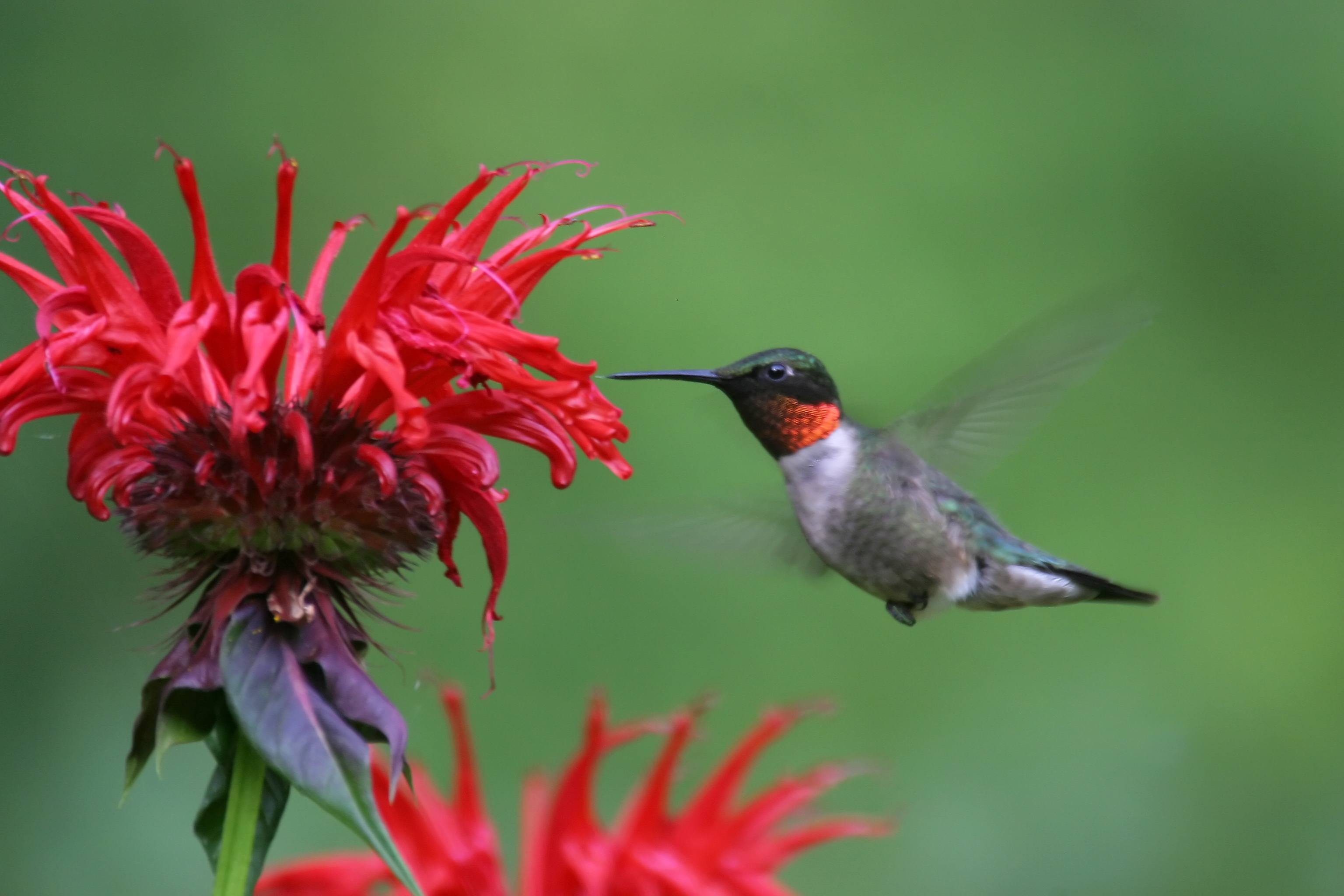

Termites are tiny insects that can cause severe damage to homes and other structures that consist of wood. Termites are an example of what type of factor?
Biotic
Abiotic

Air is a mixture of colorless gases. The air that makes up the Earth's atmosphere consists primarily of nitrogen and oxygen. Air is an example of which type of factor?
Biotic
Abiotic

All living things or organisms in an ecosystem are
Neither
Biotic Factors
Abiotic Factors
A(n) ______________ can be described as a group of individuals of the same species in a particular area.
interaction
survival
population
ecosystem
__________________ are abiotic and biotic factors that limit the growth of a population.
Carrying capacity
Environmental coefiicients
Limiting factors
Environmental pressures
Organisms and environment function as a unit in a(n) ________________.
ecosystem
species
community
population
The ________________ capacity of an environment is limited by the availability of biotic and abiotic resources.
external
carrying
limiting
interacting
____________________ is the struggle among organisms for resources such as food, water, and space.
crowding
predation
limitation
competition
Biotic factors include all of the following except -
parasitism.
feeding relationships.
predation.
climate.
Parasitism is considered a(n) -
abiotic factor.
carrying capacity.
nonessential factor.
biotic factor.
An abiotic factor is
Living
Non-living
Both
Neither

The science of describing, classifying, and naming living things is called:
Geology
Biology
Taxonomy
Chemistry

The scientific name for an organism is made from the:
class and family name
genus and species name
domain and kingdom name
kingdom and phylum name
Term given to describe the 2 part (name) naming system is:
dichotmous key
binomial nomenclature
2 scientific names
binomial key
Which levels of hierarchy form the scientific name?
Class and species
Order and genus
Phylum and species
Genus and species
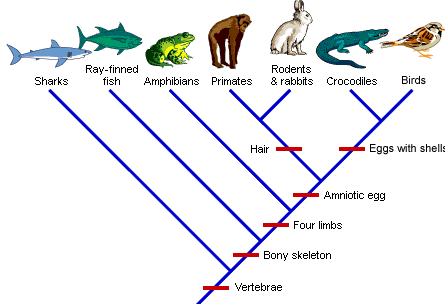
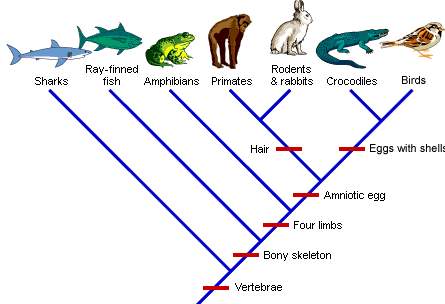
Which organisational tool links organisms by their common ancestor?
Dichotomous key
Cladogram
Canis lupus

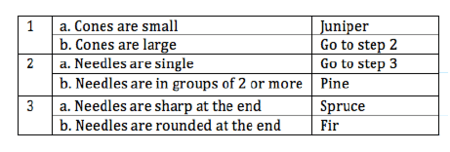


Which leaf is shown in the drawing?
Magnolia
Redbud
Sweetgum
None of the above
Which type of reproduction has the following benefits:
-relatively quick
-Low energy cost to parent
-good for non-mobile
sexual
asexual
Which type of reproduction has the following negative implications:
-must find a mate
-takes a longer time
-requires more energy
sexual
asexual
species possess relatively stable populations fluctuating near the carrying capacity of the environment
K selection
R selection
species whose populations are governed by their biotic potential (maximum reproductive capacity, )
k species
r species
when a structural instability in a system leads to a change in its dynamical form, that is, a change in the structure
binomial
bifurcation
bispecies
bimaximum
Speciation has definitely occurred when two groups of related organisms
cannot interbred successfully.
have drastically different behaviors.
have drastically different appearances.
become permanently isolated from each other.
Which of these best describes genetic drift?
the movement of alleles between population
random fluctuations in the gene frequencies within a population
a planned method to reduce the number of inferior genes in a population
the combining of alleles to create more genetic variations within a population
Which diagram is the most appropriate representation of gene flow?


A small group of individuals leave a larger population and colonize a new area that is physically separated from the original population. Due either to chance or genetic drift, the genetic composition of the new colony differs from the larger population. This is an example of
gene flow.
a founder event.
geographic isolation.
allopatric speciation.
Why does the definition of species being interbreeding, naturally individuals producing fertile off spring not always effective
it may take
not all offspring reproduce sexually
genetic testing can identify species that can interbreed but may not naturally interbreed due to changes in geography
all of the above.

You are researching reptiles and encounter two garter snakes on a hike. Both snakes are brown and white, but their patterns are slightly different. You bring them back to the lab for further study. What is the BEST way to determine if these two are the same species?
Their appearance - if they look similar, they must be the same species
Their adaptations - if they have the same traits, they must be the same species
A breeding experiment - if they are able to produce offspring, they must be the same species
DNA testing - if their DNA/genes are the same, they must be the same species
Members of the same species will always have a similar body appearance.
True
False
If two species breed and produce offspring, they may be
they will never produce offspring
infertile like a mule

Why is biodiversity in an ecosystem so important?
Because it can help humans where to determine good places to develop farm land.
Because places that have a healthy biodiversity are unaffected by major disturbances.
Because having a high biodiversity allows ecosystems to withstand major changes.
Because having a high biodiversity makes the ecosystem less stable.
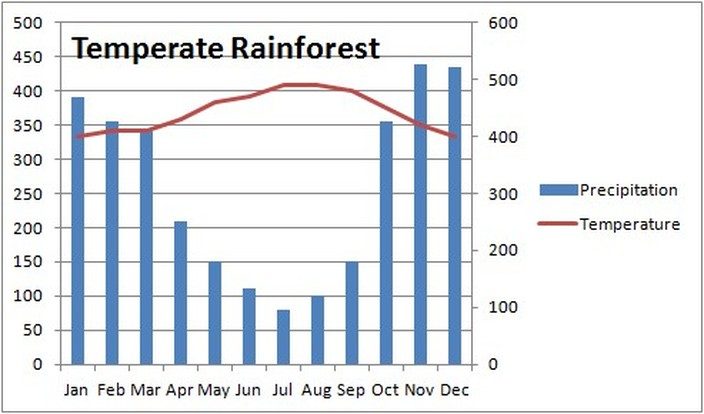
What is the difference in a microhabitat and a biome?
size
temperature
climate
precipitation
An ecosystem comprising the ENTIRE EARTH and the organisms that inhabit it.
Biosphere
Biome
Abiotic
Ecoregion
Maximum sustainable yield, ecosystem based management, and adaptive management are three approaches to
poaching
overharvesting
resource management
none of the above
Which of the following is NOT an ecosystem service?
Provisioning Services
Cultural Services
Regulating Services
Economic Services
Fruits, fish, and livestock are examples of which ecosystem service?
Regulating
Provisioning
Cultural
Supporting
Music, art, and architecture born from interactions with nature are examples of which ecosystem service?
Provisioning
Cultural
Regulating
Supporting
The number of different habitats available in a given area
Ecosystem diversity
Ecosystem services
Species diversity
Species services
The number of different species in an ecosystem
Species services
Species diversity
Habitat services
Habitat diversity
What is a square called that we use to sample populations?
grid
quadrat
cube
quarter
What type of population would you ESTIMATE using a quadrat?


Limpets were found in 25 out of 50 quadrats. What percentage of quadrats contained limpets?
100%
25%
50%
75%

These four 1m2 squared quadrats were place in a 8m2 garden. Estimate the total population of flowers in the whole garden.
16
17
8
40
20
Which organism can be measured with a quadrat?
lion
flies
rat
dandelion plants
fish
what is meant by structural adaptations?
these are ways that organisms behave
these are things that go on inside an organism's body
there are no such things as structural adaptations
these are features of an organism's body structure
These are used to study the distribution of organisms
microscopes
transects
measuring cylinders
quadrats
Why do scientists use sampling techniques to gather population data rather than counting everything?
scientists are lazy
sampling is more efficient and achievable
sampling is more accurate
scientists prefer estimations
sampling is cheaper

The graph shows that:
Pisaster causes a decline in species richness
Species richness declines when Pisaster is removed
Pisaster is a predator
There is a maximum of 20 species in this ecosystem
Habitat loss has a disproportionate effect on :
Endemic species
Specialist species
Species with large territories
All of the above
Which process removes carbon dioxide from the atmosphere?
deforestation
tree farms
burning fossil fuels
cellular respiration
Which statement is correct?
matter cycles; energy cycles
matter cycles; energy disintengrates
matter cycles; energy converts
matter converts; energy cycles
Which of the following is correct?
There is as much carbon on earth as when it was formed
Carbon is being created whenever it is recycled
Carbon is lost every time it is recycled
Carbon changes to different forms and is never recovered
What is the greatest contributor to atmospheric carbon?
burning garbage
burning biomass
transportation
household usage

