
 Worksheets
Biology Y9 Review Week 42
Total questions: 106
Worksheet time: 1hrs 3mins
The genotype for a yellow plant is...
Who is considered the "father" of modern genetics?
Einstein
Mendel
Disney
Washington
Which of the following alleles is homozygous (purebred) recessive?
TT
Tt
tt
ts

Genotype or Phenotype: Black hair
Phenotype
Genotype

In the punnett square below, what belongs in the missing square


What is the probability that the offspring will express the dominant trait?
25%
50%
75%
100%

How many alleles make up a simple genotype?
1
2
3
4

What is heridity?
A kind of genetic disorder
A trait you inherit from your parents
The way DNA divides
The passing down of traits from parents to children

A segment of DNA that codes for a trait
gene
chromosome
allele
chromatid

What is the missing pairing?
AA
Aa
aa
Polydactyly is caused by an allele which is
Dominant
Recessive
Cystic Fibrosis is caused by an allel which is
Dominant
Reccessive
Both parents have to carry the cystic fibrosis allele for you to inherit the disease
True
False
Which of the following is the correct definition for a phenotype?
The physical expression of a gene. (Characteristics)
A strand of DNA made up of multiple mutations.
The expression of one of your parents traits.
The set of genes in our DNA which is responsible for a particular trait.

Name the part at the star
pollen
ovary
petal
anther

Name the part at the star
filament
style
ovary
stigma

Name the part at the star
sepal
pollen
stigma
anther

Name the part at the star
stigma
style
ovary
ovules

Which ways can flowers spread pollen?
By insects
By wind
Self-pollination
All of the above

The flowers that need insects for pollination, why do they have colourful petals and sweet nectar?
To be colourful
To be beautiful
To attract insects
To make food
_________ reproduction involves 2 parent cells, a sperm and an egg.
Sexual
Asexual
______ reproduction involves 1 parent organism duplicating itself (copying)
Sexual
Asexual
Offspring are identical to the parent
Sexual
Asexual
Offspring are not identical to the parent, but contain genes from both
Sexual
Asexual
This type of reproduction produces offspring quicker.
Sexual
Asexual
This type of reproduction produces offspring that are unique or different from the parents and siblings
Sexual
Asexual
This type of reproduction requires more time and energy.
Sexual
Asexual

A clipping from a plant will become a new plant thanks to vegetative propagation.
Sexual
Asexual

Bacteria will produce offspring by dividing in half during binary fission.
Sexual
Asexual

Males will pass DNA to sperm cells, and females will pass their DNA to egg cells to produce an offspring.
Sexual
Asexual
Some advantages of sexual reproduction include: (select all that apply - there are 3)
genetic variation
improves chances of adapting to the environment
helps species survive catastrophes
it doesn't take as much energy as asexual reproduction
What are some advantages of asexual reproduction are: (select all that apply - there are 3)
it only requires one organism
it takes less energy than sexual reproduction
offspring are already well-adapted for the environment
there is a lot of genetic variety
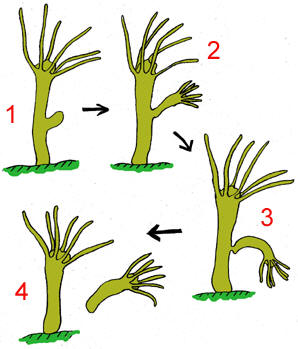
When an offspring grows off from the body of a parent organism it is called __________________.
budding
fission
fragmentation
sporulation

___________________ is a type of asexual reproduction in which a piece of a parent organism breaks off to form an new organism (ex. starfish).
fission
budding
fragmentation
fertiliztion
Male and female reproductive cells are collectively known as:
spores
pollen
gametes
offspring
Genetically identical offspring are _____________ the parent organism.
opposite of
clones of
superior to
inferior to
Selective breeding is...
a process to create an organism with desired traits from parents with those desired traits
natural method of producing offspring with desired traits
creating a new species
making organisms reproduce during times of stress
One problem with selective breeding is
creating a new species
gene variety is lost
new food sources
Problems with selective breeding include
Better animals
Increased meat production
Animals can have bad health problems
more diversity

Natural selection is where ___________ decides which traits should be passed on.
nature
a human
traits
evolution

How can farmers best use selective breeding to increase apple production?
By limiting the number of trees growing so they can have more space.
By choosing trees that are the largest in size.
By increasing the amount of water and fertilizer the trees receive.
By choosing trees that consistently have the most apples.

Problems with animals that are selectively bred include:
Being more disease resistant
Producing more meat
Being more likely to suffer from genetic disease
Being more genetically diverse
Which statement explains how a population’s genetic variability and diversity can be affected by selective breeding?
Genetic variability and diversity decrease because only select individuals are bred.
Genetic variability and diversity increase because only select individuals are bred.
Genetic variability increases and diversity decreases because only select individuals are bred.
Genetic variability decreases and diversity increases because only select individuals are bred.

What is genetic modification?
Organisms are chosen to be bred together based on beneficial genetic traits.
Seeds used for the next generation are chosen from plants with preferred traits.
Genes from one species are incorporated into the cells of completely unrelated species
Organisms with beneficial traits surviving and passing on those traits through reproduction.

Putting the gene for bioluminescence into a non-bioluminescent fish is an example of...
Natural Selection
Genetic Engineering

Which of the following is an example of selective breeding?
A fire kills off half of an orchard. The remaining plants are bred to produce seeds to replace the lost crop.
A bee keeper places his hives near orange blossoms to influence the taste of the honey that the bees produce.
Farmers grow square shaped watermelons to sell as a novelty by growing them in box shaped molds.
Sheep farmers want the animals to produce more wool, so they breed the sheep with the thickest wool.

Through genetic modification, scientists have been able to produce goats whose milk contains proteins that can be used in medicines. Which of the following is most likely to produce this effect?
Mixing the foreign genes into containers of goat’s milk.
Inserting the foreign genes into fertilized goat eggs.
Selectively breeding for goats that eat this protein.
Changing the nutritional needs of the goats’ offspring.

Which of the following correctly compare selective breeding and genetic modification?
Genetic modification involves the transfer of genes from one organism to another and selective breeding is choosing parents within the same species to mate together.
Genetic modification involves human intervention but selective breeding does not involve human intervention.
Genetic modification is choosing seeds with preferred genetic traits to be grown and selective breeding is picking preferred genes to be implanted within a bred offspring.
Genetic modification is safe for organisms but selective breeding produces crops that can be unhealthy to eat.
What is the continued breeding of individuals with similar characteristics.
Hybridization
Inbreeding
Systematic Breeding
Focused Breeding


What is most likely to happen to moth populations in the picture shown?
Light moths--hunted easily, dark moths--population increase
Dark moths--hunted easily, dark moths--population increase
Light moths--hunted easily, light moths--population increase
Lights moths will change their color to match dark moths.
According to Darwin, organisms that are best adapted to their environment are more likely to produce offspring than organisms that are less well adapted to their environment. Which phrase is used to summarize this idea?
species variability
survival of the fittest
use and disuse of organs
evolution through mutation

Which coat color provided the BEST protection from predators?
red
black
white
red striped

Darwin hypothesized that there are definite steps to natural selection. Consider the model of bacterial resistance to antibiotics. Use the Roman numerals (I - III) to guide you through the steps to describe how Darwin would explain antibiotic resistance.
There is a change in the environment: an antibiotic is added. Some of the bacteria adapt to the new environment. They survive and reproduce.
In any population, variation exists. Some bacteria are resistant to antibiotics. Most bacteria die, but the bacteria that are resistant survive and reproduce.
Sexual reproduction of bacteria cause variation. Some bacteria survive antibiotics and some do not. Regardless, over time all of the bacteria should become extinct.
In a population of bacteria that are exposed to antibiotics, some bacteria are able to change their genetic make-up and survive. The new genotype is passed on to offspring.

Bats are common in Texas, especially in rocky regions. Bats with longer hang claws have demonstrated higher fitness because of their ability to cling to rock while resting. This adaptation is becoming more frequent in the population. What mechanism of evolution is this?
Natural Selection
Non-random mating
Gene Flow
Genetic Drift
Which sequence represents increasing levels of organization in the human body?
organ → organ system → cell → tissue
organ → cell → organ system → tissue
cell → tissue → organ → organ system
cell → organ → tissue → organ system

According to the Punnett Square, what is the probability of an offspring being white?

The greenhouse effect is caused by
more heat arriving at the Earth from the sun
the Earth releasing more heat at night
gases in the air trapping heat released by the Earth

The graph shows us that
the earth temperature is always increasing
the earth's temperature has steadily increased since 1900
the earth's temperature has steadily rising since the 1960s
the earth's temperature decreased during the 19th and 20th centuries
Which of the following are greenhouse gases?
Carbon Dioxide
Methane
Both of these
What do greenhouse gases do?
Reflect the sun's energy
Block the sun's infrared radiation
Act as a thermal blanket for the Earth, absorbing heat and warming the surface
They help light up the moon at night
What does monoculture mean?
A game to acquire as much money and property as possible
The growing of multiple crops in one particular area
The growing of multiple types of animals in one particular area
The growing of a single crop in one particular area

What best describes the image?
Monoculture
Biodiversity
The growing of multiple types of crop in one particular area
Industrial agriculture

Asexual reproduction requires
Two parents
Only one parent

New clonal polyps develop on, then break off their parent and eventually form new colonies, is an example of which type of asexual reproduction...
Vegetative
Binary fission
Fragmentation
Parthenogenesis
Budding

A flatworm is cut in half and grows into two flatworms, is an example of which type of asexual reproduction...
Vegetative
Binary fissioin
Fragmentation
Parthenogenesis
Sporogenesis

An amoeba replicates its genetic material and divides into 2 identical daughter cells is an example of which type of asexual reproduction...
Vegetative
Binary fission
Fragmentation
Parthenogenesis
Sporogenesis

The common asexual method of reproduction by hydras is called?
Vegetative
Binary fission
Budding
Fragmentation
Parthenogenesis

Which of the following is an advantage of asexual reproduction?
There is greater genetic diversity in offspring.
There is a longer development time for offspring.
There is more food available for offspring.
There is a greater number of offspring.

___________ reproduction has the advantage of increasing genetic variation.
Sexual
Asexual
Fission
Budding
Sex cells have ____________ of the DNA found in body cells.
all
none
half
a little bit
Identify the antibiotic
Paracetamol
Statins
Penicillin
Aspirin
Identify the disease that could be treated with an antibiotic.
Common cold
Chicken pox
Tuberculosis
Measles


Inflammation....
Is caused by too many white blood cells in one affected area
Can be shown by pus
Is the body's response to infection
Arises when a pathogen leaves the body
Identify the part of the body that contains adult stem cells that can divide and differentiate into blood cells
Liver
Heart
Bone marrow
Pancreas
Where usually mangrove can be found?
Desert
Tropical rainforest
Near volcano
Near the river bank
Mangrove forests are home for...
crab
shrimp
shells
fishes
mollusk species
What photos are the Mangroves tree?


Salinity means the level of _______________in the water.
oxygen
salt
nitrogen
salcite
mangrove tree
producer
consumer
herbivore
carnivore

