wayground logo

Free Printable Worksheets

Font size

S
M
L
XL
Worksheets

U1- Introduction to Science

Total questions: 124

Worksheet time: 2hrs 28mins

Name
Class
Date
1.
A possible explanation to a problem that has not yet been tested. 
a)
data
b)
theory
c)
hypothesis
d)
fact
2.
The summary at the end of an experiment that explains the results. 
a)
conclusion
b)
procedures
c)
materials
d)
responding variable
3.

What is an observation?

a)

A scientific statement based on ideas

b)

Using your senses to notice what is going on around you

c)

To be unaware of your surroundings

d)

The question that you want an answer to.

4.
A series of steps used by scientists to solve a problem or answer a question. 
a)
scientific method
b)
recipe
c)
data collection
d)
metric system
5.
Which is NOT a step in the scientific method?
a)
Make observation
b)
Form a theory
c)
Collect data
d)
Form a hypothesis
6.
A hypothesis is simply a prediction that has not yet been _.
a)
proven or disproven
b)
made into a theory
c)
results calculated
d)
written about
7.
Should experiments be repeated over and over to see if the results are the same each time?
a)
yes
b)
no
8.
Testing a hypothesis often involves a(n):
a)
answer
b)
experiment
c)
problem
d)
safety check
9.

The information you collect while doing your experiment is called

a)

conclusions

b)

data

c)

hypotheses

d)

procedures

10.

Something that you keep the same in an experiment is called a(n) _________________________.

a)

variable

b)

control

c)

procedure

d)

conclusion

11.

I want to know if low strength bleach, medium strength bleach, or maximum strength bleach will get Heinz ketchup stains out of white T-shirts the best. What is the variable in this experiment?

a)

the type of stain

b)

the strength of the bleach

c)

the color of shirt

d)

the brand of ketchup

12.

What is an independent variable?

a)

What a scientist changes in an experiment to test their hypothesis

b)

What scientist measure to see if it responded to a change

c)

What happens when you do an experiment

d)

What you keep the same throughout all experimental groups

13.
The variable the is changed on purpose is..
a)
Constant
b)
Control
c)
Independent Variable
d)
Dependent Variable
14.
The variable that is being tested, counted, or measured and is responding to the independent variable is known as 
a)
Control
b)
Constant
c)
Independent Variable
d)
Dependent Variable
15.
Which brand of paper towel will absorb the most liquid? What is the dependent variable?
a)
brand of paper towel
b)
amount of water absorbed
16.
Which brand of paper towel will absorb the most liquid? What is the independent variable?
a)
Brand of paper towel
b)
Amount of water absorbed
17.

Angel wants to know if the type of soap has an effect on how clean her clothes get. What is the independent variable?

a)

type of soap

b)

how long the laundry takes

18.

Angel wants to know if the type of soap has an effect on how clean her clothes get. What is the dependent variable?

a)

type of soap

b)

how clean the clothes are

19.

Zach wants to determine if the amount of time spent on social media has an effect of grades. What is the independent variable?

a)

time on social media

b)

computer skills

20.

Zach wants to determine if the amount of time spent on social media has an effect of grades. What is the dependent variable?

a)

popularity

b)

grades

21.

Maddie wants to determine if the weight of the dog will determine the number of puppies in a litter. What is the independent variable?

a)

weight of dog

b)

number of puppies

22.

Maddies wants to determine if the weight of the dog will determine the number of puppies in a litter. What is the dependent variable?

a)

type of dog

b)

number of puppies

23.

Beth wants to know if increasing her exercise will decrease the time it takes her to run a mile. What is the dependent variable?

a)

time to run a mile

b)

amount of exercise

24.

Beth wants to know if increasing her exercise will decrease the time it takes her to run a mile. What is the independent variable?

a)

distance

b)

amount of exercise

25.

Julie wants to know the effect of studying 10 minutes extra each day on her Math. What is the dependent variable?

a)

her math grade

b)

studying 10 extra minutes

26.
How many total people took the survey?
a)
50
b)
150
c)
100
d)
200
27.
To find the average of a set of numbers, add up all the items and divide by...
a)
2
b)
The minimum
c)
The maximum
d)
The number of items
28.
What was the total amount of candy sold during the school year shown in the graph?
a)
43
b)
35.5
c)
23
d)
27.5
29.
What was the difference between Hannah's rehearsal time on Monday and Tuesday?
a)
0
b)
50
c)
30
d)
80
30.
In August, how many metric tons did Clark's Paper Mill and Tyler Paper Mill produce all together?
a)
10
b)
70
c)
80
d)
90
31.
Which is NOT a system rule?
a)
Systems have parts which have functions.
b)
Systems have a function as a whole.
c)
Systems are always small.
d)
Systems are related to other systems.
32.

Convert 62 miles/hour to feet/second

a)

5,456 feet/second

b)

0.003 feet/second

c)

90.9 feet/second

d)

909 feet/second

33.

How many millimeters are in 65.4 centimeter

a)

254ml

b)

654ml

c)

365ml

d)

456ml

34.

How many minutes are in four hours?

a)

175min

b)

280min

c)

240min

d)

325min

35.

Chase measured a piece of trim for his house. It is 500 millimeters long. How many centimeters is the trim?

a)

45cm

b)

62cm

c)

75cm

d)

50cm

36.

Convert 2087 feet per second to kilometers per hour. Given that 1000𝑚=1𝑘𝑚 and 0.0254𝑚=1𝑖𝑛.

a)

1356.51km/hr

b)

2,290.02km/hr

c)

5,463.07km/hr

d)

1,636.58km/hr

37.

Convert 75mph to feet per second.

a)

225ft/s

b)

150ft/s

c)

110ft/s

d)

182ft/s

38.

Convert 20 gallons per minute to milliliters per second. Given that there are 3785.41 milliliters in a gallon.

a)

1,261.80ml/s

b)

1,674.56ml/s

c)

1,439.70ml/s

d)

1,763.80ml/s

39.

You have a faucet in your bathroom that is leaking. You estimate that it is dripping every 3 seconds. How much does it drip in a week?

a)

105,300drops/wk

b)

302,600drops/wk

c)

201,600drops/wk

d)

204,600drops/wk

40.

Convert 872 mm to m.

a)

0.872m

b)

0.0872m

c)

8.72m

d)

0.8721m

41.

If 1 mile = 1.6km, convert 42km to miles.

a)

26.205mi

b)

2.625mi

c)

26.25km

d)

26.25mi

42.
A scientist is performing an experiment to determine the melting point of a new substance. Which action could increase the likelihood of obtaining accurate results? 
a)
repeating the experiment three times
b)
experimenting with multiple substances
c)
writing out the procedure after the experiment
d)
using three types of thermometers
43.
How does repeating an expirement improve the likelihood of obtaining accurate results?
a)
data can be compared
b)
time can be decreased
c)
equipment can be added
d)
procedures can be changed
44.
Science is ________________ because it is based on using prior knowledge to fortell the expected results of an event, such as an experiment or study.
a)
natural
b)
testable
c)
predictable
d)
tentativeness
45.
Which of the following is not an observation?
a)
Desirie used a thermometer to observe the temperature of the water.
b)
Jose believes that he remembers having seen a chupacabra (legendary creature) when he was a little boy.
c)
Pedro was looking at the bread and saw there was moisture in the bag.
d)
Michael could feel that the unknown substance was very rough. 
46.
As technology continues to improve, our understanding of science improves, because more advanced tools allow us to make better observations of the natural world.
a)
True
b)
False
47.
Science or Pseudoscience:  Personal bias and the opinion of the scientist.
a)
Science
b)
Pseudoscience
48.
A scientific theory...
a)
is based on lots of evidence
b)
is not valid
c)
is not reliable
d)
has not been tested many times
49.
A scientific theory is not necessarily accepted as a scientific truth.
a)
True
b)
False
50.
A set of principles that explains and predicts a phenomena is called a _____. 
a)
scientific law
b)
scientific method
c)
scientific theory
d)
scientific instructor
51.
A set of principles that explains and predicts a phenomena is called a _____. 
a)
scientific law
b)
scientific method
c)
scientific theory
d)
scientific instructor
52.
A scientific ____________ is a broad explanation for events that is widely accepted as true.
a)
law
b)
theory
c)
observation
d)
method
53.
A scientific ____________ is a statement that describes what always happens under certain conditions in nature.
a)
law
b)
theory
c)
method
d)
variable
54.
What is a law?
a)
Describes what happens
b)
Explains a process
55.

Theory or law: Atomic _____ of matter: all matter is made up of atoms. Explains why matter behaves a certain way.

a)

Theory

b)

Law

56.

Theory or Law? Tectonic ________ of Geology: the surface of the earth is made of tectonic plates, which move slowly. Explains why mountains are formed, earthquakes happen, etc.

a)

Theory

b)

Law

57.

Which example shows CAUSATION? (Which one CAUSED the other to happen.)

a)

High social media usage and reduced grades.

b)

Car ran out of gas and being stranded on the side of the road.

c)

Recess time and number of friends.

58.

Which example shows CAUSATION? (Which one CAUSED the other to happen.)

a)

Rainfall and time spent reading.

b)

Eating more butter and increased divorce rates.

c)

It started raining and the baseball game was delayed.

59.

Which example shows CORRELATION? (The events show correlation, but one thing does NOT cause the other thing to happen.)

a)

I put water in the freezer and now I have ice.

b)

The alarm clock went off and I woke up.

c)

Temperature and the amount of people at the beach.

60.

Which example shows a CORRELATION? (The events show correlation, but one thing does NOT cause the other thing to happen.)

a)

It rained and the ground is wet.

b)

Ice cream sales increase as temperature increases.

61.

Loops that cause a response to build up and build up until something big happens are called ____________ loops

a)

positive

b)

negative

62.

The heater kicks on and the house warms up, so it kicks off. Then the house cools a bit and the heater kicks back on. This continues all day. It's a _____________ loop.

a)

positive

b)

negative

63.

Body temperature regulation is an example of a ______________ loop

a)

positive

b)

negative

64.

In a positive feedback loop, each action creates a consequence that _____________________ the other action.

a)

decreases

b)

has no effect on

c)

amplifies

65.

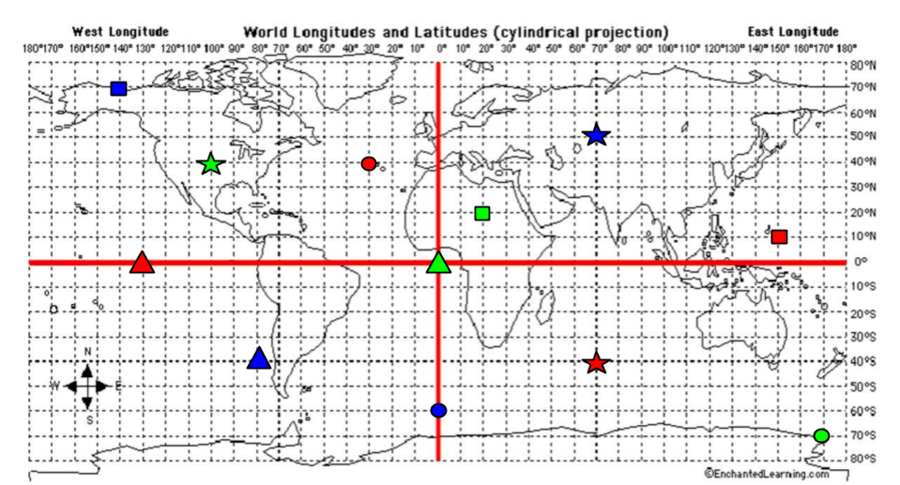
What are the coordinates for the RED star?

a)

40*S, 70*E

b)

40*N, 30*W

c)

0*, 130*W

d)

10*N, 150*E

66.

What are the coordinates for the RED Square?

a)

40*S, 70*E

b)

40*N, 30*W

c)

0*, 130*W

d)

10*N, 150*E

67.
What city is located at 32 degrees south and 150 degrees east?
a)
Shanghai
b)
Sydney
c)
Durban
d)
Calcutta 
68.
Which city is located at 38 degrees north and 120 degrees west?
a)
San Fransisco 
b)
New York
c)
New Orleans
d)
London
69.
Which continent is located completely north of the Equator and west of the Prime Meridian?
a)
Asia
b)
Europe
c)
North America 
d)
South America
70.
Which continent is completely south of the Equator and east of the Prime Meridian?
a)
Antartica 
b)
South America
c)
North America 
d)
Australia 
71.
What are the coordinates for the city of New Orleans? 
a)
30 degrees north and 90 degrees west
b)
60 degrees north and 30 degrees east
c)
30 degrees north and 120 degrees east
d)
35 degrees north and 70 degrees west
72.
If you were at 30 degrees south and 60 degrees west, which continent would you be in?
a)
Europe
b)
Africa
c)
South America
d)
Australia 
73.
If you were located at 30 degrees south and 90 degress east, what ocean would you be in?
a)
Indian Ocean
b)
Atlantic Ocean
c)
Arctic Ocean
d)
Pacific Ocean
74.
To locate the exact places on Earth, one must look at: 
a)
latitude lines only
b)
the intersecting lines of latitude and longitude
c)
longitude lines only
d)
a neighboring area to describe the location
75.
Latitude on a globe run from: 
a)
north to south
b)
north to west
c)
east to south
d)
east to west
76.
Which lines run on a globe from east to west? 
a)
longitude lines
b)
latitude lines
c)
north pole
d)
south pole
77.
On a globe, or map, the Equator is:
a)
The Horizontal, center line
b)
The Vertical, center line
c)
30 degree line
d)
The North Pole
78.
Coordinates can be written like this:
a)
20 degrees south, 140 degrees west
b)
40 degrees north, 120 degrees west
c)
20 degrees south, 160 degrees east
d)
all of the above
79.
What is the name of this line at 0 degrees latitude?
a)
Prime Meridian
b)
Equator
c)
North Pole
d)
South Pole
80.
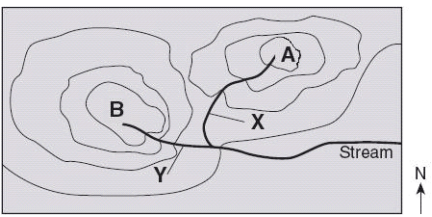
Which direction is the stream flowing?
a)
northward
b)
southward
c)
westward
d)
eastward
81.
How many peaks are on the map? (hill tops)
a)
4
b)
3
c)
2
d)
1
82.
It is steep on a topographic map where __________.
a)
lines are closest together
b)
a river flows into a lake
c)
contours bend
d)
contours are far apart
83.
What are the darker lines called?
a)
roads
b)
index contour
c)
contour interval
d)
waves
84.
Determine the contour interval:
a)
5 m
b)
10 m
c)
15 m
d)
20 m
85.
If we were in a plane, Path B --> C is about the same distance as path E --> N. But, which path is the easier walk? 
a)
B --> C is the easier walk
b)
E --> N is the easier walk
c)
B --> C and E --> N are the same walking distance
86.
What is the contour interval of the topographic map below?
a)
400 m
b)
200 m
c)
100 m
d)
80 m
87.
When you move from one contour line to another, the elevation
a)
stays the same
b)
goes up or down
c)
disappears
d)
is below sea level
88.
If contour lines are close together, then the slope is
a)
gentle
b)
steep
c)
flat
d)
going up and down
89.
The height above sea level is called
a)
topographic
b)
contour
c)
elevation
d)
depth
90.

Match the topographic map to its profile.

a)
b)
c)
d)
91.

Match the topographic map to its profile picture.

a)
b)
c)
d)
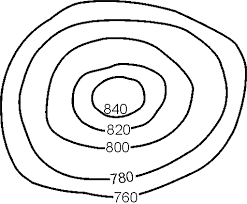
92.
What is the elevation of point B?
a)
800 ft
b)
850 ft
c)
900 ft
d)
1000 ft
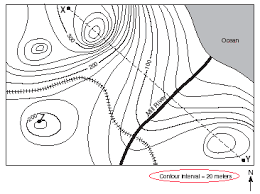
93.
What is the difference in elevation between Point X and Point Y?
a)
120 m
b)
240 m
c)
360 m
d)
340 m
94.
Which sphere would satellites orbit the Earth?
a)
atmosphere
b)
hydrosphere
c)
hydrosphere
d)
cryosphere
95.
Which spheres would feel volcanic eruptions and earthquakes?
a)
geosphere and hydrosphere
b)
geosphere and mesosphere
c)
stratosphere and hydrosphere
d)
stratosphere and thermosphere
96.
Which part of the Earth's water cycle adds vapor to the atmosphere?
a)
precipitation
b)
runoff
c)
condensation
d)
evaporation
97.
Which spheres would feel volcanic eruptions and earthquakes?
a)
geosphere and hydrosphere
b)
geosphere and mesosphere
c)
stratosphere and hydrosphere
d)
stratosphere and thermosphere
98.
Which part of the Earth's water cycle adds vapor to the atmosphere?
a)
precipitation
b)
runoff
c)
condensation
d)
evaporation
99.
This sphere includes the continents, the ocean floor, all the rocks on the surface, and all of the sand in the deserts. 
a)
Hydrosphere 
b)
Biosphere 
c)
Atmosphere 
d)
Geosphere 
100.
Bio = 
a)
Earth
b)
Sphere
c)
Life
d)
Water
101.
This system is made up of all the water on or near the earth's surface
a)
Hydrosphere 
b)
Biosphere 
c)
Atmosphere 
d)
Geosphere 
102.
The four spheres of Earth...
a)
are all connected
b)
have nothing to do with one another
c)
exist on Venus and Mars
d)
don't affect human life
103.
The body of gases surrounding Earth is the...
a)
Hydrosphere 
b)
Biosphere 
c)
Atmosphere 
d)
Geosphere 
104.
Animals, forests, grasslands, and trees all belong to which sphere?
a)
Atmosphere
b)
Biosphere
c)
Lithosphere
d)
Hydrosphere
105.
When plants draw nutrients from the soil, the interaction is between which two spheres? 
a)
The atmosphere and the geosphere 
b)
The geosphere and the hydrosphere 
c)
The hydrosphere and atmosphere 
d)
The biosphere and the geosphere 
106.
This picture best describes which connection?
a)
Atmosphere-Biosphere
b)
Hydrosphere-Atmosphere
c)
Hydrosphere-Geosphere
d)
Geosphere-Biosphere
107.
This picture shows
a)
Atmosphere
b)
Biosphere
c)
Hydrosphere
d)
Geosphere
108.
This volcano is an example of something you would find in the:
a)
Atmosphere
b)
Biosphere
c)
Hydrosphere
d)
Geosphere
109.
Animals, forests, grasslands, and trees all belong to which sphere?
a)
Atmosphere
b)
Biosphere
c)
Lithosphere
d)
Hydrosphere
110.
Animals, forests, grasslands, and trees all belong to which sphere?
a)
Atmosphere
b)
Biosphere
c)
Lithosphere
d)
Hydrosphere
111.
This sphere includes the continents, the ocean floor, all the rocks on the surface, and all of the sand in the deserts. 
a)
Hydrosphere 
b)
Biosphere 
c)
Atmosphere 
d)
Geosphere 
112.

What component of the cryosphere is represented in the image below?

a)

Frozen ground

b)

Sea Ice

c)

Glacier

d)

Iceberg

113.
Magnetism is a type of ____________
a)
force
b)
book
c)
plant
d)
animal
114.
Which of these materials will a Magnet Attract?
a)
Plastic
b)
Iron
c)
Rubber
d)
Wood
115.
A magnet cannot not move which of the following objects?
a)
a paper clip
b)
a nail
c)
a toothpick
d)
a staple
116.

The strongest parts of the magnet are ...

a)

fronts

b)

backs

c)

poles

d)

middle

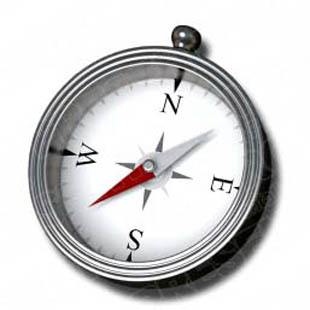
117.
An instrument used to tell direction is called a _______________________ (shown in the picture)
a)
direction finder
b)
guide
c)
compass
d)
gps
118.
The needle of a compass always points _________________________.
a)
at the equator
b)
North
c)
South
d)
What's a compass?
119.

Which direction is missing?

a)

North

b)

East

c)

Southeast

d)

South

120.

The earth has one magnetic pole.

a)

true

b)

false

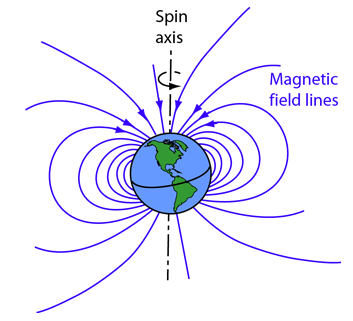
121.

Earth is like a giant magnet due to....

a)

its liquid iron core

b)

the wind patterns of Coriolis Effect

c)

the alignment of the continents

d)

solar particles moving through the atmosphere

122.

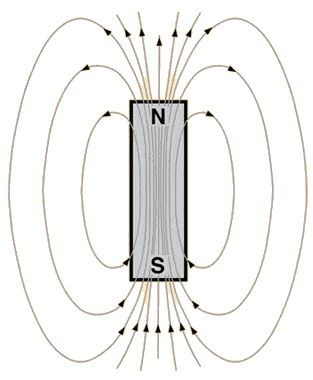
What is the shape of a magnetic field around the Earth?
a)
b)
c)
d)
123.

What word means to make a complete spin on an axis?

a)

Orbit

b)

Double Mint

c)

Rotation

d)

Root words

124.

What is the name of the star at the center of the solar system that supplies heat and light to earth?

a)

Sun

b)

Earth

c)

Mars

d)

Thanks