Wayground logo

Free Printable Worksheets

Font size

S
M
L
XL
Worksheets

Formative Assessment Electricity

Total questions: 97

Worksheet time: 2hrs 35mins

Name
Class
Date
1.
What subatomic particles would you find in the nucleus of an atom?
a)
Protons only
b)
Protons and Neutrons
c)
Neutrons and Electrons
d)
Protons and Electrons 
2.
Protons and Electrons balance the charge of an atom.
a)
True
b)
False
3.
Electric charges that are different _______ each other.
a)
Attract
b)
Repel
4.
Electric charges that are alike _______ each other.
a)
Attract
b)
Repel
5.
What charge does a proton have?
a)
negative (-)
b)
positive (+)
c)
neutral or no charge (0)
6.
What charge does a proton have?
a)
negative (-)
b)
positive (+)
c)
neutral or no charge (0)
7.
If a substance has a higher number of electrons than protons on its surface, what type of charge does it have?
a)
A positive charge.
b)
A negative charge.
c)
A neutral charge
d)
No charge at all
8.

Which of these is the electron?

a)

A

b)

B

c)

C

9.

The electric field lines for a positive charge is always directed away from the charge. True or False?

a)

True

b)

False

10.

Electric force is directly proportional to the magnitude charge and inversely proportional to the distance. True or False?

a)

True

b)

False

11.

The S.I. unit for electric field is__________?

a)

Coulomb

b)

Newtons

c)

Kilogram

d)

Seconds

12.

Which of the following is an insulator?

a)

copper

b)

wood

c)

silver

d)

Tin

13.
Metals such as copper, iron, gold, and silver are ...
a)
conductors
b)
brittle
c)
insulators
d)
resistors
14.

When two materials are rubbed together ,...…………………. transfer from one to another.

a)

electrons

b)

protons

c)

neutrons

15.
Transferring a charge without touching is ___
a)
conduction
b)
induction
c)
grounding 
d)
friction
16.
What type of charge do these balloons have?
a)
like charges
b)
opposite charges
17.
Which type of charges do these balloons have?
a)
like charges
b)
opposite charges
18.

Charging by induction is when

a)

A neutral object is charged by proximity to a charged object

b)

Electrons are transferred by a neutral object touching a charged object

c)

A static buildup quickly being discharged

d)

Positive and negative charges being attracted to each other

19.
An electric field gets ___________ the closer it is to the charge
a)
Stronger
b)
Weaker
c)
Maximal 
d)
Minimal 
20.
What types of charges attract?
a)
Positive and Positive
b)
Positive and Neutral
c)
Negative and Neutral
d)
Positive and Negative
21.

Walking across a carpet is an example of charge being transferred by

a)

electric force

b)

induction.

c)

contact.

d)

static electricity

22.
The teacher rubbed two balloons with a piece of wool. What will happen when the balloons are brought near each other?
a)
The balloons will repel each other.
b)
The balloons will attract each other.
c)
The balloons will become positively (+) charged.
d)
The balloons will pop.
23.
True or False, Lighting is a form of static electricity.
a)
True
b)
False
24.
What happens when you touch a metal doorknob after rubbing your shoes on the carpet?
a)
The doorknob sends a burst of electric current into your body
b)
Millions of electrons go from your finger into the doorknob
c)
The doorknob sends millions of electrons into your finger
d)
our finger becomes negatively charged
25.
Current is...
a)
moving protons
b)
moving electrons
c)
measured in volts
d)
measured in ohms
26.
Voltage is simply defined as...
a)
what 'pushes' electrons
b)
what 'stops' electrons
c)
moving electrons
27.
An object through which electrons can easily flow is called a(n) ___________.
a)
Conductor
b)
Insulator
28.
current is measured in....
a)
volts
b)
amps
c)
watts
d)
mph
29.
Potential energy can be converted into _________________.
a)
food & waste
b)
water & light
c)
light & heat
d)
heat & food
30.

One watt is equal to,

a)

one meter per second

b)

one Joule per second

c)

One ampere per second

d)

one farad per second

31.

Electric power is defined as,

a)

the rate of conversion of temperature

b)

the rate of conversion of current

c)

the rate of conversion of electric energy

d)

none of the above

32.
Electrical power can be calculated using
a)
Resistance x Voltage
b)
Voltage x Current 
c)
Voltage ÷ Current
33.
The voltage supplied to a circuit is 17 V and the current running through is 10 A. What is the power generated?
a)
170 W
b)
170 A
c)
1.7 V
d)
1.7 W
34.
Resistance is...
a)
What "slows down" electrons
b)
What "speeds up" electrons
c)
Moving electrons
d)
What "pushes" electrons
35.
What characteristics impact resistance of a material?
a)
Thickness 
b)
Temperature
c)
Length
d)
All of these
36.
If the voltage stays the same, but the resistance goes up, the current will....
a)
increase (speed up)
b)
decrease (slow down)
c)
stay the same
37.
If the current increases it could be because of...
a)
increasing voltage
b)
decreasing resistance
c)
both
38.
If the current increases it could be because of...
a)
increasing voltage
b)
decreasing resistance
c)
both
39.
If the current increases it could be because of...
a)
increasing voltage
b)
decreasing resistance
c)
both
40.
A light bulb is an example of a _______.
a)
current
b)
resistor
c)
battery
41.
When more branches are added to a parallel circuit, ____________________.
a)
resistance decreases
b)
voltage increases
c)
nothing changes
42.

A potential difference of 24 V is applied to a 150 resistor. How much current flows through the resistor?

a)

0.15 A

b)

3600 A

c)

6.25 A

d)

0.16 A

43.

This is an example of a _______ circuit

a)

open

b)

series

c)

parallel

d)

square

44.

This is an example of a ______ circuit

a)

Series

b)

Parallel

c)

Open

d)

Dihexihedral

45.
What size resistor would produce a 3 Amp current flow with a 12 Volt battery
a)
1 Ohm
b)
3 Ohms
c)
4 Ohms
d)
12 Ohms
46.
What is the Voltage of a circuit that has a resistance of 5 Ω and a current of 2 A?
a)
25 V
b)
10 V
c)
2.5 V
d)
0.4 V
47.
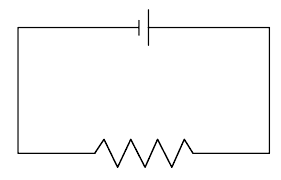
This circuit has a 24 volt battery and the resistor is 8 ohms. How many amps are running through the circuit?
a)
3 Amps
b)
192 Amps
c)
2 Amps
d)
4 Amps
48.
Which is NOT an insulator.
a)
Wool
b)
Plastic
c)
Copper
d)
Glass
49.
Two Like Charges will _______.
a)
Attract
b)
Repel
c)
Combine
d)
Fuse
50.
A material in which electrons are not able to move easily is...?
a)
Circuit 
b)
Insulator 
c)
Resistance 
d)
Conductor
51.
True or False, Lighting is a form of static electricity.
a)
True
b)
False
c)
Both
d)
Niether
52.
What is a circuit?
a)
A pathway that electricity flows in. It has a load, wire, and a taco
b)

A pathway that protons flow in. It has an output device , wire, and a power source

c)

A pathway that electricity flows in. It has an output device, wire, and a power source which provides a

Voltage difference

d)
A pathway that electricity flows in. It has a load and wire.
53.
When a balloon is rubbed on clothes it acquires a charge by ___________.
a)
Induction
b)
Reduction
c)
Friction 
d)
Conduction
54.
A material in which electrons are able to move easily is....
a)
Circuit
b)
Insulator 
c)
Resistance 
d)
Conductor 
55.
An example of a conductor is :
a)
a glass paperweight
b)
a plastic cap
c)
a metal nail
d)
a wooden handle
56.
After Sarah brushed her hair with her comb, she placed it near some uncharged pieces of paper.  Which of the following statements BEST describes what happened in the picture?
a)
the paper was not attracted or repelled by the comb
b)
the paper was attracted to the comb even before they touched
c)
the paper was repelled by the comb before they touched
d)
the paper was positively charged
57.
Choose the number of the picture that shows an unsuccessful circuit and the correct explanation as to why it was unsuccessful.
a)
1 because it is not a closed circuit
b)
2 because the circuit is open
c)
3 because there are too many light bulbs
d)
4 because there are too many batteries
58.
Which of the following forms of energy are BEST represented by a lit light bulb? 
a)
chemical, light and potential
b)
heat, kinetic and light
c)
electrical, kinetic and potential
d)
electrical, light and heat
59.
Study the picture.  How many pieces of wire are needed to close the circuit including these 3 items (battery, motor and switch)?
a)
2
b)
3
c)
5
d)
4
60.
A conductor is...?
a)
material that current can pass through easily
b)
material that current cannot pass through easily
c)
magnet
d)
electric current
61.
An insulator is....?
a)
material that current can pass through easily
b)
material that current cannot pass through easily
c)
magnet
d)
static electricity
62.
This circuit is .....?
a)
open
b)
parallel
c)
closed
d)
chris barton
63.
This circuit is...?
a)
open
b)
closed
c)
parallel
d)
all of the above
64.
What types of charges attract?
a)
Positive and Positive
b)
Positive and Neutral
c)
Negative and Neutral
d)
Positive and Negative
65.

Particles with the _________ charge are attracted to each other.

a)

same

b)

opposite

66.

Like charges will _______.

a)

attract

b)

repel

67.

Turning on a space heater is an example of electrical energy being transformed into ______ energy.

a)

light

b)

sound

c)

heat

d)

chemical

68.

Which of the following is a good insulator?

a)

copper

b)

aluminum

c)

glass

d)

silver

69.

Which of the following is a good conductor?

a)

gold

b)

wood

c)

ceramic

d)

plastic

70.

When a switch is _________, the electric current can flow through the circuit.

a)

open

b)

closed

71.

If a switch is ______, a light bulb will not light.

a)

open

b)

closed

72.

A(n) ________ is formed when an electric current passes through an unbroken path of conductors.

a)

battery

b)

insulator

c)

surge protector

d)

circuit

73.

________ electricity is the buildup of charged particles in a material.

a)

current

b)

charge

c)

static

d)

circuit

74.

Usually, the electric charge that moves is the _______. They can move from one object to another, causing the material to take on a temporary change.

a)

electron

b)

proton

c)

static

75.

Which items are good insulators?

a)

wood, copper, plastic

b)

glass, plastic, copper

c)

wood, glass, and plastic

76.
After Sarah brushed her hair with her comb, she placed it near some uncharged pieces of paper.  Which of the following statements BEST describes what happened in the picture?
a)
the paper was not attracted or repelled by the comb
b)
the paper was attracted to the comb even before they touched
c)
the paper was repelled by the comb before they touched
d)
the paper was positively charged
77.
Pick the correct sentence to describe this circuit.
a)
This circuit will work because it is a closed circuit.
b)
It is a complete series circuit.
c)
This circuit will not work because there is no energy source.
d)
This circuit will not work because there is no switch.
78.

When a circuit is open, the lamp is _________?

a)

on

b)

off

79.
The circuit  lights the light bulb. What is the purpose of the switch in the circuit?
a)
to push the electric current
b)
to open and close the circuit
c)
to insulate the circuit
d)
to make the electricity
80.

What is Electricity?

a)

the flow of electron through a conductor

b)

the flow of protons through a conductor

c)

the flow of electrons through a insulator

81.

A Generator used to convert ?

a)

Electrical energy to mechanical energy

b)

Mechanical energy to electrical energy

c)

Chomical energy to electrical energy

d)

Electrical energy to Chomical energy

82.

What picture is it ?

a)

Turbine

b)

Motor

c)

Generator

d)

Transformer

83.

Identify the power plant

a)

Wind mill

b)

Solar Power Pant

c)

Hydro electric power plant

d)

None of Those

84.

4. Which process involves reducing the voltage of electricity for household consumption?

a)

Generation

b)

Transmission

c)

Distribution

d)

All of them

85.

Which process involves raising the voltage of electricity so it can travel long distances?

a)

Generation

b)

Transmission

c)

Distribution

d)

All of them

86.

6. All of the following power plants use steam to drive the turbines to produce electricity except?

a)

Hydropower

b)

Geothermal

c)

Coal-fired

d)

Nuclear

87.

7. In the Agus VI Hydroelectric Power (HEP) Plant, what energy transformation takes place?

a)

electrical energy ® mechanical energy ® electrical energy

b)

gravitational potential energy ® kinetic energy ® mechanical energy ®electrical energy

c)

heat ® mechanical energy ® electrical energy

d)

nuclear energy ® heat ® mechanical energy ® electrical energy

88.

8. Shayne turned on a lamp switch in her room. Which of the following is the correct path of electrical power that can be traced back to the source?

a)

power plant ® transmission substations ® distribution substations ® residences

b)

ansmission substations ® power plants ® residences ® distribution substations

c)

residences ® distribution substations ® power plants ® transmission substations

d)

distribution substations ® transmission substations ® power plants ® residences

89.

1. To reduce your electric bill,

A. make use of limited appliances C. put off main switch during the day

put off appliances when not in use D. connect appliances in series

a)

make use of limited appliances

b)

put off appliances when not in use

c)

put off main switch during the day

d)

connect appliances in series

90.

10. Which of the following does not conserve energy?

a)

Turning off electrical appliances when not in use

b)

Build more power plants to supply more electricity

c)

Use energy-efficient machines

d)

All of them

91.

Electric current is measured in

a)

kWh

b)

Amps

c)

Ohms

d)

Watts

92.

Electric power is measured in

a)

kWh

b)

Amps

c)

Ohms

d)

Watts

93.

The rate at which electric energy is used is called

a)

Electric energy

b)

Electric power

c)

Voltage difference

d)

Electric current

94.

If a bulb uses 10A, which fuse would be best?

a)

10A

b)

13A

c)

8A

d)

5A

95.
Resistance in wire depends on how thick it is, how long it is and what it is made of.
a)
true
b)
false
96.
The fuse in a circuit melts when:
a)
An appliance isn't earthed
b)
Too much current flows
c)
Too much voltage flows
97.
a switch that automatically opens if the current in the circuit is too high
a)
parallel circuit
b)
circuit breaker
c)
series circuit
d)
load