Wayground logo

Free Printable Worksheets

Font size

S
M
L
XL
Worksheets

Cell Cycle Bank

Total questions: 136

Worksheet time: 7hrs 46mins

Name
Class
Date
1.

cell cycle

a)

process that cells go through for growth and repair

b)

how bacteria divide sexually

c)

mitosis of prokaryotic cells

2.

part of eukaryotic cell division during which the cell nucleus divides

a)

mitosis

b)

meiosis

c)

cell cycle

3.

fibers responsible for separating the chromosomes into chromatids during mitosis

a)

mitosis

b)

spindle

c)

century

4.

section of DNA that codes for specific traits

a)

protein

b)

gene

c)

cancer

5.

biomolecule composed of carbon, hydrogen, oxygen, phosphorous, and sometimes sulfur

a)

protein

b)

lipid

c)

carbohydrate

d)

nucleic acid

6.
The phase when the cell is resting, growing, and getting ready for mitosis is called?
a)
The cell cycle
b)
Interphase
c)
Mitosis
d)
Cytokinesis
7.
What is the process by which the cytoplasm divides?
a)
The Cell cycle
b)
Interphase
c)
Mitosis
d)
Cytokinesis
8.

What is anaphase?

a)

A stage of mitosis where chromosome line up across the middle of the cell.

b)

A stage of mitosis where the genetic information gets duplicated.

c)

A stage of mitosis where the nuclear envelop reforms.

d)

A stage of mitosis where the chromosomes get pulled to opposite ends of the cell.

9.

What is a centriole?

a)

A point where sister chromatids attach.

b)

A structure from which spindle fibers extend.

c)

A complex of DNA and a protein.

d)

A bundle of packaged DNA.

10.

Which phase of mitosis has chromosomes line up across the middle of the cell?

a)

prophase

b)

metaphase

c)

anaphase

d)

telophase

11.

During prophase

a)

DNA lines up in the middle of the cell and DNA attaches to spindle fibers

b)

centrioles and spindle fibers appear

c)

2 new identical cells are created

d)

DNA gets copied

12.

During telophase

a)

DNA lines up in the middle of the cell and DNA attaches to spindle fibers

b)

centrioles and spindle fibers appear

c)

Each DNA gets pull to the opposite sides of the cell

d)

2 new nuclei form

13.

Daughter cells created by mitosis have

a)

half of the parents genetic material

b)

twice the parent cell's genetic material

c)

an exact copy of the parent cell

d)

have a brand new DNA structure

14.

Which phase is shown here?

a)

anaphase

b)

telolphase

c)

metaphase

d)

prophase

15.
a)

metaphase

b)

prophase

c)

anaphase

d)

telophase

16.
a)

metaphase

b)

prophase

c)

anaphase

d)

telophase

17.
a)

metaphase

b)

prophase

c)

anaphase

d)

telophase

18.

What are chromosomes?

a)

They attach to the DNA and pull it to the sides

b)

They contain mitochondria

c)

They contain ribosomes

d)

DNA packaged into threadlike structures

19.
What part of the cell cycle is shown in the picture? 
a)
Cytokinesis 
b)
Interphase
c)
Mitosis 
d)
Anaphase
20.
What is the yellow dot in the middle of this picture? 
a)
Chromatid
b)
Chromosome 
c)
Centromere
21.

In which stage of the cell cycle does the cell grow in size?

a)

G1

b)

S

c)

G2

d)

Mitosis

22.

In which stage of the cell cycle does the cell duplicate its DNA?

a)

G1

b)

S

c)

G2

d)

Mitosis

23.

In which stage of the cell cycle is protein and organelle synthesis?

a)

G1

b)

G2

c)

S

d)

Cytokinesis

24.
The individual strands on duplicated chromosomes are called_____________
a)
Centromeres
b)
daughters
c)
Chromatids
d)
Karyotypes
25.

In which stage of the cell cycle do the nucleus and its contents divide?

a)

synthesis

b)

growth/gap 1

c)

mitosis

d)

growth/gap 2

26.

condensed DNA composed of two chromatids joined at the centromere

a)

chromosome

b)

chromatin

c)

sister chromatid

d)

centromere

e)

cancer

27.

uncoiled DNA during interphase of the cell cycle

a)

chromosome

b)

chromatin

c)

sister chromatid

d)

centromere

e)

cancer

28.

uncontrolled cell division

a)

chromosome

b)

chromatin

c)

sister chromatid

d)

centromere

e)

cancer

29.

two halves of the doubled structure of a chromosome

a)

chromosome

b)

chromatin

c)

sister chromatids

d)

centromere

e)

cancer

30.

holds together the chromatids of a chromosome and plays a role in chromosome movement during mitosis

a)

chromosome

b)

chromatin

c)

sister chromatids

d)

centromere

e)

cancer

31.
The phase when the cell is resting, growing, and getting ready for mitosis is called?
a)
The cell cycle
b)
Interphase
c)
Mitosis
d)
Cytokinesis
32.
What is the process by which the cytoplasm divides?
a)
The Cell cycle
b)
Interphase
c)
Mitosis
d)
Cytokinesis
33.

What is a centriole?

a)

A point where sister chromatids attach.

b)

A structure from which spindle fibers extend.

c)

A complex of DNA and a protein.

d)

A bundle of packaged DNA.

34.

Which phase of mitosis has chromosomes line up across the middle of the cell?

a)

prophase

b)

metaphase

c)

anaphase

d)

telophase

35.

During prophase

a)

DNA lines up in the middle of the cell and DNA attaches to spindle fibers

b)

centrioles and spindle fibers appear

c)

2 new identical cells are created

d)

DNA gets copied

36.
The cells produced via meiosis are called:
a)
sex cells
b)
somatic cells
c)
body cells
d)
skin cells
37.
Unlike mitosis, meiosis in male mammals results in the formation of
a)
one haploid gamete
b)
three diploid gametes
c)
four diploid gametes
d)
four haploid gametes
38.
If the Diploid number of Carrots is 18, the haploid number is
a)
18
b)
9
c)
27
d)
36
39.
If a body cell in a butterfly contains 24 chromosomes, a butterfly egg would contain
a)
3
b)
6
c)
12
d)
24
40.
Identify the phase.
a)
Metaphase I
b)
Metaphase II
c)
Prophase I
d)
Anaphase II
41.
How many daughter cells are produced from meiosis ?
a)
10
b)
6
c)
4
d)
2
42.
Name the growth phase of the cell cycle for both Mitosis and Meiosis.
a)
metaphase
b)
telophase
c)
interphase
d)
anaophase
43.
How many cells are produced during telophase I ?
a)
4
b)
8
c)
2
d)
0
44.
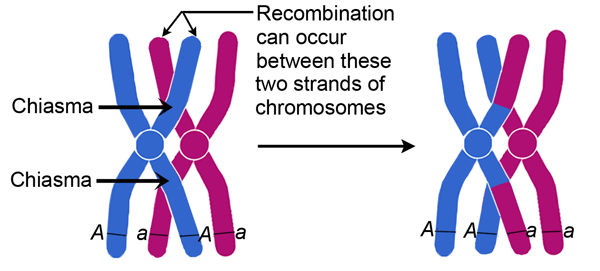
This image shows chromosomes during Prophase 1. Which of the following correctly describes the process shown?
a)
segregation of sister chromatids
b)
condensation and segregation of alleles
c)
mutationin which the DNA content of the gene is altered
d)
crossing - over in which alleles are exchanged
45.
Why do we need meiosis?
a)
To double the number of chromosomes going into sex cells
b)
To halve the number of chromosomes going into sex cells
c)
To triple the number of chromosomes going into sex cells
d)
To not change the number of chromosomes going into sex cells
46.
A human zygote should have _____ chromosomes inside.
a)
46
b)
23
c)
92
d)
64
47.
When an area of a chromatid is exchanged with the matching area on a chromatid of its homologous chromosome, _________________ occurs
a)
crossing over
b)
mutagenesis
c)
hybridization
d)
fertilization
48.

At the end of mitosis you have _____ cells

a)

identical

b)

different

c)

identical twins

d)

variety

49.
products of meiosis are genetically
a)
different
b)
identical
50.
How are your chromosomes inherited?
a)
most of your chromosomes from your mother
b)
most of your chromosomes from your father
c)
a random number of chromosomes from each parent
d)
half your chromosomes from your mother and half from your father.
51.
Name the phase of Mitosis:
a)
Prophase
b)
Metaphase
c)
Anaphase
d)
Telophase
52.

( G1,S,G2)=

a)

Interphase

b)

Haploids

c)

Sister-Chromotids

d)

46 Chromosomes

53.

The product of Mitosis is

a)

4 haploids

b)

4 Identical daughter cells

c)

2 daughter cells

d)

2 Identical daughter cells

54.

What does G1 mean

a)

Growth and normal metabolic roles

b)

DNA replication

c)

Nuclear Division

55.

G2 means

a)

Interphase

b)

Prophase

c)

Growth and preparation for nuclear division

56.
What type of reproduction is meiosis?
a)
Sexual 
b)
Asexual
57.

The stages of mitosis in order

a)

Metaphase, Anaphase, Prophase, Telophase

b)

Prophase, Anaphase, Metaphase, Telophase

c)

Prophase, Metaphase, Anaphase, Telophase

d)

Anaphase, Prophase, Telophase, Metaphase

58.
The organelle that helps in cell division and produces spindle fibers.
a)
Chromosome
b)
Centriole
c)
Cytoplasm
d)
Chloroplast
59.
Fruit fly body cells have 8 chromosomes. After mitosis, you would expect a resulting fruit fly daughter cell to have ...
a)
16 chromosomes.
b)
46 chromosomes.
c)
8 chromosomes.
d)
4 chromosomes.
60.
Structure (a) is a ____.
a)
chromosome
b)
chromatid
c)
centromere
61.
Structure (b) is a ____.
a)
chromosome
b)
chromatid
c)
centromere
62.
Structure (c) is a ____.
a)
chromosome
b)
chromatid
c)
centromere
63.
Name the phase:
a)
Anaphase
b)
Telophase
c)
Metaphase
d)
Prophase
64.
Name the phase:
a)
Prophase
b)
Metaphase
c)
Anaphase
d)
Telophase
65.
Name the phase:
a)
Prophase
b)
Metaphase
c)
Anaphase
d)
Telophase
66.
Name the phase:
a)
Prophase
b)
Metaphase
c)
Anaphase
d)
Telophase
67.
Name the previous phase.
a)
Prophase
b)
Metaphase
c)
Anaphase
d)
Telophase
68.
Name the previous phase.
a)
Prophase
b)
Metaphase
c)
Anaphase
d)
Telophase
69.
Name the previous phase.
a)
Prophase
b)
Metaphase
c)
Anaphase
d)
Telophase
70.
What is the next phase of mitosis?
a)
Prophase
b)
Metaphase
c)
Anaphase
d)
Telophase
71.
What is the next phase of mitosis?
a)
Prophase
b)
Metaphase
c)
Anaphase
d)
Telophase
72.
What is the next phase of mitosis?
a)
Prophase
b)
Metaphase
c)
Anaphase
d)
Telophase
73.
Identify the phase of mitosis.
a)
prophase
b)
metaphase
c)
anaphase
d)
telophase
74.
Which is the correct order?
a)
C,D, B, A, F, E
b)
D,A,F,C,E,B
c)
B,E,C,F,A,D
d)
C,B,D,A E,F
75.
This picture shows which process? 
a)
mitosis
b)
meiosis
c)
the cell cycle
76.
This diagram depicts which phase of mitosis? 
a)
prophase
b)
metaphase
c)
anaphase
d)
telophase
77.
The chromosomes line up across the middle of the cell
a)
Anaphase
b)
Interphase
c)
Prophase
d)
Metaphase
78.
What phase of mitosis is pictured?
a)
Prophase
b)
metaphase
c)
anaphase
d)
telephase
79.
Which phase comes NEXT?
a)
prophase
b)
metaphase
c)
anaphase
d)
telophase
80.
What is this phase of mitosis?
a)
prophase
b)
metaphase
c)
anaphase
d)
telophase
81.
Put the stages of mitosis in the correct order.
a)
prophase - metaphase - anaphase - telophase
b)
metaphase - anaphase - prophase - telophase
c)
anaphase - prophase - telophase - metaphase
d)
telophase - metaphase - prophase - anaphase
82.
Which of the following phases of mitosis is represented by the diagram below? 
a)
Prophase
b)
Metaphase 
c)
Anaphase 
d)
Telophase 
83.
What letter correctly represents structure X in the diagram? 
a)
Spindle fibers
b)
Cleavage Furrow 
c)
Chromosomes
d)
Centrioles
84.
a)
Anaphase
b)
Cytokinesis
c)
Telophase
d)
Metaphase
85.
a)
Prophase
b)
Interphase
c)
Anaphase
d)
Telophase
86.
Place these cells in order of mitosis.
a)
A, B, C, D, E
b)
B, E, D, A, C
c)
C, E, A, D, B
d)
B, D, A, E, C
87.
The process on the left is:
The process on the right is:
a)
Left: meiosis
Right: meiosis
b)
Left: meiosis
Right: cloning
c)
Left: mitosis
Right: meiosis
d)
Left: mitosis
Right: mitosis
88.
Why would it be important to replicate DNA before a cell divides in mitosis or meiosis?
a)
In order for genetic information to be transferred into daughter cells.
b)
In order for the cell to be able to increase in size.
c)
In order for the DNA to be contained in the nucleus.
d)
In order for the cell to re-order the DNA sequencing in the new cells.
89.
These structures pull the spindle fibers and attached chromosomes to opposite ends of the cell.
a)
Spindle fiber
b)
Centriole
c)
Nucleus
d)
Centromere
90.

This graphic represents

a)

prophase

b)

metaphase

c)

anaphase

d)

telophase

91.

This graphic represents

a)

prophase

b)

metaphase

c)

anaphase

d)

telophase

92.

This graphic represents

a)

prophase

b)

metaphase

c)

anaphase

d)

telophase

93.

Spindle fibers begin to form

a)

prophase

b)

metaphase

c)

anaphase

d)

telophase

94.

Spindle fibers begin to break down

a)

prophase

b)

metapase

c)

anaphase

d)

telophase

95.
The process by which the nuclear material is divided equally between two new cells
a)
mitosis
b)
cancer
c)
spindle
d)
centromere
96.

The stages of mitosis in order

a)

Metaphase, Anaphase, Prophase, Telophase

b)

Prophase, Anaphase, Metaphase, Telophase

c)

Prophase, Metaphase, Anaphase, Telophase

d)

Anaphase, Prophase, Telophase, Metaphase

97.
The organelle that helps in cell division and produces spindle fibers.
a)
Chromosome
b)
Centriole
c)
Cytoplasm
d)
Chloroplast
98.
Fruit fly body cells have 8 chromosomes. After mitosis, you would expect a resulting fruit fly daughter cell to have ...
a)
16 chromosomes.
b)
46 chromosomes.
c)
8 chromosomes.
d)
4 chromosomes.
99.
Structure (a) is a ____.
a)
chromosome
b)
chromatid
c)
centromere
100.
Structure (b) is a ____.
a)
chromosome
b)
chromatid
c)
centromere
101.
Structure (c) is a ____.
a)
chromosome
b)
chromatid
c)
centromere
102.
Name the phase:
a)
Anaphase
b)
Telophase
c)
Metaphase
d)
Prophase
103.
Name the phase:
a)
Anaphase
b)
Telophase
c)
Metaphase
d)
Prophase
104.
Name the phase:
a)
Prophase
b)
Metaphase
c)
Anaphase
d)
Telophase
105.
Name the phase:
a)
Prophase
b)
Metaphase
c)
Anaphase
d)
Telophase
106.
Name the phase:
a)
Prophase
b)
Metaphase
c)
Anaphase
d)
Telophase
107.
Name the phase:
a)
Prophase
b)
Metaphase
c)
Anaphase
d)
Telophase
108.
Name the phase:
a)
Prophase
b)
Metaphase
c)
Anaphase
d)
Telophase
109.
Name the phase:
a)
Prophase
b)
Metaphase
c)
Anaphase
d)
Telophase
110.
Name the previous phase.
a)
Prophase
b)
Metaphase
c)
Anaphase
d)
Telophase
111.
Name the previous phase.
a)
Prophase
b)
Metaphase
c)
Anaphase
d)
Telophase
112.
Name the previous phase.
a)
Prophase
b)
Metaphase
c)
Anaphase
d)
Telophase
113.
Name the previous phase.
a)
Prophase
b)
Metaphase
c)
Anaphase
d)
Telophase
114.
What is the next phase of mitosis?
a)
Prophase
b)
Metaphase
c)
Anaphase
d)
Telophase
115.
What is the next phase of mitosis?
a)
Prophase
b)
Metaphase
c)
Anaphase
d)
Telophase
116.
What is the next phase of mitosis?
a)
Prophase
b)
Metaphase
c)
Anaphase
d)
Telophase
117.
What is the name of this phase?
a)
prophase
b)
metaphase
c)
cytokinesis
d)
telphase
118.
What phase is this?
a)
prophase
b)
metaphase
c)
anaphase
d)
telephase
119.
What phase is this?
a)
prophase
b)
metaphase
c)
anaphase
d)
telephase
120.
What phases is this?
a)
Prophase
b)
metaphase
c)
anaphase
d)
telephase
121.

What phase is this?

a)

prophase

b)

metaphase

c)

anaphase

d)

telephase

122.
the stage in the cell cycle where cells spend the majority of their life.
a)
mitosis
b)
meoisis
c)
interphase
d)
anaphase
123.

the phase in mitosis where chromosomes move to opposite sides and new nuclei form

a)

prophase

b)

metaphase

c)

anaphase

d)

telophase

124.

the phase in mitosis where chromosomes line up in the middle of the cell and the nucleus disapears.

a)

prophase

b)

metaphase

c)

anaphase

d)

telophase

125.

the phase in mitosis where chromosomes move away and are pulled by spindles to opposite sides of the cell.

a)

prophase

b)

anaphase

c)

metaphase

d)

telophase

126.
Which of the following lists, in order, the phases of mitosis?
a)
interphase, metaphase, anaphase, telophase
b)
prophase, metaphase, anaphase, telophase
c)
prophase, metaphase, anaphase, interphase
d)
prophase, anaphase, metaphase, telophase
127.

The red dot (2) is the:

a)

Chromatid

b)

Chomatin

c)

Centrosome

d)

Centromere

128.
What process does a multi-cellular organism use to replace its damaged body cells?
a)
mitosis
b)
meiosis
c)
replication
d)
transcription
129.
Which of these lists presents the stages of the cell cycle in the correct order?
a)
interphase, mitosis, cytokinesis
b)
cytokinesis, mitosis, interphase
c)
mitosis, interphase, cytokinesis
d)
interphase, cytokinesis, mitosis
130.
During interphase, the DNA is in the form of
a)
chromatin
b)
chromosomes
c)
chromatids
d)
centromeres
131.
Identify the stage.
a)
interphase
b)
metaphase
c)
anaphase
d)
telophase
132.
Identify the stage of mitosis.
a)
interphase
b)
prophase
c)
metaphase
d)
anaphase
133.
Identify the stage of mitosis.
a)
interphase
b)
prophase
c)
anaphase
d)
cytokinesis
134.
Identify the stage of mitosis. 
a)
interphase
b)
prophase
c)
anaphase
d)
cytokinesis
135.
In mitosis, the two resulting cells are
a)
different from the starting cell and identical to each other.
b)
different from the starting cell and different from each other.
c)
identical to the starting cell and different from each other.
d)
identical to the starting cell and identical to each other.
136.
A chromosome is a single, long DNA molecule in a compact formation
a)
True
b)
False