wayground logo

Free Printable Worksheets

Font size

S
M
L
XL
Worksheets

Cell Biology Unit Review Quizizz

Total questions: 133

Worksheet time: 1hrs 7mins

Name
Class
Date
1.
The diffusion of water is called
a)
active transport 
b)
osmosis
c)
endocytosis
2.
Which of the following is found in plant cells but not in animal cells? 
a)
Cytoplasm
b)
Mitochondria
c)
Cell Wall 
d)
Ribosomes 
3.
What part of the cell membrane is the arrow pointing to? 
a)
phospholipid
b)
carbohydrate chain 
c)
protein channel 
d)
amino acid 
4.
What type of cells are pictured 
a)
Muscle Cells
b)
Cells of the Immune System 
c)
Human Cheek Cells
d)
Plant Cells 
5.
Which diagram best represents the cell membrane 
a)
a
b)
b
c)
c
d)
d
6.
What is a key role of lipids (phospholipids) within a cell?
a)
 They make proteins
b)
They cause DNA to replicate
c)
They are the main structual componet of membranes 
d)
They produce energy for the cell
7.
What plant organelle is used to make sugars?
a)
Cell wall 
b)
Mitochondria 
c)
Chloroplast 
d)
Vacuole
8.
What kind of molecule is the arrow pointing to? 
a)
Phospholipid
b)
Protein
c)
Sugar
d)
Nucleic Acid 
9.
What is the function of DNA?
a)
Use oxygen and sugar to produce energy
b)
Forms part of the nuclear membrane 
c)
Transport materials throughout the cell 
d)
Contains information to make proteins
10.
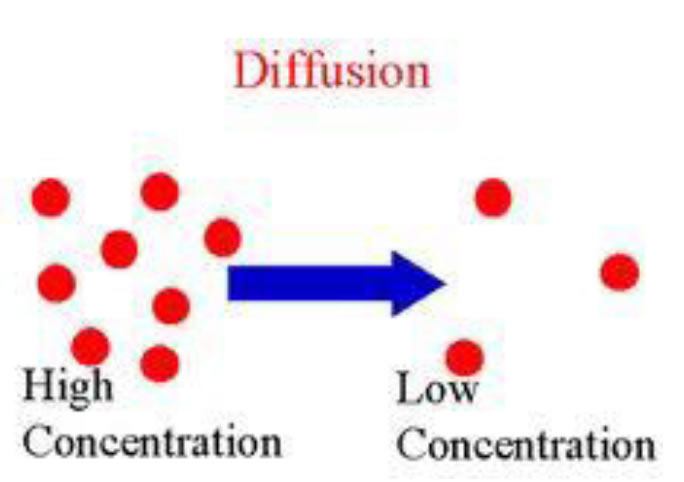
What process moves gases such as oxygen through the cell membrane as shown in the drawing? 
a)
Active Transport 
b)
Osmosis
c)
Diffusion
d)
Protein Channel 
11.
What cell function would be affected if the Golgi apparatus is damaged? 
a)
Exporting Proteins
b)
Storage of water and waste
c)
Production of Energy 
d)
Cell divison
12.
What structure in the cell contains most of the cells genetic information? 
a)
A. rough Endoplasmic Reticulum 
b)
B. mitochondria 
c)
C. nucleus 
d)
D. cytoplasm 
13.
What would happen to a saltwater protozoan if it is removed from its normal habitat and placed into a freshwater pool?
a)
Loss of water through active transport
b)
Loss of water through diffusion 
c)
Gain of water through protein channels 
d)
Gain of water through osmosis
14.
Paramecium and Euglena are both eukaryotes because 
a)
Both have a cell membrane
b)
Both have a nucleus 
c)
Both are single-celled organisms
d)
Both have ribosomes 
15.
Which organelle is responsible for the movement of molecules throughout the cell?
a)
Ribosomes
b)
Nucleus 
c)
Vesicle
d)
Mitochondria
16.
The cell membrane consists of mainly of 
a)
Phospholipids & proteins 
b)
Water & carbon dioxide 
c)
Carbohydrates & sugars 
d)
Cellulose & lactose 
17.
Which structure is not present in animal cells? 
a)
Chloroplast
b)
Cell membrane 
c)
Cytoplasm 
d)
Nucleus 
18.
What is the primary function of the cell's selectively permeable membrane? 
a)
Regulate energy production 
b)
Keeps the cell's shape
c)
Control what enters and leaves the cell
d)
Maintain a free flow of molecules
19.
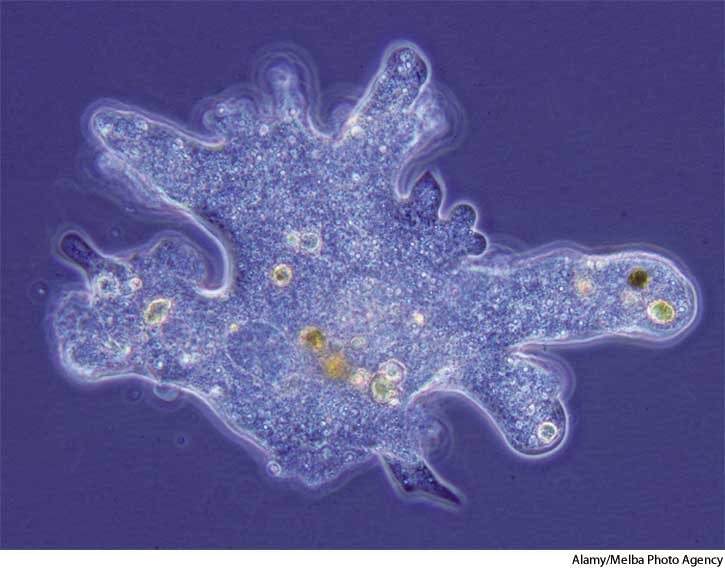
What does this single-celled organism use to move? 
a)
Pseudopodia
b)
Flagella
c)
Cilia
d)
Mitochondria 
20.

Which of these is NOT true of organelles(cell parts)?

a)

Organelles perform a certain function for a cell.

b)

Organelles are membrane-enclosed structures in a cell.

c)

Organelles are all the same inside a particular animal.

d)

Organelles are separated from the other parts of the cell.

21.

Which of these is most commonly the largest structure inside an animal cell?

a)

endoplasm

b)

nucelus

c)

DNA

d)

ribosomes

22.

How do mitochondria regulate energy in a cell?

a)

Mitochondria transfer energy between cells as energy is needed.

b)

Mitochondria convert energy in nutrients into usable energy.

c)

Mitochondria absorb and convert energy from the sun.

d)

Mitochondria convert energy from the nucleus into usable energy.

23.

Which of these is NOT a unique structure to plant cells?

a)

cell wall

b)

central vacuole

c)

chloroplas

d)

nucleus

24.
Which of the following is the smallest unit of life that can carry out all life functions?
a)
the mitochondria
b)
the vacuoles
c)
the nucleus
d)
the cell
25.
What is the function of the cell nucleus found in both plant and animal cells?
a)
to produce energy
b)
to control cell activity
c)
to remove waste products
d)
to allow molecules to enter the cell
26.

All cells need energy (ATP) to function. Which cell organelle is responsible for producing energy in the cell? "The Powerhouse"

a)

chloroplasts

b)

mitochondria

c)

nucleus

d)

vacuoles

27.

Where do new cells come from?

a)

other cells

b)

nucleus

c)

Golgi body

d)

macrophages

28.

Because they share similar structures, cells all carry out the same function.

a)

True

b)

False

29.
Contains chlorophyll and is where photosynthesis takes place. Found in plant cells only.
a)
mitochondria
b)
chloroplast
c)
vacuole
d)
cytoplasm
30.
Semi-permeable layer around the cell that encloses the contents of the cell
a)
nucleus
b)
cell membrane
c)
cell wall
d)
chloroplast
31.
jelly-like substance that is located between the cell membrane and the nucleus
a)
mitochondria
b)
chloroplast
c)
vacuole
d)
cytoplasm
32.
I am found in plant cells. I am rigid, strong & stiff. I give support to the plant cell.  I give the cell it's box shape
a)
cell membrane
b)
cell wall
c)
chlorophyll
d)
mitochondria
33.
I am located in the nucleus – I’m the genetic material of a cell
a)
cytoplasm
b)
membrane
c)
chromosomes/DNA
d)
vacuole
34.
   I provide the cell with protection and controls what comes in and out of the cell.
a)
nucleus
b)
cell wall
c)
cell membrane
d)
mitochondria
35.

A large central vacuole is found in a _____ cell.

a)

animal

b)

plant

36.

What is the function of a chloroplast?

a)

makes proteins for animal cells

b)

allows materials in and out of the cell

c)

provides structure and support

d)

absorbs sunlight for photosynthesis

37.
The major function of ribosomes is to
a)
Make fats
b)
Synthesize protein
c)
Digest protein
d)
Make sugars
38.
Which of the following is an enzyme filled organelle that breaks down waste in the cell?
a)
lysosomes
b)
chloroplast
c)
mitochondria 
d)
Golgi apparatus 
39.
which of the following transports material within the cell?
a)
Golgi apparatus 
b)
Endoplasmic reticulum
c)
cell wall 
d)
ribosomes
40.
Which structures are found in every living cell?
a)
cell membrane and cytoplasm
b)
chloroplasts and mitochondria
c)
a cell wall and nucleus
d)
chloroplasts and cell wall
41.
Cells with a nucleus and membrane-bound organelles are called ____________________.
a)
prokaryotes
b)
eukaryotes
c)
bacteria
d)
protists
42.
Animal and plant cells are both this type of cell.
a)
Eukaryote
b)
Prokaryote
43.
an organism that consists of a single cell that does not have a nucleus or membrane bound organelles
a)
eukaryotic
b)
prokaryotic
c)
ribosomes
d)
cell membrane
44.
an organism made up of cells that have a nucleus enclosed by a membrane as well as membrane bound organelles
a)
prokaryote
b)
bacteria
c)
cytoplasm
d)
eukaryote
45.
a membrane bound organelle in a eukaryotic cell that contains the cell's DNA
a)
cytoplasm
b)
ribosome
c)
membrane
d)
nucleus
46.
What is the name of the genetic material that is inside the nucleus?
a)
ER
b)
ATP
c)
YOLO
d)
DNA
47.
A rigid layer that lies outside the cell's  membrane is...
a)
Cytoskeleton
b)
Cilia
c)
Cell Wall
d)
Flagella
48.
Movement of particles from high to low concentration. 
a)
Passive Transport
b)
Active Transport
49.
Osmosis is a form of ______________. 
a)
Passive Transport
b)
Active Transport
50.
a)
Passive Transport
b)
Active Transport
51.
Endocytosis
a)
Passive Transport
b)
Active Transport
52.
Endocytosis
a)
Passive Transport
b)
Active Transport
53.
The diffusion of WATER across a semi-permeable membrane is
a)
osmosis
b)
diffusion
c)
endocytosis
d)
exocytosis
54.
Active transport requires
a)
energy
b)
the nucleus
c)
chloroplasts
d)
lysosomes
55.
How does a cell maintain homeostasis?
a)
Regulates what enters and leaves the cell
b)
Flexibility
c)
Protective barrier
d)
Structure and support
56.
Another term for equilibrium is...
a)
Not enough
b)
Too little
c)
Homeostasis
d)
Too much
57.
The cell membrane is selectively permeable, which means...
a)
All materials can enter and leave the cell
b)
Certain things can enter while others cannot
c)
The cell manually sorts through all materials
d)
Only certain cells can interact with the cell.
58.
The movement of molecules against a concentration gradient
a)
simple diffusion
b)
facilitated diffusion
c)
active transport
d)
osmosis
59.
A molecule that diffuses down a concentration gradient goes from an area of ______ concentration into an area of ______ concentration.
a)
high, low
b)
low, high
c)
passive, active
d)
active, passive
60.
This picture represents what type of cell transport?
a)
endocytosis
b)
exocytosis
c)
osmosis
d)
passive transport
61.
ALL living cells have this in common
a)
Nucleus
b)
Cell Membrane
c)
Cell Wall
d)
Mitochondria
62.
A cell will _____________________ in a hypertonic solution.
a)
swell
b)
shrink
c)
will not change
d)
will explode
63.
A cell will __________________ in a hypotonic solution.
a)
swell and perhaps burst (lyse)
b)
shrink
c)
the size of the cell will not change
d)
the size of the cell will change from large to small and from small to large
64.
Active transport requires ______, moves materials from __________________, and goes _______ the concentration gradient.
a)
No energy, low to high, against
b)
ATP, high to low, with
c)
ATP, low to high, with
d)
ATP, low to high, against
65.
Controlling what goes into or out of the cell without energy is called
a)
active transport
b)
endocytosis
c)
passive transport
d)
exocytosis
66.
An Amoeba is a unicellular, animal-like protist that lives in ponds and streams. According to cell theory, where did this cell come from?
a)
another pre-existing amoeba cell.
b)
energy from sun that allowed the protist to reproduce.
c)
a multicellular organism.
d)
the nonliving environment.
67.
Robert Hooke, Anton van Leeuwenhoek, Theodor Schwann, Rudolf Virchow, and Matthias Schliden were all responsible for what theory?
a)
The Theory of Gravity
b)
The Theory of Relativity
c)
The Cell Theory
d)
The Theory of Continental Drift
68.
What tool do you use to view the cells?
a)
metric ruler
b)
centrifuge
c)
microscope
d)
telescope
69.
Which of the following is NOT a cell theory.
a)
All non-living things are made of cells
b)
All cells come from pre-existing cells
c)
Cells are the basic unit of structure and function of all living things
70.
All living things are made up of...
a)
cells
b)
cell tissues
c)
organ
d)
organ systems
71.
All cells come from___________ cells.
a)
pregnant
b)
pre-existing
c)
paternal
d)
pin size
72.
Rocks are not living because
a)
they never move
b)
they aren't needed for humans
c)
they are not made of cells
d)
they don't break down
73.
What is the basic structural and functional unit of all living things? 
a)
atom
b)
cell
c)
molecule
d)
human
74.
All cells are produced ____________.
a)
From pre-existing and deceased cells
b)
from other pre-existing cells
c)
Cells can come from anywhere, as long as there is the sun.
75.
An organism made of one cell is called
a)
unicellular organism
b)
multicellular organism
76.
What is one way in which all living things on Earth are alike?
a)
All living things have hair.
b)
All living things are made of cells and come from other cells.
c)
The cells of all living things have chloroplast.
d)
All living things can move. 
77.
Which of the following statements is not part of the cell theory?
a)
Cells are the basic unit of structure and function in all living things.
b)
All cells are produced from other cells.
c)
Only animal cells are composed of cells.
d)
All living things are composed of cells.
78.
Which of the following scientists concluded that all animals are made of cells?
a)
Rudolf Virchow
b)
Matthais Schleiden
c)
Robert Hooke
d)
Theodor Schwann
79.
Which of the following scientists was the first to observe bacteria under a microscope?
a)
Anton van Leuwenhoek
b)
Matthais Schleiden
c)
Robert Hooke
d)
Theodor Schwann
80.
In order to sustain life, all cells must...
a)
digest nutrients and water
b)
excrete waste and fluids
c)
must be able to maintain a homeostasis environment (aka cellular respiration and regulation)
d)
All of the above
81.
Which is NOT part of the Cell Theory
a)
New cells are produced from existing cells
b)
All living things are composed of cells
c)
Only eukaryotic cells have a nucleus
d)
Cells are the basic unit of structure & function in living things
82.
How are unicellular organisms different from multicellular organisms? 
a)
There are no differences.
b)
They are made of many cells. 
c)
They are only classified as prokaryotes.
d)
They are made of only one cell. 
83.

What type of cell is an animal cell?

a)

Prokaryotic

b)

Eukaryotic

84.

What type of cell is a plant cell?

a)

Prokaryotic

b)

Eukaryotic

85.

What type of cell is a bacterial cell?

a)

Prokaryotic

b)

Eukaryotic

86.

How to prokaryotes reproduce?

a)

Sexually

b)

Asexually

c)

Both

87.

How do eukaryotes reproduce?

a)

Sexually

b)

Asexually

c)

Both

88.

Which scientist coined the term "cell"?

a)

Schleiden

b)

Schwann

c)

Hooke

d)

Van Leuwenhoek

89.

Which scientist invented the first compound microscope?

a)

Jansen

b)

Hooke

c)

Van Leuwenhoek

d)

Newton

90.

Which scientist discovered bacteria?

a)

Jansen

b)

Hooke

c)

Van Leuwenhoek

d)

Newton

91.

The idea that all living things are composed of cells, the cell is the basic unit of structure and function, and all cells come from cells is known as the

a)

Theory of relativity

b)

Agenda Theory

c)

Cell Theory

d)

Theory of naturalization

92.

A cell without a true nucleus

a)

Prokaryotic

b)

Eukaryotic

93.

A cell that has a true nucleus

a)

Prokaryotic

b)

Eukaryotic

94.
What are the tiny structures that carry out jobs inside cells called?
a)
membranes
b)
nucleus
c)
organelles
d)
animalicules
95.
This structure is a storage area for the cell.
a)
Lysosome
b)
Vacuole
c)
Ribosome
d)
Golgi Body
96.
This small structures break down materials in the cell.
a)
Cholorplasts
b)
Ribosomes
c)
Lysosomes
d)
Golgi Body
97.
This structure packages and distributes proteins throughout the cell. 
a)
Golgi Body
b)
Lysosome
c)
Ribosome
d)
Mitochondria
98.
This structure is a passageway though out the cell. 
a)
Ribosome
b)
Endoplasmic Reticulum
c)
Nucleus
d)
Cell Membrane
99.
What organelle packages and distributes proteins for the cell?
a)
Golgi complex
b)
ribosome
c)
endoplasmic reticulum
d)
nucleus
100.

Which of the following statements is TRUE?

a)

Food breakdown occurs only in the stomach.

b)

Food breakdown releases energy and matter for cells to use.

c)

Food breakdown is a simple process that happens when food is chewed.

d)

Food breakdown is a way for plants to store energy for other organisms.

101.

Cells do which of the following?

a)

respire

b)

take in nutrients

c)

produce wastes

d)

all of the above

102.

Which of the following best describes structures in the human body from the largest to smallest?

a)

organ, tissue, cell, organelle

b)

organ, tissue, organelle, cell

c)

organelle, organ, tissue, cell

d)

organelle, cell, tissue, organ

103.

Which of the following statements is TRUE?

a)

All cells look the same.

b)

All cells perform the same functions.

c)

The shape and structure of a cell is related to its functions.

d)

All of the above.

104.
Maintenance of a constant, stable internal state, despite changing external environment.
a)
mitosis
b)
osmosis
c)
photosynthesis
d)
homeostasis
105.
Which of the following structure is where cellular respiration occurs in the cell?
a)
nucleus
b)
cytoplasm
c)
mitochondria
d)
vacuoles
106.
The green pigment in plants is due to the presence of 
a)
chlorophyll
b)
Chlorine
c)
Chlorophyta
d)
chromatophores
107.
When using the microscope, you should always start with this objective lens
a)
low power
b)
high power
108.
Permeable means
a)
things can pass through
b)
the concentration levels are different
c)
it is permanent
d)
things are stuck
109.
The levels of organization from the simplest to the most complex are
a)
Cells, tissues, organs, organ systems, organism
b)
Organisms, organs, tissues, cells, organ systems
c)
Cells, organs, organ systems, tissues, organism
d)
Tissues, cells, organs, organism
110.
This is a real picture of chloroplast inside plant cells. What process takes place in the chloroplast?
a)
Cellular Respiration
b)
Photosynthesis 
111.
This is a _____________________ cell because it has a __________________.
a)
Prokaryotic, Eukaryotic 
b)
Eukaryotic, Nucleus 
c)
Prokaryotic, Ribosomes 
d)
Bacteria, Animal 
112.
What type of cell is this?
a)
Plant
b)
Animal 
c)
Fungi
d)
Bacteria 
113.
is this photosynthesis or cellular respiration?
a)
Photosynthesis 
b)
Cellular Respiration 
114.
The chloroplast can be described as a bean with ...
a)
stacks of pancakes
b)
water
c)
maze
d)
little race track
115.
This is a ______________ because it does not have a _____________.
a)
Eukaryotic, Ribosome
b)
Eukaryotic, Nucleus 
c)
Prokaryotic, Nucleus
d)
Prokaryotic, Cell Wall
116.
This is most likely an _________________ cell because it has a nucleus but no cell wall and no chloroplast.
a)
Plant 
b)
Animal 
c)
Bacteria 
d)
Cell
117.
The main difference between animal and plant cells is that plant cells have ______________________ and __________________.
a)
Chloroplast, Ribosomes 
b)
Cell Wall, Mitochondria 
c)
Mitochondria, Cell Wall
d)
Chloroplast, Cell Wall
118.

Plant cells have two organelles that animal cells do not. What are the two organelles they have that animals don't?

a)

Chloroplast, Ribosomes

b)

Cell Wall, Mitochondria

c)

Mitochondria, Cell Wall

d)

Chloroplast, Cell Wall

119.
Which of these is NOT a part of the Cell Theory?
a)
All cells work independently
b)
Cells are the basic unit of living things. 
c)
All living things are made up one of or more cells.
d)
Cells come from cells.
120.
This organelle turns the light energy into a simple sugar. 
a)
Mitochondria
b)
ER
c)
Chloroplast
d)
Nucleus
121.
The Golgi apparatus _____.
a)
packages/modifies cell products for export
b)
eliminates waste
c)
stores DNA
d)
makes energy
122.

The __________ is the basic unit of life.

a)

Carbohydrates

b)

Protein

c)

Lipids

d)

Cell

123.

Multicellular organisms means they are made up of ___________

a)

one cell.

b)

many different types of cells

c)

many of one type of cell

d)

one of many cells

124.

A process by which organisms use light to make their food, storing the light as chemical energy in the form of sugar. 6CO2 + 6H2O + energyC6H12O6 + 6O

a)

Cholorophyll

b)

Electron Transport Chain

c)

Chemosynthesis

d)

Photosynthesis

125.

Which type of plant cell would have more chloroplasts than others?

a)

Leaf cell

b)

Root cell

c)

Stem cell

d)

Root epidermal cell

126.
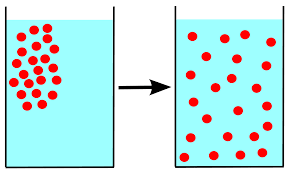
The picture below is an example of _________________.
a)
osmosis
b)
isotonic
c)
diffusion
d)
active transport
127.

During osmosis

a)

water moves from low solute to high solute concentration.

b)

large or oddly shaped molecules move across a cell membrane

c)

water moves from high solute to low solute concentration

d)

molecules moves across membranes actively

128.

A person would never have pure water put into their veins in a hospital because their cells would...

a)

Shrink

b)

Expand

c)

Dehydrate

d)

Stay the same

129.

A solution containing a higher solute concentration is said to be

a)

Hypertonic

b)

Hypotonic

c)

Isotonic

130.

Which of the following organelles would you not find in a plant cell?

a)

Chloroplast

b)

Centrioles

c)

Central vacuole

d)

Cell wall

131.

Which principle of cell theory best supports the idea that new cells will replace damaged cells in a scraped knee?

a)

All living things are made of one or more cells.

b)

Cells are the basic unit of life.

c)

All cells come from other cells.

d)

The nucleus of cells in animals reproduces when exposed to air.

132.

In a hypotonic solution, water will move _____ the cell, causing the cell to _____.

a)

Into; shrivel

b)

Out of; lyse/swell

c)

Out of; shrivel

d)

Into; lyse/swell

133.

Which organelle is critical for cell division?

a)

Centrioles

b)

Cilia

c)

Vacuoles

d)

Vesicles