wayground logo

Free Printable Worksheets

Font size

S
M
L
XL
Worksheets

BIO 102 Monster Review Unit 3

Total questions: 112

Worksheet time: 4hrs 7mins

Name
Class
Date
1.
What does DNA stand for?
a)
Deoxyribonucleic acid
b)
Denitrogenous acid
c)
Deribonucleic acid
d)
Diribonucleic acid
2.
Which of the following best describes a DNA molecule?
a)
double helix
b)
contains ribose
c)
made of amino acids
d)
contains Uracil
3.
DNA is a polymer made of:
a)
Nucleotides
b)
Ribosomes
c)
Purines
d)
Pyrimidines
4.
Why is DNA important?
a)
it is very small and very complicated
b)
it's in everything
c)
it serves as the blueprint for traits of all living things
d)
because we eat it every day for energy
5.
In a molecule of double-stranded DNA, the amount of Adenine present is always equal to the amount of
a)
cytosine
b)
guanine
c)
thymine
d)
uracil
6.
Which organelle is DNA usually found in?
a)
cell membrane
b)
vacuole
c)
ribosome
d)
nucleus
7.
Guanine bonds with ______________.
a)
Adenine
b)
Guanine
c)
Cytosine
d)
Thymine
8.
What will the matching sequence be on a strand that reads AAGCTAT?
a)
AACGATA
b)
TTCGTTA
c)
CCTGATA
d)
TTCGATA
9.
What are the three components of a nucleotide?
a)
sugar, hydrogen, nitrogen base
b)
sugar, oxygen, nitrogen base
c)
sugar, phosphate, nitrogen base
d)
sugar, phosphate, protein
10.

A change in a DNA sequence(order) that affects genetic information.

a)

Recessive trait

b)

Mutation

c)

Allele

11.
the process of making a copy of DNA
a)
transcription
b)
double helix
c)
DNA replication
d)
replication fork
12.
Which shows the correct complementary base pairing for DNA?
a)
C-A, T-G
b)
A-G, C-T
c)
C-G, U-A
d)
T-A, G-C
13.
The enzyme that unwinds the DNA to prepare for replication
a)
helicase
b)
replicase
c)
polymerase
d)
synthase
14.
A process in which DNA has the unique ability to make an exact copy of itself.
a)
Replication
b)
Translation
c)
Transcription
15.
Why does DNA replicate?
a)
To create another copy for the new cell
b)
To create a duplicate copy in case the original gets damaged
c)
To create a new copy to replace the damaged original
16.

DNA replication results in

a)

2 completely new DNA molecules

b)

2 DNA molecules that each contain a strand of the original

c)

1 new DNA molecule and 1 old

d)

1 new molecule of DNA

17.

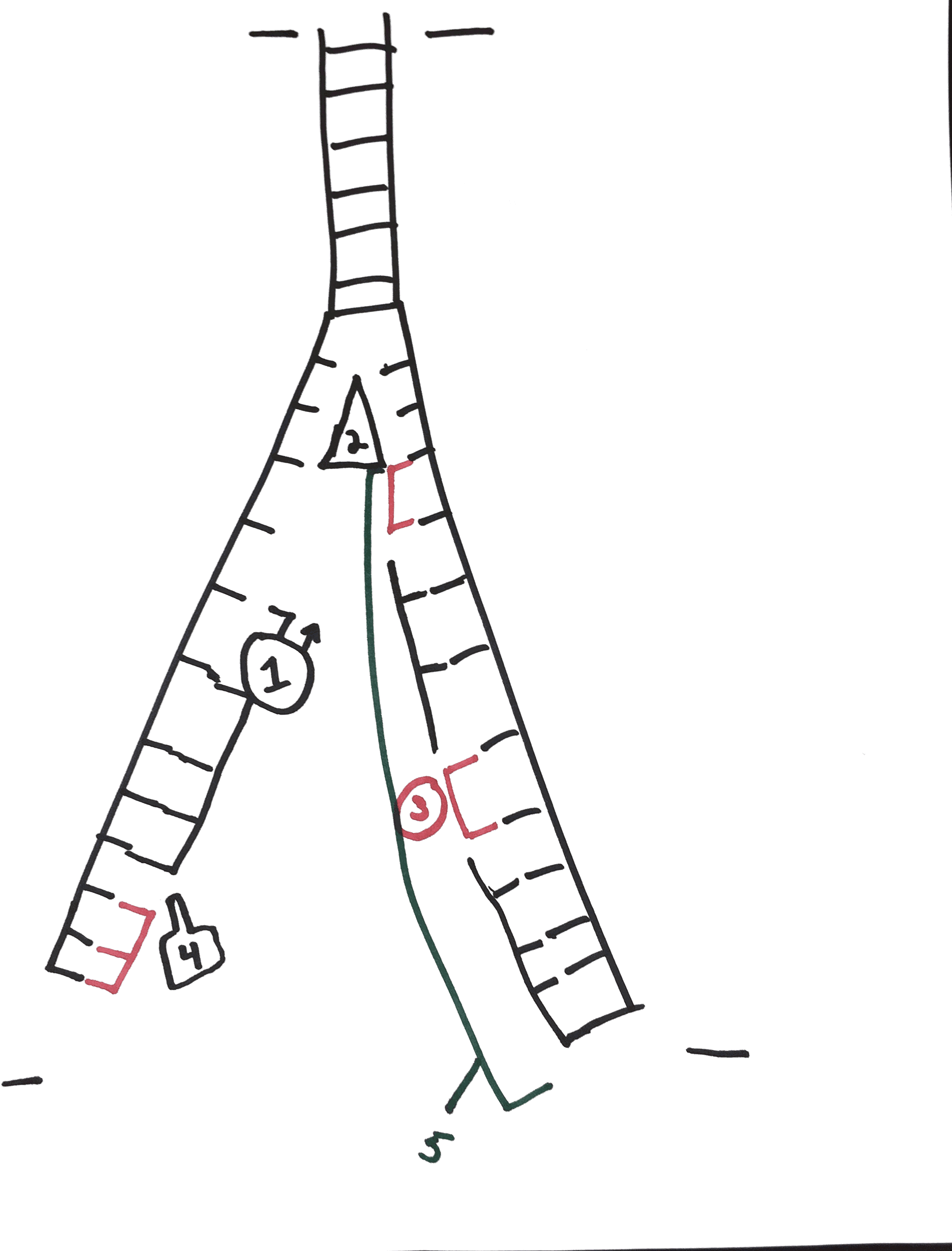
#1 in the picture above (builder)

a)

Helicase

b)

Primase

c)

Polymerase

d)

Ligase

18.

When DNA is replicated, the result is

a)

1 old double helix and 1 new

b)

2 double helixes. Each with 1 old and 1 new strand

c)

1 double helix

d)

2 new double helixes

19.

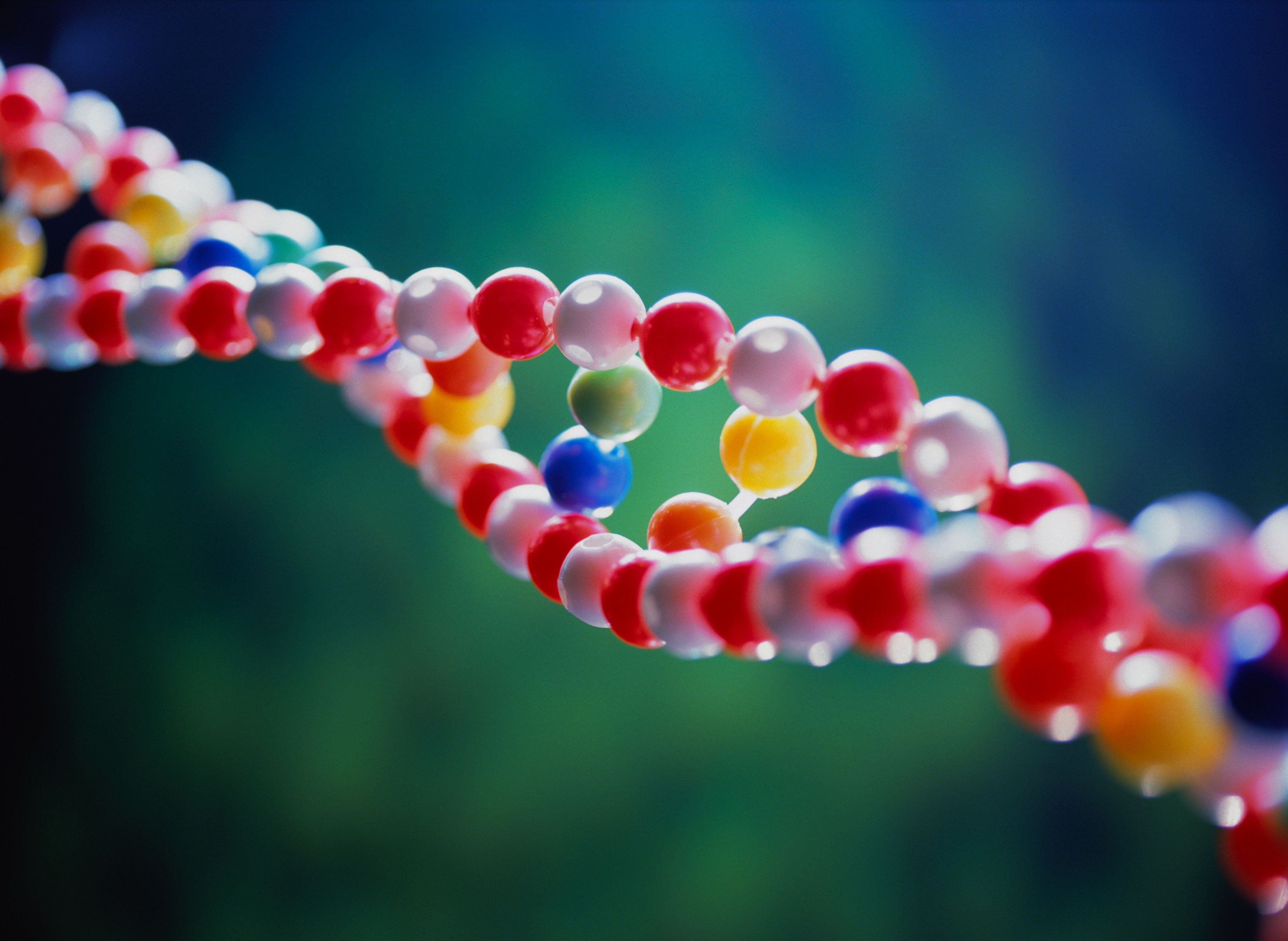
Name this structure

a)

double helix

b)

nucelotide

c)

twisted ladder

d)

hydrogen bond

20.

The letters of the DNA alphabet are:

a)

A, C, G and T

b)

A, O, G, and T

c)

C, G, P and T

d)

C, G, T and D

21.

A nucleotide is the building block of:

a)

DNA

b)

Protein

c)

Cell membranes

d)

Mitochondria

22.

The sides of the DNA ladder are made of alternating:

a)

Letters from the DNA alphabet

b)

Sugar and phosphate

c)

Sugar and protein

d)

Phosphate and sulphur

23.
The building block of nucleic acids are nucleotides.  Nucleotides are composed of a sugar, a phosphate group, and a _________________ base.
a)
oxygen
b)
hydrogen
c)
nitrogen
d)
carbon
24.

The sugar in DNA is ?

a)

sucrose

b)

glucose

c)

deoxyribose

d)

fructose

25.
Which 2 molecules form the sides (backbone) of the DNA ladder?
a)
deoxyribose sugar and adenine
b)
deoxyribose sugar and a hydrogen bond
c)
deoxyribose sugar and the nucleus
d)
deoxyribose sugar and phosphate
26.
The two strands of nitrogenous bases in DNA are joined by which type of bond?
a)
polar bonds
b)
ionic bonds
c)
covalent bonds
d)
hydrogen bonds
27.
order of replication
a)
3, 4, 2, 1
b)
3, 1, 4, 2
c)
2, 1, 4, 3
d)
3, 4, 1, 2
28.
Place the following in sequential order
1. Recoil
2. Straightens the double helix
3. Breaks Hydrogen bonds
4. Adds Free nucleotides
a)
1, 2, 3, 4
b)
3, 4, 2, 1
c)
3, 2, 4, 1
d)
2, 3, 4, 1
29.

The new DNA strand formed after DNA replication is an exact copy of its parent strand

a)

True

b)

False

30.

The picture below shows the steps of DNA replication beginning with step one and ending with step three.


​Because you are reusing the old, or parent, DNA strand DNA replication is said to be

a)

Semi- Conservative

b)

Semi-discontinuous

c)

Continuous

d)

Fully-Conserveative

31.
Chromosomes and genes are replicated during
a)
prophase
b)
telophase
c)
metaphase
d)
interphase
32.
The uncontrolled division of cells can lead to:
a)
cancer
b)
mitosis
c)
meiosis
d)
cellular recombination
33.
The process of going from a diploid cell to a haploid cell occurs during
a)
mitosis
b)
meiosis
c)
binary fission
d)
interphase
34.

Crossing over involves:

a)

synapsis

b)

formation of a tetrad

c)

alignment of homologous chromosomes

d)

all of the above

35.
What phase does a cell stay in the longest?
a)
interphase
b)
cell division
c)
cytokinesis
d)
mitosis
36.
What is the result of mitosis?
a)
unique parent cells
b)
unique daughter cells
c)
identical parent cells
d)
identical daughter cells
37.
When a chromosome is NOT dividing, what form does it take?
a)
chromatid
b)
chromatin
c)
chromosome
d)
centromere
38.
The point of attachment between two sister chromatids is called
a)
kinetochore
b)
centromere
c)
chromosome
d)
spindle
39.

The correct order of the stages of interphase is

a)

M, G1, G2, S, and cytokinesis

b)

G1, S, M, G2

c)

G1, S, G2, M

d)

none of these

40.
If a sample of human cheek cells was examined, the cells should have a chromosome number that is
a)
haploid; 23
b)
diploid; 23
c)
haploid; 46
d)
diploid; 46
41.
Which best describes the role of p53 protein in the cell cycle
a)
it makes sure organelles are properly replicated
b)
it makes sure that the cytoplasm is equally divided
c)
it make sure DNA is free of errors
d)
It makes sure the DNA is copied
42.

G1 is associated with what event?

a)

normal growth and cell function

b)

DNA replication

c)

The beginning of mitosis

d)

breakdown of the nuclear membrane

43.

The mitotic spindle (microtubules) plays a role in which process?

a)

cytokinesis

b)

condensation of chromatin into chromosomes

c)

dissolving the nuclear membrane

d)

separation of sister chromatids

44.

The amount of DNA in a cell is measured right after mitosis and found to be 8 picograms. How many picograms of DNA would be found in a nucleus in the G2 phase?

a)

4

b)

8

c)

16

d)

24

45.

Why do cells such as neurons divide very rarely?

a)

They no longer have active nuclei

b)

They have entered G0

c)

they can no longer break down cyclins

d)

They no longer produce MPF

46.

What two components make an active MPF

a)

a growth factor and a mitotic factor

b)

ATP synthetase and a protease

c)

cyclin and tubulin

d)

cyclin and a cyclin-dependent kinase

47.

Which molecule triggers the cell to pass the G2 checkpoint and enter mitosis?

a)

PDGF

b)

MPF

c)

cyclin

d)

cdk

48.

Cells from cancerous tumors usually have an unusual number of chromosomes, and unusual looking chromosomes. What could explain this?

a)

cancer cells are in G0

b)

cancer cells are arrested in the S phase

c)

cell cycle check points are not in place

d)

transformation introduces new chromosomes to cells

49.
When a plant cell goes through cell division,  _____________.
a)
the 2 new nuclei are separated by the cell membrane pinching off.
b)
4 new cells are formed
c)
a cell plate forms, dividing the 2 new nuclei
d)
None of the above
50.
The stages of mitosis in order
a)
Metaphase, Anaphase, Prophase, Telophase
b)
Prophase, Anaphase, Metaphase, Telophase
c)
Prophase, Metaphase, Anaphase, Telophase
d)
Anaphase, Prophase, Telophase, Metaphase
51.
The purpose of meiosis is to form ________ cells.
a)
body
b)
sex
c)
somatic
d)
brain
52.
Why do we need meiosis?
a)
To double the number of chromosomes going into sex cells
b)
To halve the number of chromosomes going into sex cells
c)
To triple the number of chromosomes going into sex cells
d)
To not change the number of chromosomes going into sex cells
53.
Meiosis makes sperm and egg cells. In humans, sperm and egg cells each have _____ chromosomes. Therefore a fertilized human egg cell (sperm and egg cell combined) would create a cell with _____ chromosomes.
a)
23, 46
b)
46, 23
c)
2, 4
d)
50, 100
54.
What is it called when a sperm and egg meet?
a)
meiosis
b)
fertilization
c)
cell division
d)
mitosis
55.
a)

Anaphase

b)

Cytokinesis

c)

Telophase

d)

Metaphase

56.

Suppose that in sheep, a dominant allele (B) produce black hair and a recessive allele (b) produce white hair. If you saw a black sheep, you would be able to identify

a)

its phenotype for hair color

b)

its genotype for hair color

c)

the genotype of only one of its parents

d)

the phenotype of both of its parents

57.
One of the main reasons genes assort independent of one another  is that 
a)
they produce unrelated traits
b)
they produce related traits
c)
they are on the same chromosome
d)
they are on different chromosomes.
58.

If 2n = 48 for a particular cell, then the chromosome number in each cell after meiosis would be

a)

96

b)

48

c)

24

d)

12

59.
What is the percentage of homozygous recessive offspring?
a)
0%
b)
25%
c)
50%
d)
75%
60.
Green peas are dominant (G) to yellow peas (g). What is the genotype for a hetereozygous dominant offspring?
a)
Gg
b)
gg
c)
GG
61.
Which of the following is a heterozygous dominant genotype? 
a)
GG
b)
gg
c)
GGG
d)
Gg
62.
What percentage of the offspring will be purebred dominant?
a)
0%
b)
25%
c)
50%
d)
75%
63.
Dominant alleles are represented by a(n)
a)
phenotype
b)
lower case letter
c)
upper case letter
d)
punnett square 
64.
What type of traits "show up" in a population more often?
a)
dominant
b)
recessive
c)
punnett squares
d)
alleles
65.
True or False:
A heterozygous dominant trait can be written as BB.
a)
True
b)
False
66.
D = dimples        d = no dimples 
What is the genotype for a homozygous recessive offspring?
a)
DD
b)
Dd
c)
dd
67.
What is the percentage of a homozyogus dominant offspring?
a)
75%
b)
50%
c)
25%
d)
0%
68.
Round (R) seeds are dominant to wrinkled (r) seeds.
What is the genotype for a homozygous dominant offspring?
a)
RR
b)
Rr
c)
rr
69.
If two purebred species (BB) are crossed, what percentage of their offspring would be BB?
a)
25%
b)
50%
c)
75%
d)
100%
70.
What do you call the physical expression of a gene?
a)
genotype
b)
dominant
c)
phenotype
d)
allele
71.
Short hair (S) is dominant to long hair (s).
What is the genotype for an offspring with long hair?
a)
SS
b)
Ss
c)
ss
72.

The instructions of this allele are covered up by the other allele in a homologous pair. Symbolized by a small letter.

a)

Homozygous

b)

Dominant

c)

Recessive

d)

Genetics

73.

A genotype where only dominant alleles were passed on

from both parents for one trait

BB AA TT LL

a)

Homozygous Recessive

b)

Homozygous Dominant

c)

Dihybrid

d)

Heredity

74.

During meiosis and gamete formation, homologous (paired up) alleles split up

a)

Phenotype

b)

Law of Segregation

c)

Genotype

d)

Dihybrid Cross

75.

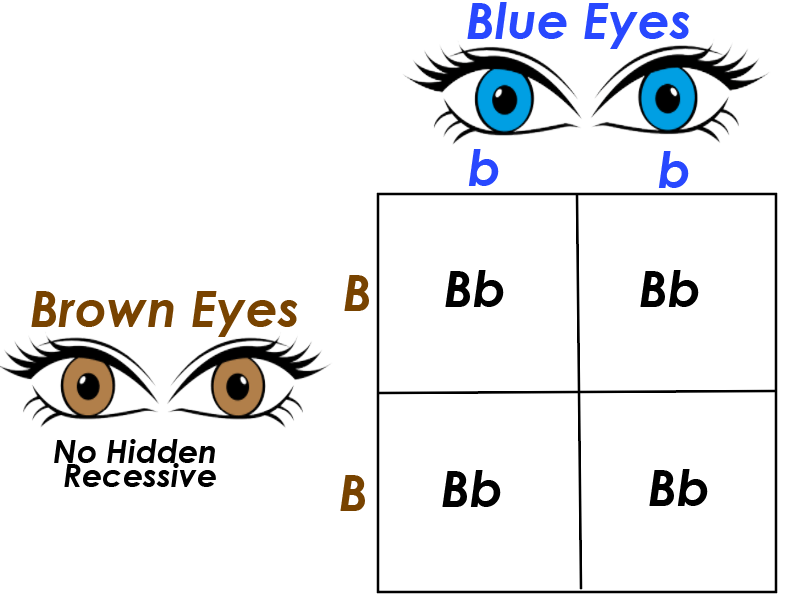
The genetic cross between two parents for one trait:

Example BB x bb

B = dominant for brown

b = recessive for blue

a)

Incomplete Dominance

b)

Dihybrid Cross

c)

Monohybrid Cross

d)

Iron Cross

76.

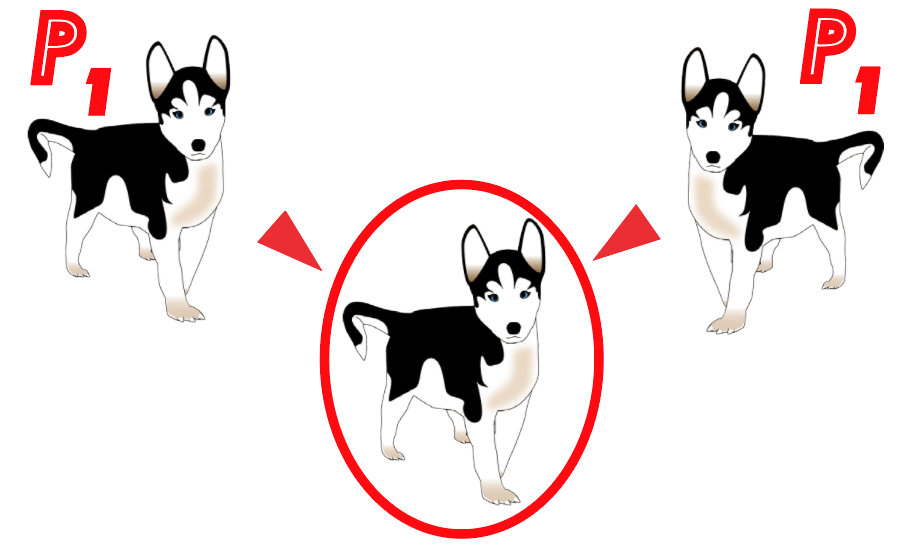
Referring to the original parents.

a)

P1

b)

F1

c)

F2

d)

Homozygous

77.

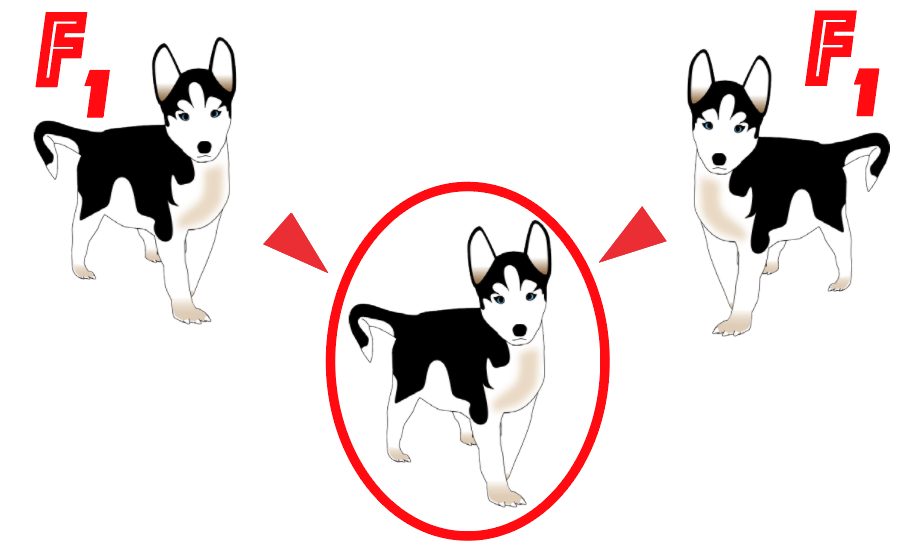
Second Filial Generation: the offspring of F1

a)

P1

b)

F1

c)

F2

d)

Homozygous Recessive

78.

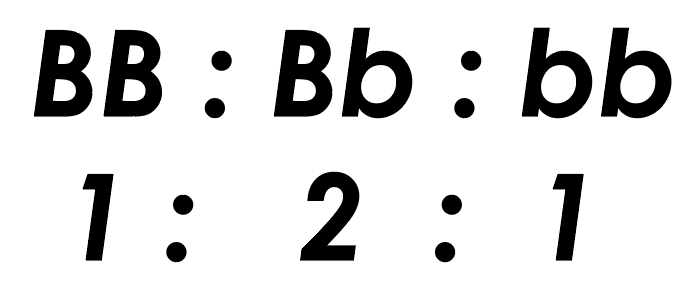
The ratio of homozygous dominant to heterozygous

to homozygous recessive offspring

a)

Genotypic Ratio

b)

Phenotypic Ratio

c)

Monohybrid Cross

d)

Homologous Pair

79.

The ratio of phenotypes in a Punnett Square

a)

Phenotypic Ratio

b)

Genotypic Ratio

c)

Dihybrid Cross

d)

Independent Assortment

80.

a trait that is masked unless 2 copies are present is ________________________

a)

recessive

b)

dominant

c)

weak

d)

hidden

81.
incomplete dominance means that there traits are,,,
a)
expressed equally
b)
dominant
c)
recessive
d)
blended
82.

What is NOT a possible genotype for someone with type B blood?

a)

IBIB

b)

IAIB

c)

IBi

83.

What is the genotype of a person with type A blood, who had a father with type O blood?

a)

IAIB

b)

IAi

c)

IAIA

d)

ii

84.

What is the phenotype of a person with the genotype IBi?

a)

type A

b)

type O

c)

type B

d)

type AB

85.

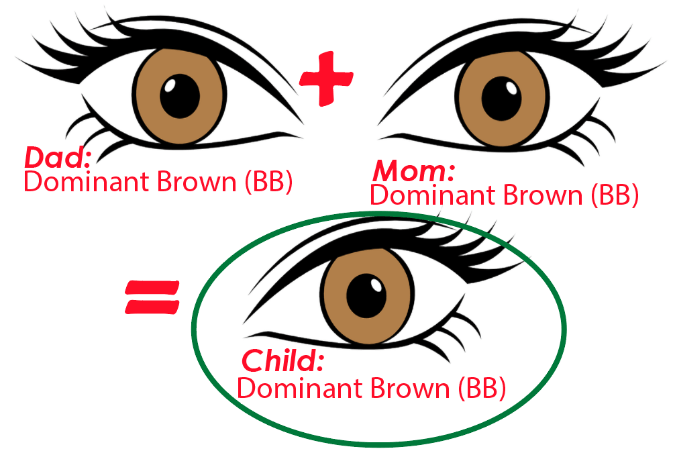
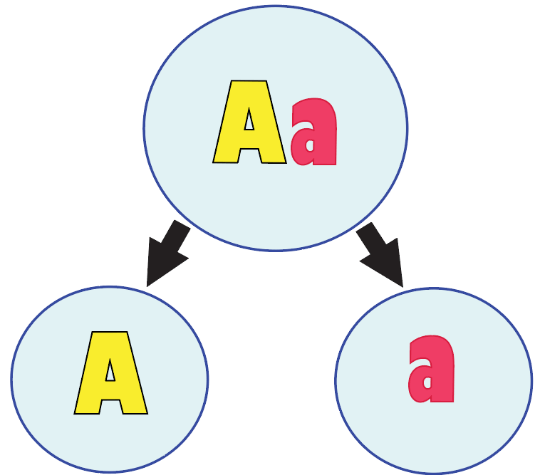
What pattern of inheritance is shown in this image?

a)

Codominance

b)

Incomplete dominance

c)

Complete dominance

86.

What pattern of inheritance is shown in this image?

a)

Codominance

b)

Incomplete dominance

c)

Complete dominance

87.

A man with type AB blood is accused of being the father of a type O baby. The mother is type A. Could this man be the father?

a)

Yes

b)

No

88.
Which term(s) best describes the inheritance of human blood types? 
a)
incomplete dominance and multiple alleles
b)
codominance and epistasis
c)
codominance and multiple alleles
d)
incomplete dominance and codominance
89.

A calico cat shows both the traits for orange fur and black fur. What kind of allele expression is this?

a)

Incomplete Dominance

b)

Codominance

c)

Independent assortment

d)

Recessive inheritance

90.

A roan cow shows co-dominance in fur color (red and white). What is the phenotype ratio expected if a roan cow and a roan steer mate together?

a)

4/4 Red and White

b)

2/4 Red, 2/4 White

c)

2/4 Red, 2/4 Roan, 0/4 White

d)

1/4 Red, 2/4 Roan, 1/4 White

91.

Snap dragon color is a incomplete dominant trait. A red flower (RR) is crossed with white flower (R'R')? What color are flowers that are RR'?

a)

Red

b)

Red and White

c)

White

d)

Pink

92.

A bubble guppy with a yellow tail has offspring with a bubble guppy with a red tail. The offspring have orange tails. What is this an example of?

a)

Codominance

b)

Incomplete Dominance

c)

Multiple Alleles

d)

Polygenic Triats

93.

There are many different alleles for fur color in cats. What is this an example of?

a)

Codominance

b)

Incomplete Dominance

c)

Multiple Alleles

d)

Polygenic Traits

94.

Flowers can be red or green. What heredity is displayed?

a)

Complete dominance

b)

Incomplete dominance

c)

Codominance

d)

Polygenic trait

95.

Flowers can be purple, yellow or purple & yellow. What heredity is displayed?

a)

Codominance

b)

Complete dominance

c)

Incomplete dominance

d)

Epistatic gene is involved

96.

Which organelle is the location where protein is made?

a)

Ribosome

b)

Nucleus

c)

Cytoplasm

d)

Nucleotide

97.

During transcription, this type of ribonucleic acid is responsible for copying the DNA and brining it out of the nucleus.

a)

tRNA

b)

mRNA

c)

rRNA

d)

dRNA

98.

When these bond together, they form a protein

a)

Amino Acids

b)

Peptide Bonds

c)

Ribose

d)

Nucleotides

99.

These building blocks consist of a sugar, phosphate, and nitrogen base.

a)

Ribose

b)

Nucleotide

c)

Gene

d)

Protein

100.

mRNA occurs during this process

a)

Translation

b)

Transcription

c)

Replication

d)

Delivery

101.

Which of the following is the complementary mRNA sequence to this DNA strand: AACTGAA

a)

UUGACUU

b)

TTGACTT

c)

AACTGAA

d)

AACUGAA

102.
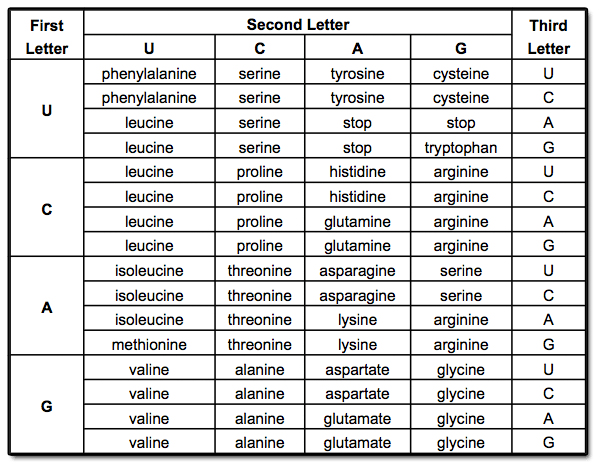
What is the term for a three-nucleotide sequence that codes for an amino acid?
a)
base
b)
codon
c)
amine
d)
serine
103.
The process to go from DNA to mRNA is _______
a)
translation
b)
transcription
c)
replication
104.
The process to go from mRNA to a protein is called ____
a)
transcription
b)
rRNA
c)
replication
d)
translation
105.
What amino acid is represented by the codon UUA?
a)
Phenylalanine
b)
Tyrosine
c)
Leucine
d)
Stop codon
106.
A sugar, a phosphate group, and a nitrogen base form the building blocks of which organic compound?
a)
carbohydrates
b)
nucleic acids
c)
lipids
d)
proteins
107.
Which of the following is the template for the production of RNA within a cell?
a)
DNA
b)
protein
c)
ATO
d)
carbohydrate
108.
Genetic info flows in one direction. Which best represents this flow?
a)
DNA-protein-RNA
b)
Protein-RNA-DNA
c)
RNA-protein-DNA
d)
DNA-RNA-protein
109.
In RNA, Uracil pairs with ______. 
a)
cytosine
b)
adenine
c)
guanine
d)
thymine
110.

Why must transcription occur where DNA can be found?

a)

because DNA can't leave

b)

because ribosomes are in the nucleus

c)

because DNA polymerase is found there

d)

because helicase unzips the DNA

111.
What is the location in the cell for transcription?
a)
nucleus
b)
cytoplasm
c)
ribosome
d)
mitochondria
112.
What is the location in the cell for translation?
a)
nucleus
b)
mitochondria
c)
ribosome
d)
chloroplast