wayground logo

Free Printable Worksheets

Font size

S
M
L
XL
Worksheets

CA 1 Review

Total questions: 150

Worksheet time: 4hrs 2mins

Name
Class
Date
1.

Why are advantageous traits more likely to be passed onto offspring?

a)

Because they are more likely to survive and reproduce.

b)

Because they come from dominant alleles.

c)

Because they come from recessive alleles.

d)

Because the organism knew it needed that trait, survives, and passes it on.
2.
The differences among a species, like different bird beaks, are called
a)
genes.
b)
variations.
c)
traits.
d)
theories.
3.
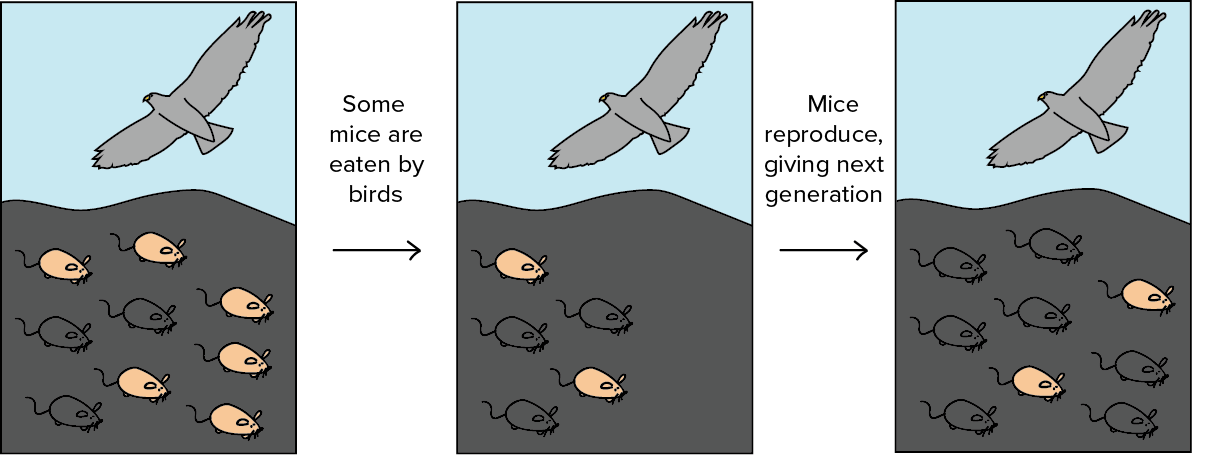
Why is the mouse population changing over time?
a)
The light mice can reproduce more successfully than the dark mice
b)
The hawks eat more dark mice than light mice because the dark mice taste better
c)
The hawks eat more light mice than dark mice because they can see the light mice more easily
d)
The hawks eat more dark mice than light mice because they can see the dark mice more easily
4.
What process is being shown in this image?
a)
Variation
b)
Natural Selection
c)
Selective Breeding
d)
Homeostasis
5.

"Organisms that are better adapted to the environment survive to pass traits to their offspring" is the definition of

a)

Natural Selection

b)

Evolution

c)

Selective Breeding

d)

Artificial Selection

6.
The long and sharp beak of a woodpecker is an example of:
a)
Natural Selection
b)
Selective Breeding
7.
Do organisms "decide" to evolve and change?
a)
Yes, they know they need to change to survive 
b)
No, they change because of natural selection
8.
Domesticated dogs are an example of:
a)
Natural Selection
b)
Selective Breeding
9.

An example of selective breeding is

a)

a dog breeder mating 2 dogs to make more dogs

b)

a farmer grows bees to pollinate the plants on his farm

c)

a person pollinates 2 white rose plants to only create white roses

10.
Which is another term for selective breeding?
a)
Artificial selection
b)
Natural Selection
c)
Intelligent selection
11.

Which is NOT a result of selective breeding?

a)

Large seedless watermelons that consumer demand

b)

Bright oranges that are all about the same size

c)

An insect that matches the color of the environment

d)

A dog that has been bred to have short hair

12.
Scientists genetically engineer corn to be immune to corn diseases. This is BENEFICIAL because
a)
This causes corn to be less likely to reproduce
b)
This causes corn to be less likely to survive
c)
This causes corn to be smaller
d)
This allows increased production of corn
13.

The purpose of selective breeding is to

a)

get bigger animals

b)

get smaller animals

c)

create animals with desirable traits

d)

create animals with bad traits

14.

When selective breeding food crops what might a farmer select for? (Select all that apply.)

a)

The plant the produced the most grain

b)

The plant the produced the largest sized grain

c)

The plant that was the most disease resistant

d)

The plant that was the smallest

e)

The smelliest plant

15.

Which of these is the first step in selective breeding flowers.

a)

Repeat the process only with the offspring with the desired traits

b)

watch the seeds grow

c)

Choose plants that have the desired trait to pollinate

d)

chose which trait is desirable

16.

Which of these is the third step in selective breeding flowers.

a)

Choose which trait is desirable

b)

Watch the seeds grow

c)

Choose plants that have the desired trait to pollinate

d)

Repeat the process only with the offspring with the desired traits.

17.

"Survival of the fittest" describes which theory

a)

Natural selection

b)

Selective breeding

18.

Natural selection is where ___________ decides which traits should be passed on.

a)

nature

b)

a human

c)

traits

d)

evolution

19.

How can farmers best use selective breeding to increase apple production?

a)

By limiting the number of trees growing so they can have more space.

b)

By choosing trees that are the largest in size.

c)

By increasing the amount of water and fertilizer the trees receive.

d)

By choosing trees that consistently have the most apples.

20.

Problems with animals that are selectively bred include:

a)

Being more disease resistant

b)

Producing more meat

c)

Being more likely to suffer from genetic disease

d)

Being more genetically diverse

21.
What is the purpose of a dichotomous key?
a)
to find a common ancestor
b)
to show the evolution of organisms
c)
to show relationships between organisms
d)
to identify organisms
22.
What step do we always start with when using dichotomous keys?
a)
1
b)
2
c)
3
d)
4
23.
When using a dichotomous key to identify organisms, what do we look at?
a)
physical features
b)
weather patterns
c)
environment
d)
diet
24.
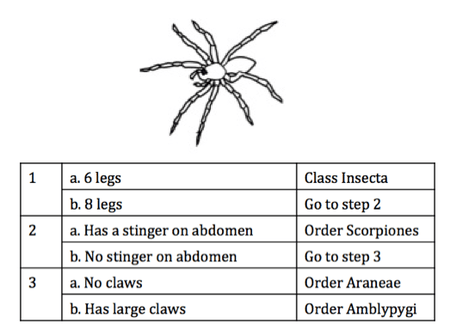
An illustration and a dichotomous key are given. What is the correct classification for this organism?
a)
Class Insecta
b)
Order Amblygygi
c)
Order Araneae
d)
Order Scorpiones
25.

Which of the following is an accurate description of the fiddler crab?

a)

3 Paris of walking legs on both sides

b)

Two propodus

c)

3 Chelipeds

d)

A pair of eyes

26.

How many options should every branch in a dichotomous key have?

a)

1

b)

2

c)

3

d)

4

27.
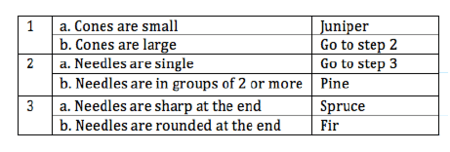
A dichotomous key for trees is provided. Hikers found a tree that has large brown cones and single sharp needles. What species of tree have the hikers found?
a)
Juniper
b)
Pine
c)
Spruce
d)
Fir
28.
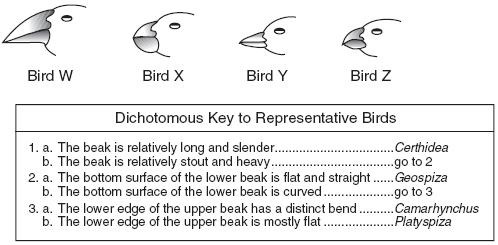
What is the name of bird Z?
a)
Certhidea
b)
Geospiza
c)
Camarhynchus
d)
Platyspiza
29.
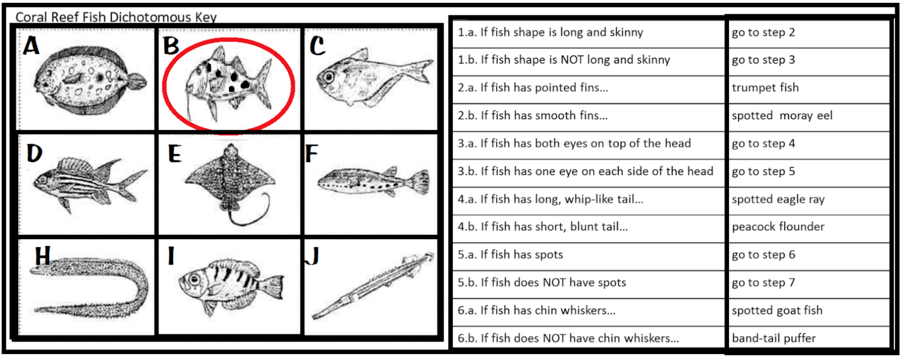
Using this dichotomous key, identity the name of the circled fish.
a)
band-tail puffer
b)
spotted goat fish
c)
peacock flounder
d)
trumpet fish
30.

Leaf S (3RD LEAF)

a)

Eastern white pine

b)

balsam poplar

c)

sweet gum

d)

ginko

31.

Identify leaf F

a)

Cydonia

b)

Magnolia

c)

Aesculus

d)

Fraxinus

e)

Ilex

32.

A student discovers an arachnid with a segmented abdomen, long legs, and a tail with no stinger.

The student uses the dichotomous key below to identify it.

1. a) Abdomen segmented.............go to 2

b) Abdomen not segmented ......go to 4

2. a) Abdomen with tail....................go to 3

b) Abdomen without tail...............go to 5

3. a) Tail with stinger..........................Scorpion

b) Tail without stinger.....................Whip scorpion

4. a) Legs longer than body.............Daddy Long Legs

b) Legs not longer than body……….Wind scorpion

5. a) Covered with spines .......................Mite

b) Few spines.....................................Tick

a)

Whip Scorpion

b)

Daddy Long Legs

c)

Mite

d)

Tick

33.

According to key above, which animal has wings covered by an exoskeleton and a round body?

a)

Ladybug

b)

Grasshopper

c)

Dragonfly

d)

Housefly

34.

Which leaf is shown in the drawing?

a)

Magnolia

b)

Redbud

c)

Sweetgum

d)

None of the above

35.
What are plants called in a food chain?
a)
Producers
b)
Consumers
c)
Decomposers
d)
Scavengers
36.
What are animals called in a food chain?
a)
Producers
b)
Consumers
c)
Decomposers
d)
Plants
37.
What are the organisms that break down dead stuff?
a)
Producers
b)
Consumers
c)
Decomposers
d)
Organisms
38.
What is the role of a producer?
a)
Use sunlight to make food
b)
Gain energy from eating other organisms
c)
Keep other species from overpopulating
d)

Breaking down dead things

39.
What's the role of consumers in a food chain?
a)
Use sunlight to make food 
b)
Eat other species and keep them from overpopulating
c)
Break down dead stuff
d)
Add nutrients to the soil
40.
What is the role of decomposers in a food chain?
a)
Use sunlight to make food
b)
Eat other organisms to gain energy
c)
Make the food for the whole food chain
d)
Break down dead organisms and add nutrients to the soil
41.

Which of these organisms would RECEIVE energy from the snake?

a)
Plant
b)
Rabbit
c)
Mouse
d)
Hawk
42.
Which of the following is a producer?
a)
Maple tree
b)
Sunfish
c)
Bunny
d)
Bear
43.
Producers get their energy from the ______.
a)
water
b)
Sun
c)
eating animals
d)
eating plants
44.
Which food chain is in the correct order?
a)
cat, grass, bird, snail
b)
bird, snail, grass, cat
c)
grass, snail, bird, cat
d)
grass, cat, bird, snail
45.

Molds, maggots, and worms are ________.

a)
decomposers
b)
producers
c)
consumers
d)
food chains
46.
A tree is a ....
a)
composer
b)
decomposer
c)
producer
47.
Humans are considered...
a)
consumers
b)
decomposers
c)
producers
48.
Frogs are considered...
a)
consumers
b)
decomposers
c)
producers
49.

an organism that gets energy from eating other things

a)

consumer

b)

producer

c)

energy pyramid

d)

decomposer

50.

an organism that makes its own food

a)

consumer

b)

producer

c)

herbivore

d)

omnivore

51.

an organism that eats only plants

a)

carnivore

b)

herbivore

c)

omnivore

52.

an organism that eats only meat

a)

carnivore

b)

herbivore

c)

omnivore

53.

an organism that eats both plants and animals

a)

carnivore

b)

herbivore

c)

omnivore

54.

shows one possible flow of energy

a)

food web

b)

food chain

c)

energy pyramid

55.

shows all possible flows of energy

a)

food web

b)

food chain

c)

energy pyramid

56.

shows how energy is passed from one organism to the next

a)

food web

b)

food chain

c)

energy pyramid

57.
A third-level consumer has to be which type?
a)
Carnivore.
b)
Decomposer.
c)
Producer.
d)
Herbivore.
58.
In a food web, arrows point at:
a)
who gets energy.
b)
who gets eaten.
59.
Which of the following is a herbivore?
a)
cricket
b)
frog
c)
hawk
d)
shrew
60.
If the grasshopper were to be removed completely from the food web, what organism would be most effected?
a)
The squirrel
b)
The shrew
c)
The deer
d)
The rabbit
61.
Which organism recieves the least amount of energy from the producer?
a)
Owl
b)
Grasshopper
c)
Lilypad
d)
Mouse
62.
Which organism in this food chain is a secondary consumer?
a)
Fish
b)
Grass
c)
Grasshopper
d)
Hawk
63.
Which organism in this food chain is a tertiary consumer?
a)
Fish
b)
Grass
c)
Grasshopper
d)
Hawk
64.
In this food pyramid, which level has the greatest amount of energy?
a)
Producers
b)
Primary Consumers
c)
Secondary Consumers
d)
Tertiary Consumers
65.
How much energy is passed from one trophic level to the next?
a)
1%
b)
10%
c)
50%
d)
100%
66.
an organism that can produce its own food through photosynthesis
a)
consumer
b)
heterotroph
c)
autotroph
d)
herbivore
67.
An organism that eats the secondary consumer.
a)
Primary Consumer
b)
Secondary Consumer
c)
Tertiary Consumer
d)
Consumer
68.
Organisms which carry out the process of decomposition by breaking down dead or decaying organisms.
a)
Consumer
b)
Producer
c)
Decomposer
d)
Herbivore
69.
Which type of consumer eats plants only?
a)
Herbivores
b)
Omnivores
c)
Carnivores
d)
Scavengers
70.
Which type of consumer eats meat only?
a)
Producers
b)
Herbivores
c)
Carnivores
d)
Omnivores
71.
Which type of consumer eats meat and plants?
a)
Herbivores
b)
Carnivores
c)
Omnivores
d)
Plants
72.
Which type of consumer is always a first consumer?
a)
Herbivore
b)
Omnivore
c)
Carnivore
d)
Producer
73.
Which type of consumer could be a first or second consumer?
a)
Herbivore
b)
Omnivore
c)
Carnivore
d)
Producer
74.
Which of these is a decomposer?
a)
Fungi
b)
Hawk
c)
Dog
d)
Grass
75.
Which of these is true about this food web?
a)
The Owl gets its energy from the producer.
b)
The Lion gets its energy only from a wild cat.
c)
The Kite gets its energy from the goat.
d)
The Mouse is most likely to die, several ways.
76.
The ___% rule states that only ____% of energy is transferred to the next trophic level.
a)
10%
b)
25%
c)
50%
d)
100%
77.
What are "trophic levels"?
a)
Levels in a food web/food chain
b)
Levels of land in a mountain
c)
Animal diets
78.
Panda: Producer, consumer or decomposer?
a)
Producer
b)
Consumer
c)
Decomposer
79.
Cats ONLY eat meat. They are ____.
a)
Carnivores
b)
Herbivores
c)
Omnivores
80.
Raccoons eat meat AND plants. They are ____.
a)
Carnivores
b)
Herbivores
c)
Omnivores
81.
Which of the following is a "primary energy source"?
a)
Grass
b)
Sun
c)
Bacteria
d)
Soil
82.
Which habitat exhibits the greatest biodiversity?
a)
A habitat with 15 different species with about 300 individuals each
b)
A habitat with 10 different species with about 75 individuals each
c)
A habitat with 4 different species with about 150 individuals each
d)
A habitat with only one species with about 2000 individual
83.
How can humans best help an endangered species avoid extinction?
a)
they can feed the animals
b)
they can put the animals in a zoo
c)
they can protect the animal’s habitat
d)
they can take the animal to new habitats
84.
Why is biodiversity so important?
a)
Because all species depend on each other to survive, so if one becomes extinct another species that relies on it could go extinct as well
b)
Because it’s better to have only one variation of each species.
c)
Because it better to only have a few species on Earth.
d)
Honestly, I have no idea what biodiversity is!
85.
What factor does NOT affect biodiversity?
a)
Urbanization
b)
Planting Native Plants
c)
Overfishing
d)
Pollution
86.
A plant nursery only grew one type of tomato. All of their tomatoes died from the same disease. What was most likely true of the tomato plant population?
a)
a. It had too little biodiversity
b)
b. It had a lot of resistance to disease
c)
c. It had a few plants that were resistant to disease
d)
d. It had too much genetic variation
87.
In what way are humans most impacting the biodiversity of ecosystems around the world?
a)
a. We are putting too many organisms in zoos or keeping them as pets
b)
b. We are increasing biodiversity by breeding new species
c)
c. We are destroying the habitats of a large number of species
d)
d. Recreational hunting
88.
What does biodiversity mean?
a)
Only one species in an area.
b)
The different amount of species in an area
c)
All abiotic life
d)
Nitrogen fixation
89.
Biodiversity is the variety of ________ in a community.
a)
genes
b)
population
c)
species
d)
community
90.

Why is "A" less biodiverse than "B"?

a)

Image "A" is more biodiverse.

b)

Image "A" has many corn plants and this makes it have high "rich" biodiversity.

c)

Image "A" has a lot more plants than image "B"

d)

Even though "A" has a lot of corn plants they are all the same species and makes this a low "poor" biodiverse area.

91.
High biodiversity is 
a)
having a lot of the same organism.
b)
having a few of the same organism.
c)
having a lot of variety of different organisms.
d)
only having one of each organism. 
92.
What are the 3 types of Biodiversity 
a)
sedimentary, metamorphic, and igneous
b)
genetic diversity, Ecosystem diversity, species diversity
c)
 ionic, covalent and metallic
d)
mRNA, tRNA, rRNA
93.
What is ecosystem diversity...??..
a)
Number of different species in the biosphere.
b)
Regional extinction.
c)
A species whose numbers are so small that the species is at risk of extinction.
d)
The variety of ecosystems that are present in the biosphere.
94.
What is Species diversity?..?...
a)
the number or variety of species in the word or in a particular region 
b)
The range of genetic material present in a gene pool or population of a species.
c)
The variety of ecosystems that are present in the biosphere.
d)
A species whose numbers are so small that the species is at risk of extinction.
95.

Most wildfires are started by

a)

animals.

b)

lightning.

c)

people.

d)

meteors.

96.

Fires are considered wildfires if they are

a)

hot.

b)

uncontrolled.

c)

destructive.

d)

outside.

97.

Hurricanes form over

a)

the poles.

b)

water.

c)

continents.

d)

islands.

98.

Earthquakes are caused by movements of the crust or

a)

tsunamis.

b)

wildfires.

c)

hurricanes.

d)

volcanoes.

99.

Eighty percent of the Earth's crust was formed by

a)

volcanoes.

b)

landslides.

c)

hurricanes.

d)

wildfires.

100.

Category 5 would describe a very powerful

a)

tsunami.

b)

hurricane.

c)

earthquake.

d)

flood.

101.

What is the most common natural hazard?

a)

flood

b)

wildfire

c)

tornado

d)

landslide

102.

Which of the following does not come out of a volcano?

a)

ash.

b)

magma.

c)

rock.

d)

gases.

103.

A volcano can cause all of the following except

a)

tsunami.

b)

flood.

c)

earthquake.

d)

hurricane.

104.

Which continent does not have any tornadoes?

a)

Antarctica

b)

Australia

c)

Europe

d)

Africa

105.

The sliding down of a mass of earth or rock is

a)

a volcano.

b)

an eruption

c)

a landslide.

d)

an earthquake.

106.
what is this
a)
tornado 
b)
landslide
c)
typhoon 
d)
hurricane
107.
Floods happen when_________
a)
too much snow and winds are present
b)
too much rain in a short period of time
c)
too much rain in mountains
d)
too much rain inside a cave
108.
A large storm associated with low pressure, forms over water is called...
a)
Flood
b)
Hurricane
c)
Tsunami 
d)
Blizzard
109.
A spinning funnel cloud which causes much destruction is called a...
a)
Tornado 
b)
Earthquake
c)
Tsunami 
d)
Hurricane 
110.
A large wave created by an underwater earthquake is called a...
a)
Earthquake 
b)
Hurricane
c)
Tsunami 
d)
Flood
111.
Lava or ash spewing from a mountain vent.
a)
Earthquake
b)
Flood
c)
Drought
d)
Volcano
112.

A hurricane hits a coastal prairie and destroys the habitat. Years later there is an appearance of small plants with rapidly spreading roots on newly formed coastal sand dunes. This vegetation describes--

a)

a microhabitat

b)

primary succession

c)

secondary succession

d)

biodiversity

113.

What is the main difference between primary and secondary succession?

a)

primary begins with bare rocks and secondary starts having soil

b)

primary is the first stage and secondary is the second stage

c)

primary builds plant communities and secondary builds animal communities

d)

primary occurs after natural disasters and secondary occurs after disturbances to the ecosystem

114.
An extensive amount of snow over a short period is called a...
a)
Blizzard
b)
Flood
c)
Tsunami 
d)
Hurricane 
115.
A long period with no rain is called a...
a)
Earthquake
b)
Wildfire
c)
Drought
d)
Tornado 
116.

What catastrophic event is this? 

a)
Tsunami
b)
Tornado
c)
Hurricane
d)
Earthquake
117.

Where do most tornadoes happen?

a)

Mexico

b)

California

c)

Canada

d)

Tornado Alley in the United States

118.
Where do hurricanes form?
a)
In a river or stream
b)
Over the ocean
c)
At plate boundaries
d)
Under the Earth
119.

This catastrophic event starts by lightning or a camper forgetting a fire..

a)
Volcano
b)
Tornado
c)
Wildfire
d)
Drought
120.
A fast-spinning column of air that stretches down to the Earth's surface is called _____
a)
a hurricane
b)
a blizzard
c)
a tornado
d)
a drought
121.
Storms with blowing or falling snow, high winds, and cold temperatures are called _____
a)
hurricanes
b)
blizzards
c)
tornadoes
d)
droughts
122.
Storms with high winds and heavy rain that form over warm ocean waters are called _____
a)
hurricanes
b)
blizzards
c)
tornadoes
d)
droughts
123.
When too much rain forces streams, rivers and lakes to overflow it's called _____
a)
a hurricane
b)
a flood
c)
a tornado
d)
a drought
124.
When an area doesn't receive enough rainfall, drying up rivers and lakes, it's called _____
a)
a hurricane
b)
a flood
c)
a tornado
d)
a drought
125.
How do the conditions for a tornado differ from the conditions for a hurricane?
a)
Tornadoes never form when there is rain, while hurricanes always form with rain.
b)
Tornadoes form under low pressure, while hurricanes form under high pressure
c)
Tornadoes form in a stable atmosphere, while hurricanes form in an unstable atmosphere 
d)
Tornadoes form over land, while hurricanes form over bodies of water
126.
What storm is a funnel shaped cloud?
a)
tornado
b)
hurricane
c)
thunderstorm
127.
What are thunderstorms?
a)
a storm with thunder and lighting and typically also heavy rain or hail
b)
a storm that can be the same as thunderstorms, but even more dangerous
c)
a mobile, destructive vortex of violently rotating winds having the appearance of a funnel shaped cloud and advancing beneath a large storm system.
d)
a huge storm with strong winds and storm surges
128.
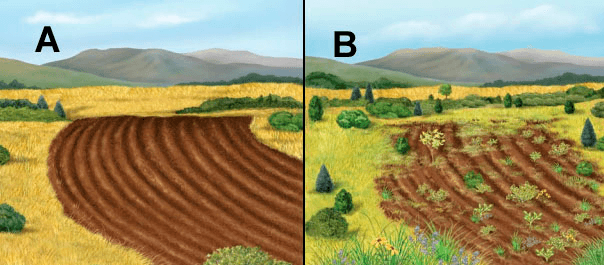
What is the order of succession shown in this figure?
a)
A, B, C, D
b)
B, A, D, C
c)
C, D, A, B
d)
D, A, B, C
129.
What type of succession is shown going from figure A to figure B?
a)
primary succession
b)
ecological succession
c)
secondary succession
d)
intermediate
130.
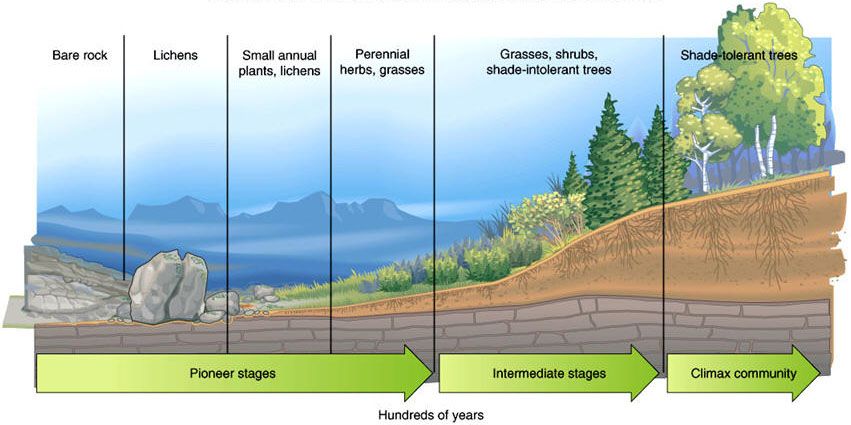
The picture shows what type of succession?
a)
primary
b)
secondary
c)
tertiary
d)
quadanary
131.
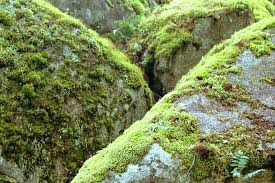
What are examples of pioneer species in a primary succession?
a)
Bushes and Shrubs
b)
Oak trees
c)
Mossess and Lichens 
d)
A rose Bush
132.
Final illustration (#8) shows
a)
pioneer species
b)
climax community
c)
only biotic factors
d)
only abiotic factors
133.
Succession type?
a)
primary succession
b)
secondary succession
c)
tertiary succession
d)
variable succession
134.
What is the most important function of pioneer species?
a)
To create rocks
b)
To create soil and add nutrients to the environment 
c)
To look nice
d)
Food for animals 
135.
Natural disasters such as flooding and tornadoes are linked to ________________.
a)
primary
b)
secondary
c)
old field
d)
ecosystem
136.

Which of the following best describes primary succession?

a)

Volcano wipes out ecosystem that gradually grows back from ash covered soil

b)

Volcano creates a new island of rock that must break down to form an ecosystem

c)

Forest fire burns down forest that must bounce back over time

d)

Tornado destroys a crop that must slowly grow back over time.

137.

What is an example of a disturbance that could bring about secondary succession?

a)

Humans cut down many trees in a small region

b)

A volcanic eruption covers a village in lava.

138.

Why does biodiversity increase during the course of succession?

a)

Biodiversity refers to the difference in ages of organisms, so some organisms arrive earlier than others.

b)

Over time, the same trees begin to reproduce and take over an area.

c)

Many populations of organisms gradually begin to occupy the same area to create a climax community.

d)

Many organisms move in to the area for a short amount of time, then leave to find a better habitat.

139.

Humans often build asphalt or concrete roads to travel through areas, such as forests. After many years, plants can be seen growing on the roads. What kind of succession is this?

a)

Primary Succession

b)

Secondary Succession

c)

Tertiary Succession

d)

Quaternary Succession

140.

What is the main difference between primary and secondary ecological succession?

a)

Primary begins WITHOUT soil; Secondary begins WITH soil

b)

Primary is the first state and secondary is the second stage

c)

Primary builds plant community; secondary builds animal community

d)

Primary begins WITH soil; Secondary begins WITHOUT soil

141.

Which is faster: Primary or Secondary Succession?

a)

Primary Succession

b)

Secondary Succession

c)

Both Take The Same Amount of Time

142.

Simba lives on the African continent.What is the name of the kindom?

a)

Hakuna Matata

b)

The Pride Lands

c)

Motunui

d)

The Elephant Graveyard

143.

What are Timon and Pumbaa?

a)

Pig and Squirrel

b)

Porcupine and Hamster

c)

boar and mastodon

d)

Warthog and Meerkat

144.

WHAT IS THE NAME OF SIMBA'S MOTHER?

a)

Amidala

b)

Sarabi

c)

Sargas

d)

Nala

145.

WHERE DOES SCAR HAVE THE SCAR?

a)

Right eye

b)

right leg

c)

Left eye

d)

Neck

146.

Who is the newborn?

a)

The son of the elephant

b)

The son of the monkey

c)

The son of the king

147.

Complete the sentence

"In the big circle of..."

a)

nature

b)

life

c)

love

148.

What is the meaning of "Hakuna matata"?

a)

no worries for the rest of your days

b)

no luck for the rest of your days

c)

no joy for the rest of your days

149.

Who brings Simba "home"?

a)

Zazu

b)

Scar

c)

Nala

150.

How many Lion King movies are in the animated franchise? Not counting CGI live action.

a)

One

b)

Two

c)

Three

d)

Four