wayground logo

Free Printable Worksheets

Font size

S
M
L
XL
Worksheets

2022 ~ Unit I TEST Practice

Total questions: 155

Worksheet time: 2hrs 17mins

Name
Class
Date
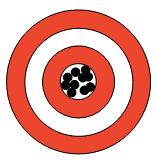
1.
This bullseye demonstrates...
a)
High Accuracy & High Precision
b)
High Accuracy & Low Precision
c)
Low Accuracy & High Precision
d)
Low Accuracy & Low Precision
2.

How close a measurement is to the true value is called..

a)

Accuracy

b)

Precision

c)

Significant

d)

Estimate

3.
When a measurement is repeatable and consistent it is said to have...
a)
High precision
b)
Low precision
c)
High accuracy
d)
Low accuracy
4.
A set of data are all close to each other, but they are not close to the actual value.  This set of data can be described as...
a)
accurate
b)
precise
c)
both precise and accurate
5.
A set of data are all close to each other, and they are close to the actual value.  This set of data can be described as...
a)
accurate
b)
precise
c)
both precise and accurate
6.
?
a)
High Accuracy & High Precision
b)
High Accuracy & Low Precision
c)
Low Accuracy & High Precision
d)
Low Accuracy & Low Precision
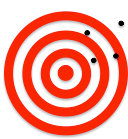
7.

Describe the accuracy and precision of the image

a)

Very accurate and somewhat precise

b)

Very accurate but not precise at all

c)

Not accurate at all but very precise

d)

not accurate and not very precise

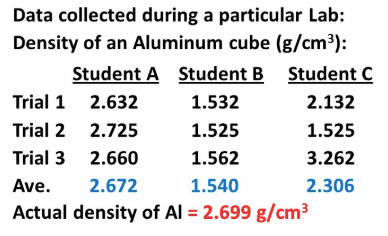
8.

Which student is the most ACCURATE?

a)

A

b)

B

c)

C

9.
a)

A

b)

B

c)

C

d)

D

e)

E

10.
a)

A

b)

B

c)

C

d)

D

11.


(a)  

12.
Which of the following numbers has three significant figures?
a)
1014 miles
b)
101 feet
c)
1000 yards
d)
all of the choices
13.
How many significant figures does the following number have: 0.002040
a)
6
b)
4
c)
3
d)
2
14.
How many significant figures does the following number have: 100.00210
a)
7
b)
5
c)
10
d)
8
15.
Round 0.010229 to four significant figures
a)
1022
b)
1023
c)
0.01023
d)
0.01022
16.
What is 0.658 rounded to 1 significant figure?
a)
0
b)
0.66
c)
0.7
d)
0.658
17.

What is the length of the object in centimeters?

a)

3.40 cm

b)

4.3 cm

c)

3.5 cm

d)

1 1/4 inches

18.

What is the volume of the liquid in this graduated cylinder?

a)

19 mL

b)

35 mL

c)

24.0 mL

d)

26.0 mL

19.

Which answer best approximates the metric temperature reading on the thermometer?

a)

82.9 F

b)

86 C

c)

30 C

d)

30.0 C

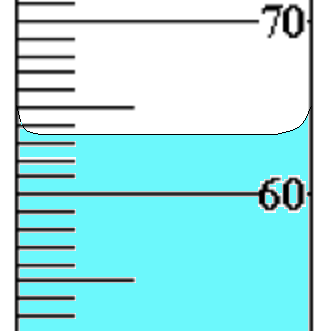
20.

Read the graduated cylinder to the appropriate precision. Which answer is most appropriate?

a)

6.3 mL

b)

6 mL

c)

6.61mL

d)

6.31 mL

21.
What is the volume of the liquid in this graduated cylinder?
a)
8.6 mL 
b)
86 mL 
c)
8.06 mL 
d)
.86 mL
22.
On this digital scale, which digit is the uncertain digit?
a)
1
b)
2
c)
6
d)
4
23.
Calculate 5.50 cm + 5.50 cm and give your answer with the appropriate number of significant figures.
a)
11 cm
b)
11.0 cm
c)
11.00 cm
d)
11.000 cm
24.
How many significant figures will be in the answer to the following question:
7.62 x 6.98 x 3.2645
a)
1
b)
2
c)
3
d)
4
25.
Calculate 12.34 + 1.234 + 0.1234
a)
13.6974
b)
13.697
c)
13.70
d)
13.7
26.

In division and multiplication, the answer should have the same number of significant figures as the

a)

number in the calculation with the fewest significant figures.

b)

number in the calculation with the most significant figures.

c)

average number of significant figures in the calculation.

d)

total number of significant figures in the calculation.

27.

Samples with masses of 0.12 g, 1.8 g, and 0.562 g are mixed together. The combined mass of the three samples, expressed to the correct number of significant figures, should be recorded as

a)

2.4 g.

b)

2.48 g.

c)

2.482 g.

d)

2.5 g.

28.
Calculate 12.47 m ÷ 3.2 s and give your answer with the correct number of significant figures.
a)
4 m/s
b)
3.9 m/s
c)
3.90 m/s
d)
3.897 m/s
29.
Round off 509.96 to 4 significant figures.
a)
509.9
b)
509.0
c)
510.0
d)
510
30.

Solve. Round using SigFig math rules.

12.5 mL + 20.05 mL + 2.69 mL

a)

35 mL

b)

35.2 mL

c)

35.24 mL

d)

35.240 mL

31.
What is 78.5 rounded to one significant figure?
a)
79
b)
78.5
c)
70
d)
80
32.

Solve. Round using SigFig math rules.

98.7°C - 97.25°C

a)

1°C

b)

1.5°C

c)

1.45°C

d)

1.450°C

33.

To wash your eye if something (like chemicals) gets in your eye

a)

Safety Shower

b)

Eye Wash

c)

Safety Goggles

34.

Made of wool, able to smother fire to put it out and act as a barrier for person using it.

a)

Fume Hood

b)

Fire Extinguisher

c)

Fire Blanket

35.

You are heating a substance in a test tube. Always point the open end of the test tube ________.

a)

Toward yourself.

b)

Toward your lab partner.

c)

Toward another classmate.

d)

Away from all people.

36.

True or False:

Chipped or cracked glassware is ok to use.

a)

True

b)

False

37.

Which is the more precise measurement?

a)

4 mL

b)

4.3 mL

c)

4.30 mL

d)

4.300 mL

38.
Volume?
a)
63.5 mL
b)
63 mL
c)
63.55 mL
d)
6 mL
39.

How close a measurement is to the accepted value is called..

a)

Accuracy

b)

Precision

c)

Significant

d)

Estimate

40.

When evaluating the measure 0.00368 ml for sig figs, which "side" do you count from? Why

a)

Pacific, because there is a decimal present

b)

Atlantic, because there is a decimal present

c)

Pacific, because there is no decimal present

d)

Atlantic, because there is no decimal present

41.

When evaluating the measure 468 000 km for sig figs, which "side" do you count from? Why?

a)

Pacific, because there is a decimal present

b)

Atlantic, because there is a decimal present465

c)

Pacific, because there is no decimal present

d)

Atlantic, because there is no decimal present

42.
How many significant figures: 2016 m
a)
1
b)
2
c)
3
d)
4
43.
How many significant figures: 0.012 km
a)
1
b)
2
c)
3
d)
4
44.
How many significant figures: 1000 mL
a)
1
b)
2
c)
3
d)
4
45.
How many significant figures: 100.000 cL
a)
1
b)
3
c)
5
d)
6
46.
A set of data are all close to each other, but they are not close to the actual value.  This set of data can be described as...
a)
accurate
b)
precise
c)
both precise and accurate
47.
When a measurement is repeatable and consistent it is said to have...
a)
High precision
b)
Low precision
c)
High accuracy
d)
Low accuracy
48.
How many significant figures does the following number have: 100.00210
a)
7
b)
5
c)
10
d)
8
49.
What is the volume of the liquid in this graduated cylinder?
a)

8.60 mL 

b)

8.65 mL 

c)

8.70 mL 

d)

9.35 mL

50.
Round off 509.96 to 4 significant figures.
a)
509.9
b)
509.0
c)
510.0
d)
510
51.

When this graduated cylinder is read correctly, the measurement will have ____ significant figures.

a)

5

b)

2

c)

3

d)

4

52.
a)

10.30 mL

b)

11.5 mL

c)

12.0 mL

d)

12.5 mL

53.

Measure with proper sig figs?

a)

35.3 mL

b)

36.5 mL

c)

35.7 mL

d)

40.7 mL

54.

Which side of the ruler is towards the top?

a)

centimeters

b)

inches

c)

feet

d)

millimeters

55.
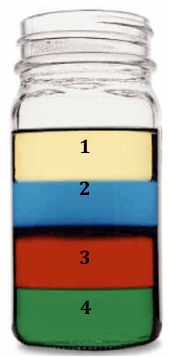
Put the liquids in order from most dense to least dense?
a)
4, 3, 2, 1
b)
1, 2, 3, 4
c)
3, 4, 2, 1, 
d)
4, 3, 1, 2
56.
What is the formula for density?
a)
density = mass x volume
b)
density = mass / volume
c)
density = mass + volume
d)
density = mass - volume
57.
Frank has an eraser. It has a mass of 4g, and a volume of 2cm3. What is its density?
a)
8 g/cm3
b)
2 g/cm3
c)
1/2 g/cm3
d)
24 g/cm3
58.
Jack has a rock. The rock has a mass of 14g and a volume of 2cm3. What is the density of the rock?
a)
7 mL
b)
7 g/cm3
c)
28 g/cm3
d)
1/7 g/cm3
59.
What is the volume of Object X?
a)
10.0 cm3
b)
15.0 cm3
c)
20.0 cm3
d)
25.0 cm3
60.
Frank has a paper clip. It has a mass of 9g and a volume of 3cm3. What is its density?
a)
3 g/cm3
b)
1/3 g/cm3
c)
27 g/cm3
d)
39 g/cm3
61.
Why do some substances float on water?
a)
they are warmer than water
b)
they are cooler than water
c)
they are more dense than water
d)
they are less dense than water
62.
Helium balloons rise on earth because
a)
helium is less dense than air
b)
helium is more dense than air
c)
helium is cooler than air
d)
helium is warmer than air
63.
What is the measuring unit for mass?
a)
centimeter 
b)
millimeter 
c)
grams 
d)
pounds
64.
Which units of measurement are used for volume?
a)
grams
b)
centimeters
c)
grams/milliliter
d)
milliliter
65.
What units are used to measure Density?
a)
cm3/g
b)
g
c)
g/cm3
d)
cm3
66.
What two types of measurements make up DENSITY
a)
Mass and Volume
b)
Temperature and Mass
c)
Grams and Centimeters
d)
Volume and Weight
67.
Look at this image.  Which object has the LOWEST density in water? How
a)
The Ping Pong Ball because it floats to the top 
b)
The bolt because it has sunk to the bottom
c)
The soda cap because it is not just full of air like the Ping Pong ball
68.
Why do the liquids form different layers?
a)
They have different densities.  
b)
They have different masses.  
c)
They have different volumes.  
d)
They are different temperatures.  
69.
If an object has a density of .6 g/mL and you put it into water, will it sink or float?  
a)
sink
b)
float
70.
If an object has a density of 3.6 g/mL and you put it into water, will it sink or float?  
a)
sink
b)
float
71.
Classify the sample
a)
Pure substance
b)
Mixture
72.
Classify the sample
a)
Element
b)
Compound
73.
Classify the sample
a)
Pure Substance
b)
Mixture of Elements
c)
Mixture of Compounds
74.
What is a pure substance made of two or more elements that are chemically combined called?
a)
A. element
b)
B. compound     
c)
C. mixture
d)
D. solution
75.
When elements form mixtures, the elements
a)
A. keep their original properties.
b)
B. react to form a new substance with new properties.
c)
C. combine in a specific mass ratio.
d)
D. always change their physical state.
76.
Salt water
a)
Homogenous Mixture
b)
Heterogeneous Mixture
77.
This type of substance is made up of one type of atom. 
a)
Element
b)
Compound
c)
Mixture
78.
Classify the Sample. 
a)
Pure Substance
b)
Mixture of Elements
c)
Mixture of Compounds
d)
Mixture of Elements and Compound
79.
Classify the sample. 
a)
Pure Substance
b)
Mixture of Elements
c)
Mixture of Compounds
d)
Mixture of Element and Compound
80.

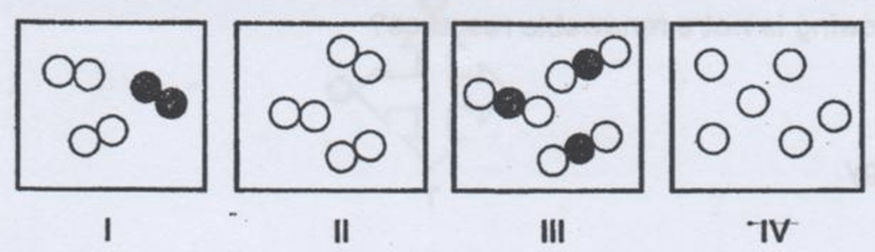
In the diagrams provided, the circles of different colors represent the atoms of different elements. Which diagram represents a mixture?

a)

I

b)

II

c)

III

d)

IV

81.
Is coffee a Homogeneous Mixture? 
a)
YES
b)
NO
82.
Type of mixture that has the SAME COMPOSITION in every part.
a)
Homogenous
b)
Heterogeneous
83.
M&M's is an examples of a
a)
homogeneous mixture
b)
heterogeneous mixture
84.
Salad is an example of a
a)
homogeneous mixture
b)
heterogeneous mixture
85.
A solution is a ________ mixture. 
a)
heterogeneous 
b)
homogeneous 
c)
dumb 
d)
mixed 
86.

A substance made of two or more different elements. Example: H2O, CO2

a)

Molecule

b)

Compound

c)

Surface Tension

d)

Surfactant

87.
A mixture in which different materials can be identified easily
a)
element
b)
heterogeneous mixture
c)
homogeneous mixture
d)
solution
88.
A mixture that contains two or more substances blended evenly throughout
a)
heterogeneous mixture
b)
homogeneous mixture
c)
suspension
d)
colloid
89.
A combination that can be separated by physical processes is a .....
a)
Pure Substance
b)
Glucose
c)
Element
d)
Mixture
90.
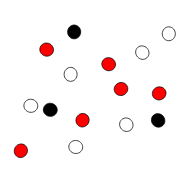
This picture represents: 
a)
Element
b)
Compound
c)
Mixture of Elements
d)
Mixture of Compounds
91.

What kind of mixture is shown in the picture?

a)

Homogeneous

b)

Heterogeneous

92.

What kind of mixture is shown in the picture?

a)

Homogeneous

b)

Heterogeneous

93.
Chicken noodle soup is an example of a
a)
homogeneous mixture
b)
heterogeneous mixture
94.
A pure substance that cannot be broken down into other substances by chemical or physical means. 
a)
compound          
b)
atom
c)
mixture 
d)
element
95.

Which of these is an element?

a)

Salt (NaCl)

b)

Water (H20)

c)

Oxygen (O)

d)

Carbon Dioxide (CO2)

96.

Which of these is a mixture?

a)

Laundry Detergent

b)

Salt (NaCl)

c)

Oxygen (O)

d)

Fluorine (Fl)

97.

Air is:

a)

An element

b)

A compound

c)

A mixture

d)

None of these

98.

Which of the following is classified as a pure substance?

a)

Lemonade

b)

Fruit punch

c)

ketchup

d)

Helium

99.
A mixture that is uniform and well mixed is _____.
a)
homogeneous
b)
hetergeneous
c)
pure substance
d)
compoud
100.

A ______________ is made up of different kinds of atoms chemically combined.

a)

element

b)

compound

c)

mixture

d)

molecule

101.

A snow globe would be an example of a __________________.

a)

colloid

b)

solution

c)

suspension

102.

Tea and air are examples of ________________.

a)

solutions

b)

suspensions

c)

colloids

103.
a)

Pure Substance

b)

Mixture

104.

Brass

a)

Pure Substance

b)

Mixture

105.

Which classification of matter is composed of two or more substances which are physically combined?

a)

atoms

b)

pure substances

c)

mixtures

d)

elements

106.

Which of the following is INCORRECT about pure substances?

a)

formed by physically combining two or more components

b)

have definite composition

c)

all elements are pure substances

d)

composed of only one kind of material

107.

Which of the following is NOT a mixture?

a)

milk

b)

lemonade

c)

vegetable salad

d)

aluminum

108.

Salt

a)

Pure Substance

b)

Mixture

109.

Coffee

a)

Pure Substance

b)

Mixture

110.

Water

a)

Pure Substance

b)

Mixture

111.

An ice cream cone melts in a kid's hand while walking outside on a hot summer day. What is this an example of?

a)

Physical property

b)

Chemical property

c)

Physical change

d)

Chemical change

112.

A silver ring gets tarnished (becomes dull) as a result of being exposed to air and moisture. What is this an example of?

a)

Physical property

b)

Chemical property

c)

Physical change

d)

Chemical change

113.

Water boils at 100˚C. What is this an example of?

a)

Physical property

b)

Chemical property

c)

Physical change

d)

Chemical change

114.

Benzene is a compound that is highly flammable. What is this an example of?

a)

Physical property

b)

Chemical property

c)

Physical change

d)

Chemical change

115.

A pastry chef bakes a cheesecake. What is this an example of?

a)

Physical property

b)

Chemical property

c)

Physical change

d)

Chemical change

116.

A burglar smashes the window of a nearby car to steal some money. What is this an example of?

a)

Physical property

b)

Chemical property

c)

Physical change

d)

Chemical change

117.

Stomach acid has a pH of approximately 2. What is this an example of?

a)

Physical property

b)

Chemical property

c)

Physical change

d)

Chemical change

118.

Mercury is a metal that is liquid at room temperature. What is this an example of?

a)

Physical property

b)

Chemical property

c)

Physical change

d)

Chemical change

119.

Copper is a good conductor of heat and electricity. What is this an example of?

a)

Physical property

b)

Chemical property

c)

Physical change

d)

Chemical change

120.

Helium is an element that is unreactive . What is this an example of?

a)

Physical property

b)

Chemical property

c)

Physical change

d)

Chemical change

121.

A student rips up his exam paper in frustration. What is this an example of?

a)

Physical property

b)

Chemical property

c)

Physical change

d)

Chemical change

122.

A group of campers burned some wooden logs to make a bonfire. What is this an example of?

a)

Physical property

b)

Chemical property

c)

Physical change

d)

Chemical change

123.

What is a physical property?

a)

A property that describes how something changes over time

b)

An observable property that describes the state of a system

c)

A property that describes how reactive something is

124.

What is a physical property of these strawberries?

a)

Red

b)

Rotten

c)

Flammable

125.

What is a chemical property?

a)

A property that describes the state of a system

b)

A property observed during a reaction

126.

What is a physical change?

a)

A change that does not affect the chemical properties of a substance

b)

A change that affects the chemical properties of a substance

127.

What is a chemical change?

a)

A change that alters the physical and chemical properties of a substance

b)

A change of state (melting, freezing, etc.)

128.

Is toasting bread a physical or chemical change?

a)

Physical

b)

Chemical

129.

Is crumpling a piece of paper a physical or chemical change?

a)

Physical

b)

Chemical

130.
Which of the following is not a chemical property? 
a)
rusting 
b)
boiling 
c)
rotting 
d)
burning 
131.
What is reactivity?
a)
how a substance combines physically with another substance
b)
how a substance combines chemically with another substance 
132.
What is the measure of how much space an object takes up?
a)
matter
b)
volume
c)
substance
d)
properties
133.
Which one of these is a chemical property?
a)
melting point
b)
boiling point
c)
color
d)
flammability
134.
Ability to rust is this type of property:
a)
Physical property
b)
Chemical property
135.
Which of the following is a chemical change?
a)
human digestion
b)
cutting a tree down
c)
melting a chocolate bar
d)
Has a density of 1 gm/mL
136.
Properties that can be observed without trying to change the identity of the substance.
a)
Physical
b)
Chemical
137.
Jack has a rock. The rock has a mass of 14g and a volume of 2cm3. What is the density of the rock?
a)
7 mL
b)
7 g/cm3
c)
28 g/cm3
d)
1/7 g/cm3
138.
What is the volume of Object X?
a)
10.0 cm3
b)
15.0 cm3
c)
20.0 cm3
d)
25.0 cm3
139.
Which of the following is a sign that a chemical reaction has occurred?
a)
change in shape
b)
melting
c)
formation of a gas
d)
dissolving
140.
A solid piece of chocolate is melted and changed to liquid form. Which property of the piece of chocolate will remain the same?
a)
Texture
b)
Temperature
c)
Shape
d)
 Mass
141.
Which of the following is NOT an example of a physical change?
a)
crumpled paper
b)
pencil sharpening
c)
shrunken clothing
d)
rust
142.
Fizzing, foaming, and burning are all examples of
a)
Chemical change
b)
Physical change
143.
A change in which NEW substances are formed.
a)
Chemical change
b)
Physical change
c)
Casual change
d)
Formal change
144.
Which of the following is NOT an example of chemical change?
a)
sour milk
b)
burning wood
c)
breaking a pencil
d)
rust
145.
A change in phase ...
a)
Chemical Change
b)
Physical Change
146.
Physical properties are
a)
properties that can be observed without changing the identity of the substance
b)
properties that describe how a substance changes into a completely different substance
147.
True or False: a physical change may produce a new substance.
a)
True
b)
False
148.
Example of a physical property
a)
magnetism
b)
reactivity with oxygen
c)
flammability
d)
non-reactive
149.
Which type of property is the ability to conduct electricity?
a)
physical property
b)
chemical property
150.

A chemical reaction occurs when one or more _____ change into one or more new substances called ______ .

a)

products / reactants

b)

chemicals / reactants

c)

reactants / chemicals

d)

reactants / products

151.

A representation of a chemical reaction is called a(n) _____________ .

a)

chemical change

b)

chemical equation

c)

physical change

d)

physical reaction

152.

In the equation:

Li + Br2 -----> LiBr

What are/is the product(s)

a)

Li

b)

Br2

c)

LiBr

d)

Li and Br2

153.

A ____________ is a new material produced as the result of a chemical reaction.

a)

catalyst

b)

reactant

c)

product

d)

element

154.
The substances listed on the right side of a chemical equation are the
a)
Yields
b)
Reactants
c)
Products
d)
Precipitates
155.
The substances listed on the left side of a chemical equation are the
a)
Products
b)
Coefficients
c)
Precipitates
d)
Reactants