
 Worksheets
DRILL for Earth and Life Science
Total questions: 108
Worksheet time: 38mins
Why is Earth called “the living planet?”
A. It sustains life.
It has atmosphere
It has water at the surface
All of the above
Which among the set of planets are called terrestrial?
A. Jupiter, Neptune, Uranus
A. Mercury, Venus, Mars, Earth
A. Earth, Venus, Mars, Jupiter
A. Jupiter, Saturn, Uranus, Neptune
1. What makes planet Earth uniquely different from other planets?
It has soil.
It has tress.
A. It has people.
It has liquid water.
1. What makes planet Earth habitable?
A. It has comfortable distance from the sun.
A. It has atmosphere that protects from radiation.
A. The atmosphere holds carbon dioxide and other gases.
A. All of the above
Why is Earth called a terrestrial planet?
It has life
It is closest to the sun
It is farther from the sun
It is placed at almost the middle planets
1. Which of the following best describes the surface of the planet Earth?
a thick layer of hydrogen gas
cloudy and hot with lots of volcano
cold, rocky, and covered with red dust
mostly water surface with some areas of land
What makes Earth different from other planets in the solar system?
A. It supports life.
A. It is mostly covered in water.
A. Its atmosphere is mostly nitrogen and oxygen.
A. All of the above
Earth is the only planet that can support
life
a moon
a rocky core
an atmosphere
How many percent of water comprises the Earth?
15%
30%
50%
70%
What are the factors that make Earth habitable?
temperature & nutrient
atmosphere and energy
only A
both A and B
What nutrients does the Earth have to maintain an organism’s body to survive?
Earth has a water cycle and atmosphere
A. Earth has volcanic activities to circulate nutrients.
A. Earth has sub-surface water or molten rock that can circulate and replenish nutrients for organisms.
A. All of the above
1. What makes Earth similar to Venus?
Earth and Venus are the right sizes to hold a sufficient atmosphere.
Venus’ atmosphere is 100 times thicker than Earth.
Among all the solid planets and moons, only Earth, Venus, and Titan have significant atmospheres.
A. Both A and C
Why are humans and other living organisms capable to live on earth?
Earth has no protective equipment like ozone.
A. Earth has layer water only for favorable climate.
A. Earth has man-made natural cycles
A. Earth’s temperature is neither the hottest nor the coldest among other planets.
1. What makes Earth different from any other planets in the Solar System?
It is the only rocky planet.
It is the only planet that turns around in space.
It is the only planet that has a large amount of liquid water.
It is the only planet that changes its structure
What does Earth offer to human for survival?
Earth has abundant plant life.
A. Earth has sufficient nutrients from ocean to land.
A. Only A
A. Both A and B.
What can you say about your earth and life science teacher?
The asteroid belt is located between the two planets, what are those two planets?
Earth and Venus
Mars and Earth
Neptune and Uranus
Mars and Jupiter
The four terrestrial planets_______, _______, ______, and _______ from nearest to farthest.
(a)
Earth includes beach grasses, forms of life in the sea, on land, and even in the air. Which term best describes the statement?
atmosphere
geosphere
biosphere
hydrosphere
Which system of the Earth is considered as the largest component of the Earth?
. atmosphere
biosphere
geosphere
hydrosphere
Life is supported by oxygen and carbon dioxide. Which subsystem will best describe the statement?
atmosphere
biosphere
geosphere
hydrosphere
Relationship between the complex communities of individual organism is seen in the different systems of the Earth. What do you call the unit in nature?
ecosystem
complexity
ground
system
All of earth’s cycles and spheres are interconnected. Why is this so?
because they are interconnected
because Earth is where we live in
because Earth is the only living planet
because every organism has its own function in the Earth
What is an example of a connection between atmosphere and geosphere?
water
nitrogen
mountains
volcanic eruption release gas
An example of a connection between atmosphere and hydrosphere is ______.
lakes
rain
rivers
rocks
From the given choices, which is an example of a connection between biosphere connecting to atmosphere?
Animals eat plants
Animals drink water
Animals lie in caves
Plants produce oxygen
Which among the choices clearly gives an example of connection between hydrosphere and geosphere?
boats transporting goods
fish swimming in water
water evaporating to make clouds
waves eroding rocks on beach
All living things, including land and sea made up the Earth. Which term best described the statement?
geosphere
ozone layer
. atmosphere
biosphere
Which interaction will take place if nitrogen is returned to the soil when dead plants decompose?
biosphere and atmosphere
geosphere and atmosphere
biosphere and geosphere
atmosphere and geosphere
Which interaction best describes carbon dioxide dissolving from the air into the ocean?
.atmosphere and hydrosphere
atmosphere and atmosphere
atmosphere and geosphere
atmosphere and biosphere
The atmosphere of the Earth is composed of ___ oxygen and _____ nitrogen and other gases
0.021% and 0.78%
21% and 78%
78% and 21%
20.9% and 78.9%
What part of geosphere is a thin layer of solid rock that makes up the outermost part of the Earth?
core
crust
mantle
biosphere
Ozone plays an important function in every single organism on Earth. To what sphere does ozone layer belong?
atmosphere
biosphere
geosphere
hydrosphere
What is the coldest part of the atmosphere?
(a)
What are the five layers of the atmosphere from nearest to farthest? ____,___,___,___,____
(a)
What are the four subsystem of the Earth?
What Latin word was the term “igneous” derived from?
ignus
lithos
meta
sedere
What classification of rocks is formed from solidification and crystallization of molten rocks?
metamorphic rocks
igneous rocks
sedimentary rocks
all of the above
Which type of igneous rocks based on composition has the highest amount of silica content?
ultramafic
mafic
intermediate
felsic
Which of the following is/are the process/es of igneous rocks?
sedimentation
recrystallization
solidification and crystallization
solidification and recrystallization
Which of the following is NOT an extrusive igneous rock?
basalt
granite
obsidian
rhyolite
What happens to the molten rocks when they reach the Earth’s surface?
They flow continuously
They cool down and solidify
Their temperature remains the same
They remain semi-liquid molten rocks
Which type of igneous rock forms when magma hardens beneath Earth's surface?
clastic
extrusive
intrusive
non-clastic
Which type of igneous rock forms from lava on Earth's surface?
clastic
extrusive
intrusive
non-clastic
Which of the following is NOT an intrusive igneous rock?
diorite
gabbro
gabbro
obsidian
What is the size of the crystals if the rock cools slowly and forms below the Earth’s surface?
large
no crystal
small
none of the above
Which of the following is TRUE about intrusive rocks?
They have fine grains.
They are usually dark
They are formed from lava
They have usually low density
Which of the following is NOT true about extrusive rocks?
They cool down quickly
They have small crystal
These are formed beneath the Earth
Basalt and scoria are example of these rocks
How are igneous rocks classified based on their origin?
large or small crystals
plutonic and volcanic
coarse or fine grains
from magma or lava
How does the amount silica affect the color of igneous rock?
It has no effect at all
It doesn’t matter what the color is
The lesser the silica has, the lighter the color is
The more the silica it has, the lighter the color is
What type of igneous rock texture has large minerals?
aphanitic
glassy
phaneritic
vesicular
It is a region where plates meet.
Fault
Plate Boundary
Mountain
Volcanic Arc
There are three distinct types of plate boundaries, which of those types creates zone of tension by moving the plates apart?
Convergent Boundary
Transform Fault
Divergent Boundary
None of these
When two tectonic plates collide, the continental crust usually rise up over the oceanic crust because it is______.
Denser than continental crust
Thicker than continental crust
Thinner than continental crust
Thinner than continental crust
Which of the following resulted to the formation of new crust from magma that rises to the earth’s surface between the two plate boundaries?
convergent boundary
divergent boundary
strike fault
transform boundary
Which of the following resulted to the formation of new oceanic lithosphere?
Convergent Boundary
Convergent Boundary
Transform Boundary
None of these
Which type of plate boundary does the shallow focus earthquake occur wherein it appears to be associated with mid ocean ridges and mountain ranges?
Convergent
Divergent
Transform
All of these
Which of the following land formation or events is not connected to convergent plate movement/margin?
deep-focus earthquake
Trench
Valleys
Volcanic Arc
Convergent plate boundary creates land formations which later become scenery. Which of the following is one of the best examples of the land formations due to convergent plate boundary?
Arc
Boundary
Valley
Volcanic Arc
Divergent: Plates pull apart (a) : Plates move alongside
Faults: A fracture or discontinuity in volume of rocks Folds: ___________________________________.
It forms from subducting plates
It occurs when flat surface bent
Occur when plates moving alongside and toward to each other.
Occur when plates moving alongside and away from each other.
What is the relative position of oldest rock layer as stated in the principle of Superposition?
at top
at the bottom
at the middle
at random location
Which process is involved when sedimentary rocks are arranged in layer?
Foliation
Deposition
Sedimentation
Stratification
Which term in the list is associated with rock layers?
Defoliation
Extrusion
Intrusion
Strata
What type of rock/s usually undergo cross- cutting on rock layers?
Igneous Rock
Stratified Rock
Sedimentary Rock
Metamorphic Rock
Why is there a need for correlation of rock layers?
It provides information that the rock layers are connected to each other long ago.
Fossils embedded in the rock layers serve as a proof of their correlation.
Fossils embedded in the rock layers serve as a proof of their correlation.
All of the above
Which principles describes that geological processes operating at the present time are same processes that have operated in the past?
Cross-cutting relationship
Original horizontality
Uniformitarianism
Inclusion
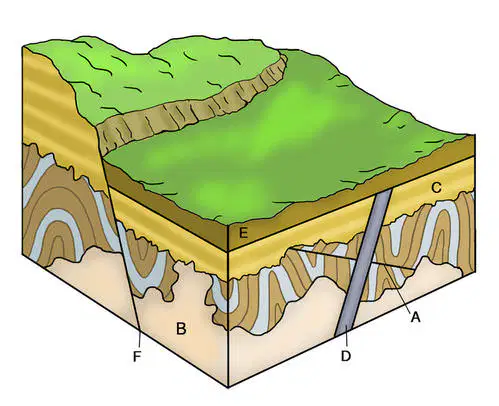
If an igneous rock D cross cuts sedimentary rock E, what will be the relative age/position of igneous rock D?
Igneous rock D will be on top of rock E
Igneous rock D is older than sedimentary rock E.
Igneous rock D is younger than sedimentary rock E.
Igneous rock D is at the same age with sedimentary rock E.
Which of the following is NOT a type of unconformity?
Angular
Uniformity
Disconformity
Nonconformity
When sedimentary rocks deposited in flat layers are left undisturbed it follows the statement in which of the given principles?
Cross-cutting Relationship
Original Horizontality
Fauna Succession
Superposition
Which type of conformities state that sedimentary rocks, when tilted or folded, are overlain by more flat- lying layer of rock?
Angular Conformity
Disconformity
Nonconformity
Inclusion
What will be the position of the youngest beds in an undisturbed sedimentary deposits?
They stay at the bottom.
They are found on the top rock layer.
Youngest beds are separated from sedimentary deposits.
Neither a or c
What are the three types of UNCONFIRMITIES?
(a)
Which is not included to the LAWS OF STRATIGRAPHY?
Law of Original Horizontality
Law of Cross Cutting Relationship
Law of Faunal Succession
Law of Exclusions
What are the two types of correlation?
(a)
Which type of dating method can be used on rock layers by applying the Law of Superposition?
Relative Dating
Absolute Dating
Radioactive Dating
Radiometric Dating
What is the difference between an absolute date and a relative date?
An absolute date refers to a year or a range of years while a relative date indicates a chronological order
A relative date is derived from radiometric dating techniques while an absolute date comes from guesswork.
A relative date is derived from radiometric dating techniques while an absolute date comes from guesswork.
An absolute date involves testing of sedimentary rocks while relative date involves testing of igneous rocks.
What method of rock dating is used in giving rocks an actual date?
Relative Dating
Absolute Dating
Historical Dating
Geological Dating
Which of the following is NOT true about Relative Dating?
quantitative method of dating
principles to recognize the relative ages of rock
used to arrange geological events and the rocks they leave behind in sequence
used stratigraphy method (oldest found at the bottom and youngest at the top)
In an undisturbed rock file, the youngest rock is found______________.
on the topmost
at the bottom
upper part
lower part
Which of the following is NOT an effect of landslide?
damage to property
injury
death
extreme heat
What refers to the use of explosives underground?
mining
excavation
quarrying
land pollution
What refers to the movement of rock down a slope?
wave
debris
tsunami
landslide
What will you do when there is a sudden landslide?
stay alert and awake
wait for the rescue
call the neighbor
stay cool
What makes railway and building construction a possible cause of a landslide?
slope excavation
use of heavy equipment
poor sanitation among workers
lack of personal safety gears
Which among the following human activities speed up or trigger landslide?
mining
planting of trees
watering the plants
cooking
Which of following is the human activity that trigger landslides using excavation or pit?
land use
quarrying
mining
excavation
Which of the following is an example of land use?
surfing
parasailing
scuba
construction of houses
What should be the initial reaction when there is a landslide?
scream loudly
move away from the slope
call the emergency hotline
take a picture and post in internet
Which among the following can trigger a landslide even if there is no human activity present in an area?
gravity
thunder
lighting
forest fire
How does a deforestation speed up landslide?
due to the planting trees
due to the cutting of trees
catching of wild animals
increasing the human population
What is the name of the deadliest typhoon ever hit the Philippines in 1881?
Uring
Thelma
Angela
Haiphong
What are the two seasons in the Philippines?
wet and dry
hot and cold
summer and winter
autumn and spring
Which of the following is the MOST exposed region in the country to tropical cyclones?
Region I
Region II
Region III
Region IV
What ocean is located in the eastern part of the Philippines in which most typhoons are originated?
Arctic
Indian
Pacific
Atlantic
Which of the following is an EXCEPTION on the variation of flood?
size
color
speed
duration
Which of the following is NOT a hydrometeorological hazard?
cyclone
typhoon
monsoon
tsunami
What is the highest category in the typhoon warning signal system in the Philippines?
2
3
4
5
What is the usual movement of typhoon that is coming from the Pacific Ocean?
northwest
northeast
southern
northern
Which among the following provinces has high risk to typhoons?
Albay
Masbate
Sorsogon
Pampanga
Which among the following provinces has low risk in flood?
Tarlac
Bulacan
Marinduque
Maguindanao
What makes Palawan an ideal province to live in relation to hydrometeorological hazard?
high risk in typhoon but low risk in flood
low risk in typhoon but high risk in flood
low risk in typhoon but high risk in flood
low risk in typhoon and low risk in flood
Which of the following is MOST likely be affected by typhoon originated from the West Philippine Sea and is moving northeast?
Albay
Palawan
Zamboanga
Negros Occidental
Why is the Philippines frequently visited by typhoon all year-round? Because it is
highly populated
composed mostly of islands
located near the Pacific Ocean
near the western hemisphere
Samer would like to settle to a province that is LEAST prone to typhoon and flood, which among the following provinces will be a good option?
Albay
Tarlac
Palawan
Pampanga
Which of the following is NOT a coastal process?
waves
storm surge
tides
landslide
What do you call the movement of sediments from the visible portion of a beach to the nearshore region of the coast?
tides
submersion
coastal erosion
saltwater intrusion
As a student, what ways can you do to help adapt and mitigate coastal hazards?
Educate yourself.
Participate in local disaster preparedness program.
Promote the programs of the community
All of the above

