
 Worksheets
AP NEWSTONS LAWS SUBTITUTE DAY WORK OCT 19
Total questions: 85
Worksheet time: 2hrs 9mins
Newton's First Law States........
Objects at rest tend to stay at rest unless acted on by an outside force.
Objects accelerate often and it is difficult to know when or how they will accelerate.
Objects in motion tend to stay in motion unless acted on by an outside force.
Both A & C
What is inertia?
An object that is accelerating
Gravitational force
An objects tendency to stay at rest or in motion
An unbalanced force
Inertia depends on __________.
Weight
none of these
Mass
Acceleration
What formula is used to calculate force?
Acceleration = Force x Mass
Force = Mass x Acceleration
Work = Force x Distance
Mass = Force + Acceleration
A force of 40 N acts upon a 2 kg block. Calculate the acceleration of the object.
20 m/s2
20 m/s
80 m/s2
80 m/s
Newton's third law states.......
For each action there is a larger reaction associated with it.
None of these choices
For each action there is an equal and opposite reaction.
For each action there is a smaller reaction associated with it.
The tendency of an object to just keep doing what it is doing.
Laziness
F=MA
No Clue
Inertia

Newton's 3rd Law

Newton's 3rd Law


Which one of Newton's laws is shown
3rd law
2nd law
1st law

What does this picture represent
Force,magnetism,acceleration
Force, money, Apples
Force, Mass, Acceleration
Funny, monkeys, Arrive

Which one of Newton's laws are displayed
2nd law
1st law
3rd law

Which of Newton's laws is shown
1st law
3rd law
2nd law
Letting go of a balloon full of air is demonstrating Newton's ______ _______ ________ _________ because the air comes out of the back and the balloon moves forward.
1st law of motion
2nd law of motion
3rd law of motion
13th law of motion


Is this Balanced or Unbalanced force.
Unbalanced force
Balanced force
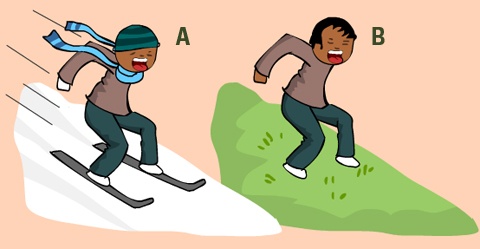
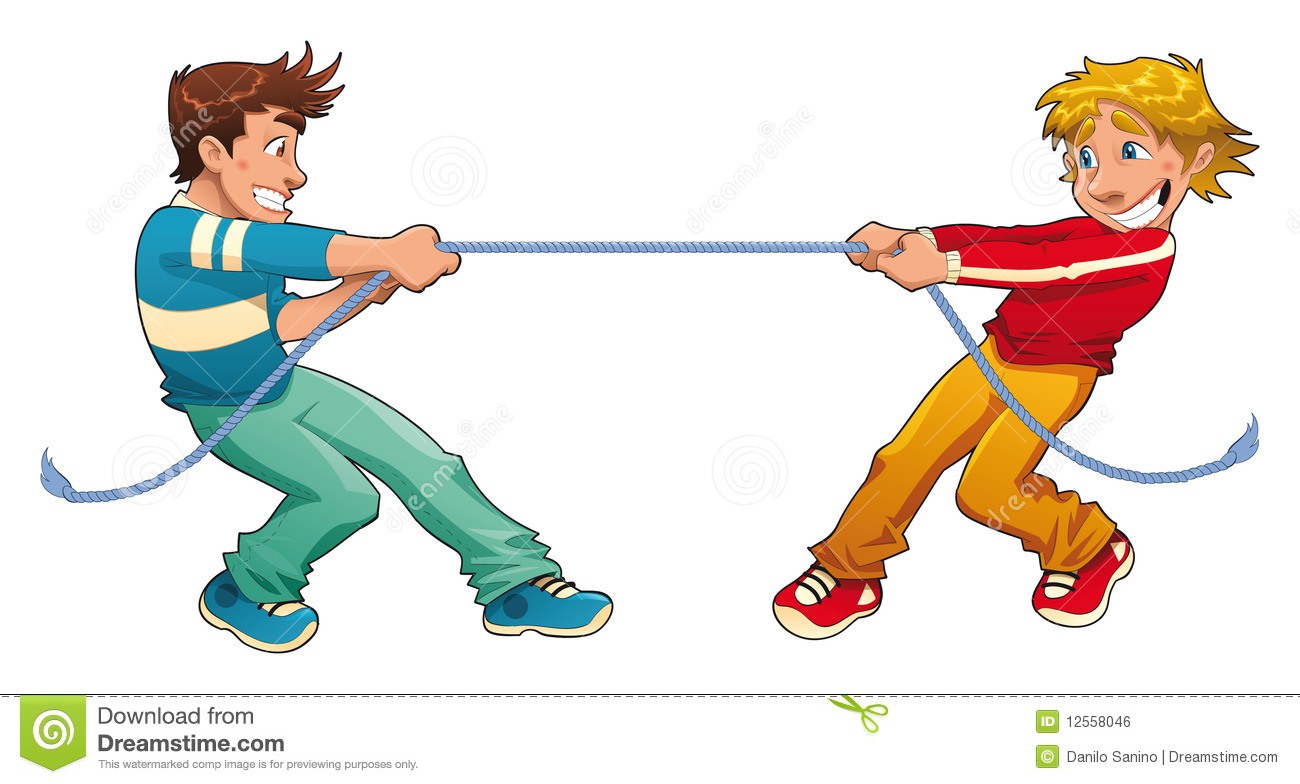

1st
Law of Motion
2nd
Law of Motion
3rd
Law of Motion
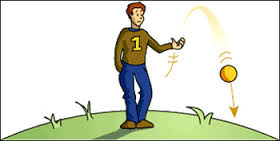


A squirrel sits on the ground and eats a donut. We know the forces on him must be balanced because...
Forces are always balanced
the squirrel is not accelerating
squirrels are projectiles
he's eating a donut
Every object in the universe exerts a force on every other object. This force is called___________.
Friction
Gravity
Push
Push
The measure of the gravitation force exerted by Earth on an object is the object's_________.
weight
mass
gravity
The amount of gravitational force between two objects depends on their____________.
color and density
mass and distance
color and shape
Weight is measured in units called_______________.
Newtons
kilograms
The greater an object's___________, the stronger the gravitational force on it.
mass
velocity
color
shape
The masses of your hand and your notebook are quite small, so the force of attraction between them is ______________.
zero
strong
weak
When an object moves in a circular path, it accelerated toward the center of the circle as a result of ____________________.
terminal velocity
momentum
centripetal force
friction
For every action there is an equal and opposite reaction:
Newton's 1st Law
Newton's 2nd Law
Newton's 3rd law
The relationship among mass, force, and acceleration is explained by:
Newton's 1st Law
Newton's 2nd Law
Newton's 3rd Law
Acceleration due to gravity is:
.98
98
9.8
980
If you push a skateboard with a force of 8 N and your mass is 80 kg, what is the force that the skateboard exerts on you?
75 N
8 N
7N
10 N
The force that responds to the first force in a force pair
Reaction Force
Action Force
The forces in a force pair are in ____ direction.
Opposite
Same
The forces in a force pair are the ____ strength.
Same
Opposite
Newton’s 3rd Law of motion states that any action will have a(n) ________and ______reaction
Equal and similar
Equal and different
Equal and opposite
Greater and opposite
A book rests on a table. The force of gravity pulls down on the book with a force of 20N. What prevents the book from accelerating downward at 9.8m/s2?
The table and the book are pushing back with an acceleration of 9.8m/s2.
The table presses back up on the book with a force greater than 20N
The inertia of the book is equal to the inertia of gravity
The table presses back up on the book with an equal and opposite force of 20N

Describe the other force in the action-reaction force pair
The glove pushes the baseball to the right
The glove pushes the baseball backward
The glove pushes the baseball downward
a. None of the above

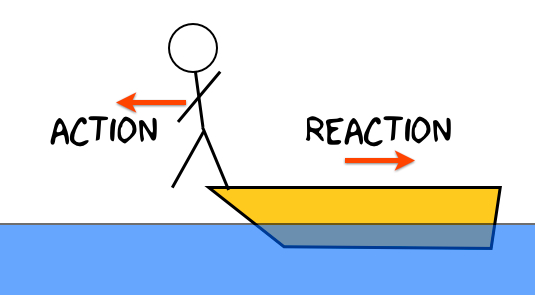

A nickname for Newton's 3rd Law of Motion might be...
Action/Reaction
F=m*a
The law of inertia
Which describes the 3rd Law of Motion?
Flowing water
A ball inside a box
Bow and arrow
Spinning top

What is the reaction in this picture? (Hint: the motion.)
The rocket moving upward.
The gasses from the rockets pushing downward.
The wind rushing upward past the shuttle wings.
An amazing feat of sorcery and wizardry!


You and your dad are moving the couch from one side to another. Your dad pushes with a force of 35 N to the right and you push with a force of 25 N right. What is the net force on the couch? Draw a Free body diagram showing the forces and amounts.
60 N right
10 N left
60 n right
50 N left
Acceleration due to gravity, g, is ____ m/sec2. This is the rate at which ALL objects fall to Earth when we neglect air resistance.
4.9
9.8
19.6
39.2
The rate that a car's velocity changes is its
speed
force
gravity
acceleration
Which statement best explains Newton's Third Law of Motion?
Inertia or resistance to change
Force pairs: For every action there is an equal and opposite reaction.
Acceleration: based on the net force applied
An object continues its motion until an unbalanced force is applied.
Whenever an object is moving, a force responds perpendicular to the surface. What is that force.
inertia
normal
friction
applied force
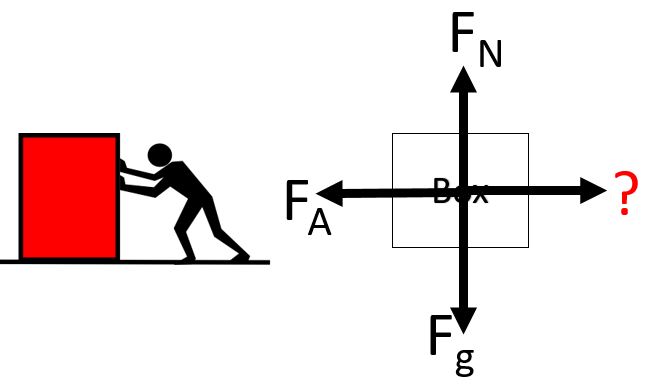
Which diagram best shows a person pushing a couch that will not move at all?


What are the TWO ways we can have UNBALANCED forces? (Hint: Take your time with this. Draw a free body diagram to figure this out.)
1) unequal forces in opposite directions and
2) forces in same direction
1) forces in same direction and
2) equal forces in opposite direction
1) unequal forces in opposite directions and
2) forces in opposite directions but same sizes
you can't have unbalanced forces, forces will always balance each other out

What happens when unbalanced forces act on an object at rest?
the object remains at rest
the object begins moving in an unpredictable direction
the object begins moving in the direction of the net force
the object begins moving opposite to the direction of net force

A cannonball with a mass of 0.5 kg is flying at an acceleration of 10 m/sec^2. What is it's force? (Hint: Use an equation.)
50 Newtons
5 Newtons
20 Newtons
9.5 Newtons
You push on a tree with 20 N of force. If the tree doesn't move, the tree is pushing back on you with _____of force.
20N
10N
40N
70N

Calculate the net force acting upon the object.
10 N right
0 N
14.1 N right
20 N up

What is the net force on the car?
Draw a Free body diagram of the car and the forces on it.
Label each arrow with the name of the force.
.
.
.
.
What is the acceleration of the car if it has an mass of 1000 kg?
Show all your work.
Identify the Variables
Write the equation
Substitution
Answer with unit of measure.
.
.
.
.
While driving at an average velocity of 15.6 m/s down the road, a driver slams on the brakes to avoid hitting a squirrel. The car stops completely in 4.2 seconds. What is the average acceleration of the car?
Show all your work.
Identify the Variables
Write the equation
Substitution
Answer with unit of measure.
.
.
.
.

