
 Worksheets
chemicals KENITCS
Total questions: 65
Worksheet time: 1hrs 1mins
It is the factor that affect affection rates where reactants must come together to react.
(a)
One of the factors that affect reactions rate where most chemical reactions proceed faster if the concentration of one or more reactants is increased.
(a)
Reaction rates generally decrease as temperature is increased.
True
False
Catalysts are agents that increase reaction rates without themselves being used up.
True
False
The following are the kinds of intermolecular interactions are involved in solution formation EXCEPT:
Solute–solute
Solvent–solvent
Solvent–solute
Solution-solvent
Is it possible for all phases of matter to be a solvent? Why? why not?
A solution that is in equilibrium with undissolved solute is saturated.
True
False
The amount of solute needed to form a saturated solution in a given quantity of solvent is known as the solubility of that solvent.
True
False
If we dissolve less solute than the amount needed to form a saturated solution, the solution is unsaturated.
True
False
Under suitable conditions it is possible to form solutions that contain a greater amount of solvent than needed to form a saturated solution. Such solutions are supersaturated.
True
False
They are held together by a delocalized “sea” of collectively shared valence electrons. This form of bonding allows metals to conduct electricity. It is also responsible for the fact that most metals are relatively strong without being brittle.
(a)
They are held together by the mutual attraction between cations and anions. Differences between ionic and metallic bonding make the electrical and mechanical properties of ionic solids very different from those of metals.
(a)
They are held together by an extended network of covalent bonds. This type of bonding can result in materials that are extremely hard, like diamond, and it is also responsible for the unique properties of semiconductors.
(a)
Why do polymers are normally stronger and have higher melting points than molecular solids?
What is a Dispersion Forces (London dispersion force)?
How would you differentiate Dipole–Dipole Forces from London Dispersion Force?
Hydrogen bonding is a special type of intermolecular attraction between the hydrogen atom in a polar bond.
True.
False
An ion–dipole force exists between an ion and a non-polar molecule. Cations are attracted to the negative end of a dipole, and anions are attracted to the positive end.
True
False
The strengths of intermolecular forces in different substances vary over a wide range but are generally much weaker than intramolecular forces—ionic, metallic or covalent bonds.
True
False
Compare and contrast Solid, Liquids and Gas in a Molecular caracteristic.

a
b
c
d

a
b
c
d

a
b
c
d

a
b
c
d

a
b
c
d

a
b
c
d

a
b
c
d

a
b
c
d

a
b
c
d

a
b
c
d

a
b
c
d

a
b
c
d

a
b
c
d

a
b
c
d

a
b
c
d

a
b
c
d

a
b
c
d

a
b
c
d

a
b
c
d

Which of the following point represents Azeotropic Mixture concentration ?
A
B
C
D
X + Y → Z + Q ΔH = +22kj/mol
Collison
Evaluation
How can above reaction be classified in terms of energy exchange during chemical change?
2NaOH + H2SO4 → Na2SO4 + 2H2O
Given the following rate law,
rate = k[A]2[B]
if [A] were doubled, what must happen to [B] to keep the rate constant?
[B] must tripled
[B] must double
[B] must be havled
[B] must be quartered
The catalyst alters the rate of a chemical reaction by,
providing an alternative pathway with a lower Ea
changing the products formed in the direction of the reaction
providing a surface on which the molecules react
increasing the frequencies of collisions between molecules

The following data were measured for the reaction
BF3(g) + NH3(g) ⟶ F3BNH3(g)
What is the rate law for the reaction?
rate = k[NH3]
rate = k[BF3]2[NH3]
rate = k[BF3][NH3]
rate = k[BF3][NH3]2

What is the rate law for this mechanism?
rate = k[A][B]2
rate = [B][X]2
rate = [A]0.5[B]1.5
rate = [W][Y][Z]
Which factors increase the rate of a reaction?
increasing temperature
increasing concentration
increasing surface area
all of the above
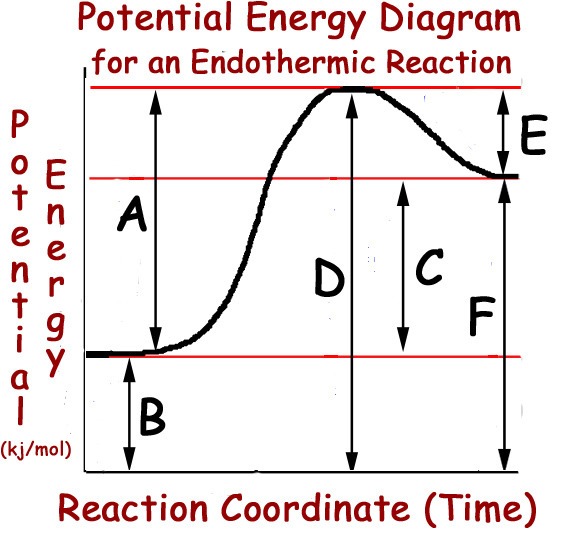
What letter represents the activation energy?
A
B
C
D
What is the parameter to measure the rate or speed of a reaction beside time?
Change in volume
Change in concentration
Change in pressure
Change in temperature
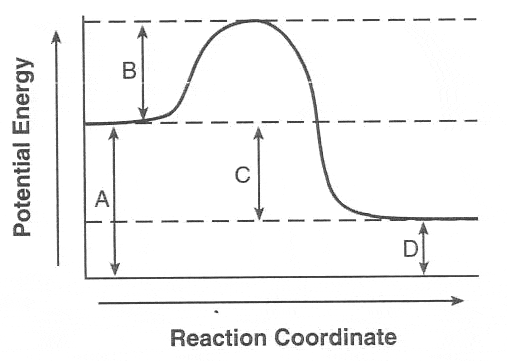
Rate=[A]2[B]1

