
Font size
 Worksheets
Genetic Code and Protein Synthesis
Total questions: 103
Worksheet time: 52mins
DNA carries the instructions for making what?
Proteins
Hydrogen bonds
Nitrogen bases
Double Helix
What holds 2 strands of DNA together?
Hydrogen Bonds
Nitrogen Bases
Proteins
Superman
DNA molecules are what shape?
Double Helix
Triangle
Quadrilateral
Pentagon
Why can genes be transferred between organisms?
They use the same genetic code
The nitrogen bases have complementary bases
They have the same nitrogen bases
Because Guanine always pairs with Cytosine
What are the 4 nitrogen bases found in DNA?
A, T, G, C
A, U, G, C
A, T, U, C
A, T, U, G
Which cell organelle directs Protein Synthesis?
Ribosomes
Golgi Body
Nucleus
Mitochondria
What is the purpose of transcription?
To make new proteins
To make mRNA
To use the genetic code
To break proteins down into amino acids
What is the purpose of translation?
To make new proteins
To make mRNA
To use the genetic code
To break down proteins into amino acids
What is each codon translated into?
Amino acid
Protein
Nucleic acid
tRNA
Which process transfers information from DNA to RNA?
Transcription
Translation
Meiosis
Photosynthesis
Which process uses information from mRNA to make proteins?
Translation
Transcription
Meiosis
Photosynthesis

What term does #2 represent?
Transcription
mRNA
Translation
Deoxyribose
Protein

What term does Y represent?
Transcription
mRNA
Translation
Deoxyribose
Protein

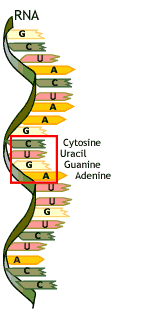
What term does this image represent?
Transcription
mRNA
Translation
Deoxyribose
Protein

What term does this image represent?
Transcription
mRNA
Translation
Double Helix
Protein
Which is a macromolecule that carries the genetic code and allows for organisms to pass on traits to their offspring?
protein
DNA
hemoglobin
lipids
A _____________ is a segment of DNA. It has a particular location on a chromosome.
protein
gene
nucleic acid
histone
Where do eukaryotic organisms store their DNA?
in the cytoplasm
in the ribosomes
in the Golgi apparatus
in the nucleus
Type of RNA that carries instructions in the nucleus to the ribosome
(a)
sequence of three bases on a strand of mRNA that provides genetic code information for a particular amino acid
(a)
A jellylike fluid inside the cell in which the organelles are suspended
(a)
A part of the cell containing DNA
(a)
building block of protein
(a)

The letters on the DNA molecule represent different types of
Sugars
Molecular bases
Enzymes
Proteins
A nitrogenous base sequence found in a portion of a gene is C-G-A-T-A. Which sequence would be bonded to this section of the gene?
A-T-G-C-A
G-C-T-A-T
T-A-C-G-C
A-T-A-G-C
In a DNA molecule, 12% of the molecular bases are Cytosine. What percent are Adenine?
12
24
38
62
Process by which an exact copy of each chromosome is made before cell division
Synthesis
Genetic Engineering
Replication
Mutation
Which base is used in RNA synthesis but not in DNA synthesis?
Uracil
Adenine
Guanine
Cytosine
Choose the best complementary messenger-RNA sequence for the following DNA sequence: C-A-A-G-G-T
C-A-A-G-G-U
G-T-T-C-C-A
C-A-A-G-G-T
G-U-U-C-C-A
Skin cancer caused by exposure to radiation in tanning beds is a direct result of a
Change in a sugar molecule
Mutation in genetic material
Mutation in protein
Change in a fat molecule
sugar in RNA
(a)
consists of a phosphate group, sugar, and nitrogen base
(a)
process by which a section of DNA is used to produce a single-stranded RNA molecule
(a)
the process whereby genetic information coded in messenger RNA directs the formation of a specific protein at a ribosome in the cytoplasm
(a)
organelle where amino acids are bonded together to form proteins
(a)
The process of making proteins from amino acids
(a)
Nitrogen base that pairs with adenine in RNA
(a)


What brings the amino acids to the ribosome to assemble a protein?
DNA
How many nucleotides code for 1 amino acid?
1
2
3
4
A string of amino acids, also known as a protein
polypeptide
amino acid
chromatin
mRNA
The phase of the cell cycle in which the cell grows, prepares for division, and replicated its DNA. The cell spends 90% of its life in this phase.
Interphase
Mitosis
Meiosis
Cytokinesis
Which is a macromolecule that carries the genetic code and allows for organisms to pass on traits to their offspring?
protein
DNA
hemoglobin
lipids
What is the outcome of DNA transcription and translation?
Make muscles
Make protein
Make cells
Make DNA
What is the basic unit (monomer) of DNA?
Phosphate Group
Nucleotide
Amino Acid
Monosaccharide
What shape is DNA?
Alpha Helix
Double Helix
Tangled
Flat
DNA is the (a) of life .
DNA is found in the (a) . This is also where mRNA is created.
What is true of RNA? (select all that apply)
Single Strand
Contains uracil
Ribose Sugar
Deoxyribose Sugar
What is true of DNA?
Double Helix
Contains Thymine
Deoxyribose Sugar
Ribose Sugar
The m in mRNA stands for (a)
In RNA, Adenine (A) pairs with...
T
U
C
G
Which of the following is a characteristic of RNA?
Double stranded
Contains the base Thymine
Can leave the nucleus
Contains the sugar deoxyribose
What would be the complementary RNA sequence for the following DNA sequence?
ATTCGT
UAAGCA
TAAGCA
GCCTAC
UGCUAC
What is the name of the process in which DNA is transcribed into RNA?
Photosynthesis
Protein Synthesis
Translation
Transcription

The mRNA leaves the ________ to find the ribosome to make proteins.
cell
nucleotide
nucleus
mitochondrion
DNA holds the code for making
lipids
carbohydrates
proteins
sugars
Choose the sequence of the mRNA strand that would be match up with to the following strand:
GTAGTCA
UATUAGA
ACGACTG
CAUCAGU
CATCAGT

Process of copying a nucleotide sequence of DNA to form a complementary strand of mRNA
Translation
Transcription
Replication
Synthesis
Organelle that links amino acids together to form (make) proteins
rRNA
Ribose
Ribosome
Peptide Bond
Molecule that makes up proteins (monomer of proteins)
Ribosome
rRNA
Ribose
Amino acid
Carries copies of DNA's genetic material from the nucleus to the cytoplasm
messenger RNA (mRNA)
transfer RNA (tRNA)
ribosomal RNA (rRNA)
Ribosome
The bond formed between two amino acids when making a polypeptide
Hydrogen Bond
Peptide Bond
Phosphate Bond
Covalent Bond

Which of the following summarizes what is happening during transcription?
mRNA ⇒ DNA
DNA ⇒ mRNA
mRNA ⇒ protein
protein ⇒ mRNA

Which of the following summarizes what is happening during translation?
mRNA ⇒ DNA
DNA ⇒ mRNA
mRNA ⇒ protein
protein ⇒ mRNA

Which statement about transcription and translation is correct?
Transcription takes place in the nucleus, whereas translation takes place in the cytoplasm.
Translation takes place in the nucleus, whereas transcription takes place in the cytoplasm.

Which of the following is the complementary mRNA sequence to this DNA strand: AAA TCG TTG CCC
AAA TCG TTG CCC
TTT AGC AAC GGG
UUU AGC AAC GGG
UUU TGC TTC GGG

Transcription takes place in the
Cytoplasm
Cell Membrane
Nucleus

Translation takes place in the
cytoplasm
Cell Membrane
Nucleus

Which of the following best describes the shape of DNA?
globular
fibrils


A nucleotide is composed of
A phosphate, sugar and nitrogenous base
A protein, sulfur and guanine
A phosphate, lipid and a base
A protein, sugar and nitrogenous base

What forms the backbone of the DNA ladder?
nitrogenous bases
deoxyriboses and phosphates
genes & chromosomes
RNA

What makes up the rungs (steps) of a DNA ladder?
sugars & phosphates
nitrogen bases
sugars
genes & chromosomes
Which bonds join the nitrogenous bases in the centre of the DNA strand?
A-T, G-C
Which sequence of DNA bases would pair with this partial strand?
ATG TGA CAG
How is RNA different from DNA? Select all that apply.
RNA contains the base thymine.
RNA contains the sugar ribose.
RNA contains the sugar deoxyribose.
RNA contains the base uracil.
RNA is single-stranded
Which of the following is found in the cells of all living things?
chloroplasts
nucleus
mitochondrion
genetic material
What do we call the shape a DNA molecule takes?
double-stranded
double helix
sugar-phosphate backbone
pentagon
What are the names of the large structures of DNA which are used to package the genetic information within cells?
enzymes
ribosomes
chromosomes
vitamins
DNA is the (a) of life .
DNA is found in the (a) . This is also where mRNA is created.
Which amino acid will be added to a protein chain if the codon is UAA?
Ser
Lys
Ala
STOP

What is the amino acid sequence for the following mRNA strand:
UGG-ACU-CGA-GUG
(a)
What is the amino acid sequence for the following mRNA strand:
AUU-AAG-UGC-GGG
(a)
What is the amino acid sequence for the following mRNA strand:
CCA-GAG-UUU-UAG
(a)
What is the amino acid sequence for the following mRNA strand:
GUA-CAU-UUG-AGA
(a)

Translation is a process that produces
mRNA
chromosomes
proteins
tRNA
Which organelle is the location where protein is made?
Ribosome
Nucleus
Cytoplasm
Nucleotide
Arginine
AAG
AGG
ACU
CUG
UAG
Lysine
AAG
AGG
ACU
CUG
UAG

